A busy loading entrance in Dubai or Riyadh can exchange a significant volume of conditioned air with hot, dusty outdoor air every time its doors open. The choice between an air curtain versus airlock entrances affects more than energy use. It shapes traffic flow, hygiene controls, usable floor space, capital cost, and the reliability of the building’s entrance strategy.
For commercial and industrial facilities in tropical, humid, and desert climates, neither approach is automatically right. An air curtain creates an active air barrier at an open doorway. An airlock uses two physical doors and an enclosed transition zone. The correct specification depends on what must be controlled, how often people or goods pass through, and whether the entrance can realistically remain closed between movements.
Air Curtain Versus Airlock Entrances: The Core Difference
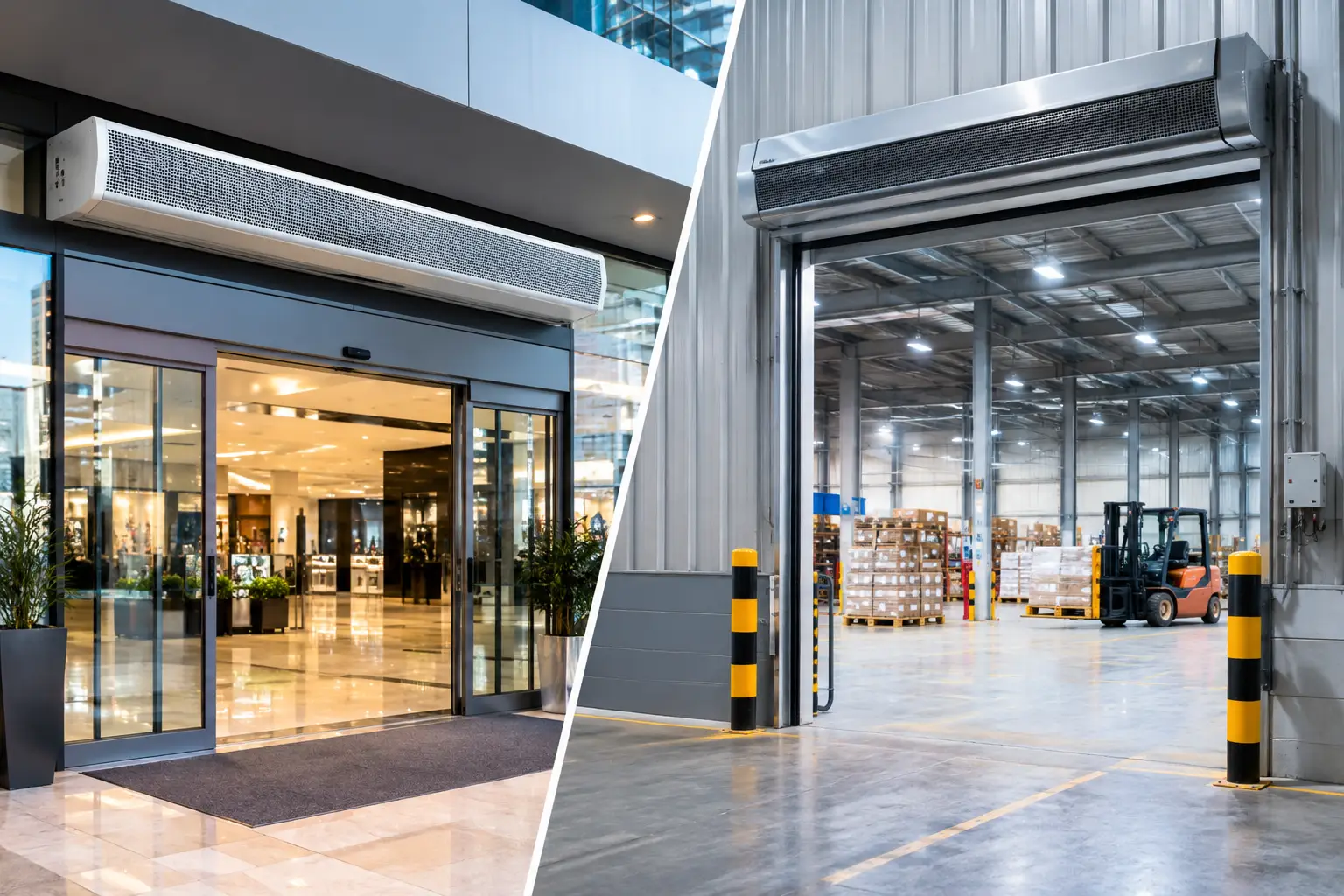
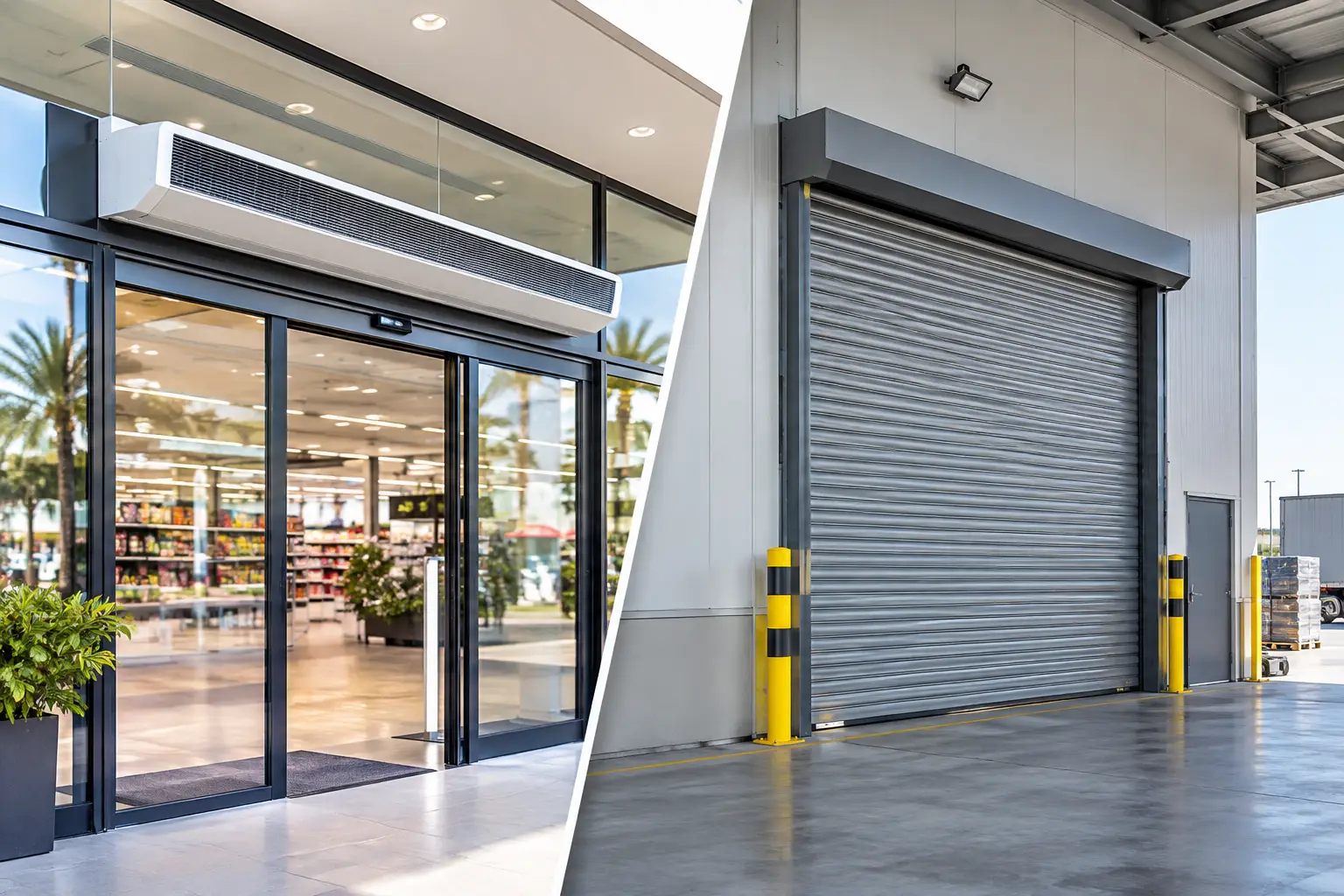
An air curtain is mounted above or beside an opening and discharges a controlled, high-velocity stream of air across the doorway. It is designed to limit the infiltration of outdoor heat, dust, humidity, insects, fumes, and airborne particles while allowing the opening to stay available for traffic. In a supermarket entrance, hotel lobby, warehouse dispatch bay, or restaurant service door, this means people and trolleys can pass without waiting for a second door cycle.
An airlock is a vestibule or chamber with an outer door and an inner door. Its performance relies on operational discipline or an interlock system that prevents both doors from opening at once. When used correctly, it creates a physical buffer between the outdoor environment and the conditioned or controlled space.
The distinction is practical. An air curtain manages infiltration during an open-door event. An airlock aims to prevent a direct open path from outside to inside. One is an airflow solution; the other is a space-and-door-control solution.
Where Air Curtains Make Better Operational Sense
Air curtains are generally the stronger choice where entrances experience frequent, unpredictable, or continuous movement. A physical vestibule can become a bottleneck when shoppers, staff, delivery teams, luggage carts, or pallet equipment need to move rapidly. At high-traffic openings, people may also prop airlock doors open, removing the protection the vestibule was intended to provide.
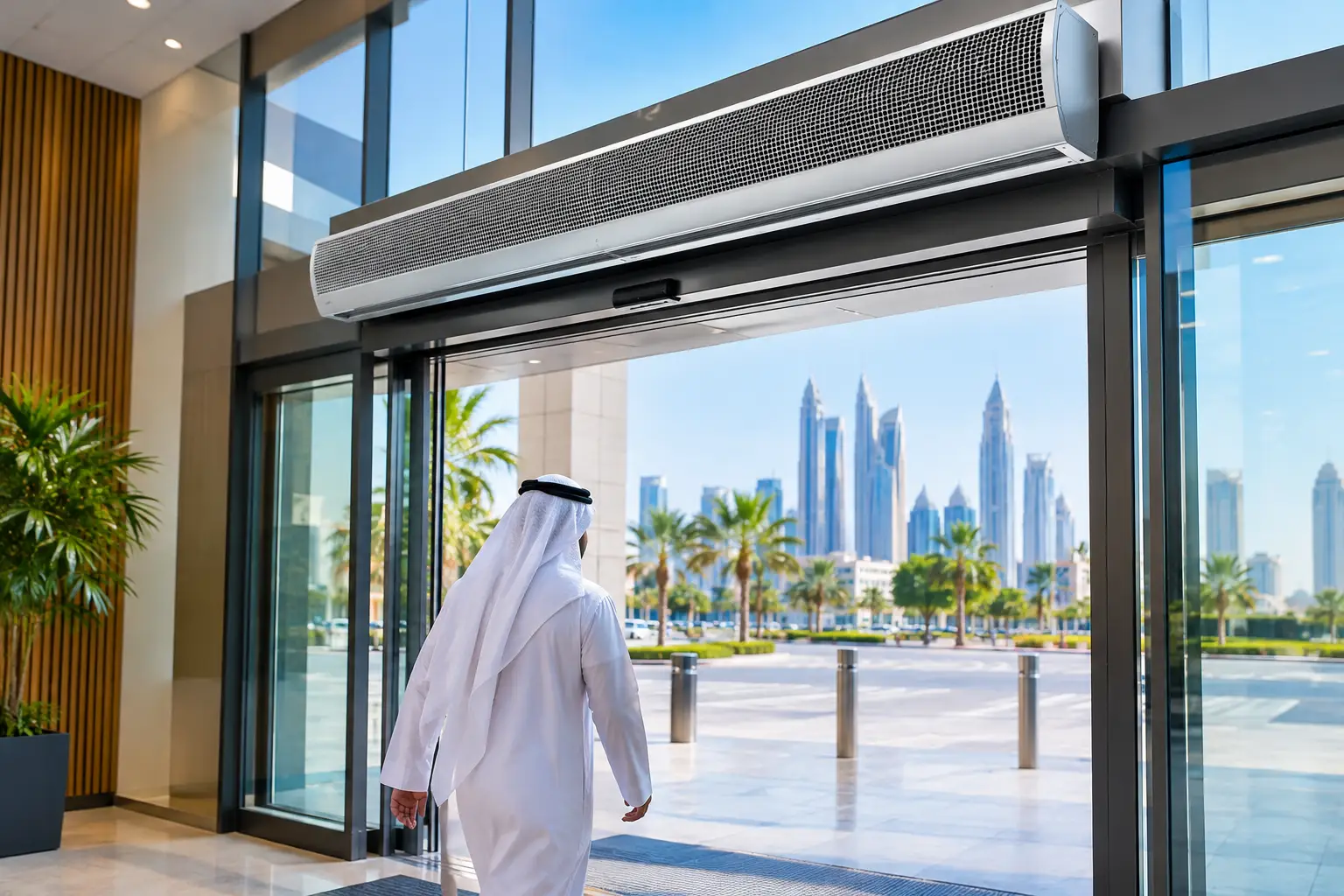
For retail stores, malls, supermarkets, restaurants, hotels, and airport public entrances, an appropriately selected air curtain maintains accessibility while reducing the load placed on the HVAC system. This matters in cities such as Doha, Muscat, Abu Dhabi, and Kuwait City, where intense outdoor heat can quickly affect comfort near an open entrance.
Industrial applications follow the same principle. Warehouses, logistics centers, factories, workshops, and distribution facilities often need wide, open access for forklifts and material handling. An airlock large enough for that operation consumes valuable floor area, increases door equipment costs, and can slow dispatch activity. A properly engineered industrial air curtain can provide active separation at the opening without changing the route vehicles and personnel use.
Air curtains also have a clear advantage where the primary concern is airborne intrusion rather than full physical isolation. For example, they can help reduce windblown dust at retail and warehouse doors, discourage flying insects at food service and food processing entrances, and limit the entry of humid outdoor air into cooled spaces. The air stream must be correctly sized for the door width, mounting height, crosswinds, and pressure conditions. A small unit installed above an oversized industrial door will not deliver the intended barrier.
Selection depends on the opening, not just the building type
The same building can require different air curtain configurations at different doors. A customer entrance in a shopping mall may suit a commercial centrifugal or high-performance recessed unit that preserves the architectural finish. A warehouse roller shutter or factory vehicle entrance requires higher throw, stronger airflow volume, and a model built for continuous industrial duty.
At FreezeeX, selection is based on the physical and operational conditions of the opening: width, height, mounting position, door type, traffic frequency, local climate, and the indoor-outdoor pressure relationship. This assessment is particularly important in dusty desert locations and humid coastal environments, where uncontrolled infiltration can affect both comfort and operating costs.
When an Airlock Is the Better Choice
An airlock is justified when the facility requires controlled personnel movement and a defined physical separation between zones. Pharmaceutical manufacturing areas, certain hospital departments, laboratories, clean production spaces, and facilities handling sensitive materials may need a vestibule as part of their contamination-control process.
In these settings, the airlock is not simply an energy-saving feature. It supports procedural control. Access may be limited, door sequencing may be monitored, and the chamber may be part of a broader pressure-management strategy. An air curtain alone cannot replace a required airlock where regulations, process validation, or internal hygiene protocols demand two physical doors.
Cold storage and food-processing applications also require careful evaluation. A high-speed operational environment may favor an industrial air curtain at selected access points, while a controlled transition chamber may be needed where temperature integrity, sanitation procedures, or product handling processes require additional separation. The answer depends on the temperature difference, door-open duration, traffic pattern, and the facility’s process requirements.
Airlocks have trade-offs. They require floor space, two door sets, controls, construction coordination, and ongoing attention to how occupants use them. If both doors are routinely left open or the chamber is too small for actual traffic, their theoretical performance will not translate into daily results.
Energy, Hygiene, and Traffic: Compare the Real Trade-Offs
The decision is often presented as a simple energy question, but energy performance is only one part of the calculation. An airlock can reduce direct exposure to outdoor conditions when doors are correctly sequenced. However, every movement requires opening and closing two doors, which can delay traffic and encourage non-compliant use during busy periods.
An air curtain allows faster passage while reducing the rate at which hot air, dust, insects, and humidity move through an open entrance. Its effectiveness depends on design quality and installation conditions. Air velocity must reach the floor or threshold area with enough stability to resist prevailing air movement, but it must not create unacceptable drafts for staff or visitors.
For a retail entrance, guest comfort and visual integration may lead to a recessed ceiling system or a quieter commercial model. For an industrial opening, airflow reach and durability take priority. For a healthcare or pharmaceutical environment, the entrance design must align with the site’s pressure zones and hygiene protocol before a product is selected.
A combined solution can be appropriate in some projects. An airlock may serve as the required physical transition space, while an air curtain at an external or high-use door reduces infiltration during door movement. This is not redundancy for its own sake. It addresses two different problems: physical separation and open-door air control.
A Practical Specification Framework
Before selecting either option, project teams should establish the operational facts. The most useful questions are straightforward:
- How wide and high is the opening, and is it a swing door, sliding door, roller shutter, or sectional door?
- How many people, trolleys, forklifts, or deliveries pass through during peak periods?
- Is the main risk cooling loss, humidity, dust, insects, fumes, contamination, or a combination of these factors?
- Does the facility need a documented two-door separation process for hygiene, security, or controlled-area access?
- Is there sufficient floor area for a vestibule without obstructing circulation, storage, or emergency egress?
- What are the local conditions, including high ambient heat, coastal humidity, wind exposure, and desert dust?
These answers prevent a common specification error: selecting equipment by doorway width alone. Door height, building pressure, outside wind, and adjacent HVAC supply patterns can all influence the stability of an air barrier. A site survey and airflow review are often more valuable than choosing the largest nominal unit available.
Choose the Entrance Strategy That People Will Actually Use
For high-traffic commercial and industrial openings, an air curtain is often the more practical way to protect cooled indoor space without interrupting operations. For controlled environments that need deliberate door sequencing and a physical transition zone, an airlock remains the appropriate foundation. Where both demands exist, a combined design may provide the strongest outcome.
The objective is not to choose the most complex entrance. It is to specify an entrance system that protects indoor conditions under real traffic, real climate exposure, and real operating behavior. For a project in the GCC, MENA, or Africa, request a consultation and quotation based on your opening dimensions, traffic profile, and tropical or desert climate conditions. The right air curtain or airlock strategy starts with how the entrance performs on its busiest day.