
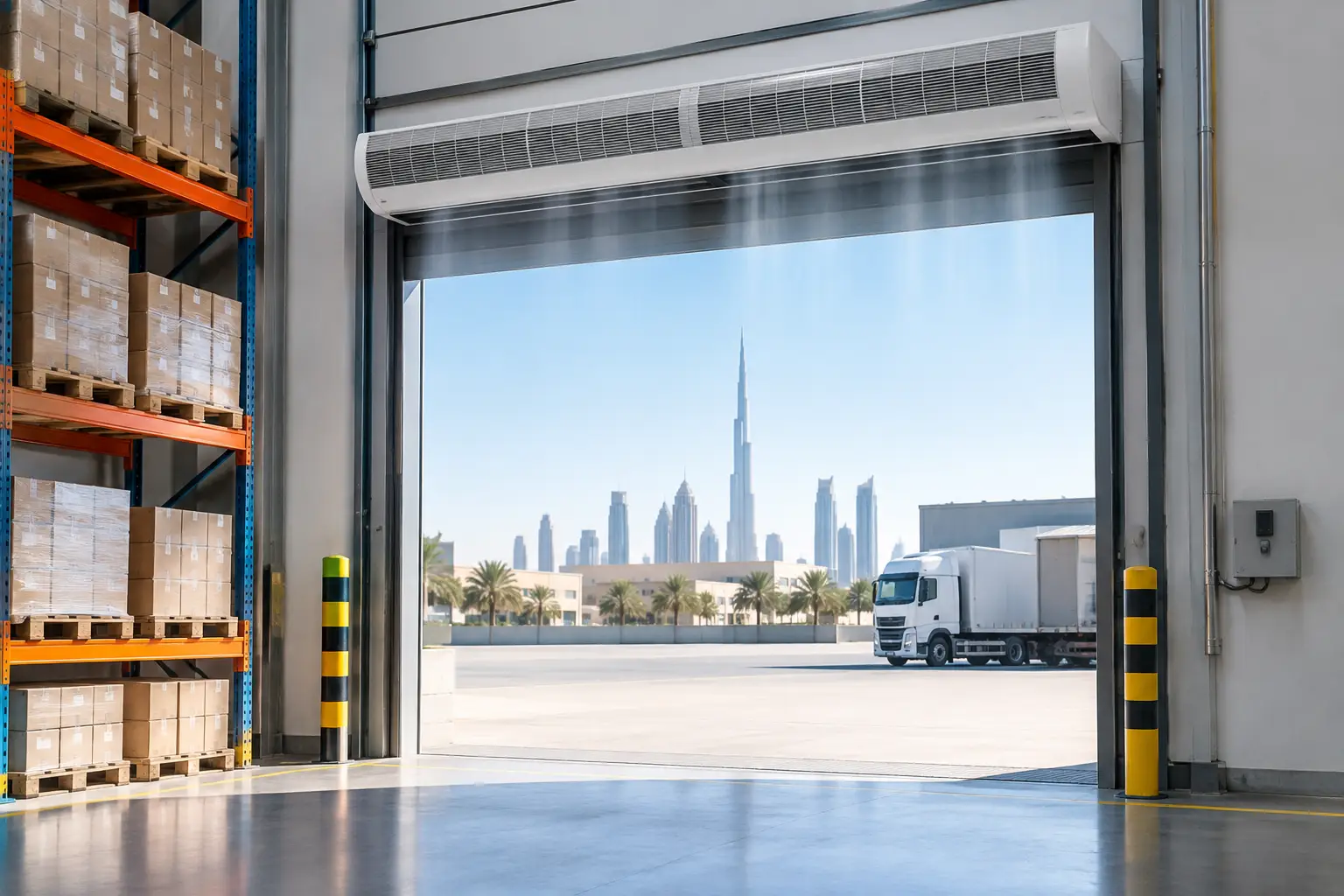
A loading bay door can remain open for a large share of the working day. Every pallet movement, vehicle turnaround, and goods-receipt cycle creates a direct path for hot outdoor air, dust, humidity, insects, and fumes to enter the facility. An air curtain for loading bay doors creates a high-velocity air barrier across that opening, helping protect conditioned spaces without slowing essential logistics traffic.
For warehouses, distribution centers, food processing facilities, and temperature-controlled operations across Dubai, Riyadh, Doha, Muscat, Cairo, Lagos, and Nairobi, this is not simply an entrance accessory. It is part of the building’s operational climate-control strategy. The right system can reduce the strain on cooling equipment while supporting hygiene, employee comfort, and product protection in demanding tropical and desert conditions.
Why Loading Bays Need More Than a Standard Door Air Curtain
Loading bays present a different engineering challenge from retail or office entrances. Their openings are wider and taller, doors are frequently open for longer periods, and traffic is often irregular. A system that performs well over a standard commercial doorway may lose air-stream effectiveness before it reaches the floor at an industrial bay.
The objective is not to create a visible wall of air. It is to maintain an air stream with sufficient volume, velocity, and throw to resist the pressure differences and crosswinds present at the bay. When warm exterior air moves into a cooled warehouse, it raises the internal cooling load. In humid locations, the incoming moisture can also increase condensation risk around sensitive stock, packaging zones, and cold rooms.
Dust is another major concern in desert and industrial environments. Fine sand, vehicle emissions, and airborne debris can enter during loading activity, increasing cleaning requirements and affecting product quality. In food, pharmaceutical, and controlled manufacturing facilities, avoiding contaminant ingress is often as important as conserving cooling energy.
How an Air Curtain for Loading Bay Doors Works
An industrial air curtain is installed above the loading opening or, in certain layouts, positioned vertically at the side. Its centrifugal fan system produces a directed air stream that travels from the unit toward the floor. This stream helps separate the indoor and outdoor air masses while the door remains open.
Performance depends on more than fan power. The air stream must remain coherent through the full mounting height, even when delivery vehicles, forklift movement, or outdoor winds disrupt the doorway. For this reason, loading-bay applications commonly require industrial centrifugal units rather than compact commercial models.
A properly selected unit can help limit the entry of heat, humidity, dust, insects, smoke, and vehicle-related fumes. It will not turn an open loading bay into a sealed room, and it should not be specified as a replacement for a dock door where security or temperature containment requires closure. Its value lies in reducing the exchange of air during active operations.
The Role of Airflow Velocity and Throw
Throw is the distance the air stream can travel while retaining useful velocity. For a high loading bay, this is critical. If airflow weakens halfway down the opening, outside air can move underneath or through the remaining gap.
Velocity must also be balanced. Excessively aggressive airflow can create discomfort for staff, disturb lightweight packaging, or interfere with certain work processes. Too little velocity provides only limited separation. The specification should therefore consider door height, width, prevailing wind exposure, internal pressure, and the operating temperature difference rather than relying on a single airflow figure.
Key Inputs for Correct Specification
Selecting a loading-bay air curtain begins with site conditions, not a generic product size. HVAC contractors, MEP consultants, and facility teams should provide operational information early in the design or retrofit process. The following factors have the greatest effect on system selection:
- Opening dimensions: Clear width and height determine unit length, mounting arrangement, and required airflow throw.
- Mounting position: Over-door mounting is common, but structural clearances, sectional doors, dock equipment, and service access can affect the final location.
- Traffic pattern: Forklift-intensive bays and long door-open periods require more capable air isolation than occasional dispatch doors.
- External exposure: Crosswinds, vehicle movement, dust, high heat, and coastal humidity all influence air-stream stability.
- Indoor conditions: General warehouses, cooled distribution areas, food zones, and cold-storage transitions have different performance targets.
It is also useful to identify whether the air curtain will operate continuously during working hours, activate with a door sensor, or be controlled through the building management system. Door-triggered operation can reduce unnecessary runtime at low-traffic bays, while continuously active operation may be appropriate where doors remain open for extended shifts.
Match the Unit to the Operational Risk
A general warehouse with moderate cooling requirements may need an industrial unit designed primarily to limit heat and dust entry. In a logistics center handling packaged food or consumer goods, insect control and cleanliness may carry equal weight. In a chilled dispatch area, the priority becomes reducing warm, moisture-laden air entering the controlled zone.
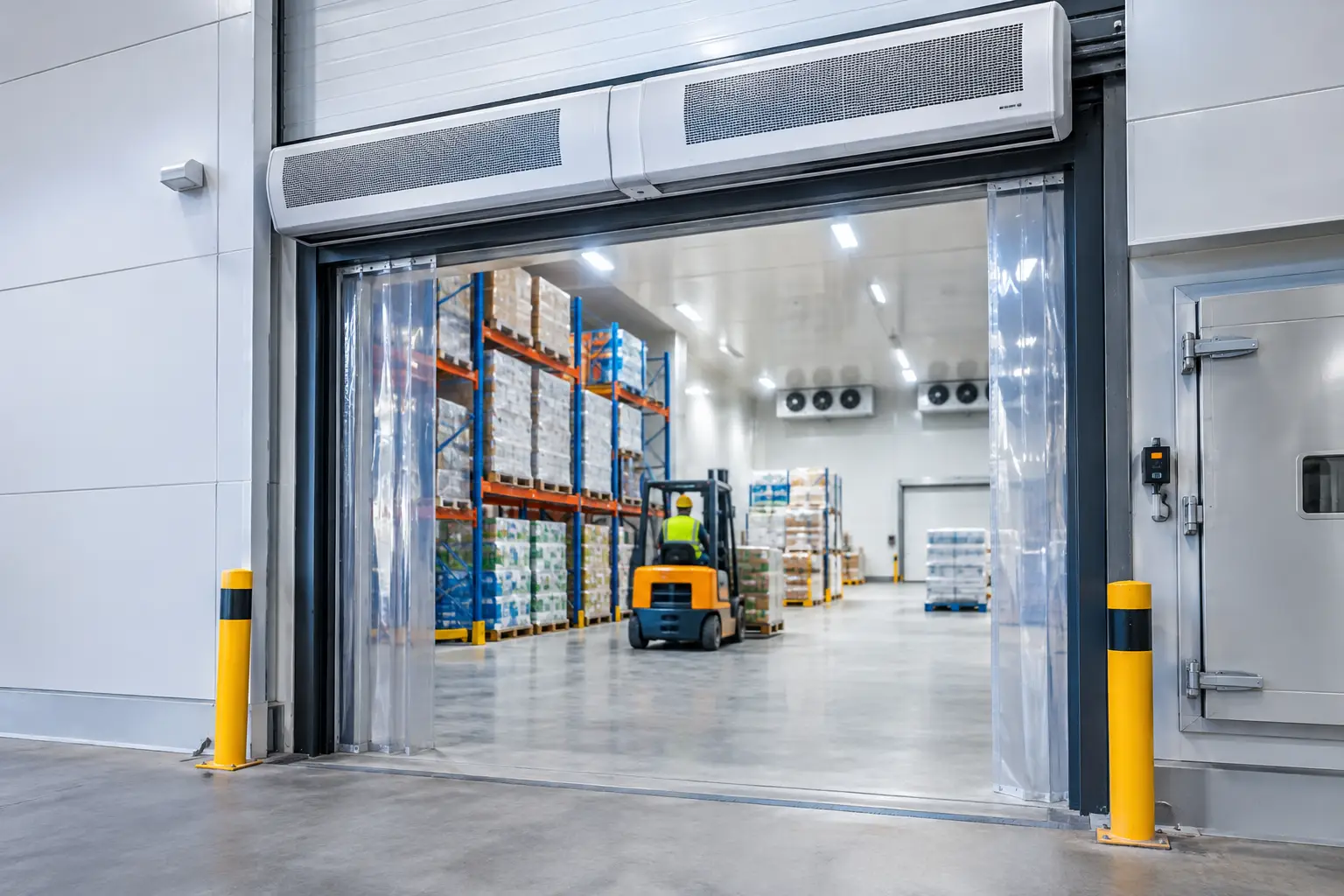
For cold storage access points, the requirements are more demanding. The air curtain must be evaluated alongside door operation, dock seals, room pressure, temperature setpoint, and defrost management. An air curtain can reduce infiltration during frequent access, but it is not a substitute for a properly designed insulated door system. This distinction matters because overpromising performance can lead to disappointing energy results and persistent condensation issues.
Facilities handling chemicals, combustion byproducts, or diesel-powered vehicle activity should also assess airflow direction and pressure relationships. An air curtain can help reduce the movement of outside contaminants inward, but it should not be used as the sole control measure where fumes or hazardous airborne materials are present.
Common Specification Errors at Industrial Bays
The most common mistake is specifying a unit by opening width alone. A unit may span the bay correctly yet still be unable to project an effective stream to floor level. Mounting height and external conditions are equally important.
Another issue is treating every bay as identical. A sheltered internal loading area may have very different requirements from an exposed dock facing prevailing desert winds. Similarly, a warehouse that receives two deliveries a day does not need the same operating strategy as a distribution center with constant forklift traffic.
Control selection is frequently overlooked as well. A manually operated air curtain may be left running after the door closes or switched off during high-traffic periods. Integrating operation with door status, time schedules, or facility controls makes performance more consistent and supports energy management.
Finally, access for professional inspection should be considered before installation. Loading environments collect dust and debris, particularly in desert locations. A practical mounting arrangement allows the facility maintenance team to inspect inlet areas, clean filter nets where fitted, and verify that airflow remains properly directed over time.
Energy Impact in Hot and Humid Markets
In GCC, MENA, and African markets, cooling demand is often high for much of the year. When a bay door opens, the building can lose cooled air rapidly while drawing in hot ambient air. The cooling system must then remove both sensible heat and, in humid climates, latent moisture.
An air curtain reduces this uncontrolled exchange. The actual energy benefit depends on door-open time, internal setpoint, outdoor conditions, HVAC capacity, and the effectiveness of the installed air stream. Facilities with frequent loading activity generally have more opportunity to benefit than sites where doors are rarely opened.
The operational benefits can extend beyond electricity use. Reduced dust ingress can lower housekeeping pressure. Better temperature stability can support staff comfort near dispatch zones. Insect reduction can assist hygiene procedures in food-related operations. These outcomes make an air curtain a practical component of entrance management, especially where dock doors cannot remain closed during normal workflow.
Plan the System as Part of the Bay Design
The strongest results come when air curtains are considered alongside dock layout, door type, traffic flow, and cooling strategy. During a new project, the MEP design team can reserve adequate mounting space and electrical provisions. During a retrofit, a site review can identify obstructions such as rails, shutters, structural beams, or signage that could disrupt the discharge path.
FreezeeX evaluates loading-bay requirements by considering the opening, mounting height, traffic volume, environmental exposure, and indoor operating conditions. Its industrial centrifugal air curtain range is designed for commercial and industrial entrances operating in high heat, humidity, and dusty conditions.
For a loading bay, the correct question is not simply, “What size air curtain fits this door?” It is, “What level of air isolation does this operation require while the door is open?” A project-specific assessment will produce a more reliable answer. Request a consultation and quotation with your bay dimensions, mounting details, operating hours, and environmental conditions to specify a system that supports the way your facility actually works.



3 Responses