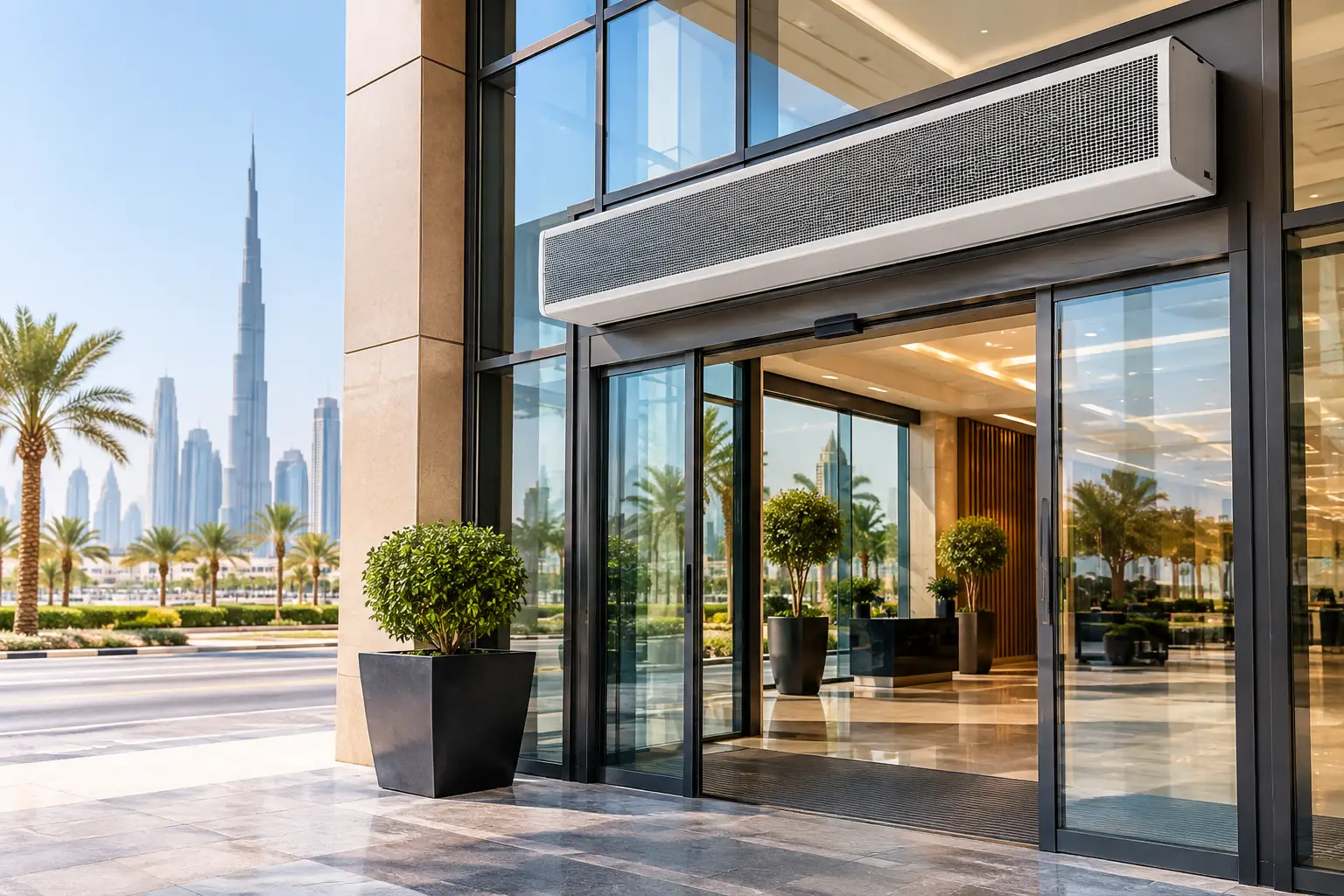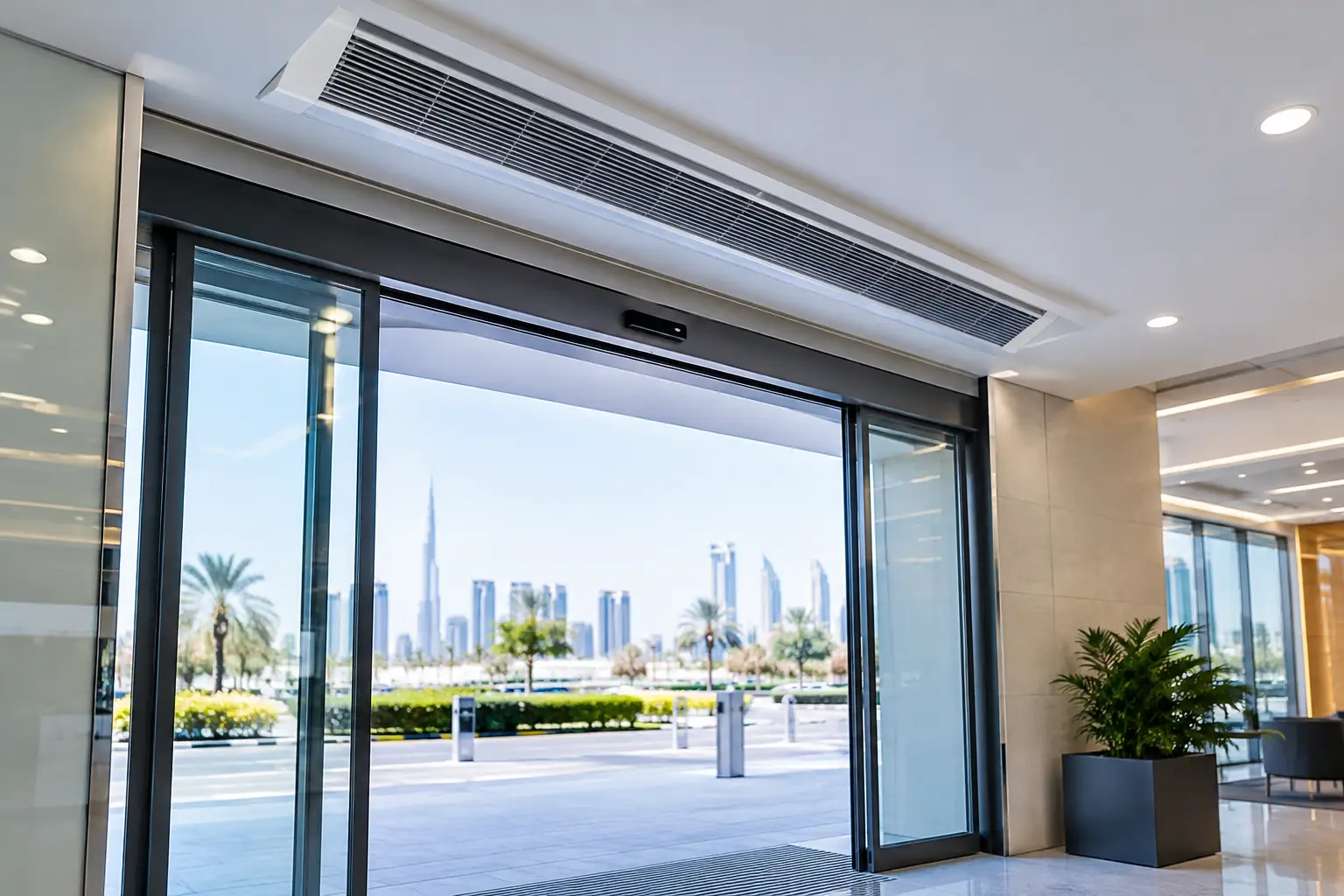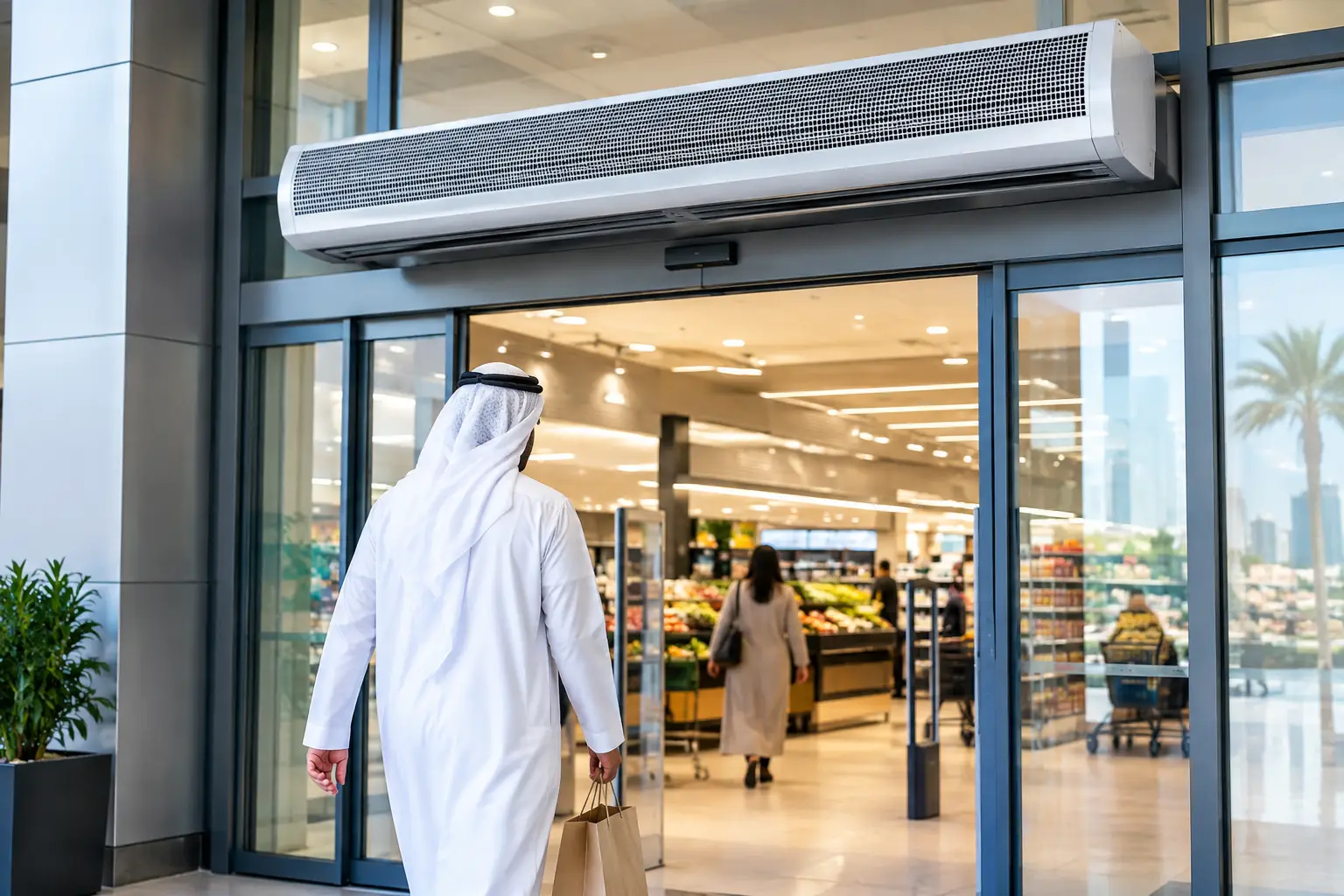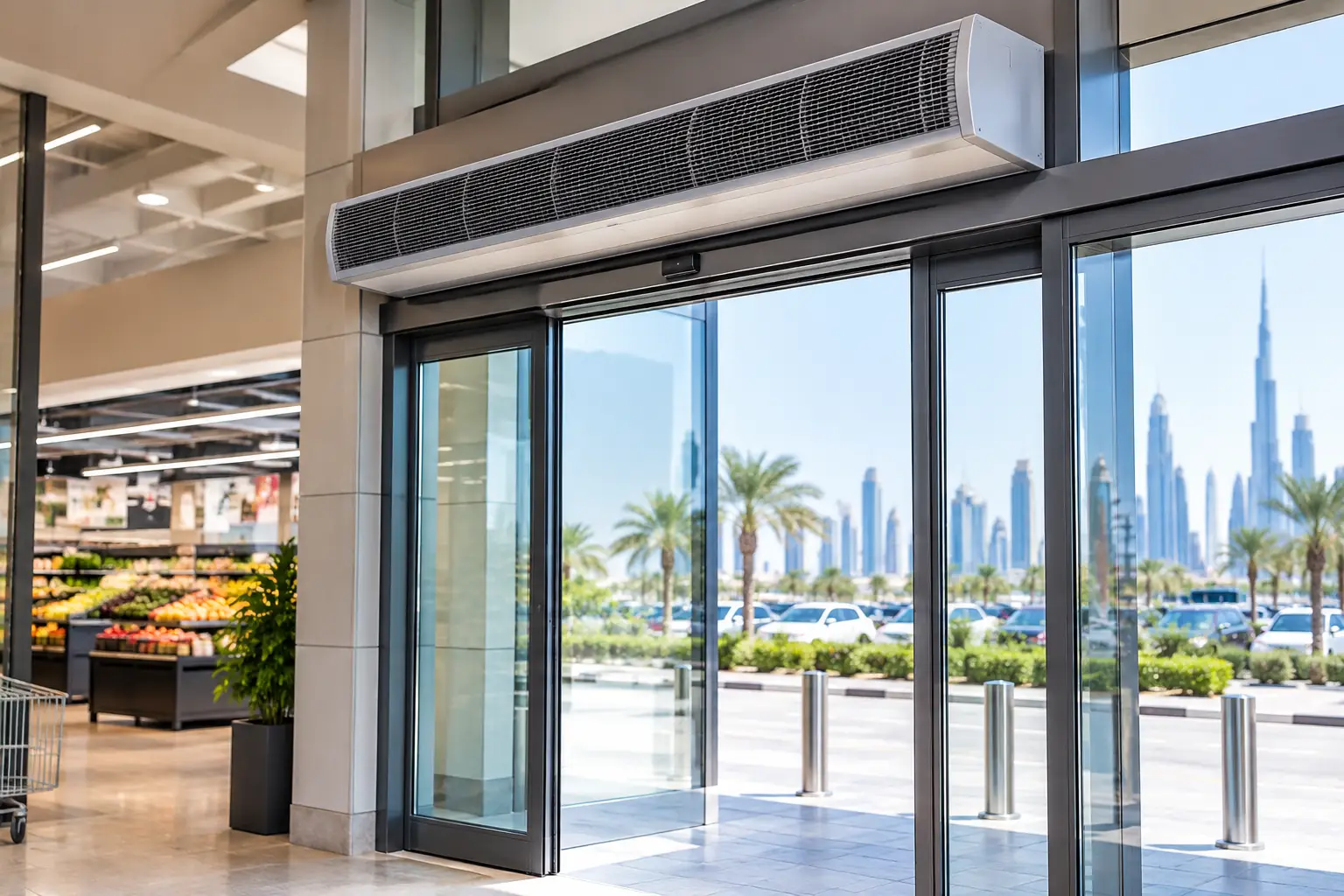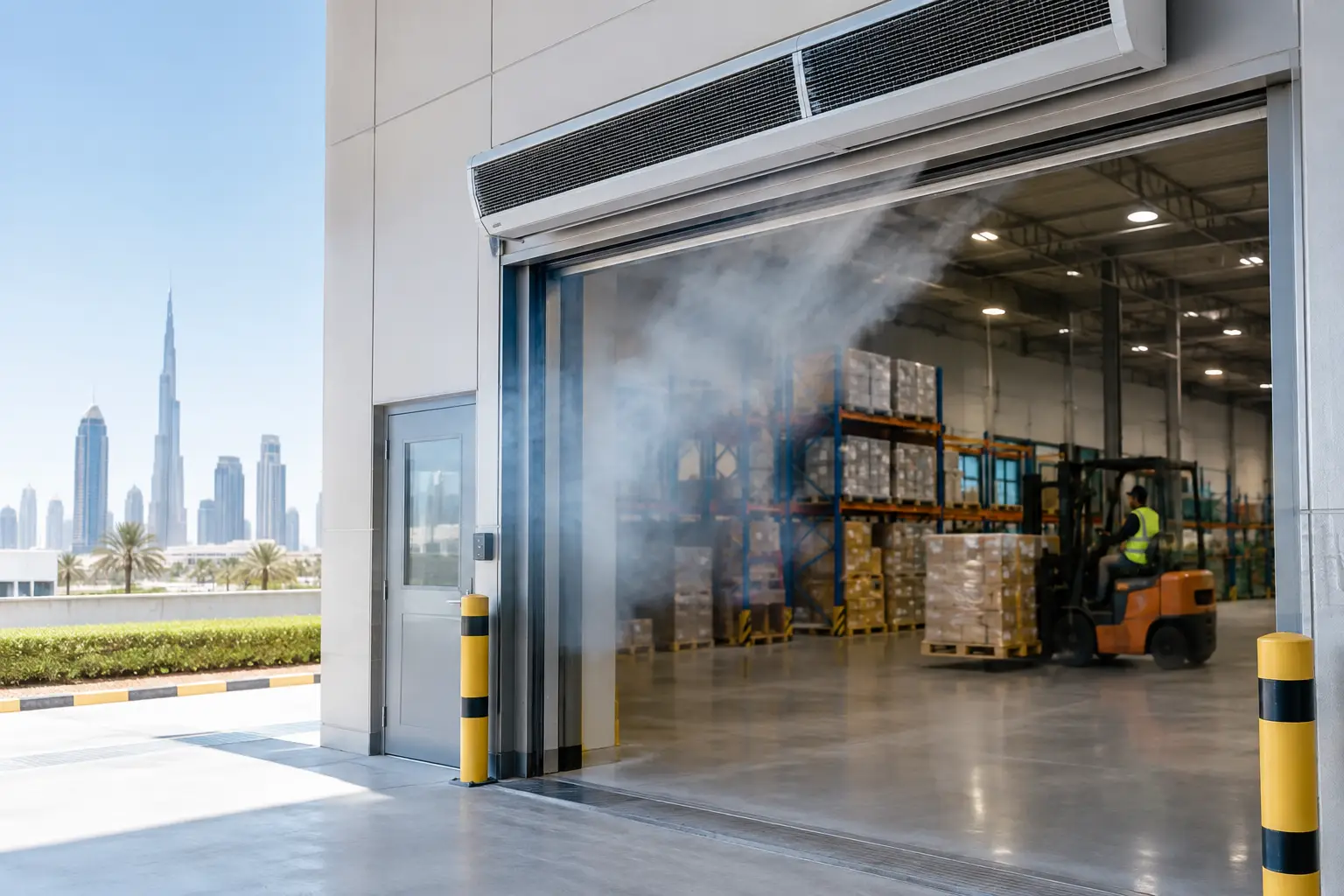
A production facility cannot keep conditioned air inside when a busy loading doorway behaves like an open exhaust point. This factory doorway airflow upgrade example shows how an industrial site can reduce cooling loss, dust entry, and worker discomfort without slowing forklift traffic or changing its operating schedule.
The scenario is typical of factories, warehouses, food handling operations, and assembly plants across the GCC, MENA, and Africa. Outside temperatures are high, airborne dust is persistent, and a large door may remain open for long periods. The result is not merely an uncomfortable entrance zone. It is higher HVAC demand, inconsistent indoor conditions, contamination risk, and a facility team repeatedly addressing the same complaint.
The operational problem at the loading entrance
Consider a manufacturing plant with a 16-foot-wide by 14-foot-high loading doorway connecting the finished-goods area to an active yard. Forklifts use the opening throughout the day. During peak dispatch periods, the shutter is open for 10 to 20 minutes at a time, and sometimes longer.
The facility is located in a hot, dusty climate. Its cooled production space is maintained for workforce comfort, product protection, and equipment reliability. Yet workers positioned near the doorway report a noticeable blast of hot air. Dust collects faster around packing stations, and the cooling system runs harder as the interior temperature rises near the entrance.
The initial response might be to lower the thermostat setting or add capacity to the cooling system. Neither action addresses the actual path of air loss. An open doorway creates a direct exchange between the conditioned interior and harsh exterior conditions. Cooling more air only increases the cost of losing it.
The upgrade target is therefore clear: create a controlled air barrier across the full doorway while preserving clear access for goods movement.
Factory doorway airflow upgrade example: the assessment
Before selecting equipment, the contractor or facility team should assess the entrance as an operating condition, not simply measure the door width. A suitable air curtain depends on mounting height, opening dimensions, door-use frequency, external wind exposure, interior pressure, and the temperature difference between inside and outside.
In this example, the key findings are straightforward. The doorway is tall, frequently open, and exposed to yard-side crosswinds. A light commercial unit would not provide enough air throw or velocity to reach the floor with useful separation. The project requires an industrial centrifugal air curtain designed for sustained duty and a high mounting position.
The assessment also checks where the discharge air will travel. The objective is a downward curtain that reaches the threshold consistently, not a loud stream that breaks apart halfway down the opening. Airflow must be sized to resist heat, dust, and wind intrusion while avoiding excessive turbulence inside the production area.
This is where entrance design becomes specific. A narrower, lower doorway with limited use may need a different solution than a wide loading bay operating through a desert afternoon. One model category does not fit every opening.
The airflow upgrade selected
For this facility, the recommended approach is a continuous industrial air curtain installation spanning the full width of the loading entrance. Multiple compatible units are arranged side by side rather than leaving gaps at either edge. The system is mounted above the doorway on the interior side, where it can protect the conditioned zone and remain accessible for planned service.
An industrial centrifugal configuration is selected because the application demands stronger, more directed airflow than a standard commercial entrance. Centrifugal blower designs are well suited to larger openings and heavy-use environments where air must travel farther from the mounting point to the floor.
The units are specified with adjustable discharge direction and appropriate speed control. This matters because airflow should be commissioned at the actual facility, not assumed from a catalog value. The discharge angle may need refinement after observing forklift movement, nearby doors, and crosswind effects.
The air curtain is interlocked with the shutter-door control. It activates when the door opens and returns to a lower-energy operating state or switches off when the door closes, depending on the site’s control strategy. This avoids running full output when no barrier is needed.
For facilities with strict hygiene requirements, an appropriate filter-net arrangement and a practical cleaning schedule can also help protect the equipment from airborne debris. The exact filtration approach depends on the dust load and the maintenance resources available on site.
What changes after commissioning
Once the system is properly installed and adjusted, the doorway no longer acts as an unrestricted channel for outdoor air. The air curtain does not physically close the opening, and it does not eliminate every trace of infiltration. Its function is to reduce air exchange significantly by creating a high-velocity separation zone across the doorway.
For this plant, the expected operational changes are visible quickly. The hot-air surge at the entrance is reduced, so the cooling system is not forced to recover from every long door opening. Dust and flying insects have a more difficult path into the facility. Personnel working near dispatch experience a more stable indoor environment, and product staging areas are less exposed to outside conditions.
The biggest benefit is often consistency. Instead of having one section of the factory feel acceptable while the loading area becomes hot and dusty, the facility gains better control of the entire occupied space. That supports productivity, housekeeping, and comfort at the same time.
Energy savings will vary. They depend on the size of the opening, door-open hours, local weather, existing cooling load, and the performance of the air curtain system. A site that leaves a large shutter open through the hottest parts of the day has a greater opportunity than one with brief, occasional access. For that reason, projected savings should be calculated from real operating data rather than treated as a universal percentage.
Design details that determine performance
An air curtain can underperform when the equipment is technically capable but poorly matched to the doorway. In industrial projects, four details deserve particular attention:
- Full opening coverage: Every gap at the side or between adjacent units becomes a potential route for hot air, dust, and insects.
- Mounting height and air throw: The selected unit must maintain effective airflow all the way to the floor at the installed height.
- External wind conditions: Yard exposure, nearby vehicle movement, and building orientation can disrupt the air stream and may require a higher-capacity configuration.
- Controls and operating behavior: Door interlocks, speed selection, and a sensible operating schedule prevent wasted energy and improve barrier performance.
Noise is another practical consideration. Industrial airflow requires power, but the system should be selected and positioned with the working environment in mind. A workshop, packing area, and food production zone may have different acceptable noise thresholds. The right answer balances air isolation performance with the realities of the space.
Why tropical and desert conditions raise the stakes
In Dubai, Riyadh, Doha, Muscat, Cairo, Lagos, Nairobi, and similar high-demand markets, open industrial entrances face more than a mild temperature difference. They may face intense solar heat, high ambient temperatures, humidity, fine dust, and frequent logistics activity all in the same shift.
That is why doorway protection should be considered part of the building’s climate-control strategy. A well-specified air curtain helps preserve the performance of the cooling system already serving the facility. It is particularly valuable where production, packaging, cold storage transfer, retail back-of-house activity, or hygiene-sensitive handling occurs close to open doors.
FreezeeX air curtain solutions are engineered for these demanding operating conditions, with industrial and commercial configurations selected around actual opening size, use pattern, and climate exposure. The goal is not to add another piece of equipment. It is to make the doorway perform as a controlled part of the facility.
If a loading entrance is driving cooling loss, dust complaints, or inconsistent indoor conditions, start with the door dimensions, mounting height, operating hours, and site exposure. Share those details with a FreezeeX specialist to request a project-specific consultation and quote for an industrial airflow upgrade.