
A lobby door in Dubai, a loading entrance in Riyadh, or a hypermarket access point in Lagos can lose conditioned air faster than most teams expect. That is why an air curtain airflow velocity guide matters – not as a theoretical spec sheet item, but as a practical control point for cooling retention, dust exclusion, insect reduction, and entrance comfort in hot, high-traffic facilities.
For most commercial and industrial buyers, airflow velocity is where air curtain performance is won or lost. Too low, and the air stream breaks before it reaches the floor. Too high, and you can create turbulence, noise, and wasted power without improving separation. The right velocity depends on opening height, exposure, traffic pattern, pressure differences, and local climate conditions.
What airflow velocity actually does
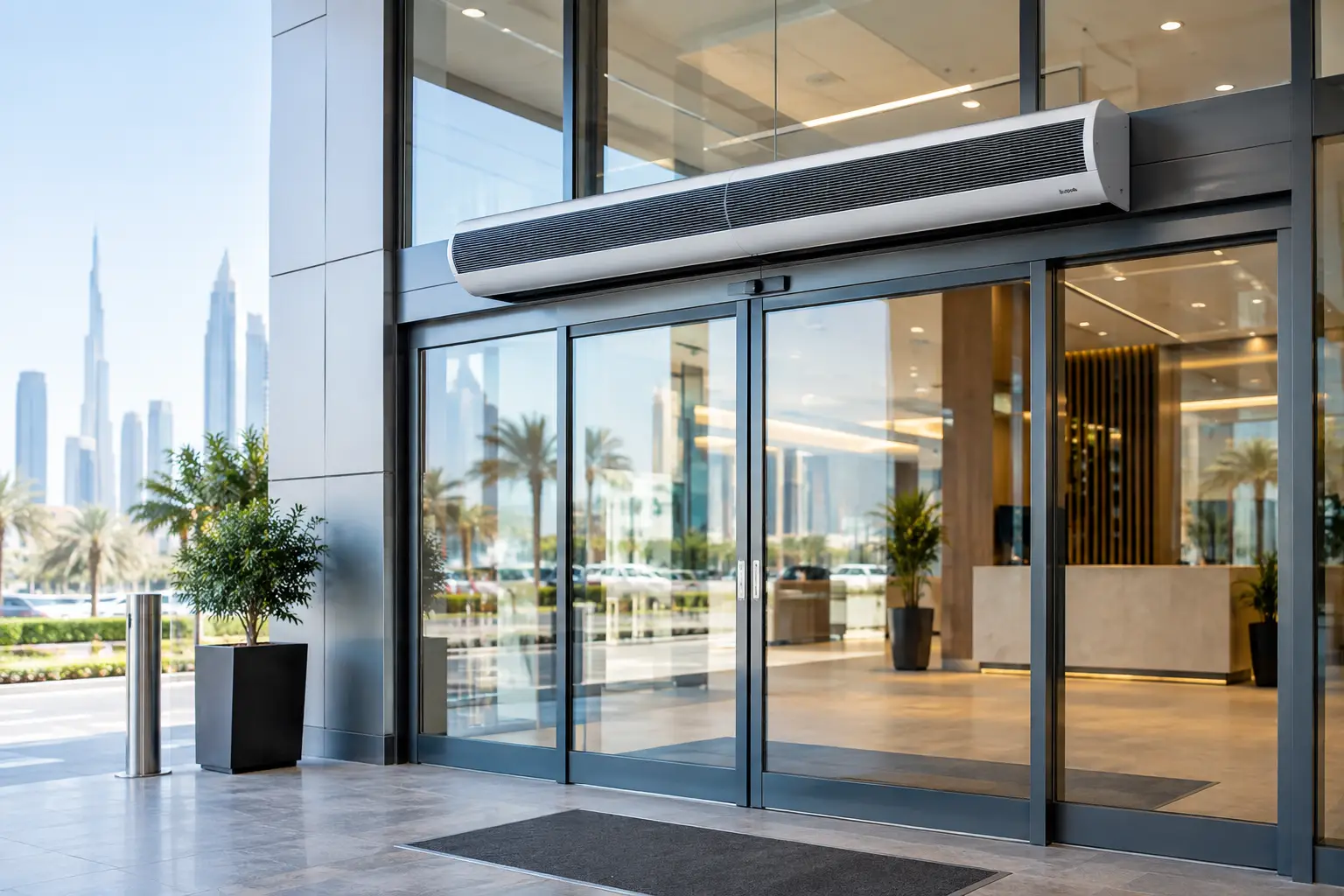
An air curtain works by projecting a controlled air stream across an opening to create an invisible barrier. That barrier helps separate indoor and outdoor environments without physically blocking movement. In high-temperature and humid regions, the goal is usually to reduce hot air infiltration, limit humidity transfer, and support the HVAC system rather than force it to compensate for every door cycle.
Velocity is the force that carries that air stream from the unit discharge to the floor or target zone. If the discharge velocity is not strong enough for the opening geometry, the stream bends, disperses, or collapses before forming an effective seal. At that point, the unit may still be running, but the entrance is not being protected properly.
This is why air curtain selection should never be based on width alone. A unit can physically fit an entrance and still be undersized from an airflow standpoint. For contractors, consultants, and facility managers, that is one of the most common reasons an installed air curtain underperforms.
Air curtain airflow velocity guide for real-world openings
A useful air curtain airflow velocity guide starts with one basic fact: required velocity rises as the opening becomes more demanding. Taller doors, wider entrances, negative building pressure, crosswinds, and heavy foot or trolley traffic all increase the workload.
For a standard commercial doorway, the design target is typically a stable air stream that reaches the floor with enough residual velocity to resist infiltration. For taller or more exposed openings, the unit needs higher outlet velocity and sufficient air volume to hold the stream together over distance. Velocity alone is not enough if the air pattern is thin or unstable.
In practice, specifiers should look at three points together – discharge velocity, air volume, and installation height. A high discharge number can look impressive on a datasheet, but if the fan design, nozzle geometry, or motor performance are not matched to the opening, field results may disappoint. This is especially true at entrances facing open parking areas, delivery zones, or desert wind exposure.
Residual velocity matters more than headline numbers
The number that gets attention is often outlet velocity. The number that matters on site is the velocity that remains where protection is needed. A unit may discharge air at a strong rate, but the stream loses energy as it travels downward. The taller the opening, the more critical residual velocity becomes.
That is why high entrances in warehouses, industrial facilities, and busy logistics areas usually need centrifugal or industrial-grade systems rather than light commercial models. The objective is not aggressive airflow for its own sake. The objective is maintaining a coherent barrier from top to bottom under actual operating conditions.
Climate changes the requirement
In tropical and desert markets, the outside air is not just warm. It can be hot, humid, dusty, and unstable. That combination increases the penalty for poor entrance control. Cooling loss rises, indoor comfort drops near the doorway, and HVAC equipment runs harder to recover conditions inside.
In cities such as Doha, Muscat, Cairo, Nairobi, and Casablanca, local conditions can vary, but the pattern is the same: higher ambient stress means the air curtain must do more work. Velocity selection should reflect that reality. A unit chosen for a mild indoor-outdoor differential may not hold up when exposed to solar heat load, humidity, and long operating hours.
How to choose the right velocity range
The first step is to define the opening, not the product. Start with the door height, width, and whether the unit is wall-mounted, recessed, or suspended. Then assess exposure. Is the entrance internal, semi-external, or fully open to wind and traffic? Is the building under negative pressure from exhaust or process airflow? These conditions often determine whether a standard commercial unit is enough or whether an industrial series is required.
Next, consider the operational objective. A retail entry may prioritize customer comfort and insect control. A cold storage transition may prioritize temperature separation and humidity reduction. A workshop or plant entrance may be more focused on dust and hot air exclusion. Different objectives can shift the preferred balance between velocity, air volume, and noise.
Then evaluate the door cycle. A frequently used entrance needs stable continuous protection, not a marginal system that performs only when the environment is calm. This is where many projects in high-traffic facilities need a stronger specification than originally assumed.
When more velocity helps
Higher airflow velocity is generally beneficial when the opening is taller, the external environment is harsher, or pressure imbalance pulls outdoor air inward. It also helps in sites where entrance doors remain open for long periods, such as hypermarkets, receiving areas, and industrial access points.
In these cases, a stronger throw supports barrier integrity. But stronger should not mean excessive. Overshooting velocity can create draft complaints at pedestrian entrances and may disrupt comfort in hospitality or premium commercial settings.
When more velocity creates problems
There is a point where added velocity stops delivering useful separation and starts creating side effects. Excessive force can increase turbulence, especially if the discharge angle is not set correctly or if the installation location is exposed to competing airflow from other equipment.
Noise is another consideration. In office, hotel, and front-of-house retail applications, acoustic performance matters. The best result is not the highest possible velocity. It is the lowest velocity that still achieves effective barrier performance for the opening and climate.
Installation details can change performance
Even a well-selected unit can fail if the installation is wrong. Mounting height, discharge angle, alignment over the opening, and side clearances all affect how the air stream behaves. If the unit is set too high above the opening, the stream may spread before it reaches the threshold. If the angle is wrong, air can deflect outward or inward and weaken the seal.
This is why specification-ready support matters in commercial projects. Entrance conditions vary widely between a mall access point in Abu Dhabi, a logistics entrance in Kuwait City, and a food retail site in Accra. The right airflow velocity must be matched with the right mounting arrangement and product type.
Common specification mistakes
One common mistake is choosing by door width alone. Another is assuming all commercial air curtains perform similarly if the housing size looks comparable. Fan type, motor quality, internal aerodynamics, and intended mounting height create major differences in actual barrier performance.
Another mistake is underestimating climate severity. In hot-weather markets, an entrance may face sustained heat load and airborne dust for long operating hours. That raises the importance of durable motors, stable airflow, and equipment designed for commercial duty rather than light intermittent use.
A final mistake is treating air curtain velocity as a single magic number. Performance is always a system question. Velocity must be evaluated together with air volume, throw, opening height, building pressure, and application type.
What buyers should ask before specifying
A good supplier should be able to translate site conditions into a realistic performance recommendation. That means discussing the opening dimensions, mounting height, environmental exposure, operating hours, and desired control outcome. If the conversation starts and ends with price, the risk of underspecification is high.
For B2B projects in the GCC, MENA, and African markets, climate-adapted selection is not optional. It directly affects energy use, comfort, hygiene, and operational consistency. FreezeeX supports this process with consultation-led recommendations for commercial and industrial entrances where tropical heat, humidity, and dust make airflow performance more demanding.
If you are planning a new project or correcting an underperforming installation, request a technical review before finalizing the specification. A proper airflow velocity assessment can prevent cooling loss, improve entrance control, and lead to a better-fit quote for your actual operating conditions.





17 Responses
Thank you for highlighting this important point. Proper installation and adjustment are just as important as selecting the right air curtain, as correct airflow direction and velocity help create an effective air barrier without causing unnecessary drafts or noise. This ensures reliable performance even in entrances exposed to heavy traffic or challenging environmental conditions.