
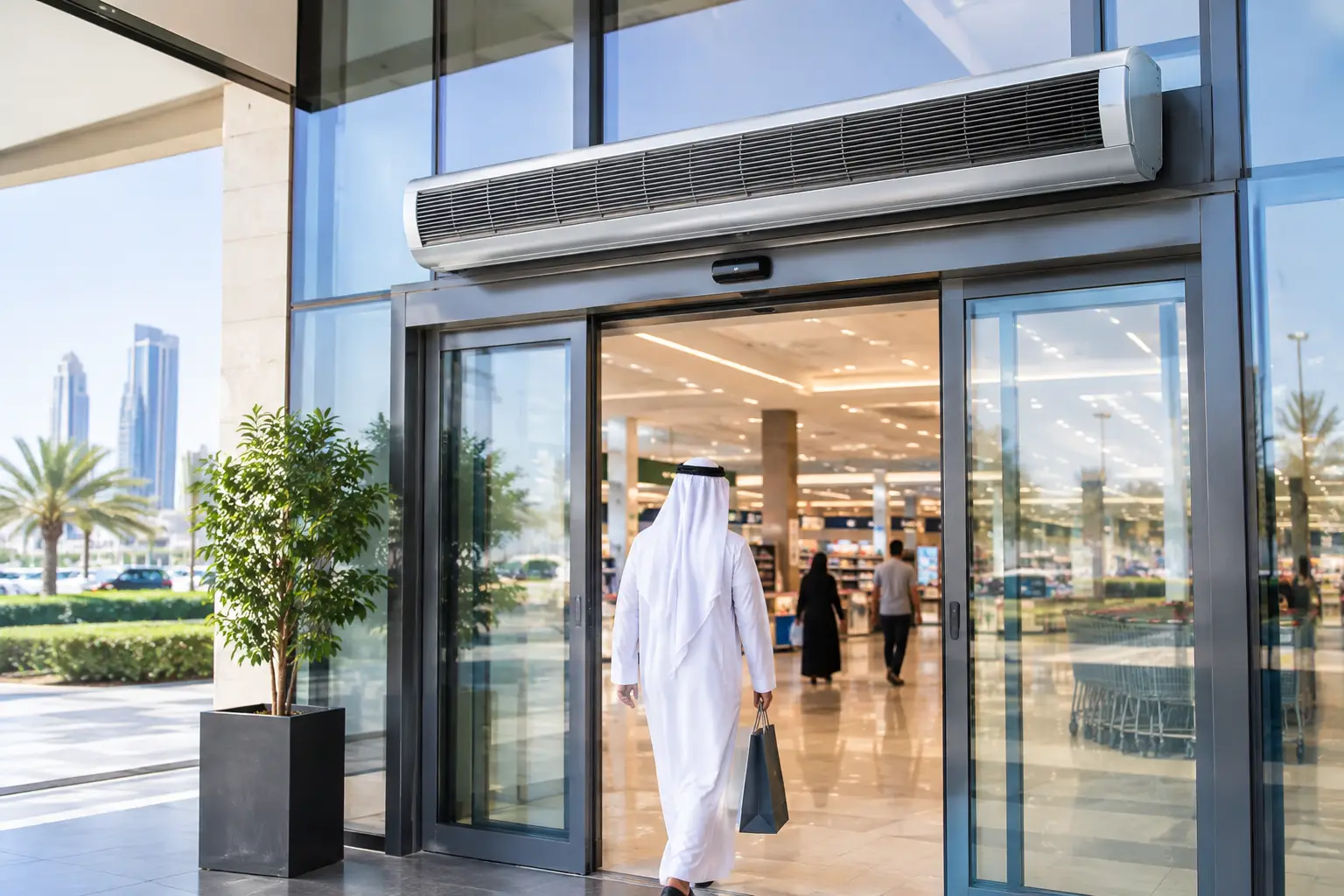
A glass-front retail entrance in Dubai or Lagos can lose conditioned air all day without anyone noticing the real cost. The lobby still feels cool near the diffuser, but every door cycle pulls in heat, dust, humidity, and insects. A recessed ceiling air curtain addresses that problem without adding visible bulk across the entrance line, which makes it a strong fit for commercial spaces that need climate control and a clean architectural finish.
For facility managers, consultants, and contractors, the question is rarely whether an air barrier helps. The real question is whether a recessed unit is the right specification for the entrance, the ceiling condition, and the site climate. In hot, high-traffic buildings, that answer often depends on more than aesthetics.
What a recessed ceiling air curtain actually does
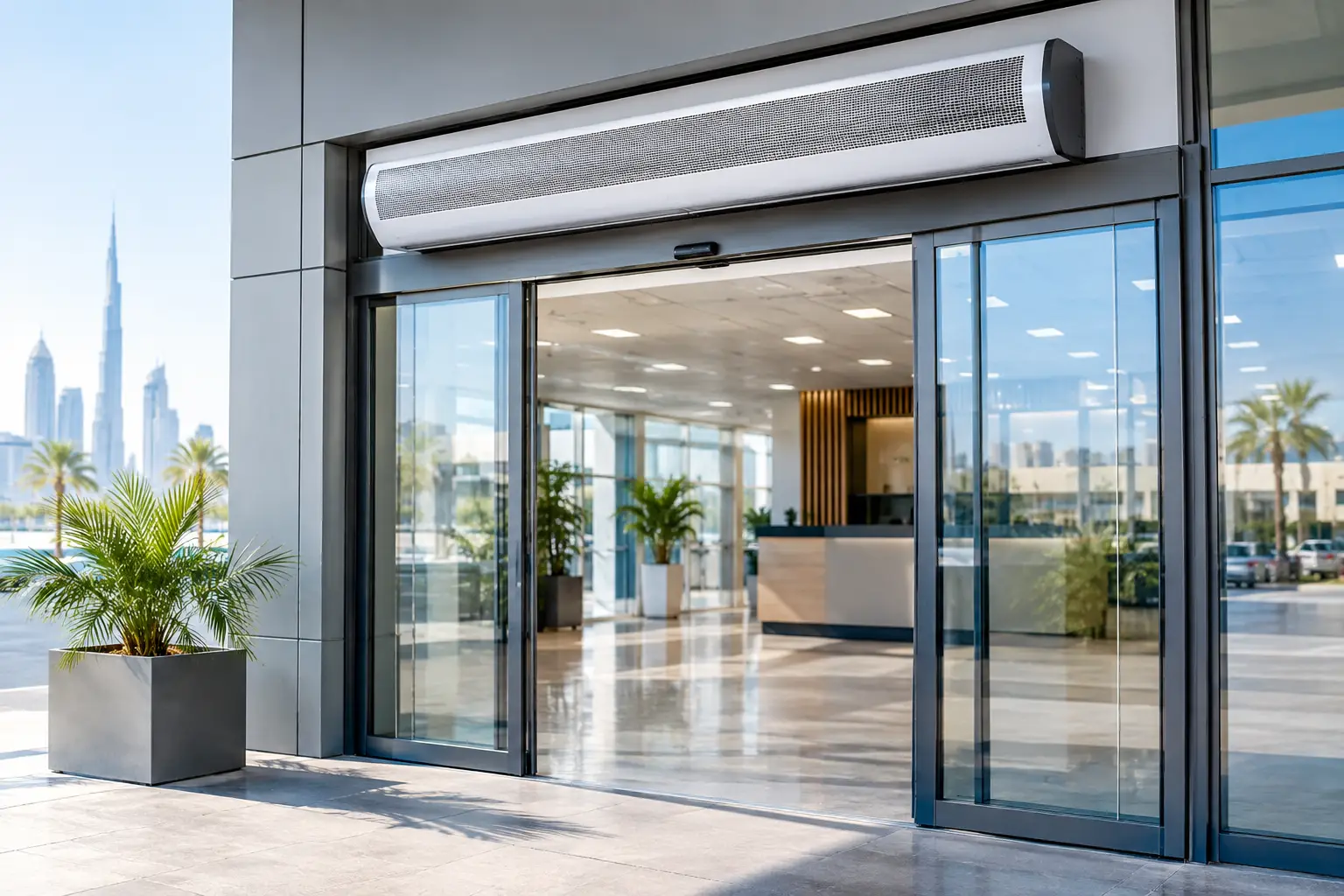
A recessed ceiling air curtain is installed above the entrance line with the main body hidden inside the ceiling void. Only the intake or discharge grille remains visible. Its job is to create a high-velocity air stream across the doorway so outside air has a harder time entering and conditioned indoor air has a harder time escaping.
That sounds simple, but performance depends on velocity, coverage, mounting height, and the pressure conditions at the opening. In a supermarket, hotel, clinic, cold room anteroom, or office tower entrance, the unit is not just moving air. It is helping the building keep cooling capacity where it belongs.
In desert and tropical climates, this matters more. Every uncontrolled entrance opening increases HVAC load, indoor humidity stress, airborne dust, and pest risk. That is why recessed air curtains are often specified for projects in places such as Riyadh, Doha, Cairo, Nairobi, and Abu Dhabi, where entrance conditions are demanding for most of the year.
Why recessed ceiling air curtain systems are chosen
The recessed format is usually selected when the entrance needs protection without an exposed mechanical look. Hotels, premium retail, corporate lobbies, clinics, and food-related commercial sites often prefer this approach because it preserves a cleaner ceiling line.
There is also a practical advantage. A recessed installation can reduce the visual clutter around glazed or branded entry zones, which matters in customer-facing properties. For consultants and fit-out teams, that makes coordination easier when appearance carries weight.
Still, a recessed ceiling air curtain is not automatically the best option for every opening. Ceiling depth, maintenance access, structural coordination, and service clearances all need to be checked early. If the ceiling void is shallow or heavily congested, an exposed unit may be easier to install and maintain.
Where recessed models perform best
This type of air curtain works well in commercial entrances where foot traffic is constant and visual presentation matters. You will often see them considered for malls, hypermarkets, hospitality entrances, office reception zones, pharmacy entries, and food service environments.
They can also make sense in light industrial or controlled commercial settings where dust and humidity entry need to be reduced but the project still requires a concealed finish. In hot-weather markets, that combination is valuable because open doors quickly compromise indoor conditions.
The key point is application fit. A recessed unit should be chosen because the entrance conditions support concealed installation and the airflow requirement can still be met. If the opening is unusually tall, wind-exposed, or heavily pressured, a more powerful visible industrial model may be the better engineering decision.
Performance factors that matter more than appearance
A clean ceiling line may get the first approval, but airflow performance determines whether the installation works in practice. Buyers should look closely at discharge velocity, air volume, blower design, and effective door coverage.
Mounting height is one of the most important variables. If the unit is too high for its rated throw, the air stream may weaken before it reaches the floor level or occupied zone. When that happens, the barrier effect drops and the entrance still pulls in hot air and dust.
Door width matters just as much. Gaps in coverage reduce performance immediately. On wider entrances, multiple units may need to be combined for continuous protection. This is common in retail and hospitality sites with broad glazed doors.
Motor and fan design also affect application fit. Commercial buyers should pay attention to centrifugal versus other airflow configurations, especially when the opening must handle repeated traffic and difficult ambient conditions. In tougher environments, the unit must maintain stable output instead of just producing a nominal airflow number on paper.
Recessed ceiling air curtain and hot-climate efficiency
In extreme heat, an entrance is not a minor leakage point. It is an operational cost center. Every time a door opens, the cooling system works harder to offset incoming heat and humidity. A recessed ceiling air curtain reduces that exchange, which can lower unnecessary HVAC strain and help stabilize the indoor environment.
This is especially relevant for facilities with long operating hours. Hypermarkets, hotels, healthcare buildings, and mixed-use commercial properties do not have the luxury of treating entrance losses as occasional. The losses are continuous, and in cities with high outdoor temperatures, they add up fast.
Humidity control is another reason these systems matter. In coastal and tropical markets, moisture infiltration can affect comfort, surfaces, and product conditions near the entrance. In dusty environments, the same applies to airborne particles. The air curtain does not replace the building HVAC system, but it supports it by reducing what enters in the first place.
Design coordination is where many projects go wrong
A recessed unit should be planned early, not added late after the ceiling package is already fixed. Ceiling void depth, support framing, access panels, electrical routing, control integration, and discharge alignment all need coordination before procurement and installation.
This is where many projects create their own problems. The architect wants a minimal visible grille, the MEP contractor has limited void space, and the performance requirement still demands a strong air stream. If those constraints are not reconciled early, the installed result may look clean but perform poorly.
Service access is another common oversight. Concealed equipment still needs inspection and maintenance. If the design leaves no practical access for cleaning, motor checks, or internal servicing, lifecycle performance suffers. A recessed ceiling air curtain should always be specified with maintainability in mind, not just aesthetics.
How to evaluate the right unit for a project
For most B2B buyers, selection should begin with the opening itself. Width, height, traffic pattern, door type, pressure conditions, and nearby HVAC supply all affect the recommendation. A revolving entrance, a sliding retail door, and a loading-side personnel entrance are not the same application.
Climate should be treated as a technical input, not background information. A site in Muscat with heat and humidity exposure is different from an inland desert opening in Riyadh with intense heat and dust. Both need protection, but the performance priorities may differ.
The best approach is specification-led rather than price-led. A lower-cost unit that underperforms at the doorway will not protect cooling efficiency or indoor hygiene. Commercial buyers usually get better long-term results when they match the unit to the opening conditions, required mounting height, and local climate stress.
Noise can also be part of the decision. In hospitality, executive offices, or reception zones, sound levels matter. In workshops or industrial areas, they matter less than airflow authority and durability. Again, it depends on the operating environment.
When recessed is not the right answer
A recessed ceiling air curtain is a strong option, but not a universal one. In high industrial openings, exposed loading access points, or facilities with limited ceiling coordination, a visible heavy-duty model may be more practical and more effective.
The same applies where service access is poor or the entrance height exceeds what a concealed commercial unit can realistically handle. Choosing recessed for visual reasons alone can create a weak specification. The better decision is the one that protects the opening properly and supports the building’s operating conditions.
That is the commercial mindset serious projects need. The entrance should be treated as part of the climate-control strategy, not as a decorative afterthought.
For contractors, consultants, and facility teams working in high-temperature regions, the right recessed solution can deliver cleaner entrances, lower cooling loss, and a more controlled indoor environment without compromising the finish. If you are planning a project in the GCC, MENA, or African markets and need a recessed ceiling air curtain matched to your opening, climate, and traffic conditions, request a consultation or quote with FreezeeX Air Curtains Ltd. for a specification-led recommendation.


16 Responses
Thank you for your feedback. Selecting the right air curtain for the specific application is critical to achieving optimal performance. Factors such as entrance size, traffic levels, environmental conditions, and architectural requirements should all be considered during specification. A properly matched system can improve climate control, energy efficiency, and overall operational performance.
Exactly. Application-based selection is far more effective than choosing a product category alone. Entrance size, traffic intensity, climate exposure, and architectural requirements all influence performance. Matching the air curtain to the specific operating environment helps ensure stronger environmental separation, better energy efficiency, and more reliable long-term results.
That’s one of the reasons recessed air curtains remain popular in hospitality projects. They help maintain a clean architectural appearance while still providing effective entrance protection, making them particularly well suited to hotel lobbies, premium retail spaces, and other customer-facing environments where aesthetics and performance are equally important.
That’s one of the key advantages of recessed air curtains in commercial environments. By integrating into the ceiling, they help maintain a cleaner architectural appearance while still providing effective environmental separation, making them a popular choice for hotels, premium retail spaces, and customer-facing entrances.
That’s why installation conditions should be reviewed alongside performance requirements. Different entrances present different constraints, and factors such as available headroom, mounting options, traffic flow, and architectural design can all influence the most suitable air curtain configuration for the application.
That’s the right approach. Effective air curtain selection starts with understanding the entrance itself rather than choosing a product first. Factors such as doorway dimensions, mounting method, traffic patterns, and exposure to wind or outdoor conditions all influence long-term performance and help ensure the system is matched to the application’s real operating requirements.
That’s an excellent example of matching the equipment to the environment. Recessed ceiling air curtains provide effective climate separation while maintaining a clean, unobtrusive appearance, making them a popular choice for premium commercial spaces where aesthetics are as important as performance.
That’s why specification should always be based on the application rather than the doorway alone. Factors such as entrance height, traffic frequency, mounting method, and architectural requirements all influence the most suitable air curtain solution and its long-term performance.