A pharmacy entrance can open hundreds of times a day. Each opening can pull hot, humid, dusty outdoor air into a customer area that must remain comfortable, clean, and reliably conditioned. Pharmacy air curtains create a high-velocity air barrier across that opening, reducing unwanted air exchange without slowing customer, staff, or delivery access.
For pharmacies in Dubai, Riyadh, Doha, Cairo, Lagos, and other hot or humid markets, the value is not limited to customer comfort. A correctly specified unit supports HVAC efficiency, helps limit dust and insect ingress, and reduces the strain created when conditioned air escapes through a frequently used door. The result depends on engineering details: door dimensions, mounting height, traffic patterns, outdoor exposure, and the air curtain’s ability to maintain a consistent air stream to floor level.
Why pharmacies need entrance air isolation
Pharmacies operate differently from many retail spaces. They may have a continuous flow of walk-in customers, automatic or manually held-open doors, delivery activity, and sensitive stock stored in climate-controlled rooms. Even where medicines are held in dedicated refrigerators or controlled storage spaces, the public retail area still needs stable conditions that support staff comfort, customer experience, and building energy performance.
An open entrance creates a pressure path between the outdoors and the conditioned interior. In desert climates, it allows heat and fine dust to enter. In tropical and coastal locations, humidity becomes an additional load on the air-conditioning system. Insects, odors, vehicle fumes, and airborne debris can also enter through doors near parking areas, roads, loading zones, or food outlets.
An air curtain is designed to interrupt that exchange with a directed stream of air. It does not physically seal the doorway, and it should not be described as a substitute for a controlled cleanroom envelope. However, when selected and installed correctly, it is an effective first line of defense at high-traffic pharmacy entrances.
What pharmacy air curtains should achieve
The right system is not simply the one with the highest airflow rating. Pharmacy applications need an air stream that reaches the floor with enough stability to resist crosswinds and pressure differences, while maintaining acceptable noise levels near customers and dispensing staff.
A well-specified system should help achieve four operational outcomes:
- Reduce loss of cooled indoor air during busy trading hours.
- Limit incoming heat, humidity, dust, insects, and outdoor odors.
- Support a more comfortable environment around the entrance and customer queue.
- Reduce unnecessary HVAC runtime caused by repeated door openings.
The balance between these outcomes matters. A powerful industrial unit may be appropriate for a rear delivery entrance, but it can be unnecessarily loud or visually unsuitable above a customer-facing doorway. Conversely, a compact decorative unit may not have the discharge strength required for a tall entrance exposed to hot winds and heavy foot traffic.
Match the air curtain to the pharmacy entrance
Customer entrances
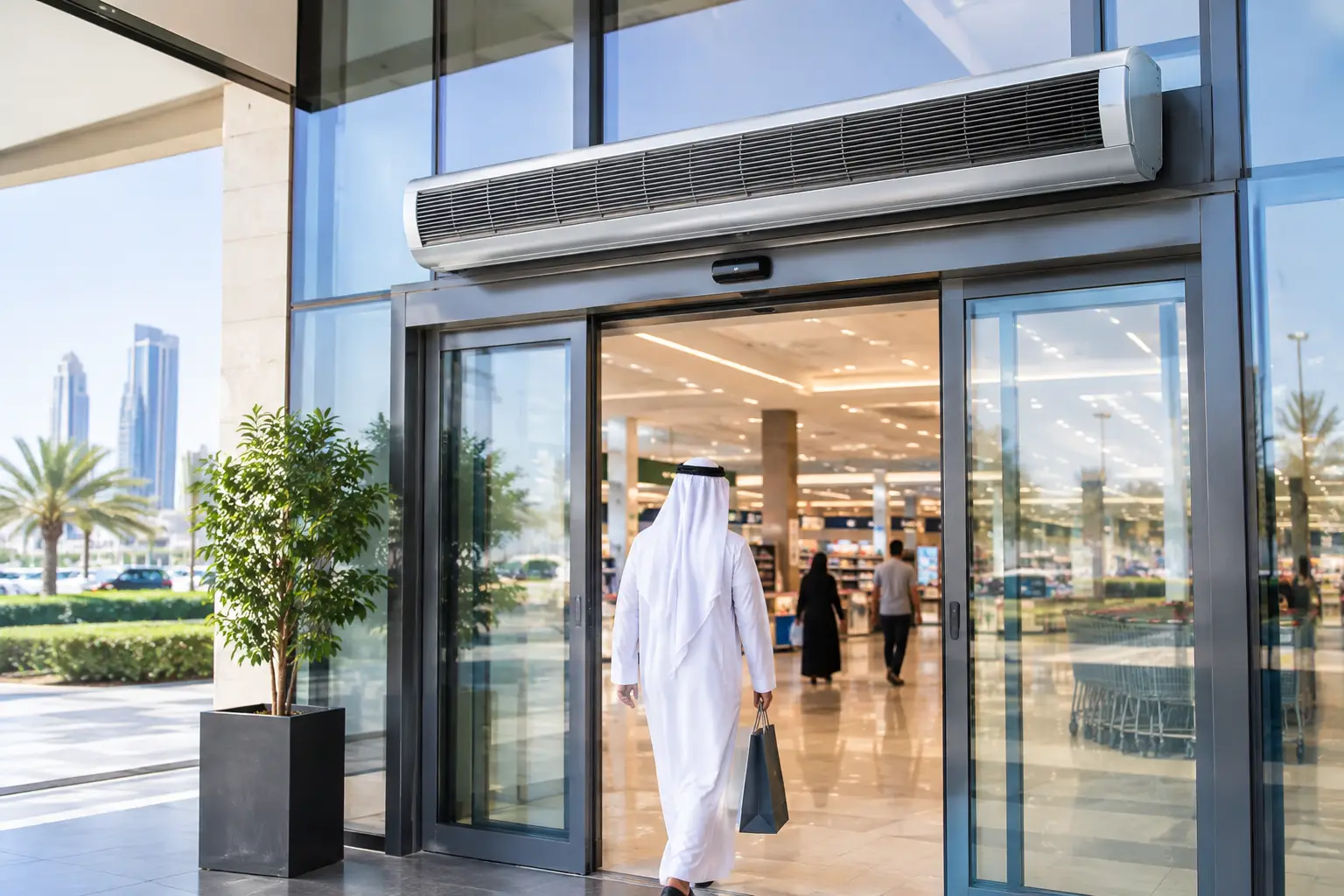
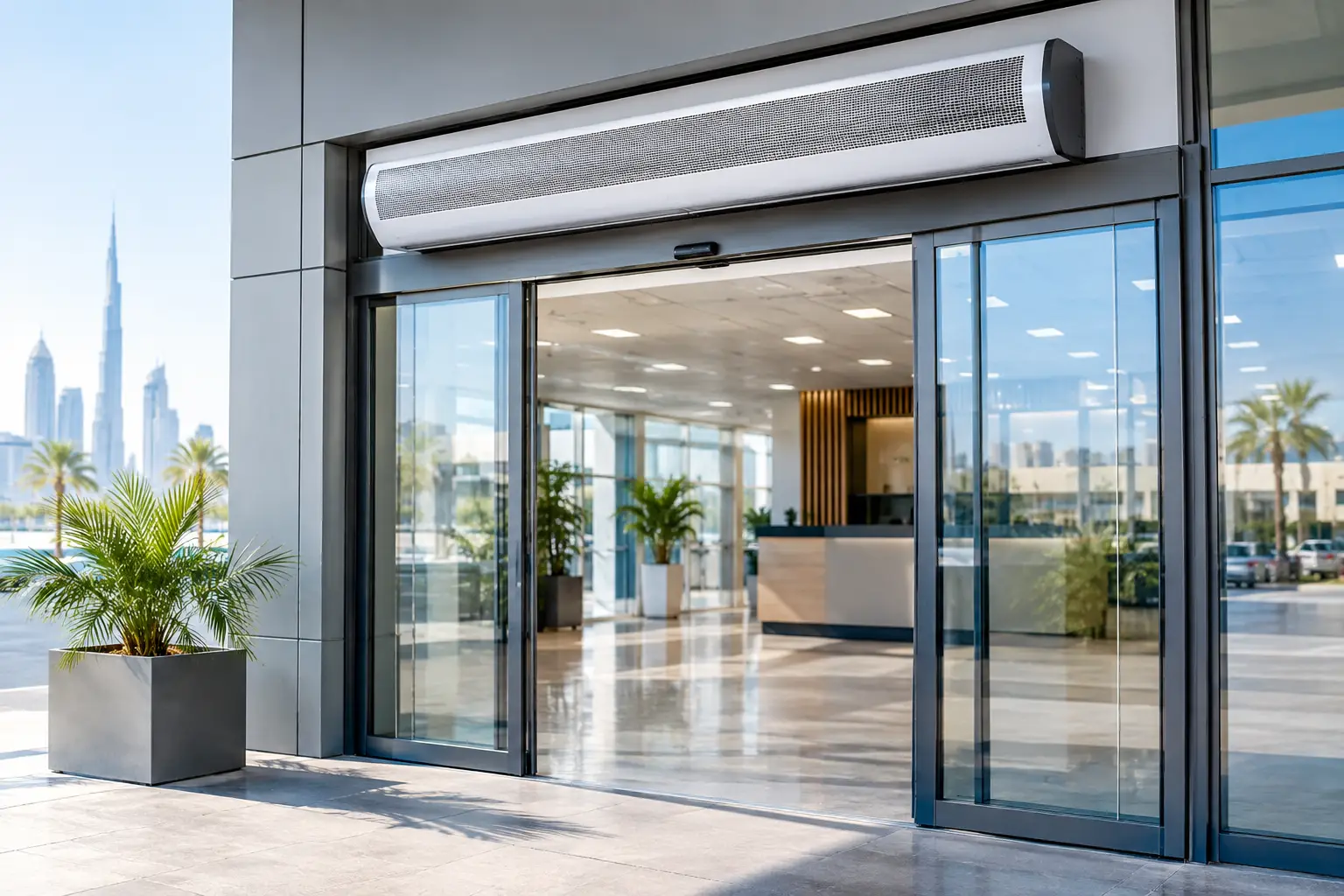
Most neighborhood and mall pharmacies need a commercial air curtain mounted directly above the public doorway. The critical factors are the clear opening width, mounting height, door type, and whether the entrance faces prevailing wind or intense afternoon sun.
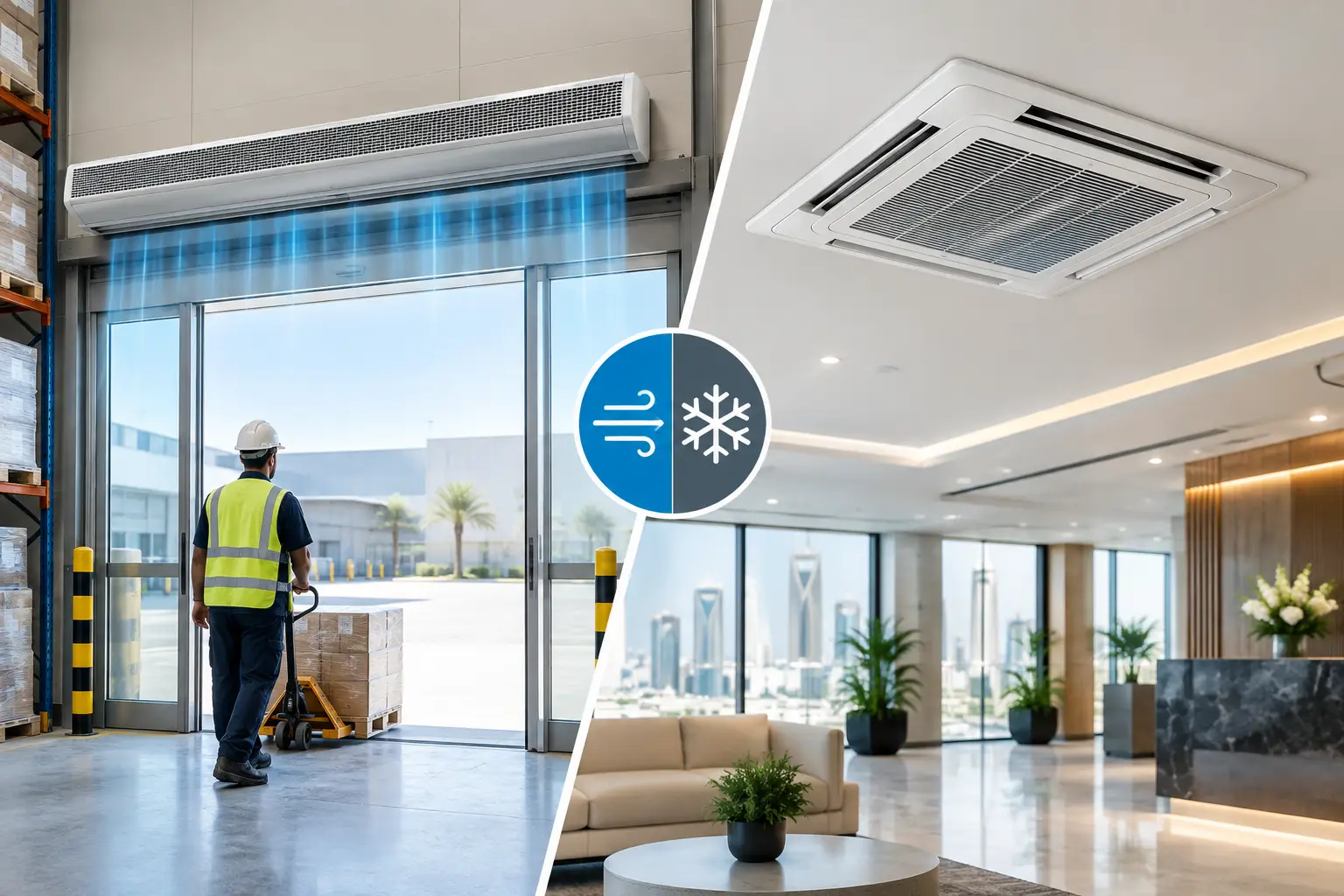
For standard-height doors in enclosed malls or protected storefronts, a commercial centrifugal or high-performance cross-flow arrangement may provide the right combination of coverage, noise control, and appearance. Where the unit needs to remain visually discreet, recessed ceiling air curtains can integrate into a finished soffit while keeping the entrance line clear.
The key is continuous coverage. A unit that is narrower than the door opening leaves bypass gaps at the sides, allowing outside air to enter around the curtain. Multiple units are often the better specification for wide storefronts rather than relying on one oversized unit with uneven coverage.
Street-facing and high-exposure doors
A pharmacy on a street-facing retail strip in the UAE, Saudi Arabia, Qatar, or North Africa may face stronger pressure differences than a unit inside a mall. Wind, heat radiating from paving, dust, and passing vehicle fumes all make the air barrier work harder.
In these conditions, discharge velocity and mounting height deserve close attention. If the unit is installed too high for its performance range, the airstream can disperse before reaching the floor. If it is undersized, it may look operational while providing limited isolation. A higher-capacity commercial centrifugal model is often more suitable where exposure is significant, but the final selection should be based on the actual site conditions rather than door width alone.
Delivery, service, and stock-receiving doors
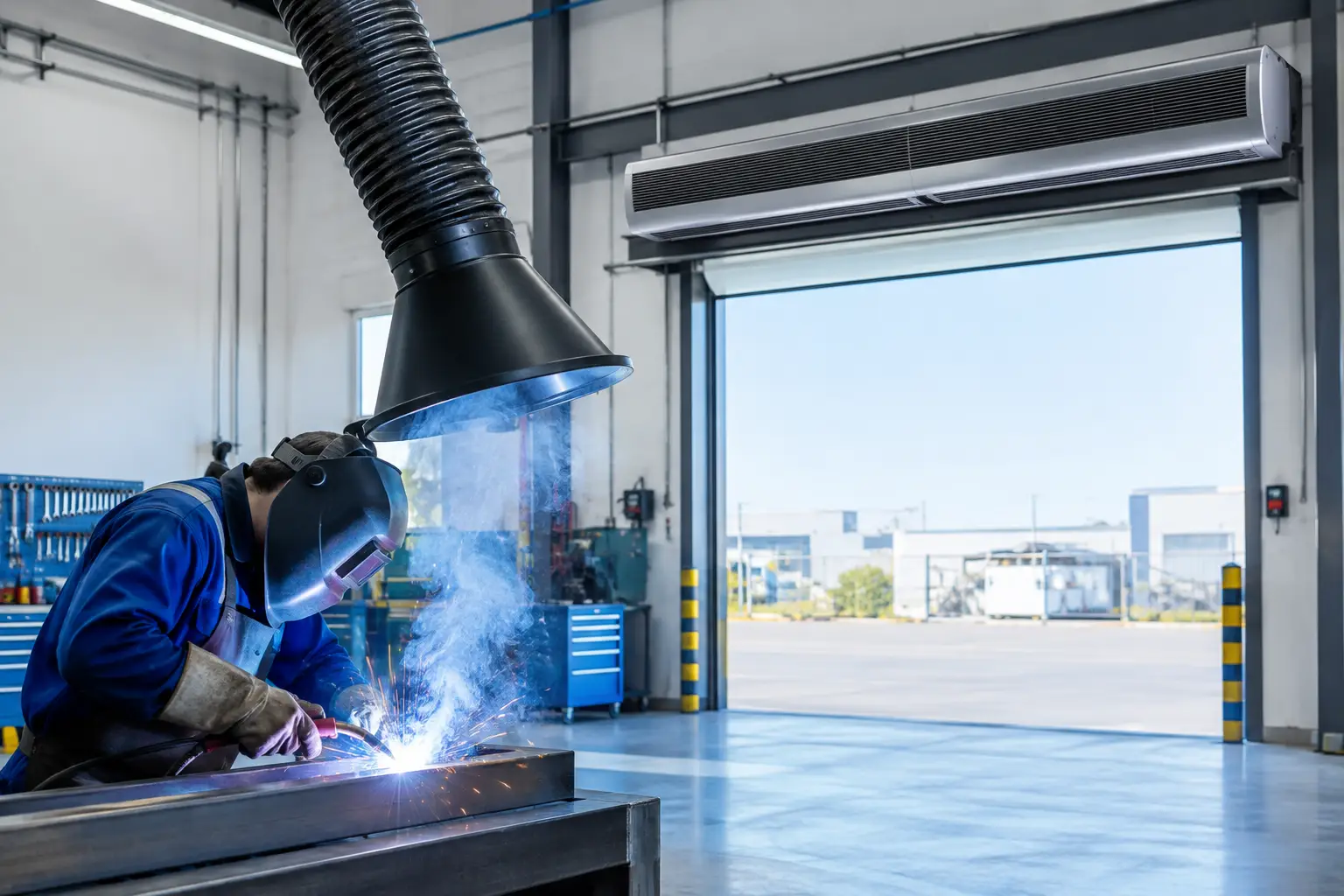
Back-of-house pharmacy doors can be a separate challenge. Deliveries may bring in cartons, packaged products, and supplies through openings that are wider, taller, or open for longer periods than the main entrance. These doors are often closer to loading areas where dust, insects, and vehicle exhaust are more prevalent.
Industrial air curtains are generally the appropriate category for these openings. Their design prioritizes air throw, durable construction, and performance across taller mounting heights. They should be selected as part of the overall loading-door strategy, particularly where the stockroom is air-conditioned or connects directly to a controlled dispensing space.
Air curtain performance is not the same as sterile protection
Pharmacies that handle sensitive products should assess entrance air curtains within the wider building-control plan. An air curtain can reduce the entry of outdoor air and airborne debris at a doorway, but it does not replace required filtration, room pressurization, temperature monitoring, or validated controls for compounding rooms and other regulated areas.
This distinction is useful during design reviews. The entrance air curtain protects the public-facing and general operational environment by reducing infiltration. Critical product areas may need separate, application-specific HVAC and containment measures based on the facility’s processes and regulatory obligations.
For hospital pharmacies, pharmacies connected to clinics, and facilities with controlled preparation areas, this separation of functions should be clear in the specification. The air curtain supports the building envelope at the entry. It should not be assigned a containment role it was not designed to perform.
Specification factors that affect results
A consultation should start with the door, not the product model. Facility managers and MEP consultants should provide the clear width and height, mounting position, operating hours, whether doors are automatic or manual, and the expected traffic volume. Information about external wind exposure, adjacent loading areas, and existing HVAC supply also helps determine the required air velocity and unit configuration.
Noise is another practical consideration. A busy customer entrance can tolerate some operating sound, but a pharmacy is often a consultation-oriented environment where staff need to communicate clearly with customers. Fan type, speed setting, and mounting location all influence perceived noise. This is one reason a higher-capacity unit is not automatically the correct solution.
Controls should also reflect how the door is used. Door-contact activation, occupancy-linked operation, and building-management integration can reduce unnecessary fan operation while ensuring the unit runs when the opening is active. For doors that remain open through long peak periods, the focus shifts from activation logic to stable, continuous barrier performance.
Maintenance access must be considered before installation. Dusty environments can load intake grilles and filters more quickly, particularly in desert locations. The selected mounting arrangement should allow the facilities team to inspect and clean the unit according to the manufacturer’s maintenance schedule without disrupting pharmacy operations.
Common specification mistakes
The most common mistake is sizing only by doorway width. Width matters, but the air curtain must also overcome the effects of height, wind, thermal difference, and internal-to-external pressure imbalance. A 10-foot-wide door in a sheltered mall needs a different approach than the same door opening directly onto a hot, dusty street.
Another mistake is treating the air curtain as an isolated purchase. Its purpose is to work with the air-conditioning system, not compensate for an inadequately designed HVAC layout. If conditioned air is not reaching the entrance area or if strong return-air paths pull outdoor air inward, the overall system should be reviewed.
Finally, avoid specifying a customer-entrance model for a receiving door simply for visual consistency. Public and service entrances have different operating conditions. Matching the product category to the opening protects performance and avoids unnecessary energy loss.
A practical path to the right pharmacy installation
For pharmacy projects, FreezeeX evaluates entrance dimensions, mounting height, traffic volume, environmental exposure, and HVAC requirements before recommending a solution. This approach is particularly valuable in tropical, coastal, and desert climates, where heat, humidity, dust, and wind can quickly expose the limitations of a generic door-mounted unit.
Request a consultation or quotation with your door schedule, site photos, and operating details. A properly matched air curtain gives your pharmacy entrance a controlled boundary that supports comfort and efficiency while keeping access open for the people who rely on it.