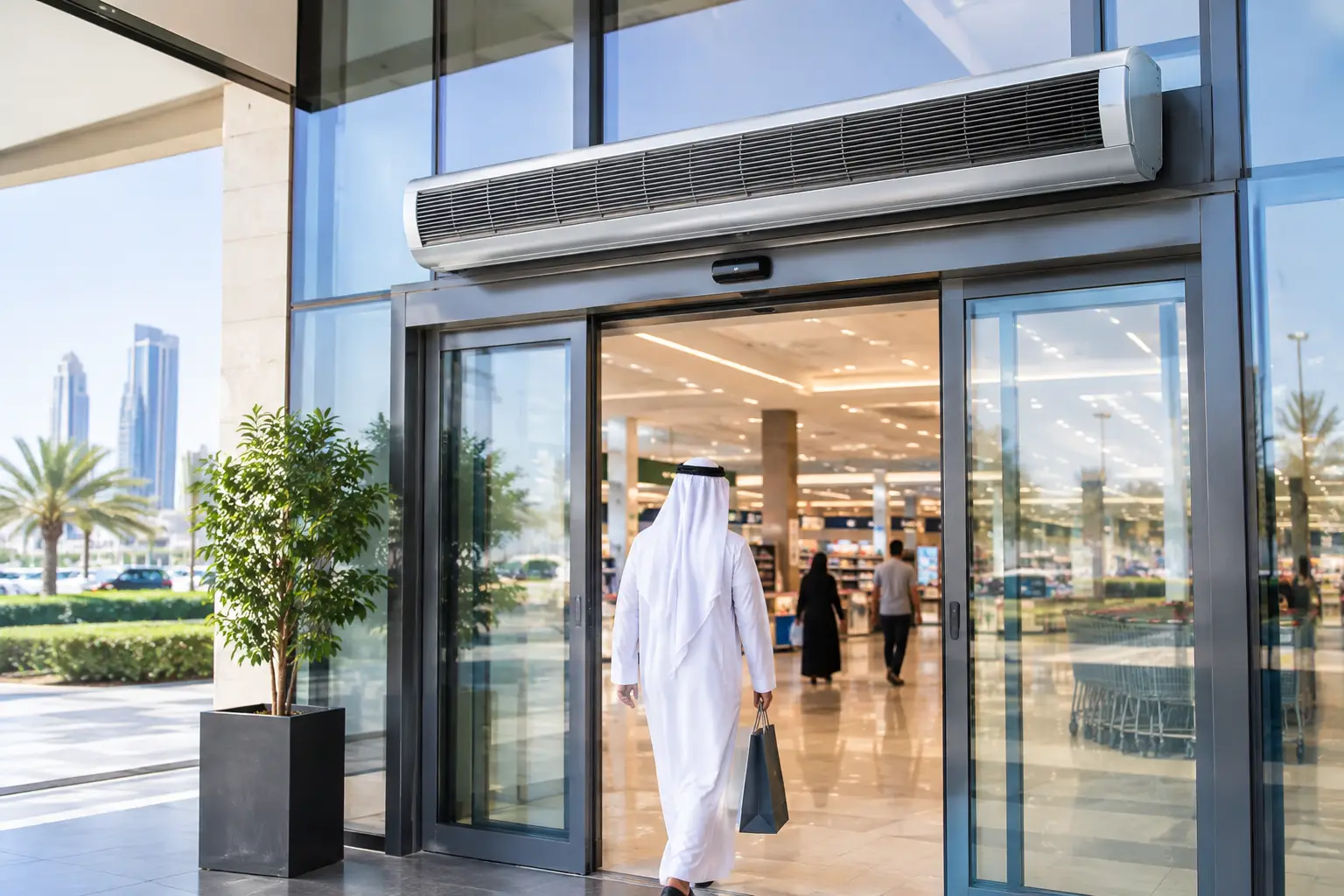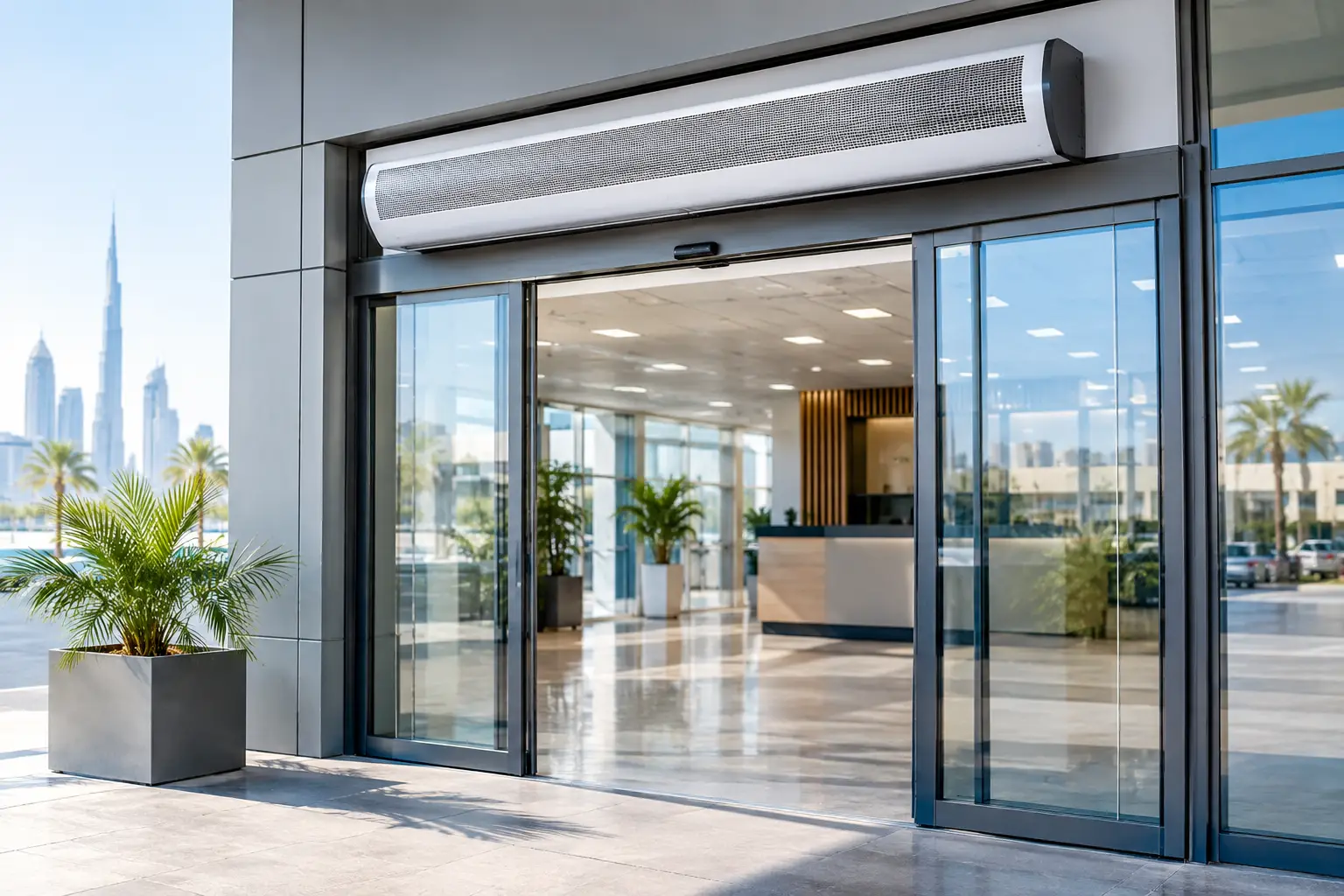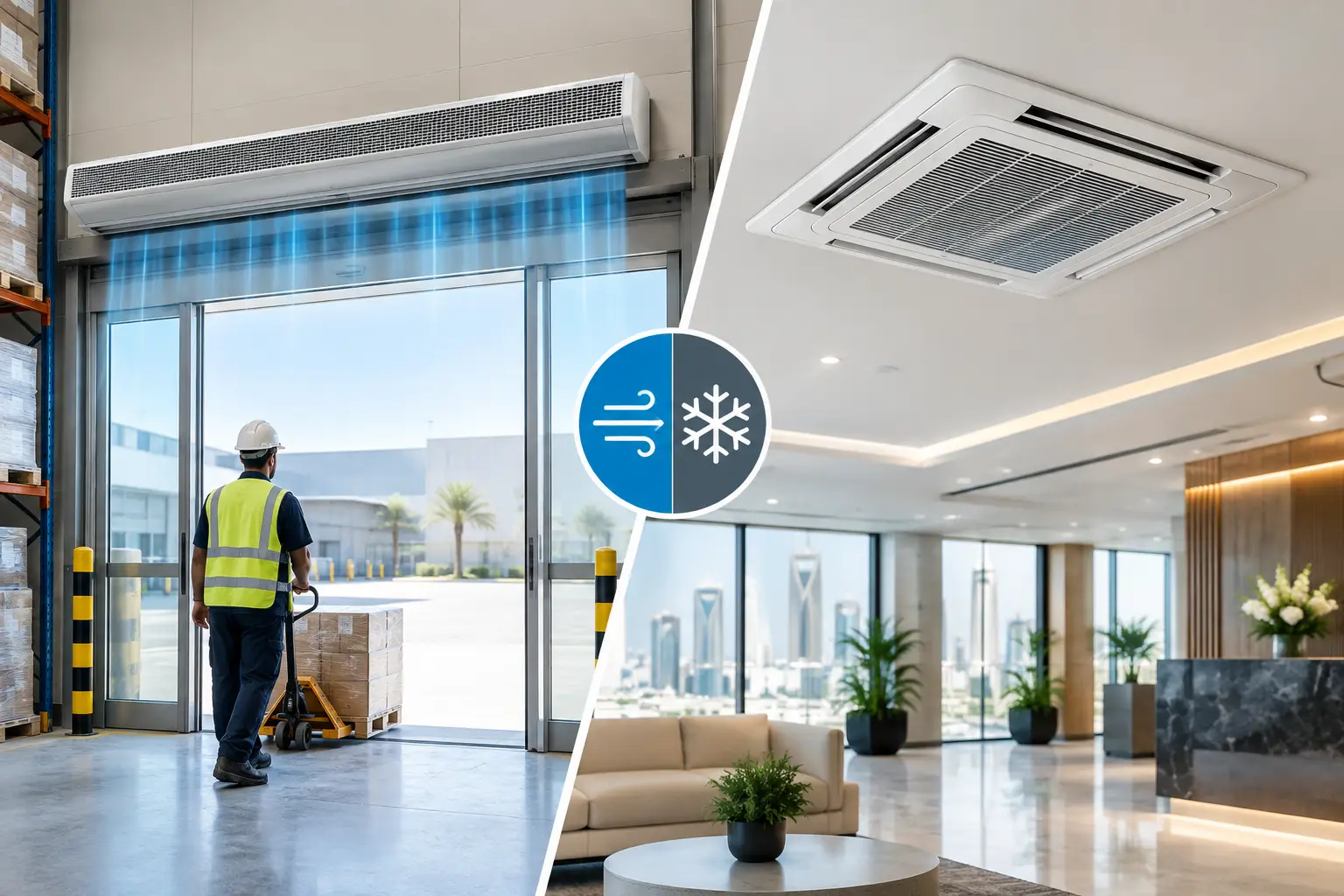
A loading dock can become the largest uncontrolled opening in a commercial facility. Every time a sectional door rises or a loading-bay entrance remains open for pallet movement, hot outside air, dust, humidity, insects, and vehicle fumes can move directly into conditioned space. In Dubai, Riyadh, Doha, Muscat, Cairo, Lagos, and similar hot-climate markets, that exchange can quickly affect HVAC load, indoor comfort, product handling conditions, and operating costs. This loading dock climate control guide explains how to assess the problem and specify an air barrier that suits real dock activity.
Why Loading Docks Challenge Building Climate Control
Unlike a customer entrance, a dock opening is rarely predictable. Doors may open repeatedly during delivery windows, stay open while a truck is positioned, or operate alongside forklifts, pallet jacks, and personnel. The opening may also be wider and taller than standard commercial doors, which makes air transfer more substantial.
The pressure difference between the cooled building and the hot exterior accelerates the problem. Conditioned air escapes at lower levels while hotter air enters through upper areas of the opening. In humid locations, moisture enters with that air. In dusty desert environments, fine particles can reach storage areas, equipment, and finished goods. Where diesel-powered vehicles operate nearby, fumes and odors add another concern.
Closing the door whenever possible remains the first control measure. Yet loading activity does not stop for the HVAC system. The practical objective is to reduce air exchange during necessary open-door periods without interrupting logistics flow. A properly specified industrial air curtain creates a high-velocity air stream across the opening, helping separate the indoor and outdoor environments while vehicles and goods continue to move.
Loading Dock Climate Control Guide: Start With the Dock Profile
Air curtain selection should begin with the opening and how it is used, not with a generic unit size. Two facilities with identical door dimensions can need very different solutions because traffic, exposure, and indoor conditions differ.
Measure the clear width and mounting height of each opening. The discharge air must reach the floor or threshold zone with enough remaining velocity to resist outside air infiltration. Higher openings generally require more powerful fans, a suitable discharge nozzle, and careful mounting geometry. A light-duty commercial unit may suit a personnel doorway near the dock, but it is not automatically appropriate for a high-bay loading door.
Then evaluate door-open time. A dock used for a few scheduled deliveries per day has a different duty cycle from a distribution center where doors cycle continuously. High traffic calls for equipment designed for sustained operation and higher air volume. It also makes controls more important, because the air curtain should operate when the opening is active rather than consuming energy when the door is closed.
Consider these site conditions together when preparing a specification:
- Opening width, height, and structural mounting position
- Truck frequency, forklift movement, and average door-open duration
- Outdoor heat, humidity, wind, dust, and nearby vehicle exhaust
- Indoor temperature target and sensitivity of stored goods or processes
- Existing HVAC capacity and the location of supply or return air points
- Required access for cleaning, inspection, and planned maintenance
This assessment avoids a common error: selecting by door width alone. At a wind-exposed dock in an industrial zone, external crosswinds may deflect the air stream before it reaches the floor. At a recessed bay, the structure may provide some protection, allowing a different airflow approach. The right answer depends on the full operating environment.
Match the Air Curtain to the Application
For busy loading doors, industrial centrifugal air curtains are usually the relevant category. Centrifugal blowers are suited to applications requiring stronger pressure capability and consistent discharge across larger openings. Their airflow is better positioned to withstand the pressure differential common between a cooled warehouse and extreme outdoor conditions.
A modular arrangement may be necessary for wide doors. Multiple units should create a continuous air barrier, with no dead zones between units where hot air and dust can enter. The mounting line, overlap, and final nozzle direction need to be coordinated during design. Small gaps can undermine the performance of an otherwise well-sized installation.
Mounting is equally important. Most dock installations are installed above the opening and aimed slightly outward, so the air stream resists infiltration rather than being pulled indoors. However, the exact angle should account for door geometry, prevailing wind, and traffic clearance. A dock canopy, door tracks, lighting, and sprinkler layout can all affect available mounting space.
For lower-height support doors, dispatch offices, or staff access points adjacent to the loading zone, a commercial centrifugal or high-performance commercial series may be appropriate. These applications have different airflow demands from the main loading aperture. Specifying each opening independently gives the facility a more accurate result than applying one product type throughout the site.
Control Heat, Humidity, Dust, and Contaminants Together
Cooling loss is often the first concern, but loading dock climate control is not only an energy issue. In food distribution, pharmaceuticals, packaging, and clean storage operations, airborne dust and humidity can affect product quality and housekeeping workload. In supermarkets and cold-chain transfer areas, warmer, moisture-laden air can make it harder to maintain stable conditions near receiving doors.
An air curtain does not create a sealed room, and it should not be treated as a replacement for properly operating doors, dock seals, or HVAC design. Its function is to reduce the volume and speed of outside air entering while the door must remain open. That reduction can lower the demand placed on cooling equipment and improve conditions near the dock perimeter.
At facilities that handle food, ingredients, or sensitive goods, the same air barrier can also support insect exclusion. At workshops or factories, it can reduce the inward movement of dust and fumes from loading yards. The priorities differ by facility, but the engineering principle is consistent: create an effective air separation where physical separation is temporarily unavailable.
Integrate Controls With Door Operation
The strongest dock climate-control strategy combines physical equipment with sensible controls. Door-contact switches can activate the air curtain when a loading door opens and turn it off after closure. This reduces unnecessary runtime and helps ensure the barrier is available during active exposure.
For multi-door logistics facilities, consider whether each opening should operate independently or whether site conditions require grouped control. Independent operation is generally more efficient where doors are used intermittently. A centralized control approach can simplify supervision in highly coordinated dispatch areas, but it must still account for the actual status of individual doors.
Variable-speed control can be useful where traffic levels change across shifts. A facility may require maximum airflow during peak receiving periods and a lower operating level for lighter activity. The trade-off is that control sophistication should serve a defined operational need. More complex controls are not automatically better if the dock schedule is fixed and straightforward.
Avoid Specification Mistakes That Reduce Performance
Undersizing is the most costly mistake because an air curtain with insufficient reach or velocity may run continuously without delivering meaningful separation. Oversizing can also create problems, including unnecessary electrical demand, noise, and an air stream that is uncomfortable for staff near pedestrian routes. The goal is controlled, targeted performance.
Noise deserves attention in mixed-use facilities, particularly where offices, dispatch desks, retail receiving areas, or customer-accessible zones are close to the dock. Industrial airflow requirements may justify a higher sound level at the main aperture, while nearby staff doors may call for a quieter commercial solution.
Another issue is assuming the air curtain can compensate for every fault around the opening. Damaged door seals, poor dock alignment, large gaps around tracks, or a door left open longer than necessary increase infiltration beyond what an air barrier should be expected to manage. Address these conditions as part of the overall dock strategy.
Finally, do not specify equipment without considering service access. Dusty environments demand regular inspection of intake areas and components. A unit mounted where it cannot be safely accessed may be neglected, which gradually affects airflow and long-term reliability.
A Practical Specification Path for Hot-Climate Facilities
For consultants and facility teams, the most useful starting point is a site-specific review of the opening, traffic pattern, and external exposure. Provide clear dimensions, photographs or drawings, mounting height, door type, operating schedule, and the required indoor condition. If the facility has persistent dust, humidity, fumes, or insect concerns, identify them early because they influence the recommended airflow performance and control arrangement.
FreezeeX helps project teams assess these variables for warehouses, factories, logistics hubs, food facilities, and commercial receiving areas across tropical and desert climates. The objective is not simply to place an air curtain above a door. It is to establish a dependable air barrier that supports HVAC efficiency, protects working conditions, and fits the operational demands of the dock.
For a loading bay that is driving cooling loss or bringing dust and humidity into the facility, request a technical consultation and quotation based on your opening dimensions, traffic volume, and local climate exposure.