
A dusty entrance is not a housekeeping problem first. In a hypermarket, logistics facility, hotel, workshop, or cold storage site, it is usually a sign that outside air is entering faster than the building can control it. Knowing how to reduce dust infiltration starts with treating every high-traffic doorway as a pressure-control point, not simply an opening between indoors and outdoors.
This matters most in hot, dry, and high-humidity markets. Fine sand and airborne debris can enter facilities in Dubai, Riyadh, Doha, Cairo, Lagos, and Nairobi with every delivery, visitor, or forklift movement. Once inside, dust affects customer presentation, hygiene standards, stored goods, HVAC cleanliness, and cooling efficiency. The right solution protects operations while reducing the load placed on conditioned air systems.
Why Dust Infiltration Gets Worse at Commercial Entrances
Dust moves into a building through two mechanisms: direct traffic and uncontrolled airflow. Doors that remain open for deliveries or peak customer periods create an obvious path. More often, though, the larger issue is pressure difference. When indoor pressure is lower than the exterior, outdoor air is drawn through doorways, gaps, service hatches, and damaged seals.
High outdoor temperatures make the problem more expensive. As hot, dust-laden air enters a cooled building, the HVAC system must remove additional heat while filters and coils contend with more airborne particles. In humid coastal environments, the incoming air may also carry moisture, creating another indoor climate-control burden.
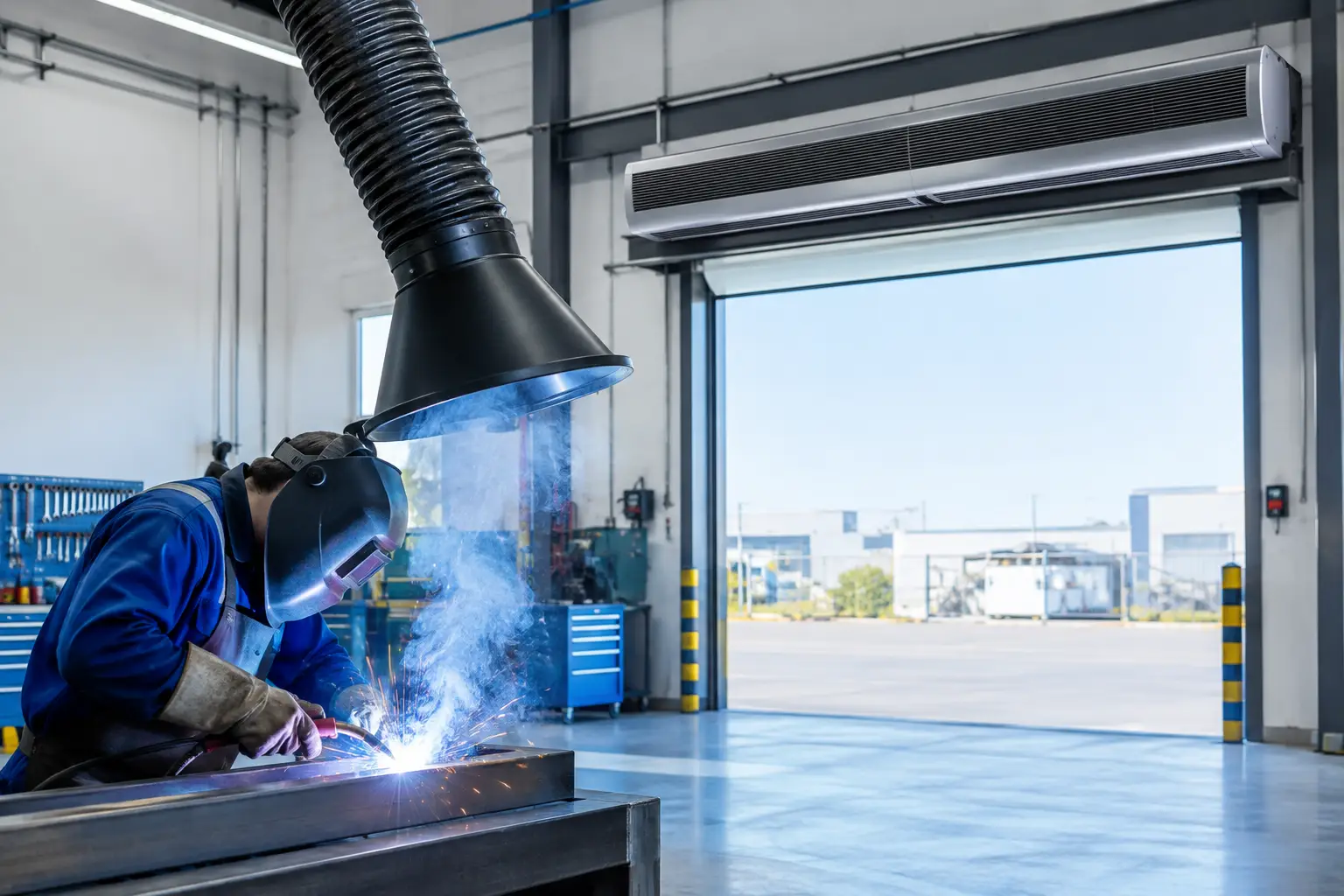
Facilities with frequent door cycles are especially exposed. Loading bays, retail entrances, food service receiving areas, industrial workshops, and warehouse dispatch doors cannot depend on keeping doors closed. They need an active barrier that works while the entrance is in use.
Start With the Entrance, Not the Cleaning Schedule
More frequent cleaning can improve appearance, but it does not stop dust at the source. A practical dust-control plan begins by identifying where the particles enter and what happens when that opening is active.
Walk the facility during its busiest operating period. Observe main public entrances, staff doors, loading points, roller shutters, dock doors, and connections between dusty production zones and clean areas. Look for dust accumulation around thresholds, door frames, ceiling diffusers, merchandise displays, and internal partitions. These patterns often reveal the actual airflow path.
Also assess the door itself. A warped leaf, worn bottom sweep, misaligned closer, or poorly sealed frame can allow leakage even when the entrance is closed. Repairing these faults is a low-cost first step. However, physical seals alone are not sufficient for entrances that stay open repeatedly or for long periods. Their value is greatest during closed-door operation.
Control Building Pressure and Airflow Direction
The objective is straightforward: prevent outside air from being pulled into the facility. Where the mechanical design allows it, maintaining slight positive pressure inside the occupied or protected space helps encourage air to move outward through small gaps rather than inward.
This is not a setting to apply blindly. Excessive positive pressure can make doors difficult to operate, disrupt adjacent zones, or push conditioned air into areas where it is not needed. The correct approach depends on the building layout, exhaust requirements, door usage, and the nature of the process inside the facility.
For example, a food storage area, a retail sales floor, and an industrial production bay will not have identical pressure targets. A consultant or MEP team should review supply and extract air volumes as part of the overall strategy. The key is coordination: door protection, HVAC airflow, and exhaust operation must support each other instead of competing.
Keep Dusty and Clean Zones Separate
Many dust issues begin inside the property rather than outdoors. A workshop, loading zone, packaging area, or receiving bay can transfer particles into offices, retail areas, storage rooms, or temperature-controlled spaces when air flows in the wrong direction.
Use physical separation where possible, including closed doors, properly designed partitions, and controlled access routes. At openings that must stay active, an air curtain can maintain a directional air barrier between zones without obstructing movement. This is particularly valuable where forklifts, carts, pallets, or high volumes of pedestrians make strip barriers impractical.
Use an Air Curtain to Block Dust at Open Doors
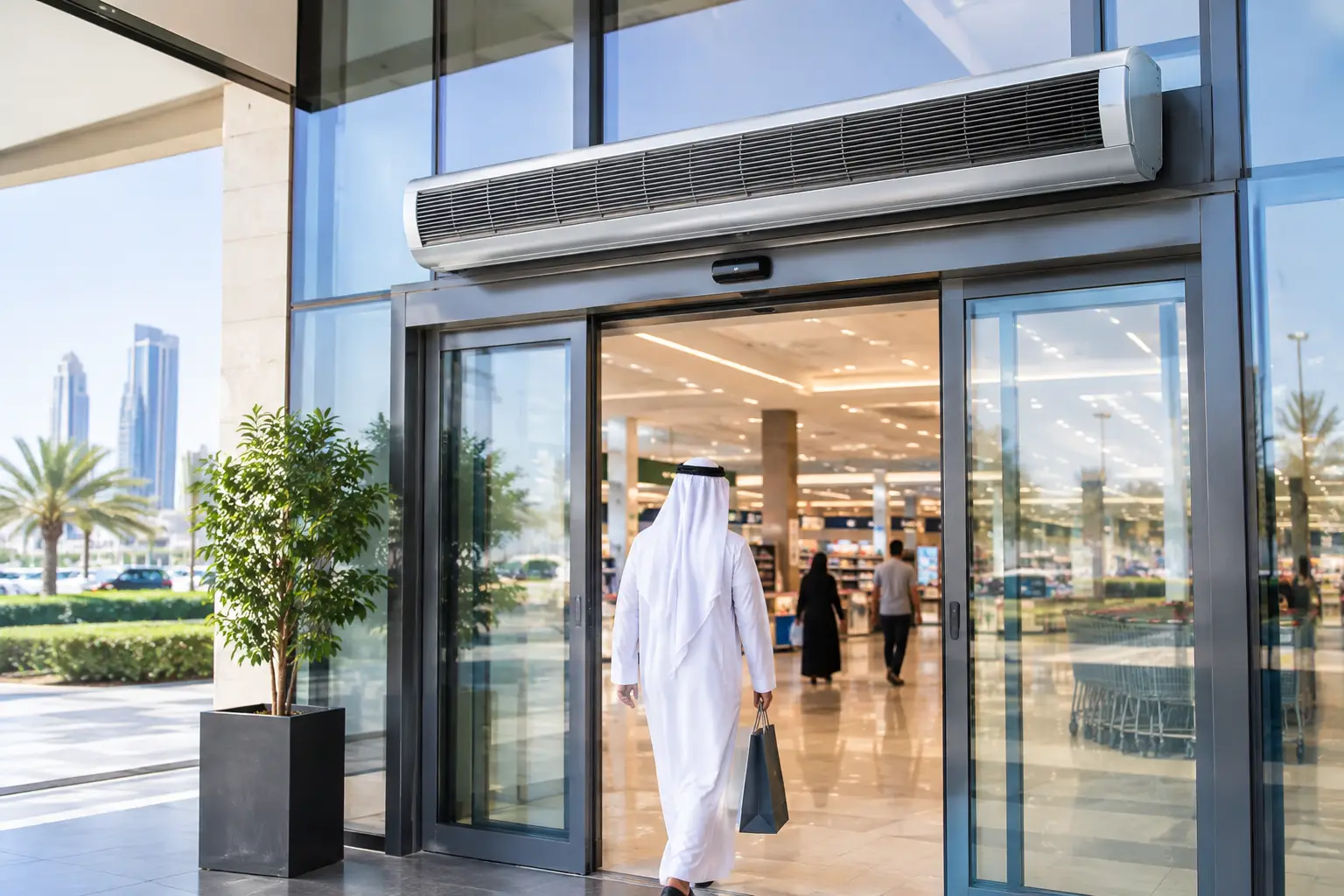
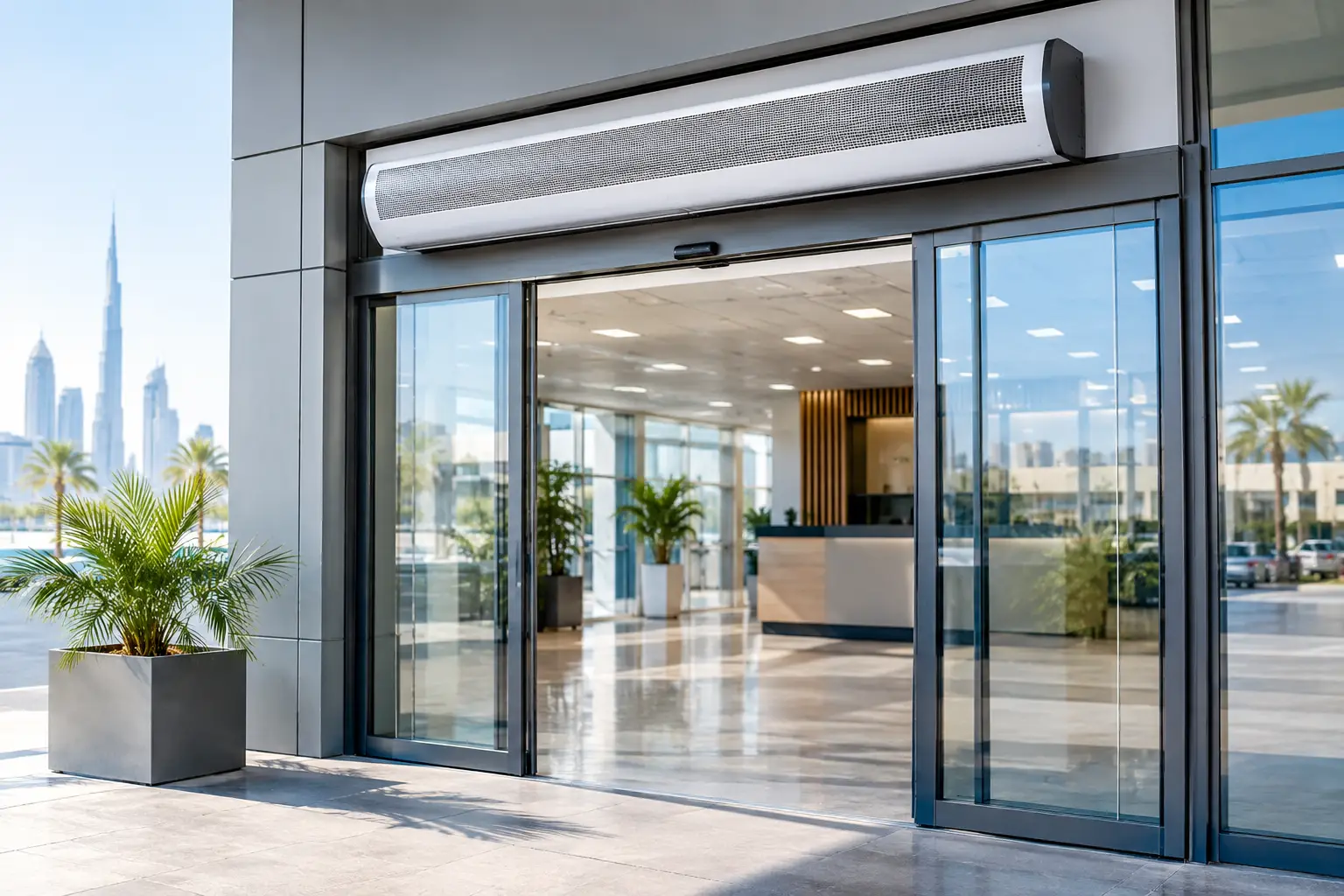
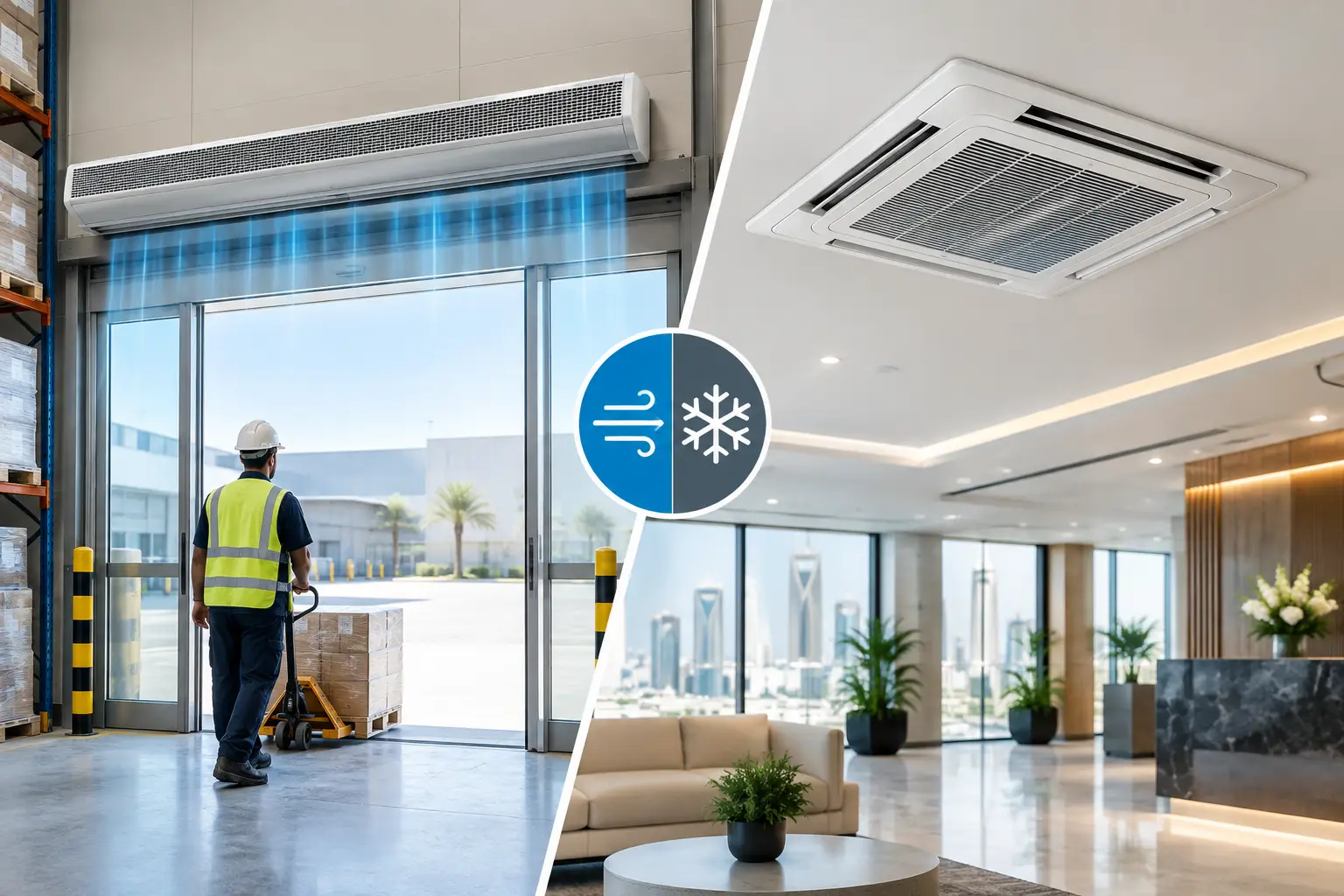
For busy entrances, an air curtain is one of the most effective tools for reducing dust infiltration. It projects a controlled stream of air across the doorway, creating an invisible barrier that resists the movement of hot, dusty exterior air into the conditioned space.
A properly selected commercial or industrial air curtain does more than move air. The discharge velocity, mounting height, throw pattern, fan type, and door geometry all determine whether the air stream reaches the floor and holds its shape under real operating conditions. A unit that is undersized, mounted too high, or poorly aligned can leave gaps near the threshold, exactly where dust-laden air can enter.
At retail and hospitality entrances, the goal is often a stable, low-noise barrier that protects customer comfort and presentation. At loading bays and industrial doors, higher air volume and stronger throw may be required to counter wind exposure, vehicle activity, and larger opening heights. Centrifugal systems are commonly suited to demanding commercial and industrial conditions because they can deliver stronger, more consistent airflow against external pressure.
Specify for the Actual Door Condition
Door width and height are only the beginning. Selection should account for whether the opening is recessed, exposed to prevailing winds, located near a parking area, connected to a loading dock, or used intermittently versus continuously. A double-door vestibule may need a different approach from a single wide entrance with automatic sliding doors.
Ambient conditions also matter. Desert dust, coastal humidity, and extreme summer temperatures place different demands on equipment and site design. In GCC, MENA, and African markets, air curtains should be selected for sustained performance in tropical and desert climate conditions, not merely for an ideal indoor test environment.
FreezeeX air curtain systems are specified around this application reality, with commercial and industrial configurations designed for high-traffic openings and harsh climate exposure. The appropriate model should be matched to the site rather than selected solely by door size or price.
Improve the Perimeter Around the Door
An air barrier performs best when the doorway itself is in good condition. Check the full perimeter for cracks, failed sealant, damaged weather strips, uneven thresholds, and gaps around cable penetrations or access-control hardware. These smaller leakage points can undermine pressure control when doors are closed.
For loading operations, review dock seals, shutter condition, and the time vehicles remain positioned at the opening. If a dock door opens before a vehicle is properly aligned, a large unprotected gap can bring in dust rapidly. Operational changes such as staging deliveries, reducing unnecessary open-door time, and maintaining seals can complement mechanical protection.
Avoid treating every entrance the same way. A heavily used customer entrance may justify a continuous air curtain operation schedule, while a service door used a few times each day may benefit more from door discipline, seals, and activation linked to the door position. The best answer depends on traffic volume and the cost of contamination or cooling loss in that zone.
Maintain the Equipment That Protects the Entrance
Dust-control performance can decline gradually, which makes maintenance easy to postpone. Dirty intake screens, blocked filter nets, worn fan components, and incorrect discharge direction all reduce the effectiveness of an air curtain. The system may still run, but the barrier may no longer reach the floor or resist crosswinds at the opening.
Include entrance protection equipment in the facility’s planned maintenance schedule. Inspect air intakes, clean components according to site dust levels, verify mounting integrity, and confirm that the airflow is directed across the full opening. In high-dust industrial sites, inspection intervals may need to be more frequent than in a controlled office lobby.
It is also worth monitoring indirect indicators. If the cleaning team reports increased dust near an entrance, HVAC filters load unusually quickly, or occupants complain about warm drafts at doorways, review the air barrier and the building-pressure balance before increasing cleaning labor or cooling capacity.
Make Dust Control Part of Operating Strategy
The strongest results come from combining measures: well-maintained doors, sensible access procedures, balanced mechanical airflow, and a correctly specified air curtain. No single component can fully compensate for a poorly managed loading bay or a building that continuously pulls outdoor air through open entrances.
For facility managers, the business case is broader than cleaner floors. Less dust entering the building can support cleaner inventory, better guest experience, reduced filter loading, more stable indoor temperatures, and lower avoidable cooling demand. In facilities that operate long hours through intense heat, those benefits compound quickly.
If your site has high-traffic doors, frequent loading activity, or recurring dust problems in a tropical or desert climate, request a FreezeeX consultation and quote based on the opening dimensions, traffic pattern, and operating environment. A properly engineered air barrier gives the entrance a job to do: keep outdoor conditions outside while your facility stays cleaner, cooler, and ready to perform.


One Response