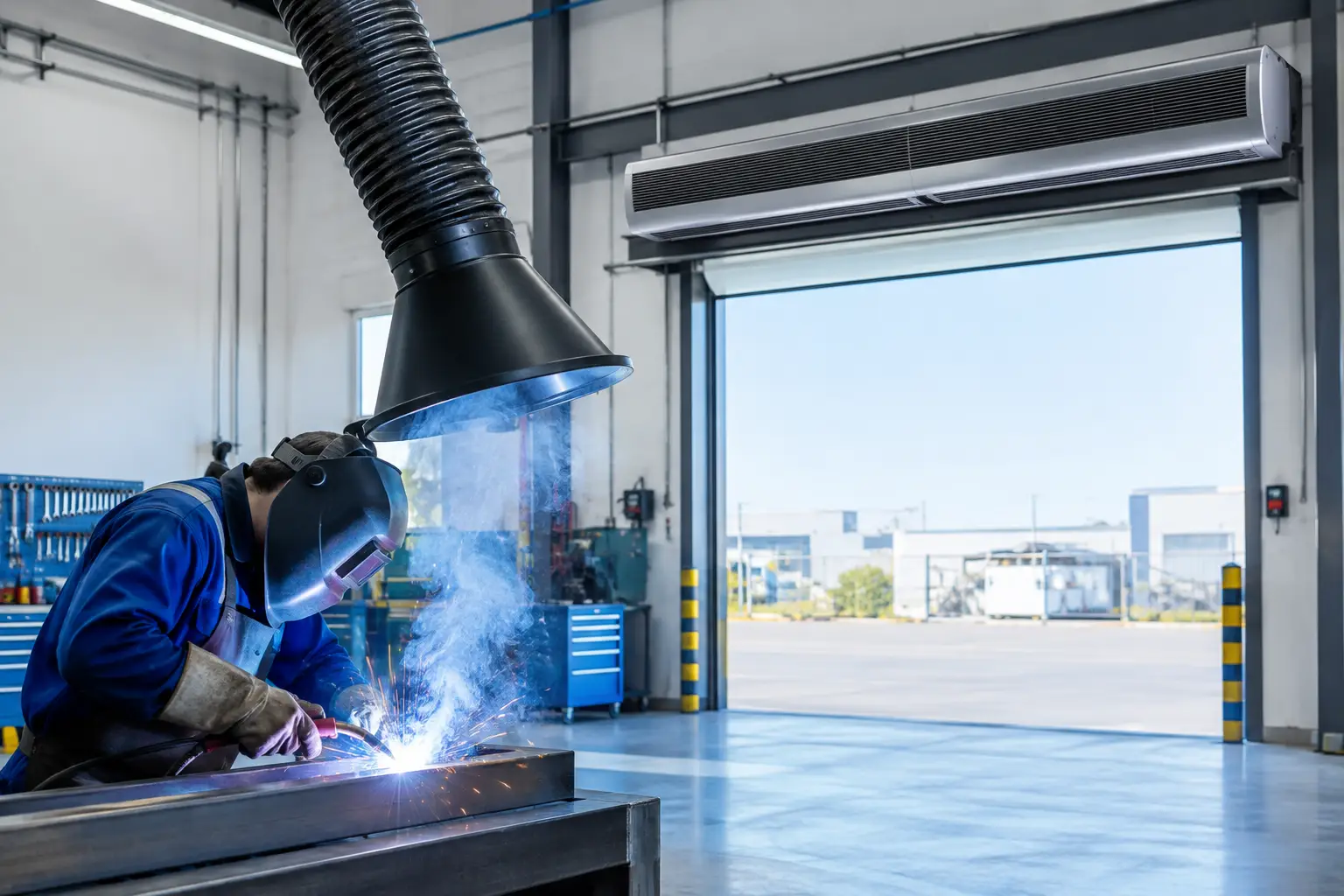
A cold room doorway can become the largest source of heat gain in an otherwise well-insulated facility. Every opening allows warmer air, moisture, dust, and airborne contaminants to move toward the lower-temperature zone. For operators assessing how to protect cold room doorways, the objective is not simply to close the door faster. It is to create a reliable barrier strategy that matches traffic patterns, temperature differential, hygiene requirements, and the demanding heat and humidity found across the GCC, MENA, and African markets.
The right approach protects product quality, reduces compressor loading, limits condensation around the entrance, and keeps material handling moving. It usually combines a properly specified insulated door with secondary protection such as strip curtains, high-speed doors, or an industrial air curtain. The best combination depends on how the doorway is used.
Why Cold Room Doorways Need Special Protection
Cold air is dense and tends to spill outward at the bottom of an open doorway, while warm, humid air enters through the upper portion. This exchange happens quickly when a forklift door is open, particularly where ambient conditions are hot and humid. In Dubai, Riyadh, Doha, Muscat, Lagos, or Nairobi, the temperature and moisture difference between the loading area and cold storage can be substantial.
The result is more than energy loss. Moisture entering the room can condense on surfaces, create slippery thresholds, increase ice formation, affect packaging, and raise the risk of product degradation. In food processing and pharmaceutical environments, uncontrolled entry can also compromise cleanliness and process conditions.
A doorway protection system therefore needs to address four issues at once: sensible heat gain, humidity infiltration, contaminant entry, and operational access. Focusing on only one can create a weak point. For example, a fully sealed door performs well while closed but does little for a dispatch area where staff or forklifts pass through dozens of times each hour.
Start With the Doorway and Traffic Profile
The correct solution begins with a site-specific review. Door width and height matter, but they are only part of the engineering picture. A narrow personnel doorway with intermittent use requires a different approach from a six-meter loading opening used continuously by pallet trucks.
Assess whether the opening serves pedestrians, trolleys, forklifts, or mixed traffic. Establish how long the door remains open per cycle and whether it is exposed to crosswinds, loading-bay pressure changes, or adjacent exterior doors. Also confirm the cold room operating temperature and the temperature and relative humidity of the surrounding space.
A chilled storage room operating just above freezing may tolerate a different barrier arrangement than a freezer or deep-chill room. Higher temperature differentials generally demand faster closing cycles, tighter perimeter sealing, and a more carefully engineered air barrier. If a doorway is near a busy loading dock, the protection strategy may also need to account for dust, insects, vehicle fumes, and fluctuating building pressure.
Use Insulated Doors as the Primary Seal
The door itself remains the first line of defense. A well-specified insulated sliding or hinged cold room door should have continuous perimeter gaskets, a properly sealed frame, and an insulated leaf appropriate for the room temperature. Damage to gaskets, threshold interfaces, guides, or closing hardware can turn a high-performance door into a persistent source of infiltration.
For high-traffic operations, automatic closing is particularly valuable. Doors should return to the closed position quickly without impeding safe movement or creating delays for handlers. The correct closing speed is a balance: too slow increases exposure time, while overly aggressive settings can disrupt traffic and damage equipment.
Door selection should also consider the floor condition. A level, durable threshold reduces gaps and helps prevent repeated impacts from carts and forklifts. Where a raised threshold is impractical, specify a doorway system designed to maintain an effective seal without restricting material flow.
Add Secondary Barriers for Open-Door Periods
A cold room door cannot provide a seal while it is open. Secondary barriers reduce the air exchange that occurs during those necessary access periods. The most suitable option depends on traffic volume, hygiene requirements, and the room’s operational temperature.
PVC strip curtains are a common choice for forklift routes and frequent pedestrian traffic. They create a physical overlap that limits direct airflow while allowing passage. Their performance depends on correct strip width, overlap, length, and condition. Worn, stiff, or poorly arranged strips leave channels for warm air to enter and can obstruct operators’ visibility.
High-speed doors can be effective where frequent cycles make conventional door opening times unacceptable. Their value comes from minimizing the duration of exposure. However, they require careful integration with traffic controls, safety systems, and the main cold room door arrangement. They may be more appropriate for intensive distribution facilities than for lower-volume storage rooms.
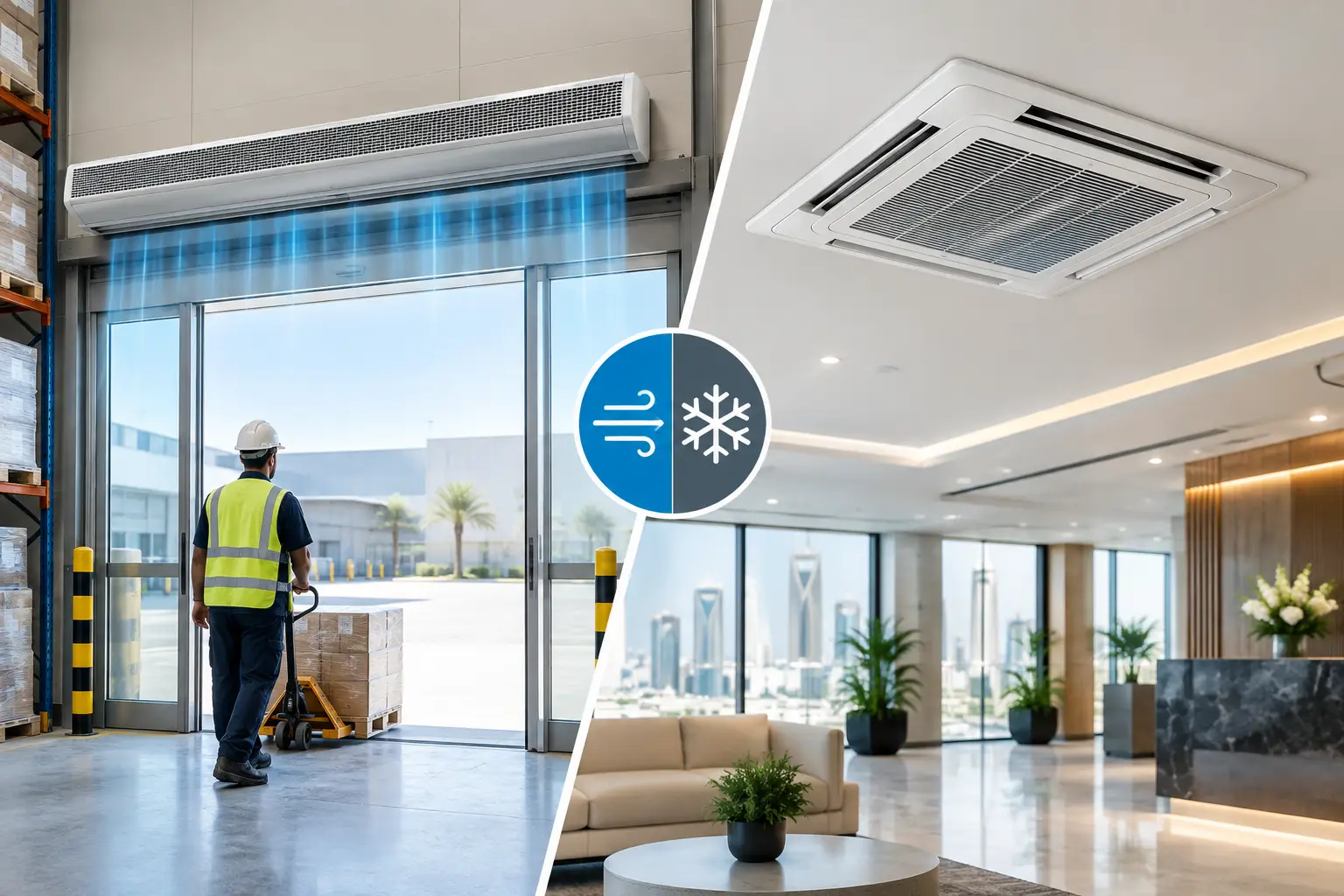
An industrial air curtain provides a non-physical air barrier across the opening. It is especially useful at chilled-room entrances, receiving areas, and transitional spaces where maintaining access is essential. A correctly specified unit projects a controlled, high-velocity air stream from the top of the doorway to the floor, helping separate conditioned and unconditioned air zones.
For cold room applications, air curtains should not be treated as a generic accessory. Performance depends on discharge velocity, throw, mounting height, doorway width, fan type, and pressure conditions around the entrance. An undersized unit may look active while allowing significant warm-air infiltration around the airstream or at floor level.
How to Protect Cold Room Doorways With Air Curtains
Air curtains work best as part of a coordinated entrance design, not as a replacement for insulated doors. When the door is open, the air stream helps reduce warm-air entry and limits the escape of refrigerated air. When the door is closed, the door and its gaskets provide the primary thermal seal.
For commercial and industrial cold storage, centrifugal air curtains are commonly suited to demanding applications because they can produce the pressure and consistent airflow needed at larger or more exposed entrances. The unit must cover the full clear opening. If the air curtain is narrower than the opening, unprotected side gaps can undermine the entire installation.
Mounting position is equally important. Most cold room doorway installations use horizontal top mounting, with the discharge angle adjusted to counter expected air movement. In locations with significant cross-drafts or loading-bay turbulence, a standard setting may not deliver a stable barrier. A professional survey should identify surrounding doors, extractor systems, vehicle movement, and other sources of pressure imbalance before final specification.
Controls should align operation with door activity. A door switch, timer, or building management interface can ensure the air curtain operates when the opening is in use rather than relying solely on manual activation. This reduces unnecessary runtime while maintaining barrier performance during actual traffic events.
Control Humidity Before It Becomes Condensation
Heat gain is measurable in energy consumption, but humidity infiltration often causes the more visible operating problems. Warm moisture-laden air entering a cold room condenses when it reaches colder surfaces. This can lead to wet floors near the entrance, dripping, icy buildup in lower-temperature rooms, and repeated cleaning requirements.
In humid coastal environments, doorway protection should place particular emphasis on reducing moisture migration. A combination of rapid door closure, properly fitted strip curtains, and a correctly engineered air curtain can materially reduce the moisture load at the entrance. The surrounding staging area also matters. If products are moved directly from hot, humid outdoor conditions into chilled storage, the door strategy should be coordinated with receiving procedures and room capacity.
Do not overlook room pressure. Excessive negative pressure inside the cold room can pull warm air inward whenever the door opens. Excessive positive pressure can force cold air outward. The preferred balance depends on the facility’s process and hygiene requirements, but uncontrolled pressure differences will make any doorway barrier less effective.
Specify for Durability and Hygiene
Cold storage entrances are exposed to repeated impacts, temperature changes, washdown requirements in some facilities, and continuous operating cycles. Equipment selection should reflect the duty cycle rather than initial cost alone. A light-duty air curtain or door arrangement may be acceptable for an occasional-access room but will not necessarily withstand a busy food distribution or manufacturing operation.
Specify durable housings, serviceable fan assemblies, and controls suitable for the operating environment. In food, pharmaceutical, and healthcare applications, consider cleanable surfaces and access for routine inspection. For facilities handling open food or sensitive goods, doorway protection should support the site’s wider contamination-control procedures.
Maintenance is not a repair task to postpone until performance drops. Facility teams should include cold room doorways in planned inspections, checking gaskets, door alignment, strip condition, sensors, mounting hardware, and air curtain airflow. A small gap or damaged strip can become a recurring energy and moisture issue over hundreds of daily cycles.
Build the Right System Around the Operation
There is no single configuration for every cold room. A supermarket back-of-house chiller may benefit from an insulated swing door paired with strip curtains and a compact air curtain. A high-volume logistics facility may require high-speed access, industrial air curtains, traffic sensors, and stronger controls to manage long forklift operating periods. A pharmaceutical cold store may prioritize hygiene, controlled access, and stable pressure conditions over maximum throughput.
The most reliable result comes from specifying the entrance as a system. Consider the door, barrier method, controls, surrounding airflow, and operational behavior together. This approach is particularly valuable in tropical, humid, and desert climates, where every unnecessary opening can impose a disproportionate load on refrigeration equipment.
For a cold room doorway assessment, request a consultation and quotation based on the opening dimensions, mounting height, cold room temperature, traffic type, and local ambient conditions. A properly matched industrial air curtain and doorway strategy can protect stored goods while reducing the ongoing cost of maintaining the required temperature.