A loading dock can become the largest uncontrolled heat entry point in a warehouse. Every time an overhead door opens, high-temperature outside air pushes into a conditioned space, while cooled air escapes around vehicles, pallets, and active loading lanes. In Dubai, Riyadh, Doha, Cairo, Lagos, and other hot or humid operating environments, learning how to manage loading dock heat is central to protecting worker comfort, stored goods, and HVAC performance.
The answer is rarely a single piece of equipment. Effective dock heat management combines door operating discipline, physical sealing, HVAC zoning, and a correctly specified industrial air curtain. The objective is not to make a busy dock airtight. It is to reduce the heat, dust, humidity, and airborne contaminants entering during the periods when doors must remain open.
Why Loading Docks Create a Heat-Control Problem
Loading docks operate differently from a standard commercial entrance. Openings are wider, doors remain open longer, and forklift traffic prevents facilities from simply keeping doors closed. A typical dock may also face direct afternoon sun, receive hot air reflected from paved yards, and experience pressure differences created by the building’s cooling system.
When outside air enters, the HVAC system must remove both sensible heat and, in humid locations, latent moisture. This increases cooling demand and can create uneven temperatures deep into the warehouse. Staff near dock doors may work in uncomfortable conditions even when the rest of the facility is adequately cooled.
The operational cost is not limited to energy use. Heat and humidity can affect packaging, labels, food products, pharmaceuticals, and temperature-sensitive inventory. Dust infiltration can also raise cleaning requirements and compromise hygiene controls in food processing or logistics operations.
Assess the Dock Before Selecting a Solution
A loading dock heat-control strategy should begin with site conditions, not a catalog selection. The correct air curtain, door arrangement, and airflow design depend on the opening and how it is used.
First, assess the clear opening width and height. An air curtain must generate a continuous, stable air stream across the full opening, with sufficient throw to reach the floor or dock threshold. A unit that is undersized for a high roller shutter may move air at the header but leave gaps lower down, where heat and dust can enter.
Next, consider door-open duration and traffic volume. A dispatch dock that opens for a few minutes at a time has different requirements from a 24-hour distribution center where forklifts continuously pass through. Longer open periods and heavier vehicle movements generally call for industrial-duty equipment with higher airflow capacity and durable components.
Outdoor exposure matters as well. Desert sites may contend with high dry-bulb temperatures, wind, sand, and dust. Coastal facilities in the UAE, Saudi Arabia, Oman, or Qatar may face intense heat combined with high humidity. Where wind regularly crosses the dock face, the air barrier needs enough velocity and correct discharge angle to resist deflection.
Finally, review indoor pressure and HVAC supply patterns. If the dock area is strongly negative relative to outdoors, it will pull hot air inward whenever doors open. An air curtain works best as part of a coordinated building-pressure and cooling strategy, rather than as a substitute for insufficient HVAC capacity.
Use an Industrial Air Curtain as an Active Barrier
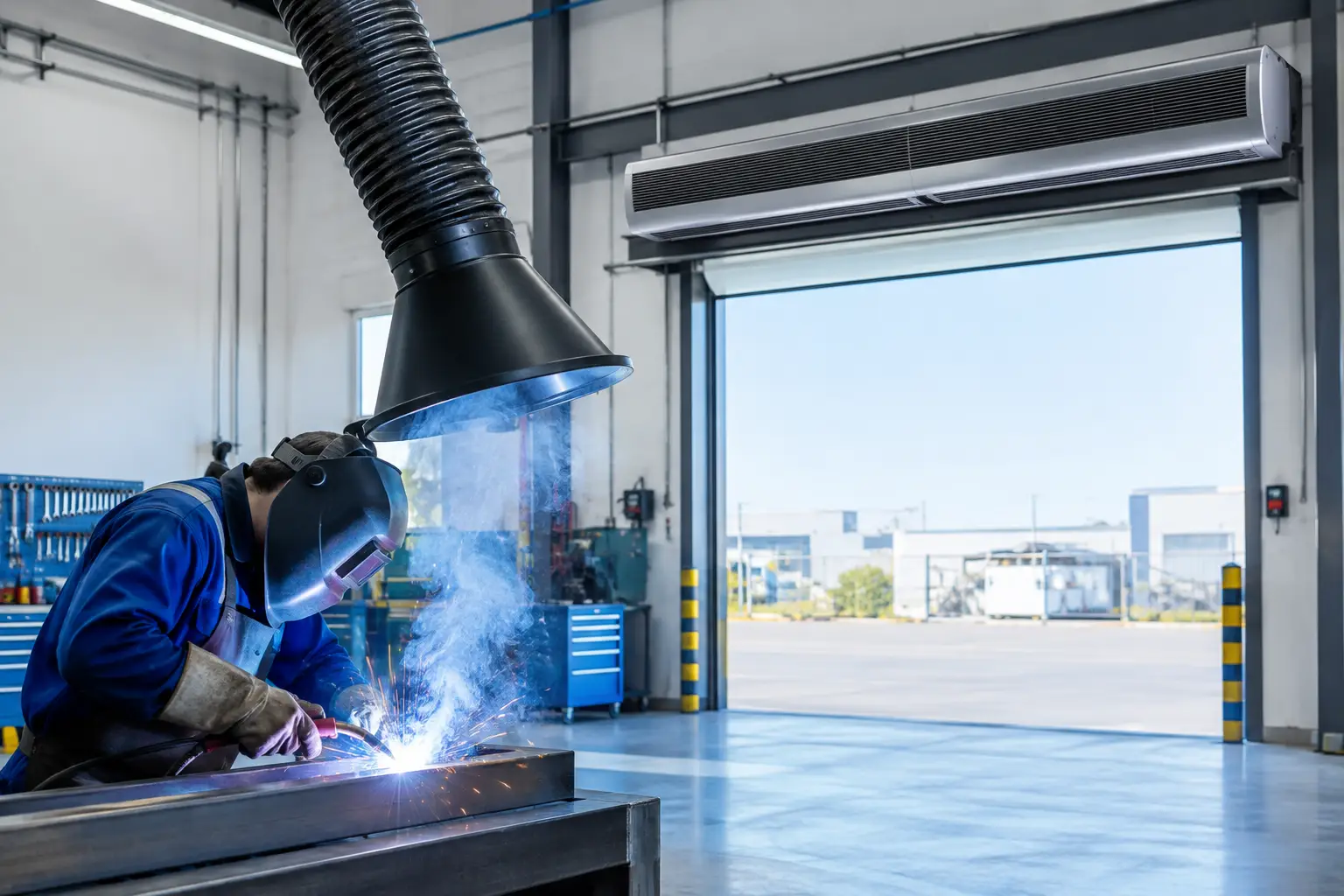
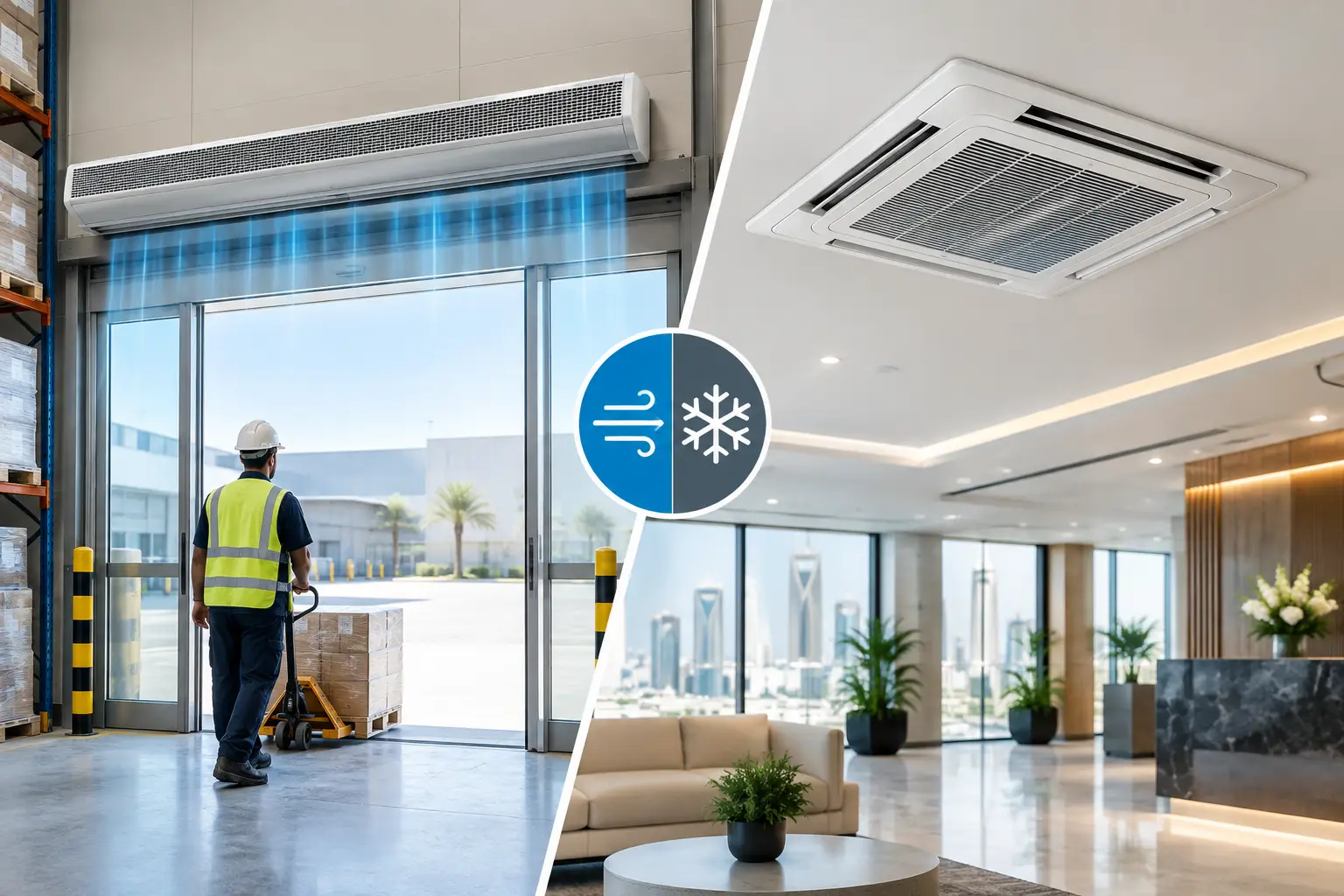
At an active loading dock, an industrial air curtain creates a high-velocity downward air stream across the doorway. This stream helps separate conditioned indoor air from the harsh external environment while allowing forklifts, pallet jacks, and personnel to pass without obstruction.
The value is practical: doors can remain operational, but heat gain is reduced compared with leaving the opening entirely unprotected. The same barrier can limit dust, insects, smoke, fumes, and humidity entering through the dock, depending on application conditions and unit selection.
For large and demanding entrances, centrifugal blower designs are often suitable because they are engineered to deliver stronger, more consistent airflow. FreezeeX Industrial Centrifugal Series systems are intended for heavy-use applications where opening dimensions, traffic frequency, and external conditions exceed the needs of a standard retail doorway.
Air curtains are not all specified the same way. A low mounting height, sheltered dock, and intermittent traffic pattern may allow a different configuration than a tall, exposed logistics opening. Discharge velocity, mounting height, nozzle design, and control integration all influence barrier performance. Selecting on width alone is a common specification error.
Match Airflow to Opening Height and Exposure
The further air must travel from the mounting point to the floor, the more carefully performance must be evaluated. A tall dock door requires an air curtain with enough effective throw to sustain separation at the threshold. If external crosswinds are significant, the unit may require an adjusted discharge angle or a higher-capacity configuration.
For especially wide openings, multiple units can be arranged side by side to avoid weak zones between sections. The goal is a uniform air barrier, not simply maximum airflow. Excessive velocity can create unnecessary noise or disturbance, while inadequate airflow fails to control infiltration. Proper selection balances both conditions.
Reduce Heat Gain at the Door Perimeter
An air curtain is most effective when the rest of the dock opening is controlled. Damaged seals, unsealed gaps around dock doors, and poorly aligned vehicle positions allow heat to enter even when the shutter is closed or partly open.
Dock shelters or seals can reduce the gap between the vehicle and the building opening during loading. Their suitability depends on fleet consistency, bay configuration, vehicle movement, and operational requirements. They do not replace an air curtain during an open-door event, but they can reduce the infiltration path around the vehicle.
Door condition also deserves attention. Ensure shutters close fully when a bay is inactive and that controls do not encourage doors to remain open after loading is complete. Fast-response door operation can reduce exposure time, though the operational value depends on forklift movement and safety procedures. For facilities with frequent short loading cycles, reducing open time often delivers meaningful cooling savings.
Coordinate Door Controls With Dock Activity
Manual switching leaves air curtains running when doors are shut or inactive, wasting energy and increasing wear. Automated controls help match airflow to the actual loading cycle.
Door-contact controls can activate the air curtain when a shutter opens and stop it after closure. In high-traffic docks, interlocks can also support different operating modes, such as a standard airflow setting for regular loading and a higher setting for periods of severe outdoor heat or wind.
Facilities should also establish a clear dock-use policy. Keep unused bays closed, avoid opening multiple adjacent doors without operational need, and schedule high-volume loading where practical. These are basic controls, but they reduce the number of simultaneous infiltration points the HVAC system must handle.
Protect Temperature-Sensitive and Hygiene-Critical Areas
For cold storage transfer points, food processing facilities, pharmaceutical warehouses, and healthcare logistics areas, loading dock heat management becomes a product-protection issue. A hot, humid influx can cause condensation, temperature excursions, and increased contamination risk.
These applications typically require closer coordination among the air curtain specification, door cycle, room temperature target, and hygiene procedures. The barrier may need to perform against a larger temperature differential than at a general warehouse dock. It may also need construction and access features suited to frequent cleaning or controlled environments.
A common mistake is placing a general warehouse solution at the boundary of a highly controlled room. The more demanding the temperature, hygiene, or pressure requirement, the more important it is to assess the complete doorway system rather than treating the air curtain as an isolated product.
Measure Results After Installation
Dock heat control should be evaluated through operating results. Facility teams can compare dock-zone temperatures, HVAC runtime, humidity readings, dust accumulation, and staff feedback before and after improvements. This makes it easier to identify whether the barrier is correctly positioned and whether door practices are supporting its performance.
If heat remains concentrated near the opening, investigate air curtain coverage, discharge direction, door-seal condition, and building pressure. The issue may be an undersized system, but it may also be an exposed dock orientation or several doors operating at once. Performance review is especially valuable during peak summer conditions, when design weaknesses are most visible.
Specify for the Actual Dock, Not a Generic Entrance
Managing loading dock heat is about controlling the open-door event without slowing the movement of goods. For warehouses, factories, distribution centers, and industrial facilities in tropical, humid, and desert climates, a professionally selected air curtain can reduce cooling loss while helping keep heat, dust, and humidity outside the conditioned workspace.
For a project-specific recommendation, request a consultation and quotation with the dock opening dimensions, mounting height, door type, traffic pattern, operating hours, and local climate exposure. That information allows FreezeeX to recommend an air curtain configuration designed for the actual demands of the loading dock.