A practical review for high-traffic commercial doors
A busy entrance is often where a building loses control of its conditioned environment. Every door opening can admit hot outside air, humidity, dust, insects, and airborne contaminants while allowing expensive cooled air to escape. This commercial HiFi Plus series review considers where this air curtain range fits in a commercial specification and the operating conditions that should guide selection.
The HiFi Plus Series is intended for commercial entrances where a clean appearance, controlled noise levels, and effective air separation are all relevant. It is not a substitute for correctly sized HVAC equipment or properly managed door operation. It is an entrance-control measure that supports both, particularly at doors that open repeatedly throughout the day.
For facilities in Dubai, Abu Dhabi, Riyadh, Doha, Muscat, Cairo, Lagos, and similar hot-climate markets, that distinction matters. External heat is not a brief seasonal issue. It is a continuous operational load, and a poorly protected entrance can undermine cooling performance during every busy trading or shift period.
Where the Commercial HiFi Plus Series Fits Best
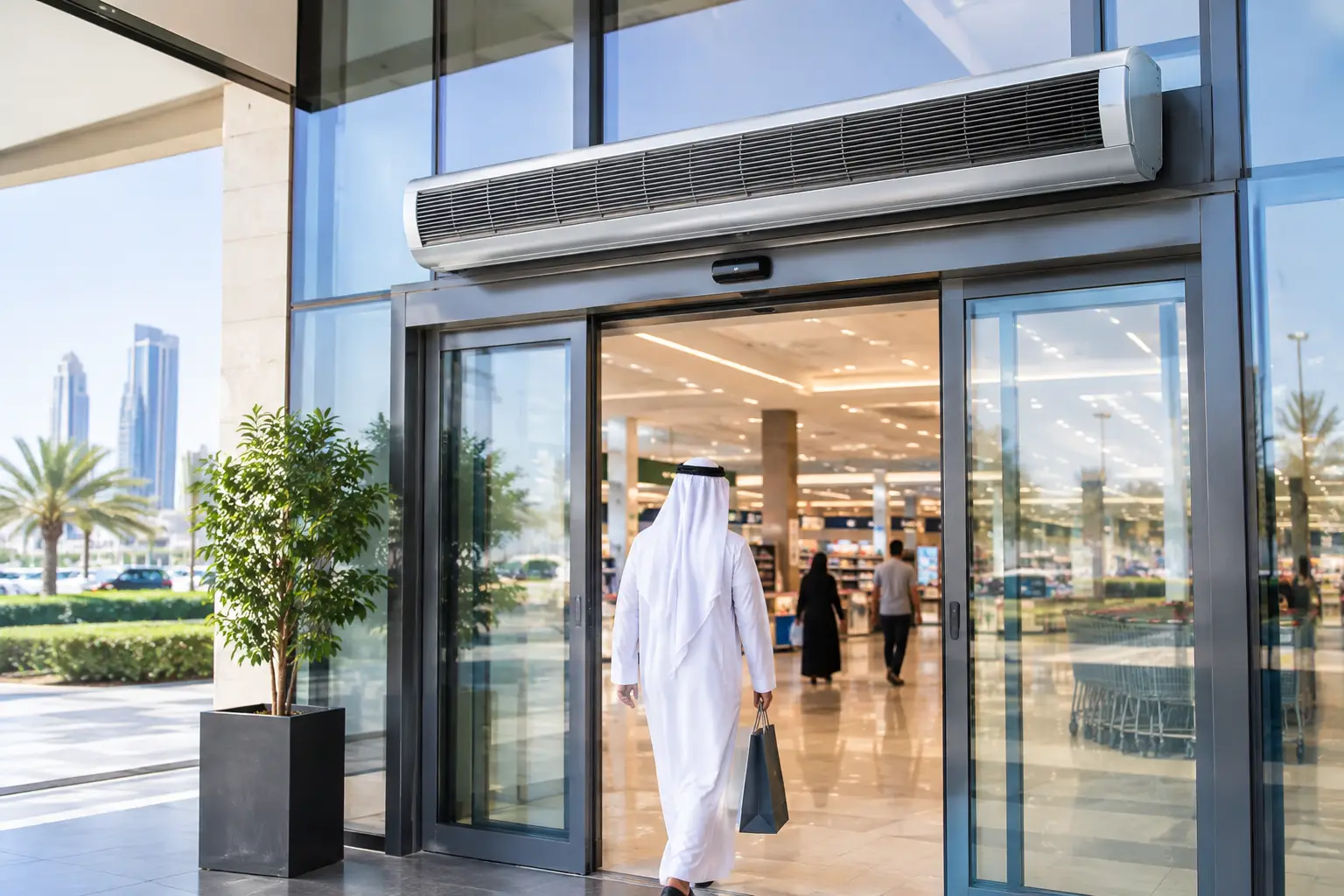
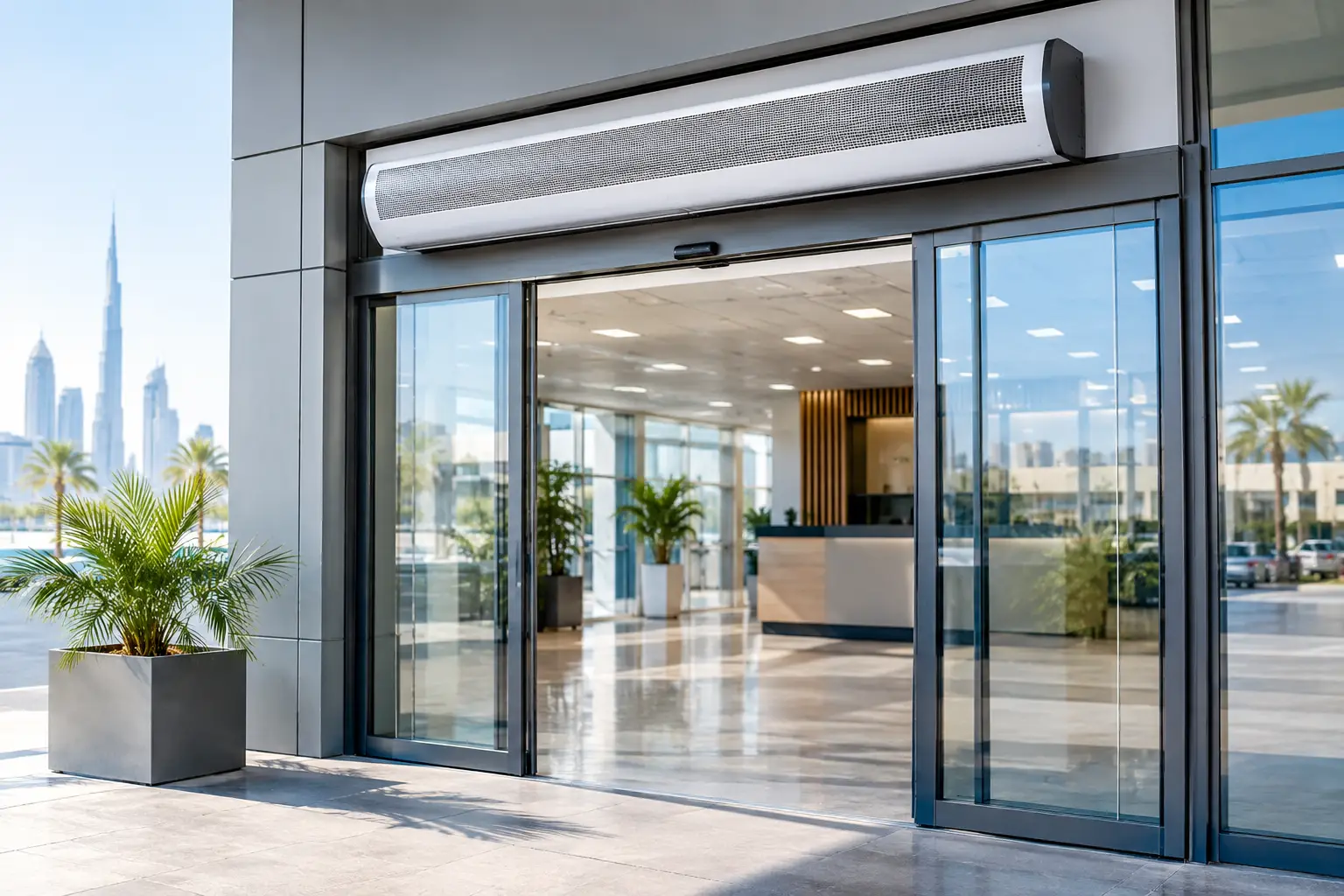
The Commercial HiFi Plus Series is most appropriate for customer-facing and staff-access entrances that require a more refined commercial presentation than a heavy industrial unit. Typical applications include retail stores, supermarkets, hotel lobbies, restaurants, clinics, office buildings, mall-facing tenants, and controlled-access areas within larger facilities.
Its value is strongest when an entrance has regular pedestrian traffic but not the extreme door heights, large loading openings, or harsh process exposure associated with warehouses and factories. At these locations, the design priority is usually a consistent air stream across the opening, acceptable acoustics near customers or reception staff, and an installation that complements the finished entrance environment.
That does not mean every retail or hospitality door should receive the same model or length. A narrow boutique entrance, a double-leaf supermarket doorway, and a hotel vehicle-side service entrance create very different air-loss conditions. Door width, mounting height, local wind pressure, internal cooling setpoint, and daily traffic patterns all affect performance.
What the Series Does Well
Maintains a conditioned boundary at open doors
An air curtain creates a directed air stream across an open doorway. When correctly selected and installed, that stream helps reduce the uncontrolled exchange of indoor and outdoor air. In hot and humid markets, the practical benefit is less warm, moisture-laden air entering the occupied space while doors are open.
For a supermarket, this can help protect customer comfort near the entrance and reduce the burden placed on cooling equipment. In a restaurant, it can limit the rapid influx of heat, dust, and insects at a frequently used front door. In a hotel, it supports a more consistent lobby environment without forcing guests to pass through a physical barrier.
The result should be viewed as reduced infiltration, not a hermetic seal. Strong crosswinds, doors held open for long periods, and oversized openings can overcome an under-specified unit. The air curtain must have sufficient reach and velocity at the floor level to form an effective barrier.
Supports commercial presentation and acoustic comfort
Entrance equipment is visible in retail, hospitality, healthcare, and office settings. The HiFi Plus Series is a logical consideration where the air curtain must perform without creating an overtly industrial appearance at the doorway.
Noise deserves equal attention. Sound levels should be evaluated in relation to the room, not in isolation. A unit that is acceptable above a busy supermarket entrance may be distracting at a quiet clinic reception desk. Fan speed selection, installation height, ceiling construction, and nearby reflective surfaces all influence perceived noise.
For this reason, consultants should review published acoustic data at the intended operating speed and consider the actual ambient sound level of the entrance zone. Specifying the lowest practical fan speed may reduce noise, but only if the unit can still maintain adequate air separation at the doorway.
Addresses dust, insects, and humidity exposure
Cooling loss is often the first reason businesses consider an air curtain, but it is not the only reason. In desert and tropical environments, entrances also become pathways for dust, insects, humidity, and outdoor odors. These issues can affect customer experience, housekeeping requirements, and the cleanliness of occupied or food-service areas.
The HiFi Plus Series is particularly relevant where a conventional open entrance must remain accessible to the public. It offers a non-contact barrier that helps manage external air movement while preserving a clear, welcoming entry point.
In food handling, pharmaceutical, and healthcare settings, an air curtain should be treated as one element of a broader hygiene and access-control strategy. The required standard of protection, cleaning regime, door configuration, and internal pressure conditions must be assessed by the project team. A commercial entrance unit may not be the right choice where process risk, contamination control, or unusually high door openings demand a more specialized solution.
Limits to Consider Before Specifying
A useful review must address fit as well as benefits. The Commercial HiFi Plus Series is not automatically the right answer for every commercial opening.
First, mounting height is critical. As the distance between the discharge grille and floor increases, the air stream has farther to travel and becomes more vulnerable to deflection. Tall lobbies, mezzanine-level entrances, and doors exposed to strong prevailing winds may require a different configuration or a higher-capacity series.
Second, entrance geometry can reduce real-world performance. Revolving doors, vestibules, recessed doors, sliding doors, and adjacent openings each alter air movement. A unit should be selected around the effective open width, not simply the nominal frame dimension. Gaps at either side of the air stream create leakage paths that weaken the barrier.
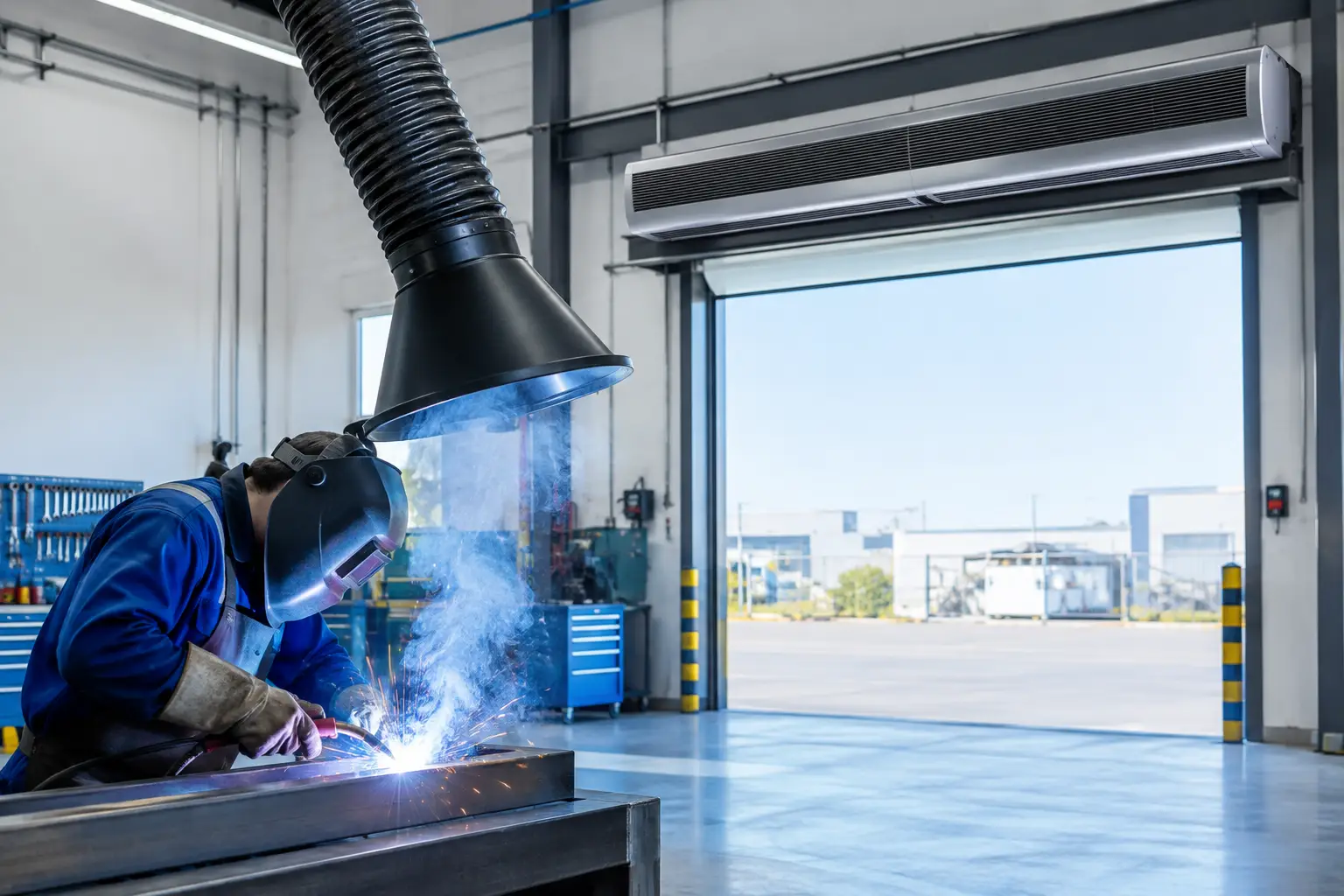
Third, consider traffic type. The HiFi Plus Series suits pedestrian-focused doors, but a logistics center with forklifts, pallet movements, or extended loading-door openings normally needs an industrial air curtain designed for larger and more demanding openings. Likewise, cold storage applications require careful selection around temperature differential, door cycle behavior, and operational exposure.
Finally, electrical and controls coordination should be defined early. The air curtain should operate in a way that matches door use and building operation. Depending on the project, this may involve door contacts, speed control, a wall controller, or coordination with building management controls. Leaving this decision until commissioning can lead to a unit that runs unnecessarily or does not respond properly when the entrance is active.
HiFi Plus Series Versus Other Air Curtain Types
The right comparison is not about which series is universally stronger. It is about matching airflow delivery to the door and environment.
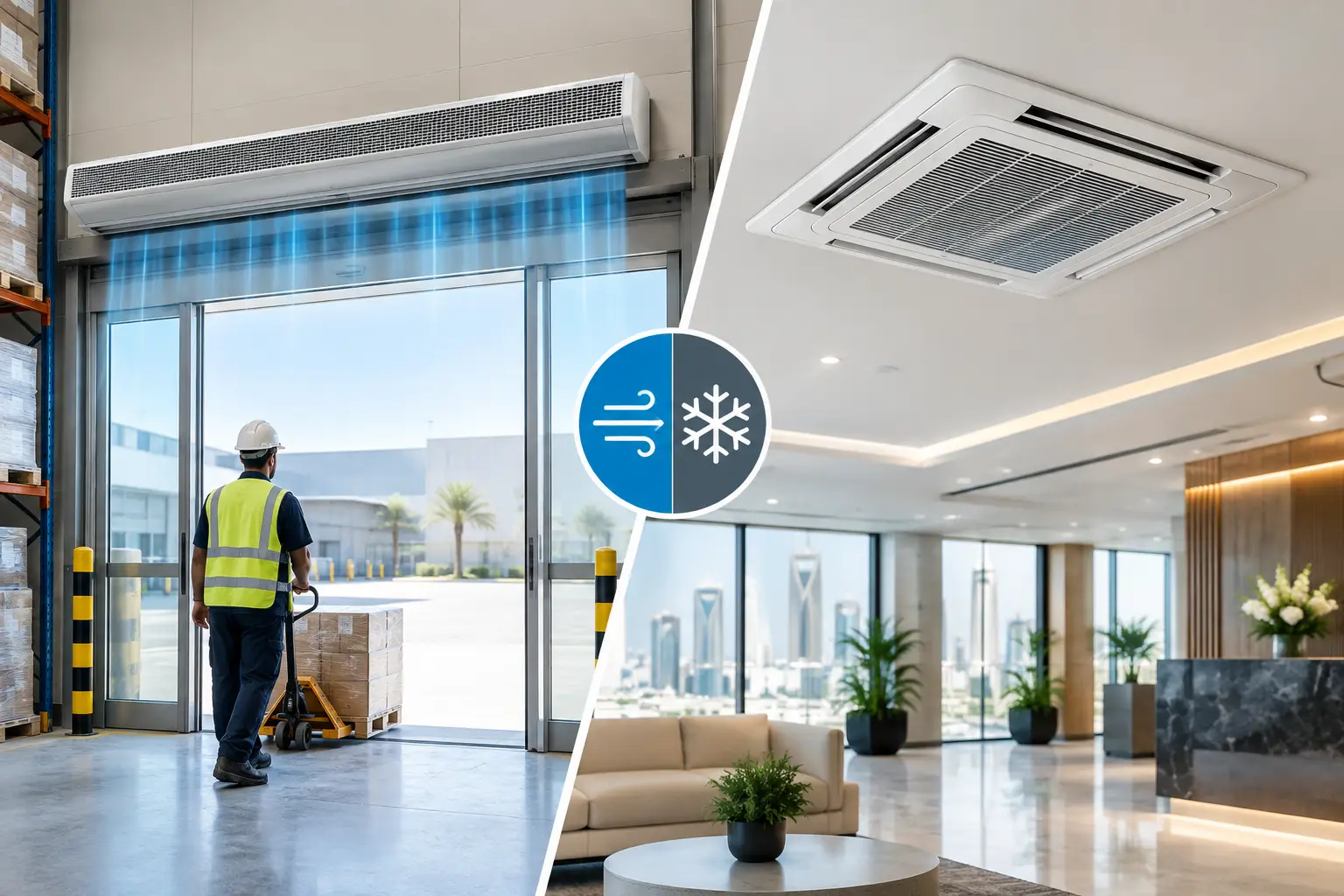
A recessed ceiling air curtain may be preferred where architects require the unit to sit within a ceiling line and visual integration is the primary concern. That option depends on adequate ceiling space and a design that still allows service access.
A commercial centrifugal-flow air curtain may be considered where the application calls for a different airflow characteristic or greater pressure capability. For larger industrial doors, dusty workshops, warehouses, factories, and loading areas, an industrial centrifugal series is generally the more appropriate starting point because the operating demands are fundamentally different.
The HiFi Plus Series occupies the practical middle ground: a commercial unit for visible, regularly used pedestrian entrances where comfort, appearance, and air isolation must work together. It is a strong candidate when the opening is within commercial scale and the site conditions do not demand an industrial-duty solution.
Selection Questions That Change the Recommendation
Before requesting a quotation, project teams should provide more than door width. The following details allow a supplier to assess whether the HiFi Plus Series is suitable and, if so, how it should be configured:
- Clear opening width and finished mounting height
- Door type, opening frequency, and typical time held open
- Whether the entrance faces direct sun, wind, dust, or humid outdoor air
- Building use, occupancy expectations, and noise sensitivity
- Existing cooling arrangement and desired control method
- Any hygiene, insect-control, or access requirements specific to the operation
These inputs are especially relevant in Gulf and African markets, where a door exposed to direct afternoon sun or wind-driven dust may perform very differently from an identical door in a protected mall corridor. A site survey or detailed drawings can prevent a seemingly small selection error from becoming a long-term comfort and energy issue.
Verdict: A Commercial Solution That Requires Proper Sizing
The Commercial HiFi Plus Series is a sensible option for pedestrian-oriented commercial entrances that need reliable air isolation without an industrial visual profile. It can support cooling retention, reduce the entry of dust and insects, and improve comfort around frequently used doors in hot, humid, and desert climates.
Its performance depends on engineering discipline rather than a generic product choice. Select it for the actual opening width, mounting height, traffic level, and external exposure. Move to a higher-capacity or industrial solution when the door is taller, wider, wind-exposed, or used for logistics rather than pedestrian access.
For a project-specific recommendation, FreezeeX can review the entrance dimensions, operating environment, and HVAC objectives and provide a commercial HiFi Plus Series quotation suited to the application. The most effective air curtain is the one sized for the doorway your building operates every day.