A loading-bay or customer entrance can introduce a surprising moisture load every time its doors open. To reduce doorway humidity infiltration, a commercial facility needs more than lower thermostat settings. It needs a controlled air barrier that limits humid outdoor air at the threshold while allowing people, carts, and goods to move without delay.
For facilities in Dubai, Riyadh, Doha, Muscat, Lagos, Nairobi, and other hot or tropical markets, this is an operational issue rather than a minor comfort concern. Moisture entering through open doors can increase HVAC demand, create condensation risks, affect product conditions, and make occupied spaces feel warmer than the temperature reading suggests.
Why Doorway Humidity Infiltration Creates Costly Problems
Humidity moves into a building when warm, moisture-laden outdoor air is drawn through an open entrance and mixes with cooler indoor air. The pressure difference between indoors and outdoors, wind exposure, stack effect, exhaust systems, and frequent traffic can all intensify the problem.
The result is not limited to a damp feeling near the doorway. In commercial and industrial environments, unmanaged infiltration can contribute to:
- Higher latent cooling demand on the HVAC system
- Condensation on cold surfaces, displays, packaging, or nearby equipment
- Slippery entrance areas and avoidable housekeeping demands
- Reduced comfort for customers, guests, employees, and visitors
- Greater strain on humidity-sensitive processes in food, pharmaceutical, and logistics operations
- Cooling loss that raises operating costs during long opening hours
A door that remains open for deliveries or steady pedestrian traffic is effectively a gap in the building envelope. The right entrance air curtain helps create powerful air isolation across that gap without forcing facilities to choose between access and climate control.
How Air Curtains Reduce Doorway Humidity Infiltration
An air curtain projects a carefully directed stream of air across the full doorway opening. This stream forms a barrier that disrupts the exchange between conditioned indoor air and humid outdoor air.
It does not make an open entrance airtight, and it should not be presented as a substitute for a properly designed building envelope or HVAC system. Its value is practical: it reduces the amount of outside air that can enter while the door is in active use. That can help the air-conditioning system maintain indoor temperature and humidity more consistently.
The air stream must reach the threshold
An air curtain only performs effectively when its discharge air reaches the floor or door threshold with adequate velocity and the correct angle. If the unit is undersized, mounted too high, obstructed by signage, or aimed incorrectly, the air stream can break down before it protects the full opening.
This is why equipment selection should begin with the physical entrance, not with a generic product preference. Door height, width, mounting arrangement, local wind, interior pressure, and traffic type all affect the required solution.
Airflow direction matters in humid climates
For a doorway exposed to humid exterior conditions, the air stream must resist outdoor air movement without creating an uncomfortable blast for occupants or disrupting operations. The goal is controlled separation, not simply maximum airflow.
At retail and hospitality entrances, noise, appearance, and customer comfort may guide the specification. At warehouses, factories, and loading points, the priority may shift toward heavy-duty performance, higher mounting positions, and stronger resistance to wind and sustained traffic.
What Should Be Evaluated Before Specifying an Air Curtain?
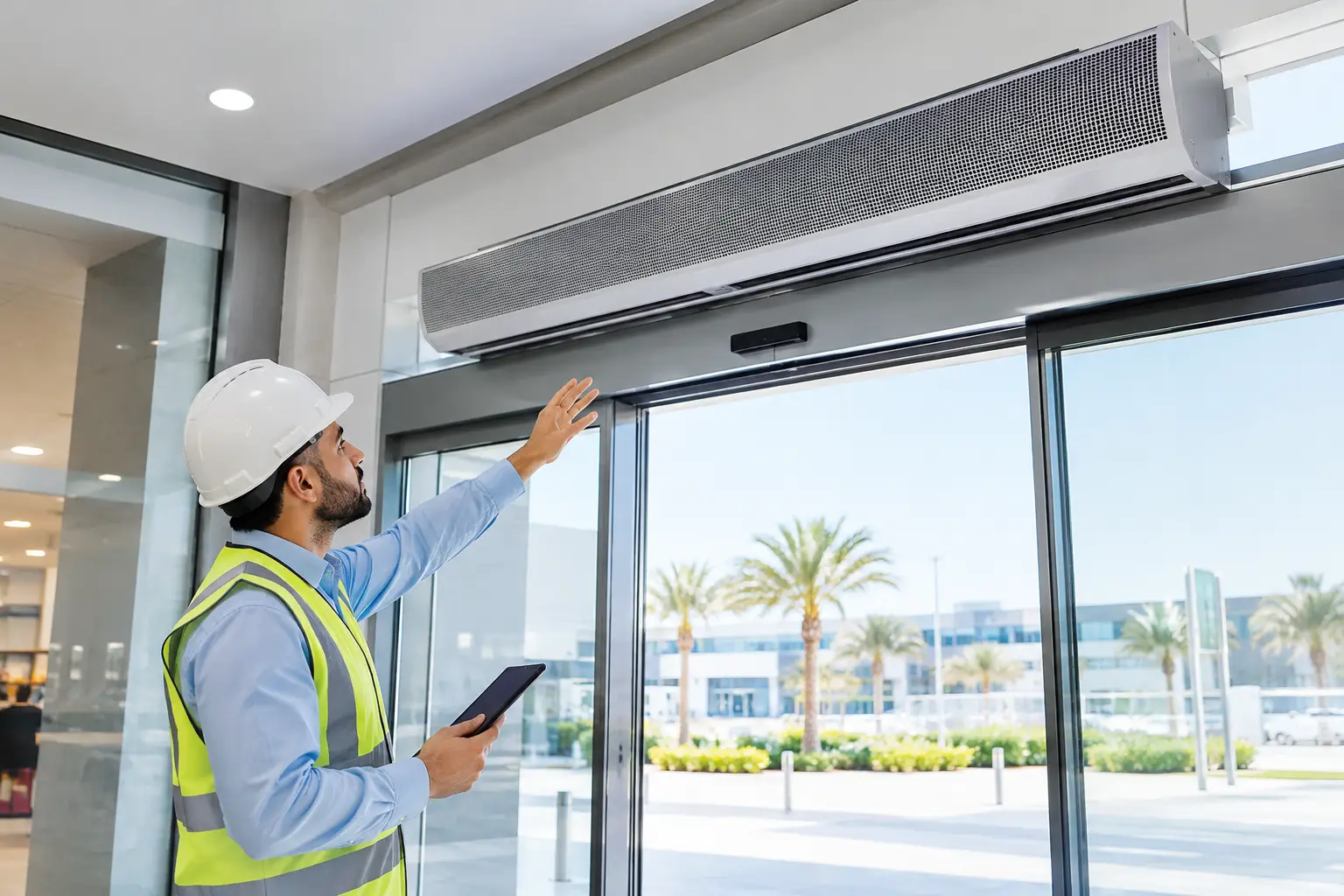
A consultation-led selection process produces a better result than choosing a unit based on doorway width alone. MEP consultants, HVAC contractors, and facility managers should evaluate the entrance as part of the building’s wider air-management strategy.
| Selection factor | Why it affects humidity control | Typical project implication | |—|—|—| | Door width and height | Determines the coverage area and required air throw | Wider or taller openings may require multiple units or industrial-duty equipment | | Opening frequency | Longer open-door periods allow more humid air to enter | High-traffic entrances need continuous, dependable air separation | | Mounting position | Changes the distance the air stream must travel | Recessed, surface-mounted, or high-level installation affects unit choice | | Wind and exterior exposure | Wind can deflect or weaken the air barrier | Exposed entrances require stronger, correctly oriented airflow | | Indoor temperature and humidity target | Affects the severity of condensation and latent-load risks | Cold storage, food processing, and pharmaceutical areas need closer review | | Traffic type | Pedestrians, trolleys, forklifts, and pallets create different operating conditions | Loading bays often require industrial configurations |
The assessment should also account for nearby exhaust systems, adjacent open doors, vestibules, automatic door timing, and HVAC supply-air arrangement. These conditions can change air pressure at the entrance and influence real-world performance.
Selecting the Right Air Curtain for Each Entrance Type
FreezeeX Air Curtains supports specification-based selection because commercial entrances have different operating demands. A compact retail doorway, a hotel lobby, a supermarket receiving door, and a factory dispatch opening should not receive the same recommendation.
Retail stores, malls, restaurants, and hotels
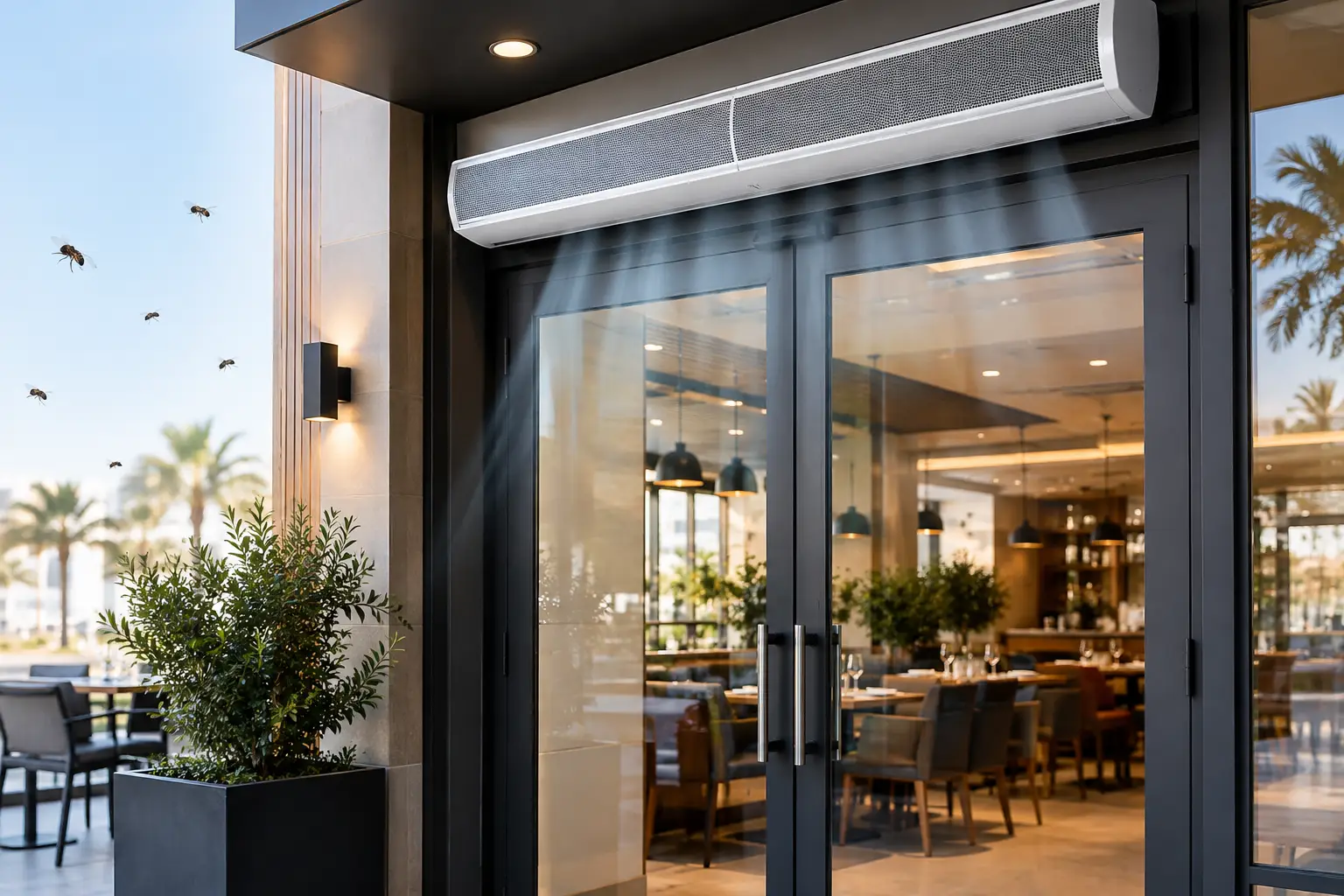
Public-facing entrances require an air curtain that protects comfort without compromising the visual standard of the space. Recessed ceiling air curtains can be appropriate where a discreet finish is required, while commercial series options may suit entrances with heavier daily foot traffic.
In humid coastal markets, such as Dubai, Abu Dhabi, Doha, or Casablanca, this application can help limit the humid air surge that occurs each time automatic doors cycle. It also supports more stable conditions around customer-facing refrigerated displays and comfort-sensitive lobby areas, though the air curtain must be coordinated with door layout and HVAC design.
Supermarkets, food facilities, and cold-chain operations
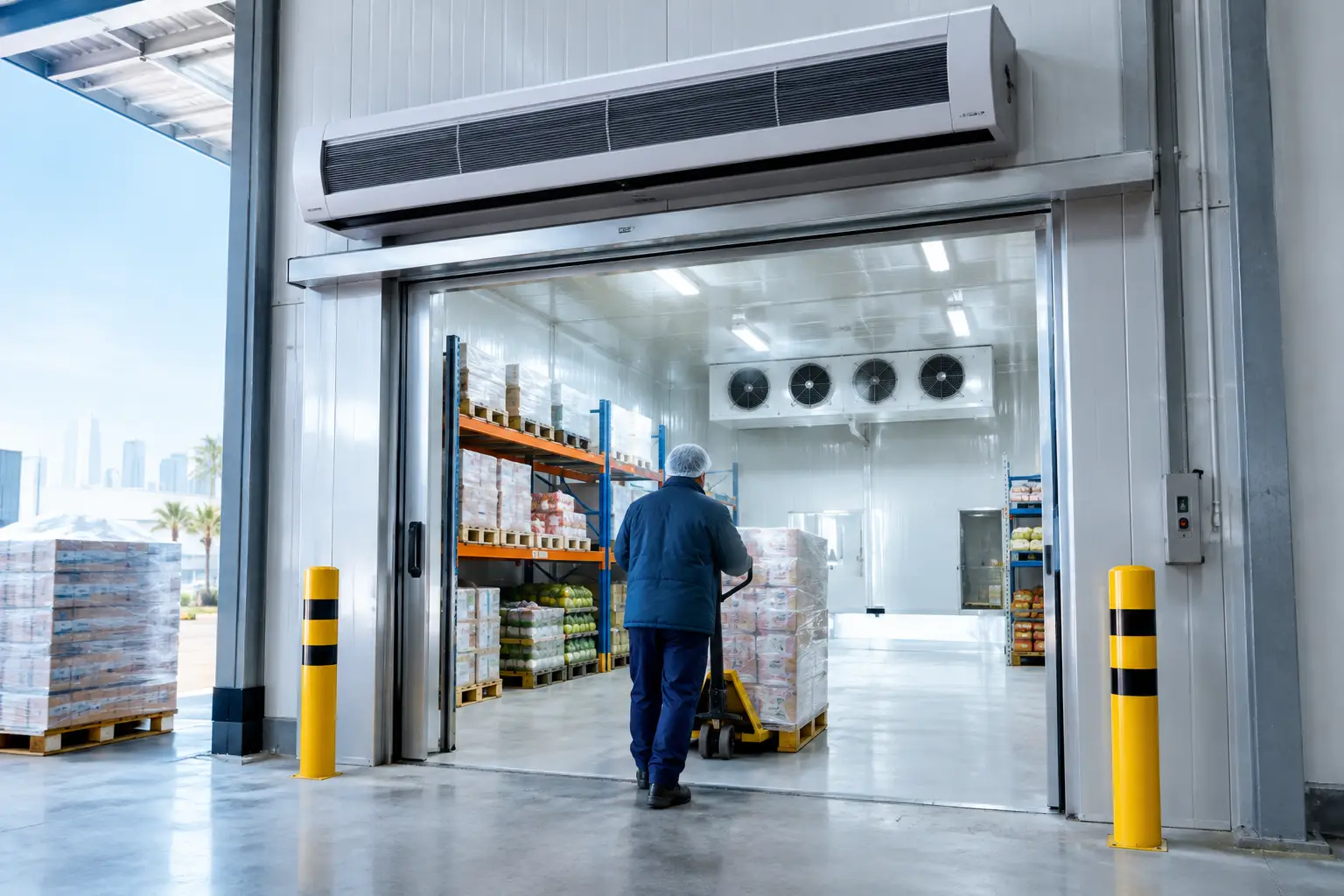
Where a cool interior meets warm, humid outdoor air, moisture control becomes especially important. Infiltration can raise cooling demand and increase condensation potential around entrances, staging areas, and cold-room access points.
For these applications, decision-makers should consider opening duration, goods movement, sanitation practices, nearby cold surfaces, and the pressure relationship between spaces. Commercial centrifugal-flow and industrial centrifugal systems may be evaluated depending on the opening size and operating intensity. The correct choice depends on the site conditions rather than the industry label alone.
Warehouses, factories, and logistics centers
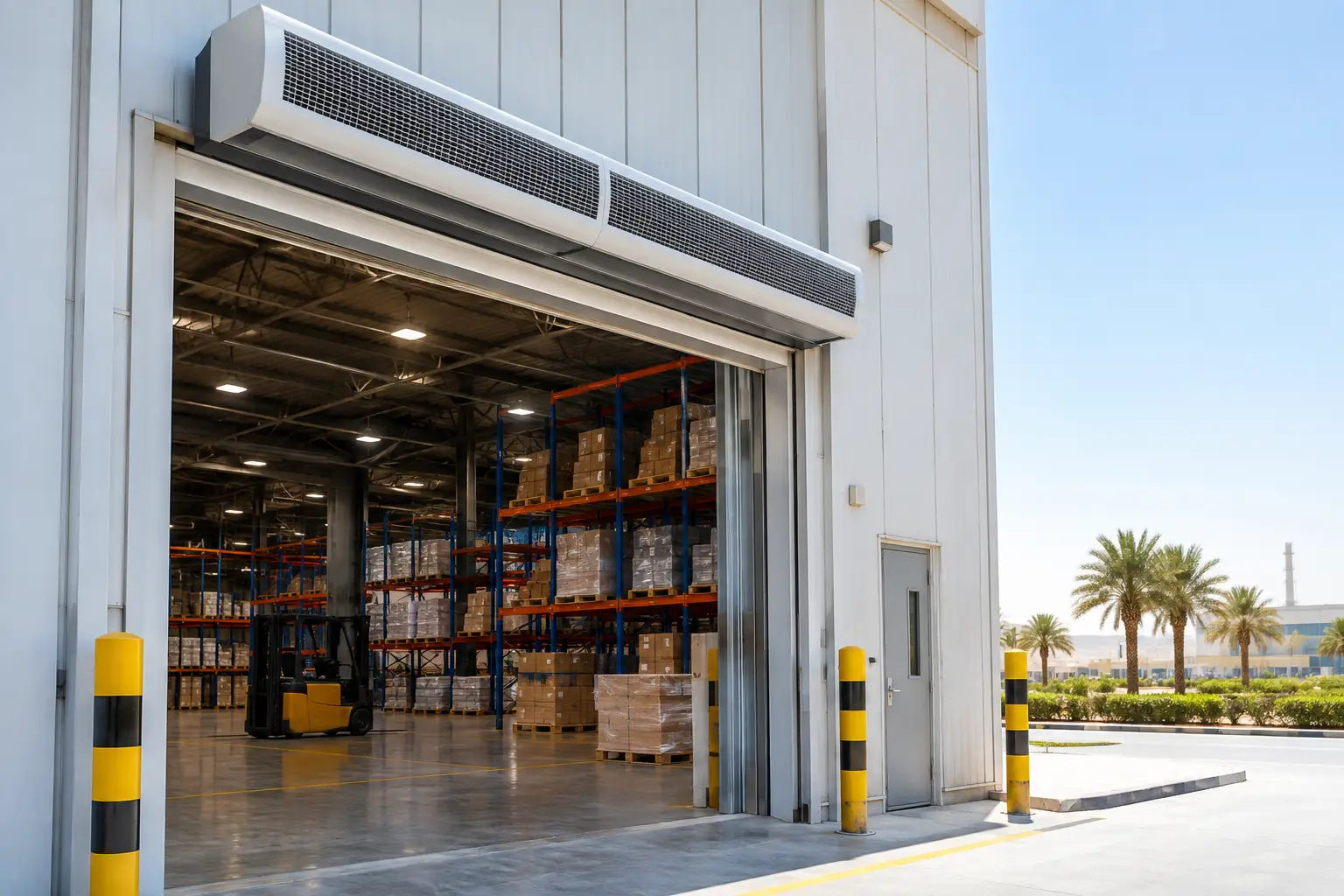
Large doors and repeated forklift movement create a more demanding scenario. A standard commercial unit may not provide the air throw or duty capability required for a tall, exposed industrial opening.
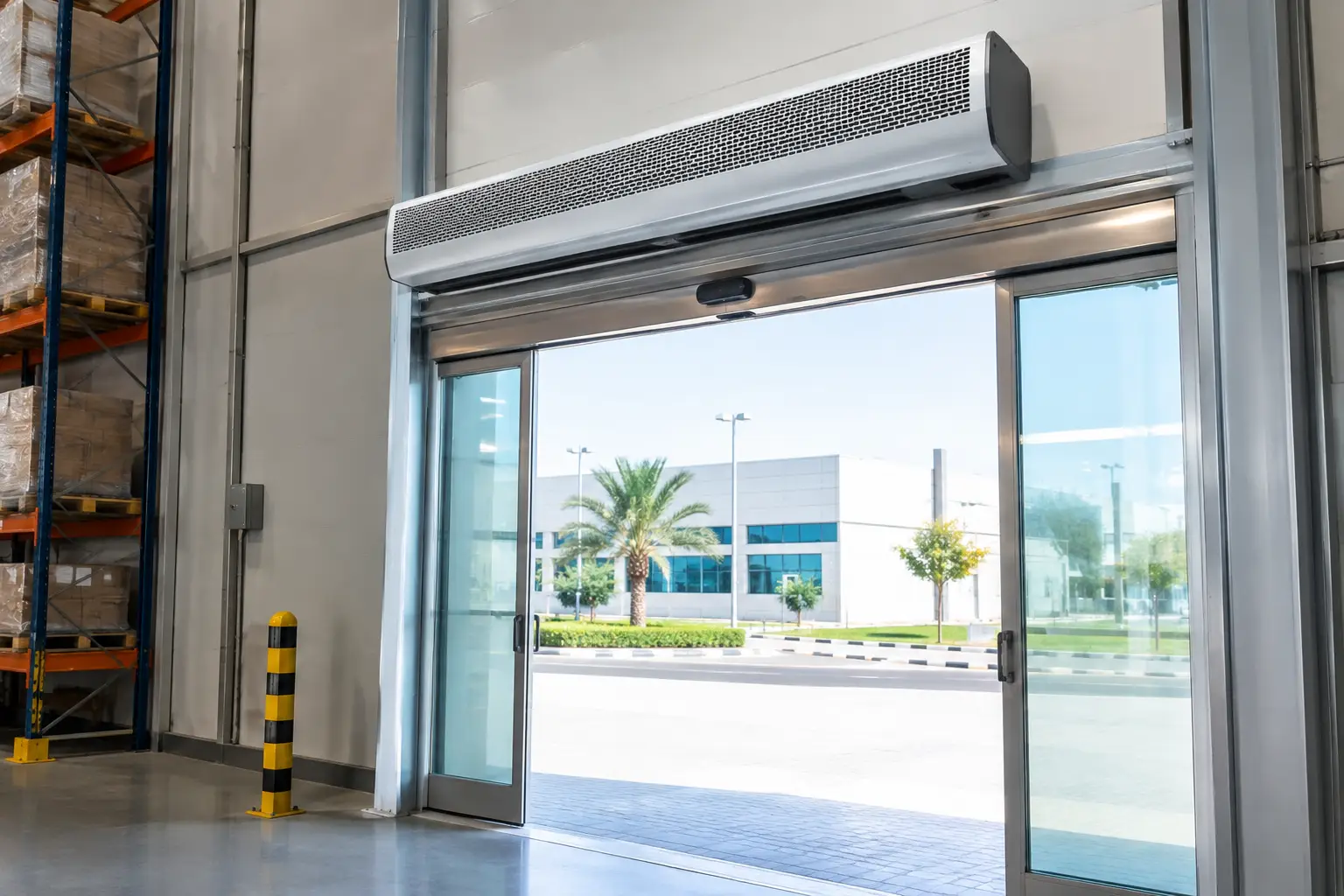
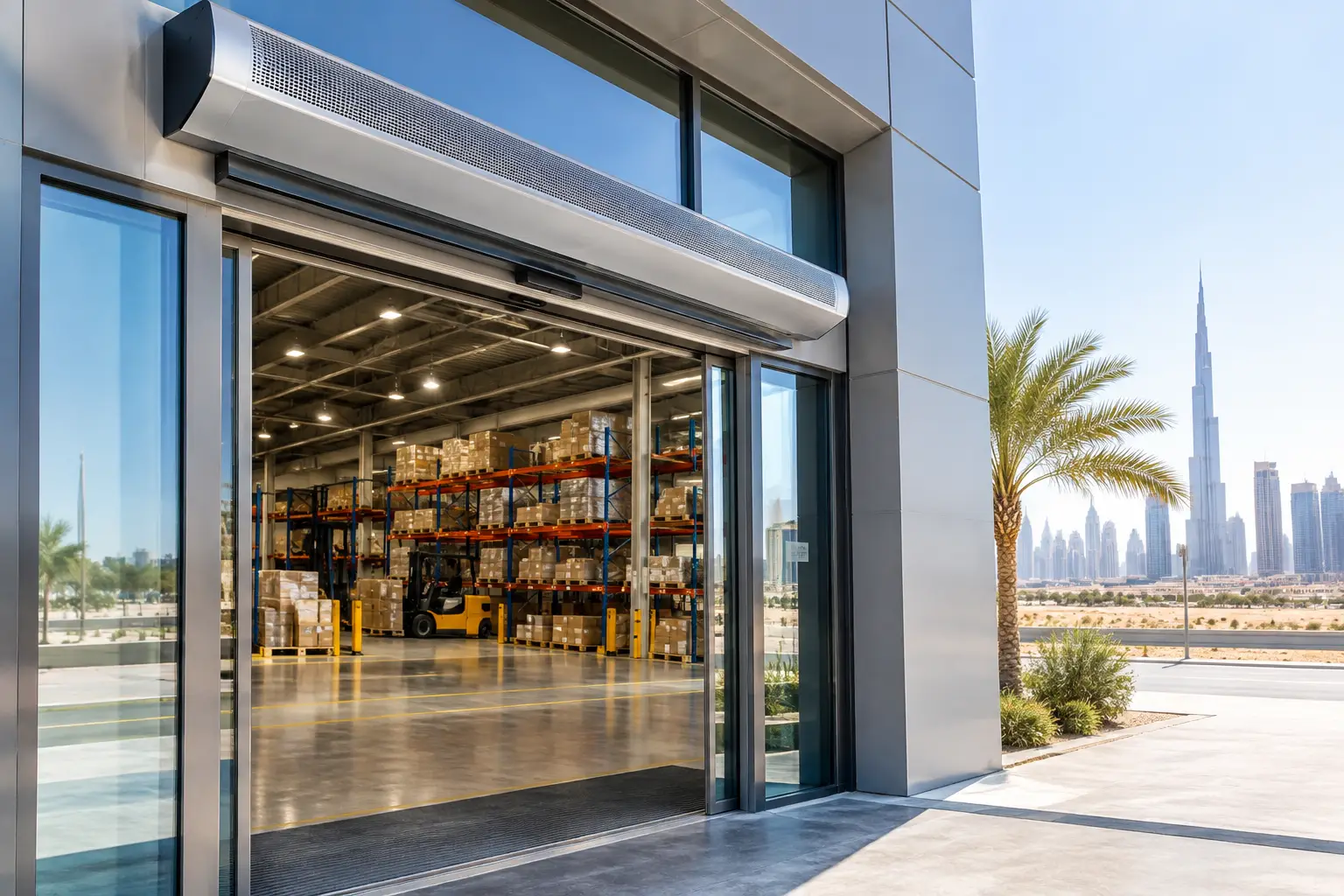
Industrial air curtain configurations are often better suited to these sites, particularly where hot, dusty, or humid outside air enters during receiving and dispatch activities. They can support a cleaner, more stable internal environment while reducing unnecessary cooling loss. The design still needs to consider door height, crosswinds, and whether the opening is continuously open or used in short cycles.
A Practical Specification Process
The following process helps project teams reduce risk before equipment is selected or installed:
- Document the opening. Record clear width, clear height, mounting height, door type, and any obstructions above the entrance.
- Review operating conditions. Identify opening frequency, traffic flow, exterior wind exposure, indoor setpoints, and nearby exhaust or supply systems.
- Define the primary control objective. Determine whether humidity reduction, cooling retention, dust control, insect reduction, smoke separation, or a combination is the highest priority.
- Match the air curtain to the application. Select a commercial, recessed, or industrial approach based on the actual entrance conditions and required air coverage.
- Coordinate installation and controls. Confirm placement, discharge direction, activation method, access for planned maintenance, and integration with door operation where appropriate.
- Verify performance after commissioning. Observe the air stream under normal traffic and exterior conditions, then adjust settings if site conditions call for refinement.
This approach is particularly valuable on multi-entrance projects. A mall may need different solutions for its main public doors, loading dock, service corridors, and food-service receiving areas.
Common Mistakes That Limit Humidity Control
The most common mistake is treating an air curtain as a one-size-fits-all accessory. If it is too narrow, too weak for the mounting height, or installed where the discharge is blocked, humidity infiltration will continue around or below the air stream.
Another issue is ignoring the surrounding pressure conditions. A facility with strong exhaust near an entrance may pull outdoor air inward more aggressively. Likewise, a highly exposed doorway in a desert or tropical climate may require a more deliberate selection than a sheltered internal entrance.
Facility teams should also avoid evaluating performance only during quiet periods. The meaningful test is whether the barrier remains effective during the busiest traffic pattern, when doors are open most often and outdoor conditions are most demanding.
Specify for the Climate, Not Just the Door Size
Humidity control at an open entrance is a building-performance issue with direct consequences for comfort, HVAC efficiency, cleanliness, and operational reliability. Correctly specified air curtains help reduce the uncontrolled exchange of hot, humid, dusty, or contaminated outdoor air without obstructing essential access.
For a new project, retrofit, or high-traffic entrance assessment, request a FreezeeX consultation and quotation based on doorway dimensions, mounting conditions, traffic volume, climate exposure, and HVAC objectives. A solution selected for tropical and desert-climate performance will provide a more dependable starting point than a generic doorway unit.