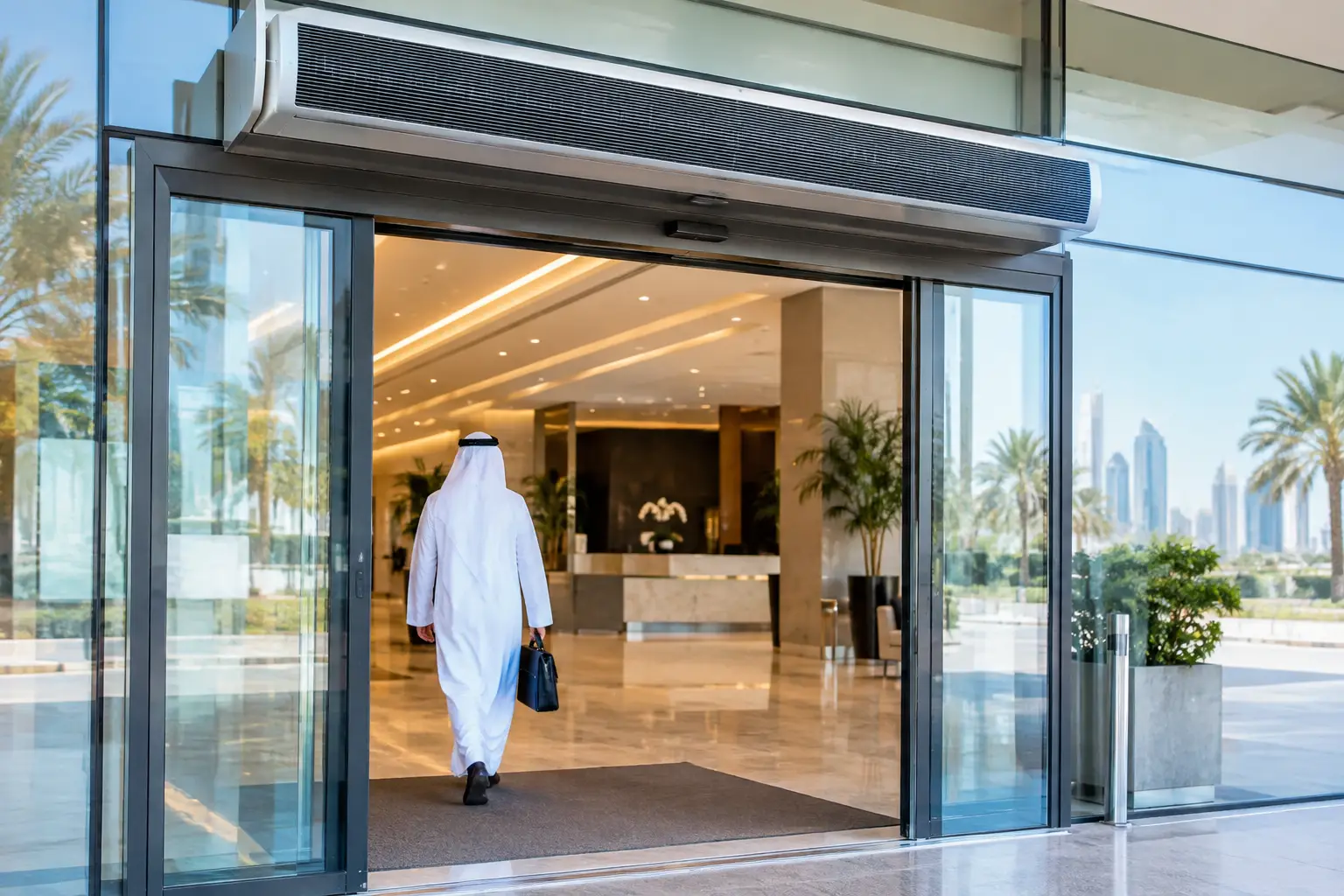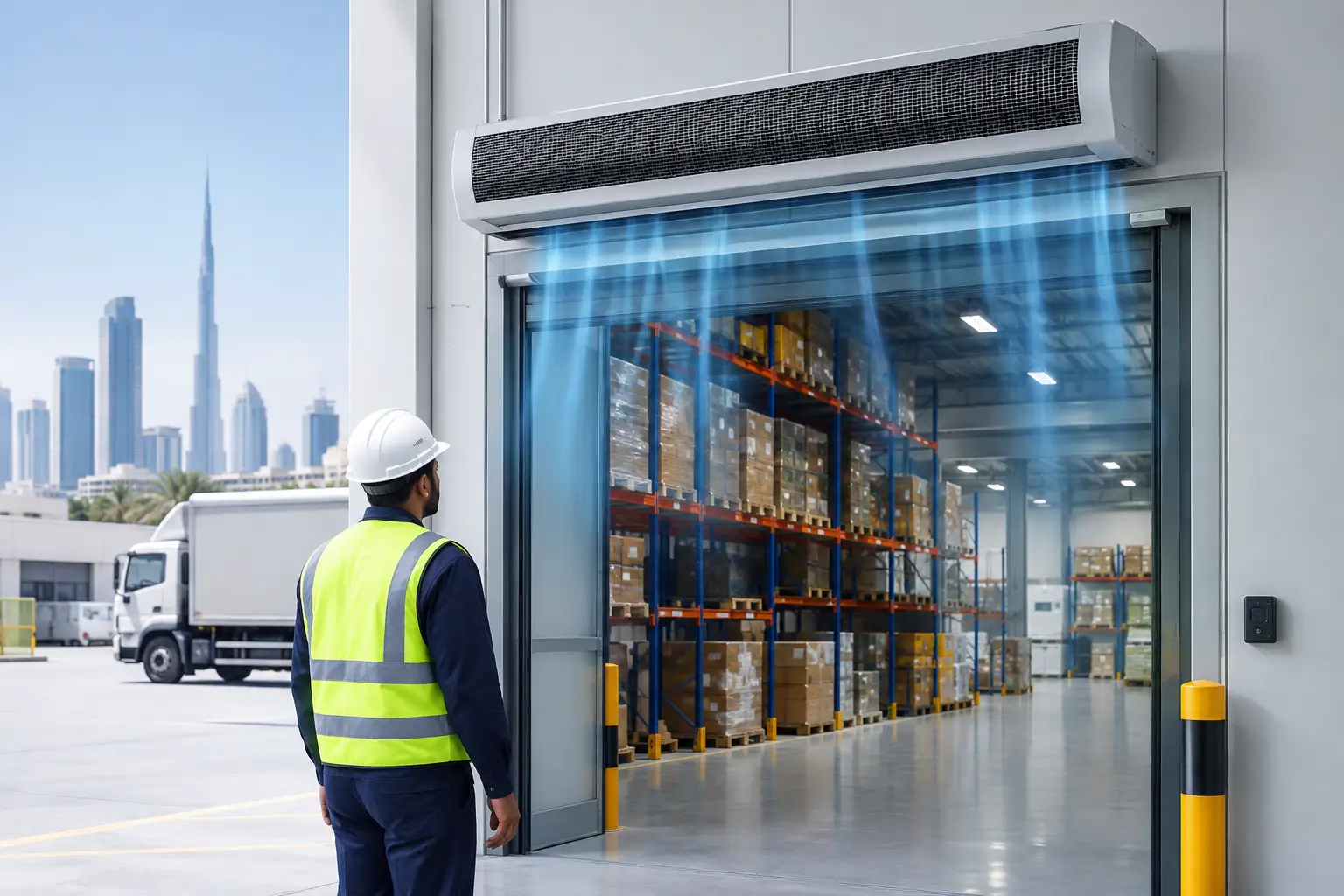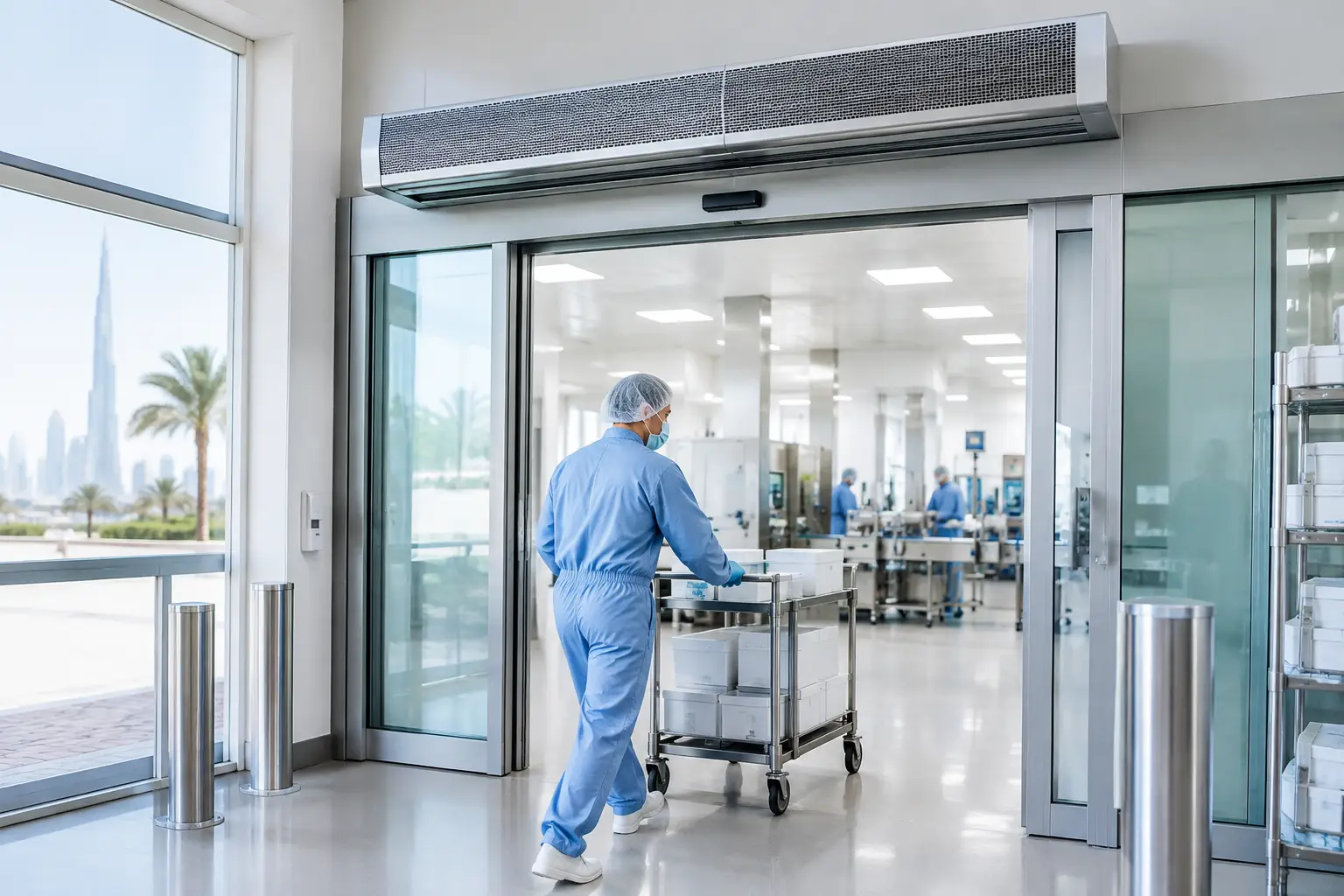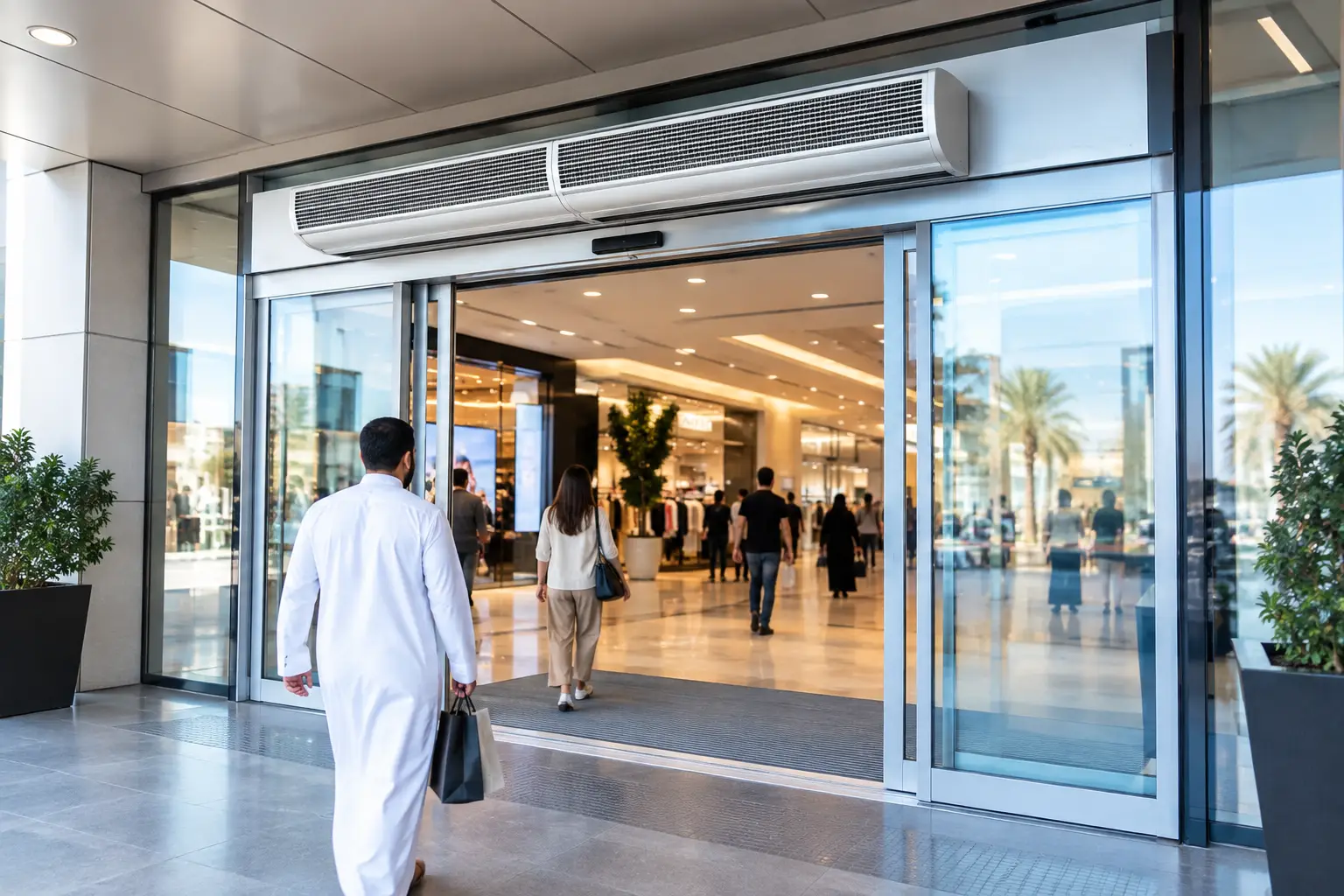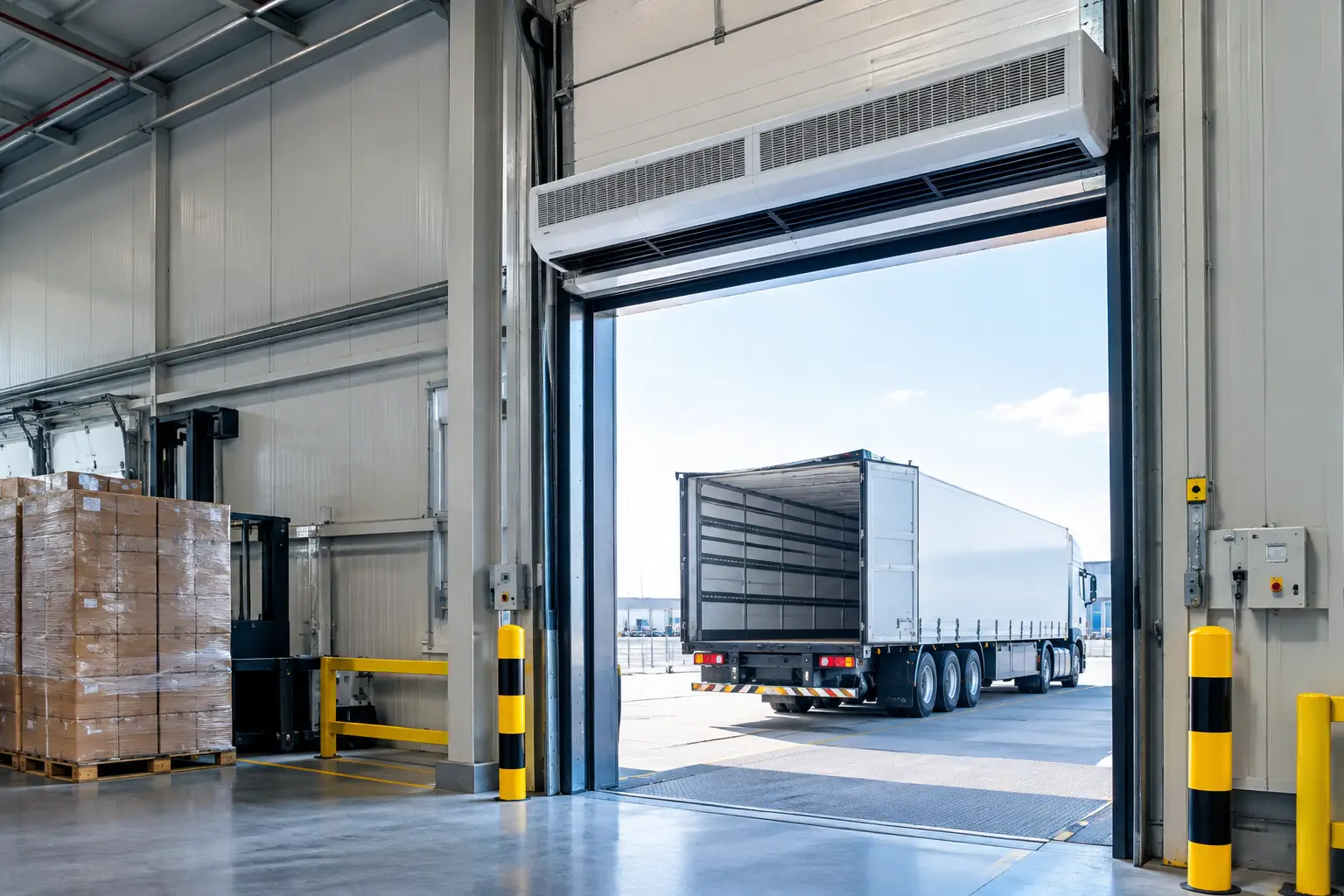
An open loading-bay door in Dubai, a busy supermarket entrance in Riyadh, or a hotel lobby in Doha can become a continuous source of heat gain, dust, humidity, and airborne contamination. Commercial air curtains create a controlled air barrier across that opening, helping facilities protect conditioned indoor space without interrupting access for customers, staff, deliveries, or equipment.
For commercial and industrial operators across the GCC, MENA, and Africa, the value is not simply a cooler doorway. A correctly specified air curtain supports HVAC performance, improves entrance comfort, and reduces the operational impact of frequent door openings in hot, humid, tropical, and desert environments.
What Do Commercial Air Curtains Do?
Commercial air curtains direct a high-velocity stream of air downward across an entrance. This stream helps separate indoor and outdoor air when a door is open, limiting the movement of hot air, dust, insects, humidity, fumes, and other unwanted contaminants into the building.
They do not replace the building’s air-conditioning system or physical doors. Instead, they support both. Where a door must remain open for customer traffic, goods handling, vehicle movement, or operational access, an air curtain can reduce the burden placed on the HVAC system.
The practical outcome depends on the application. A retail entrance may prioritize customer comfort and a clean appearance. A warehouse may need stronger air isolation over a wider, higher opening. A food processing or pharmaceutical facility may focus on protecting controlled internal conditions from dust, insects, and airborne contaminants.
Why Entrance Air Control Matters in Hot Climates
In Dubai, Abu Dhabi, Riyadh, Muscat, Doha, Cairo, Lagos, Nairobi, and Casablanca, outside conditions can place constant pressure on conditioned interiors. The issue becomes more pronounced when doors open repeatedly throughout the day.
When unconditioned outside air enters a facility, the HVAC system must work harder to restore the intended indoor temperature and humidity conditions. Dust and insects can also affect housekeeping, customer experience, product handling, and hygiene procedures. At high-traffic entrances, these problems are operational rather than occasional.
Commercial air curtains are especially relevant where a business needs to maintain access without accepting an uncontrolled opening to the outdoor environment. They can help facilities address:
- Cooling loss at customer entrances, service doors, and loading areas
- Hot air and humidity infiltration in tropical and coastal locations
- Wind-driven dust and sand at desert-facing entrances
- Insect entry around food, retail, hospitality, and healthcare operations
- Smoke, fumes, and airborne particles near industrial or logistics areas
- Uneven comfort conditions for staff and visitors near frequently opened doors
The result is a more controlled entrance zone. However, performance depends on selecting a unit that matches the actual opening and operating conditions. An undersized model may not maintain an effective barrier, while an over-specified solution can add unnecessary cost or create avoidable noise concerns in customer-facing spaces.
Which Commercial Air Curtain Fits the Application?
There is no single commercial air curtain that suits every entrance. Door height, width, mounting position, traffic volume, external climate, internal temperature requirements, and surrounding air movement all influence the right selection.
| Application | Primary Entrance Challenge | Typical Selection Priority | |—|—|—| | Retail stores and supermarkets | Frequent customer traffic and cooling loss | Appearance, low-disruption operation, coverage across the full entrance | | Hotels, restaurants, and malls | Guest comfort, humidity, insects, and outside heat | Consistent entrance protection with a suitable architectural fit | | Warehouses and logistics centers | Large doors, forklifts, deliveries, and dust | Stronger airflow for high and wide operational openings | | Factories and workshops | Dust, fumes, heat, and intensive traffic | Industrial-duty performance matched to the operating environment | | Cold storage and food handling areas | Temperature separation and hygiene control | Application-specific air isolation and coordinated door operation | | Hospitals and pharmaceutical facilities | Airborne contaminants and controlled environments | Careful specification around cleanliness, access, and building procedures |
FreezeeX offers several ranges to address different commercial and industrial requirements, including Recessed Ceiling Air Curtains, Commercial Centrifugal Flow Series, Commercial HiFi Plus Series, Industrial Centrifugal Series, and the New Dynamic Series. The most appropriate range is determined by the site conditions, not by a one-size-fits-all product choice.
Customer-Facing Entrances
For retail stores, shopping malls, hotels, restaurants, and office entrances, an air curtain must protect indoor comfort without becoming visually intrusive. Recessed installations may suit projects where the unit needs to integrate into the ceiling line, while commercial series can be selected for visible mounting positions and regular traffic patterns.
Noise expectations also matter in these environments. A unit installed at a luxury hotel entrance or premium retail location should be assessed differently from one serving a back-of-house receiving door. The specification should reflect both the environmental challenge and the experience expected within the space.
Industrial and Logistics Openings
Warehouses, factories, distribution centers, workshops, and loading areas typically present a different challenge. Openings may be wider or higher, traffic may include pallet movement and forklifts, and external wind or dust can disrupt the airflow barrier.
Industrial centrifugal solutions are designed for demanding use cases where dependable air delivery and application fit are central to performance. These entrances require a site-led assessment, particularly when there are high doors, uneven airflow around the building, or sustained operational traffic.
How Should a Project Team Specify Commercial Air Curtains?
A successful selection begins with accurate entrance data. Product selection should not be based only on door width or a general assumption that an air curtain is needed. The project team should evaluate the physical opening and how it operates during a normal day.
Use this specification process when preparing a quotation request:
- Measure the clear opening. Record the width and height of the door when fully open. This establishes the coverage requirement and mounting considerations.
- Confirm the mounting location. Determine whether the unit will be surface-mounted, recessed, or positioned in another approved location above the entrance.
- Assess traffic and door behavior. Note whether the entrance is continuously open, activated by sensors, opened manually, or used for high-frequency deliveries.
- Identify external conditions. Consider direct sun exposure, prevailing wind, dust, humidity, nearby vehicle activity, and the difference between indoor and outdoor conditions.
- Define the operational objective. Clarify whether the priority is cooling retention, insect control, dust reduction, hygiene support, staff comfort, or a combination of these requirements.
- Coordinate with the HVAC and building design. Air curtain selection should complement the facility’s cooling strategy, ceiling layout, door system, and electrical provision.
This information allows an HVAC contractor, MEP consultant, architect, or facility manager to request a solution based on operating reality rather than product assumptions.
Common Specification Mistakes to Avoid
The most frequent issue is treating an air curtain as a standard accessory rather than a performance component. It is installed above a door, but its effectiveness is shaped by the building environment around that door.
A common mistake is selecting only by width. Width matters, but door height, wind exposure, mounting height, indoor pressure conditions, and traffic intensity can be equally significant. A high loading-bay opening needs a different approach from a standard retail entrance, even if both openings have a similar width.
Another issue is overlooking installation coordination. Recessed ceiling air curtains require early planning with ceiling, structural, and MEP teams. Surface-mounted systems may offer more direct access, but clearances, discharge direction, door hardware, and maintenance access should still be reviewed before final approval.
Finally, facilities should avoid judging performance only at the moment of commissioning. The relevant test is how the entrance performs during the hottest hours, busiest delivery periods, or dustiest operating conditions. This is particularly important in desert and tropical climates, where environmental loads can change quickly.
When Is an Air Curtain Worth the Investment?
Commercial air curtains are most valuable where an entrance is opened often enough to create a measurable operational burden. For a supermarket, that may mean constant customer movement. For a logistics center, it may mean dispatch doors opening throughout the day. For a hospital or food facility, it may mean maintaining better separation between internal operations and outside contaminants.
The business case should consider more than energy use alone. Improved comfort near entrances can support customer experience and staff working conditions. Reduced dust and insect entry can lower cleaning pressure and support site hygiene. Better control of conditioned air can help facilities protect the performance of their wider HVAC investment.
The right system is therefore not necessarily the largest unit or the lowest initial-cost option. It is the model and installation approach that matches the opening, climate exposure, operational traffic, and performance objective.
For a project in the UAE, Saudi Arabia, Qatar, Oman, Kuwait, Bahrain, or wider MENA and African markets, provide the entrance dimensions, mounting details, traffic pattern, and site conditions to FreezeeX for a consultation and quotation. A properly matched commercial air curtain can turn a vulnerable open doorway into a more controlled, comfortable, and efficient part of the facility.