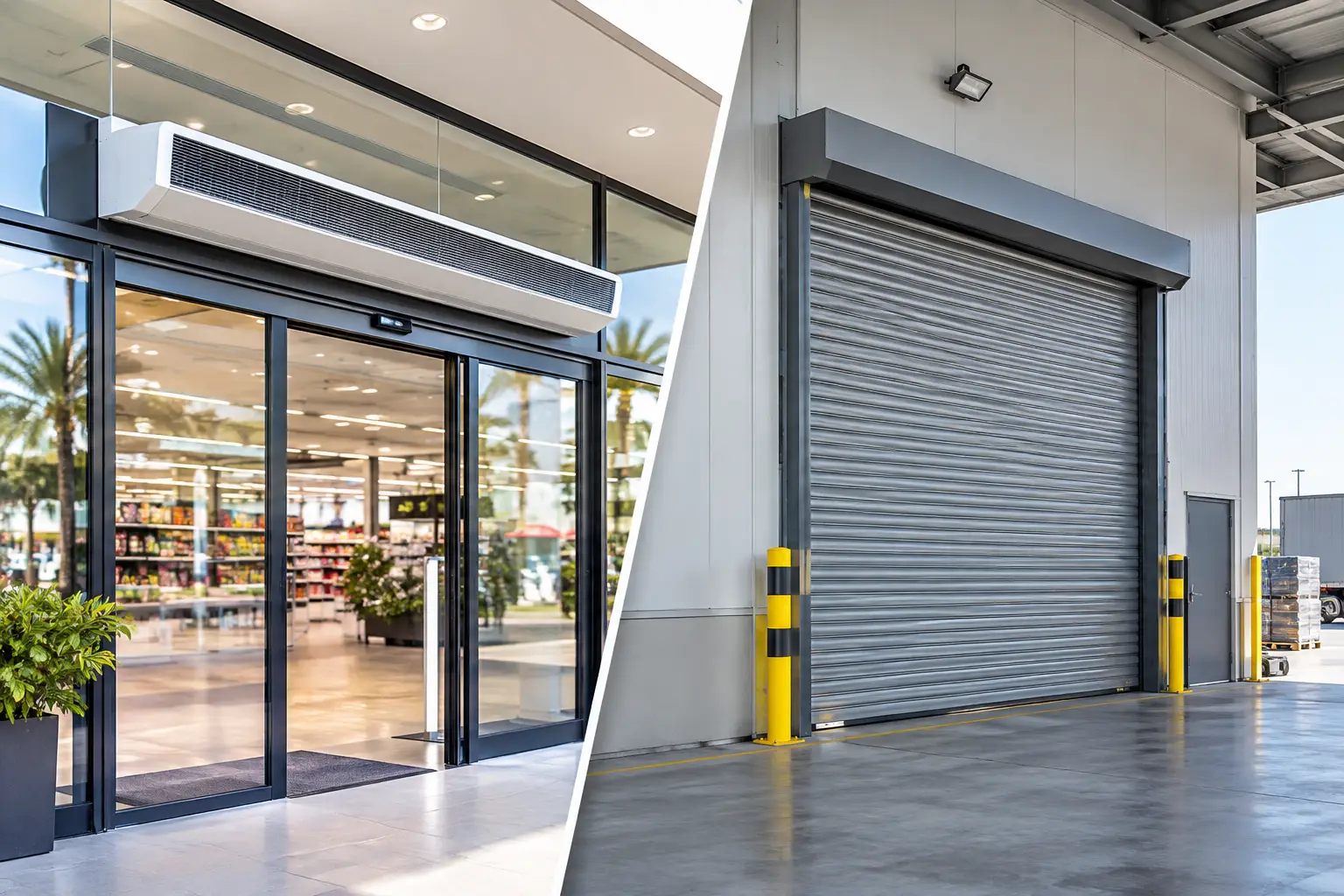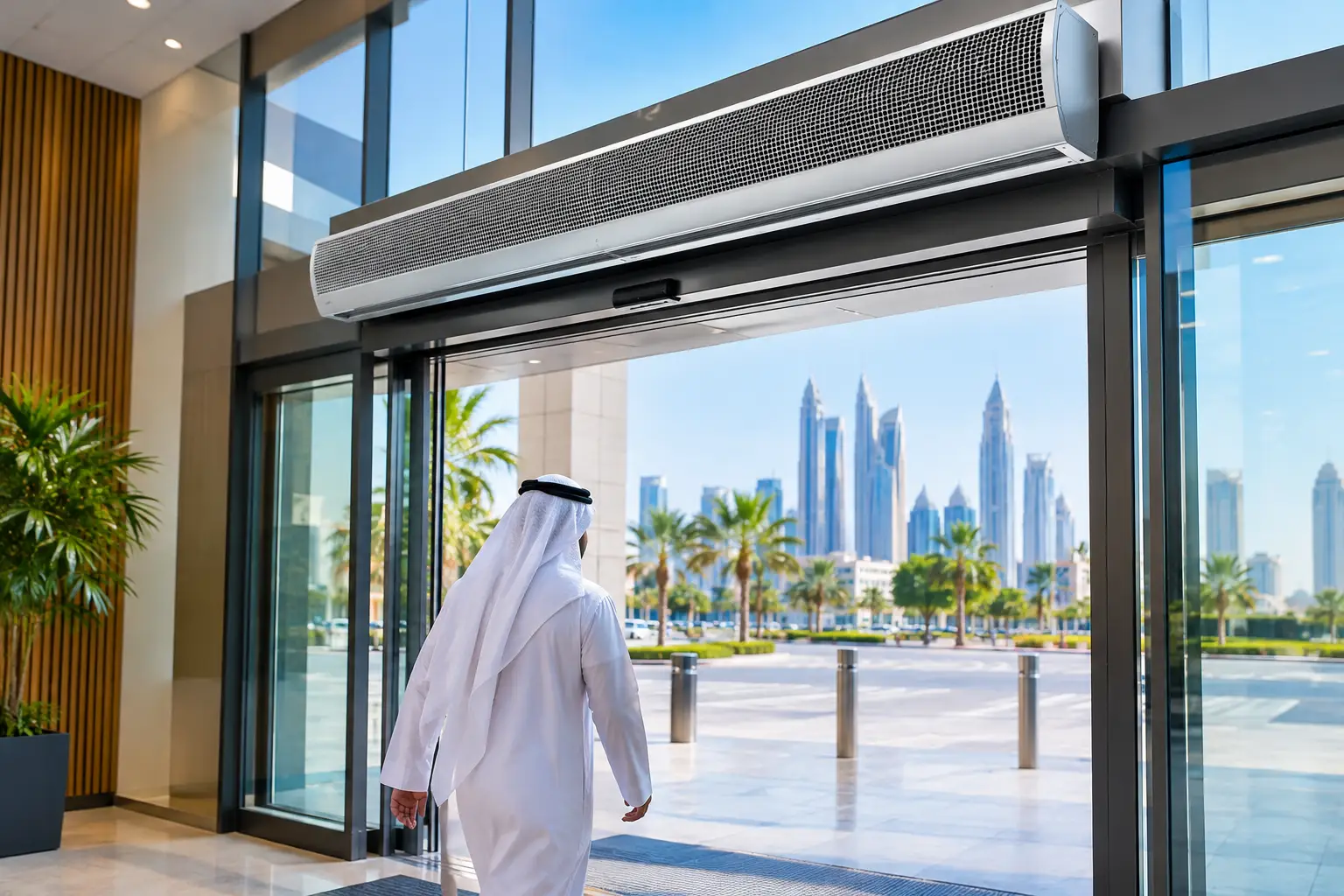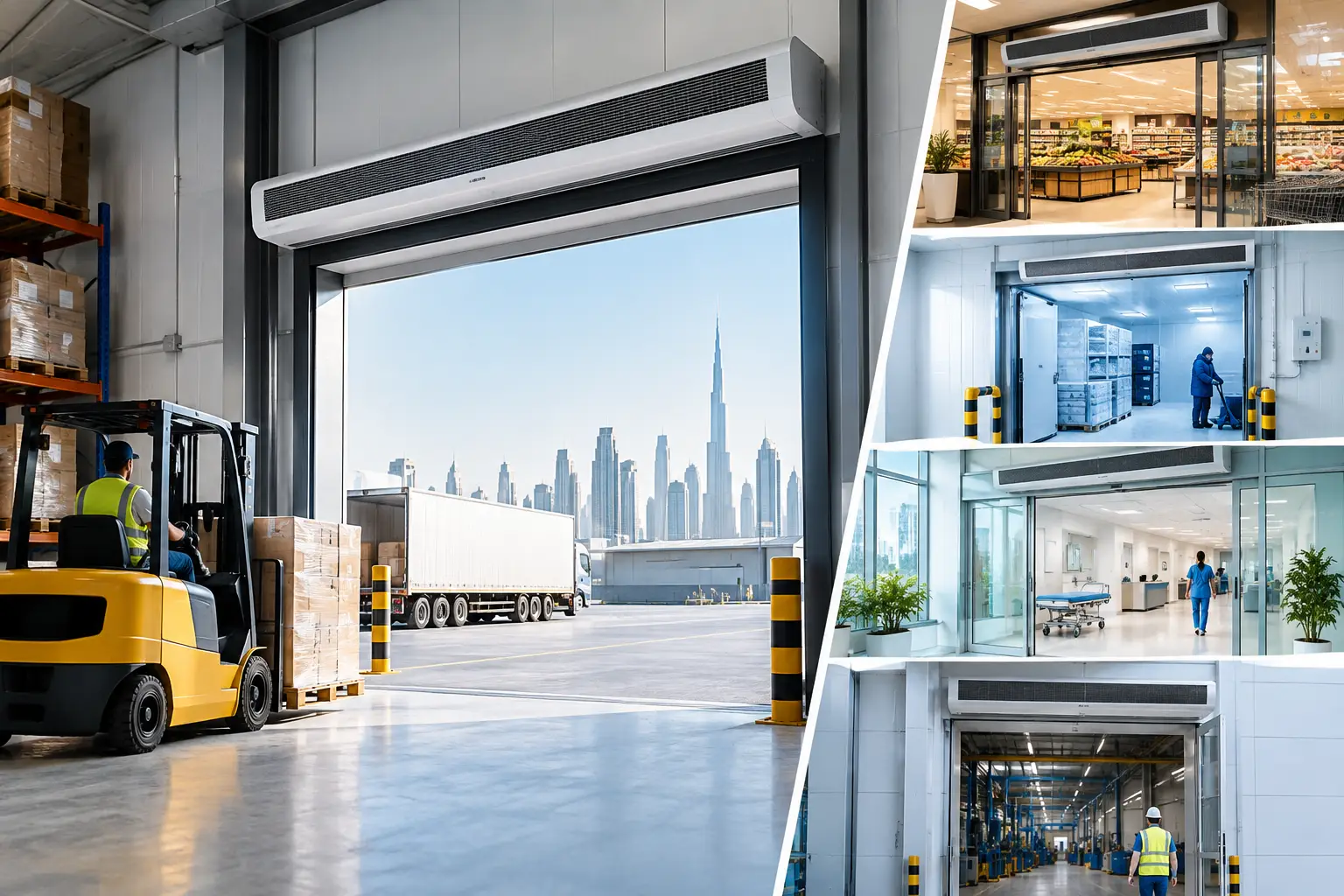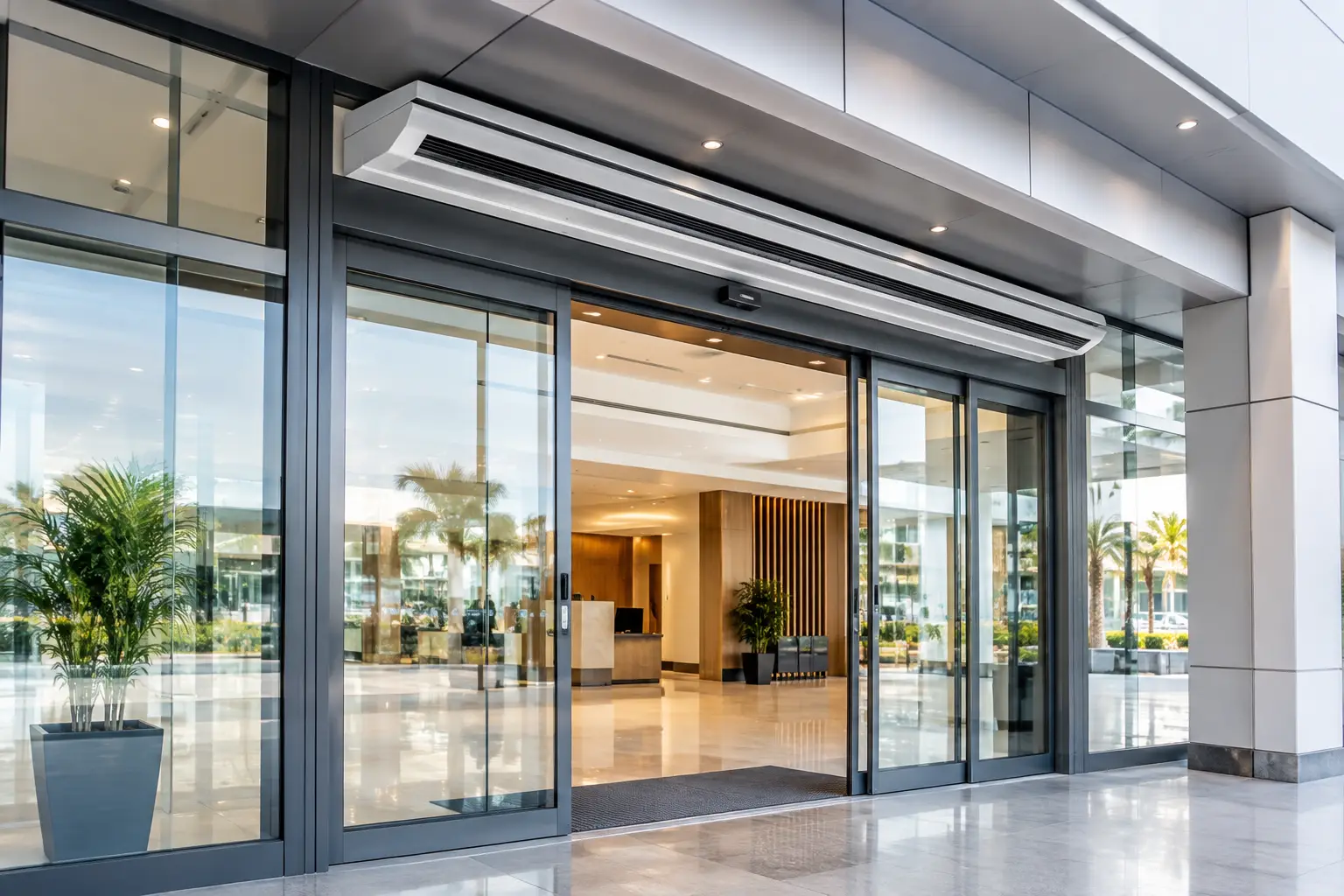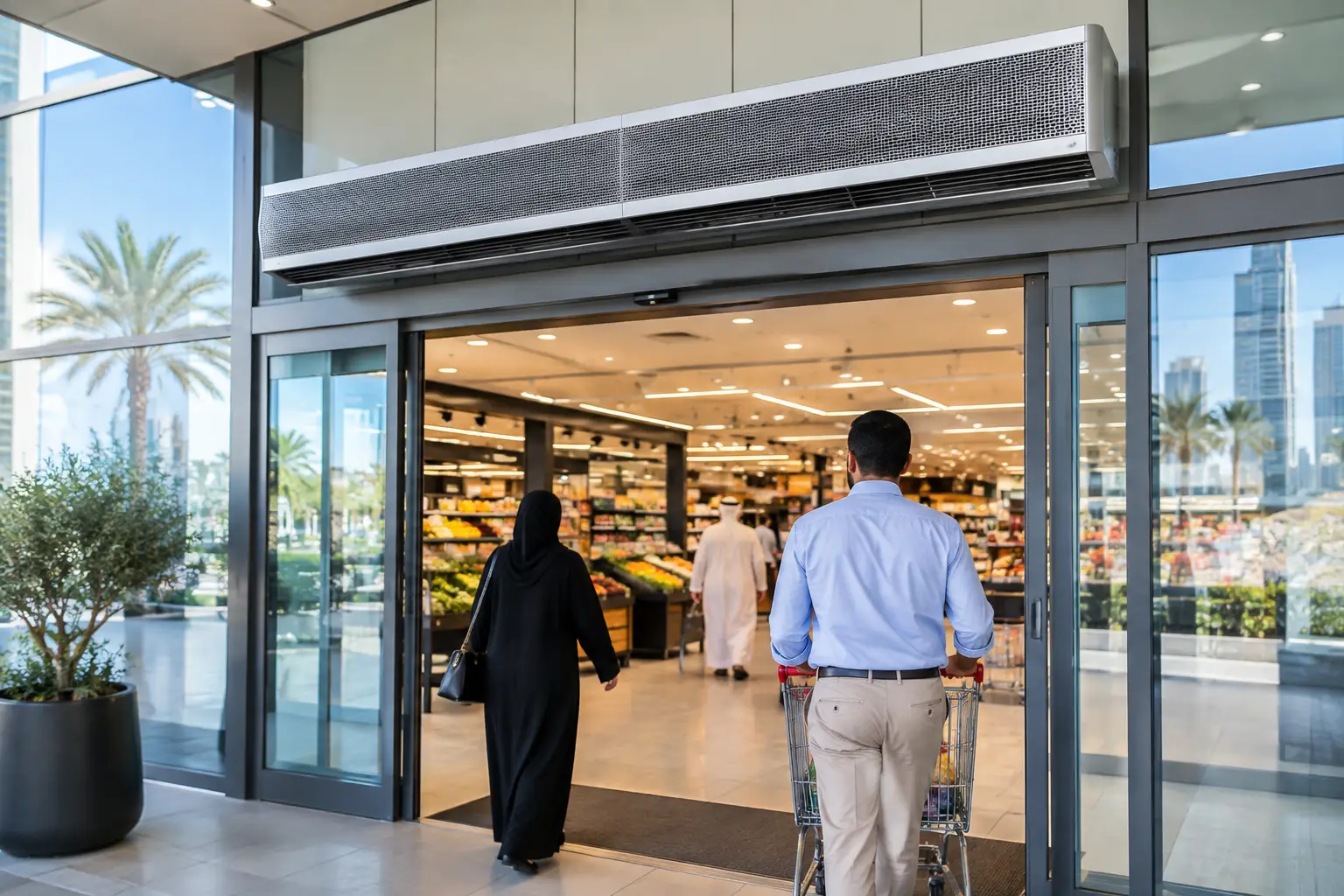
A supermarket loading entrance in Dubai, a hospital lobby in Riyadh, and a warehouse dispatch bay in Lagos face a similar operating problem: every open doorway can become a path for conditioned air to escape and heat, dust, humidity, insects, or fumes to enter. The most relevant air curtain efficiency trends are therefore not about adding equipment for its own sake. They are about producing a reliable air barrier at the doorway while reducing unnecessary fan energy, HVAC demand, noise, and maintenance exposure.
For MEP consultants, facility managers, and project teams, efficiency starts with application fit. A poorly selected unit can consume power without creating sufficient air separation. A properly specified system supports indoor comfort, protects temperature-sensitive operations, and helps HVAC systems cope with demanding tropical and desert conditions.
Why air curtain efficiency is changing
Commercial buildings are under greater pressure to control operating costs without compromising accessibility. High-traffic entrances cannot simply remain closed, particularly in retail, hospitality, logistics, food processing, and healthcare environments. Air curtains have become more closely tied to whole-building HVAC performance because the entrance is often where conditioned space meets extreme outdoor conditions most directly.
The leading trend is a shift from viewing air curtains as a standard doorway accessory to treating them as engineered entrance climate-control equipment. Buyers increasingly assess the relationship between door geometry, outdoor climate, mounting height, traffic patterns, interior pressure, and the adjacent HVAC system before selecting a model.
This matters across the GCC, MENA, and Africa. High ambient heat can quickly raise cooling demand. In coastal locations such as Dubai, Doha, Muscat, and Lagos, humidity also affects comfort and condensation risk. In dusty desert environments, airborne particles increase the need for a stable barrier and practical service access.
Which air curtain efficiency trends matter most?
Correct sizing is replacing one-size-fits-all selection
The most consequential efficiency improvement is not always a new control feature. It is correct sizing. Air velocity and air volume must be suitable for the opening width, mounting arrangement, door height, and pressure conditions at the entrance. A unit selected only by door width may leave gaps in the barrier or use more fan capacity than the application requires.
Specification teams are giving greater attention to the full doorway condition, including:
- The clear opening height and width, including roller shutters, sliding doors, and multiple-leaf entrances
- Mounting position, such as exposed surface mounting or recessed ceiling integration
- Door-open frequency and vehicle, trolley, customer, or pedestrian traffic
- Outdoor heat, humidity, wind exposure, dust, smoke, and insect-control requirements
- The temperature and pressure conditions of the indoor space
- Whether the entrance serves a public area, a conditioned production zone, or cold storage
For a busy retail frontage, visual integration and low perceived noise may influence selection alongside air separation. At a factory or logistics dock, the priority may be the reach and resilience needed to protect a larger, more frequently open doorway. The best option depends on the operating condition, not on a generic efficiency label.
Smarter controls are reducing wasted runtime
Another important trend is the use of controls that match air curtain operation to door activity and building demand. Running at full output throughout every operating hour may be appropriate in some continuously open entrances, but it is not automatically the most efficient approach.
Door-status control, staged fan operation, building management system coordination, and timed operating schedules can reduce runtime when the barrier is not required. These controls should be specified carefully. If airflow ramps too slowly after a door opens, the system may miss the period of greatest infiltration. If control logic is too complex for site operations, it may be overridden or ignored.
The practical objective is straightforward: deliver the required barrier when the opening is active, and avoid consuming energy when the door is closed or traffic is low. This is particularly valuable in facilities with variable traffic patterns, such as shopping malls, hotels, airports, and distribution centers.
Airflow quality is receiving as much attention as airflow volume
Higher fan output does not automatically mean better entrance protection. The discharge must be directed and sustained so that it reaches the threshold with enough integrity to resist infiltration. Turbulent, poorly aimed, or interrupted airflow can allow hot air and contaminants to enter even when the unit appears powerful.
This is why centrifugal air curtain designs continue to be relevant for demanding commercial and industrial settings. They can be specified where consistent airflow performance and effective throw are needed over larger openings or at higher mounting positions. FreezeeX offers commercial and industrial centrifugal series for applications where entrance conditions require more than a light-duty solution.
Recessed installations also remain popular in premium commercial interiors because they can preserve ceiling lines while providing entrance air separation. However, visual integration should never override serviceability or the clearance required for effective discharge. A concealed unit still needs to be selected around the actual entrance condition.
Energy performance now includes the HVAC system
Air curtain energy use should be evaluated alongside the cooling energy it may help prevent at the entrance. The relevant question is not simply, “How much power does the air curtain consume?” It is, “What operating burden does the doorway place on the cooling system without an effective barrier?”
When hot outdoor air and humidity enter a conditioned space, the HVAC system must remove both sensible heat and, in humid locations, latent moisture. Dust and airborne contaminants can also affect indoor conditions and increase cleaning requirements. An effective air curtain supports a more stable interior environment while allowing operations to continue through an open doorway.
This does not mean an air curtain replaces appropriate HVAC design, closed-door discipline, vestibules, or physical seals where those are feasible. It is part of an entrance-control strategy. Results depend on how the doorway, air conditioning system, pressure relationships, and operating behavior work together.
How does climate affect air curtain efficiency?
Climate is central to specification. In hot, dry desert areas, the air curtain must help limit heat and dust infiltration under harsh ambient conditions. In tropical and coastal markets, the barrier must also contend with humid air that can make indoor spaces feel uncomfortable and add to cooling demand.
Wind exposure is another common complication. An entrance facing prevailing winds or vehicle movement may experience cross-drafts that disrupt the air stream. In these cases, project teams may need to consider mounting location, increased performance requirements, doorway orientation, and whether a physical lobby arrangement can support the air curtain’s work.
Application priorities differ by facility type
| Application | Main entrance challenge | Efficiency priority | |—|—|—| | Retail stores and malls | Frequent pedestrian traffic and customer comfort | Controlled operation, low noise, clean integration | | Warehouses and logistics centers | Large openings, dispatch activity, dust exposure | Strong air reach, durable construction, application-specific sizing | | Restaurants and hotels | Comfort, insects, odors, and public-facing appearance | Stable barrier performance with suitable mounting integration | | Hospitals and pharmaceutical facilities | Indoor environmental control and contaminant reduction | Reliable air separation aligned with facility protocols | | Food processing and cold storage | Temperature separation and high operational demand | Correct selection for the opening and operating process |
The table illustrates why product series should follow the use case. Commercial HiFi Plus or recessed ceiling configurations may suit projects where aesthetic coordination and commercial entrance performance are priorities. Industrial centrifugal or Dynamic Series solutions may be more appropriate where entrances are larger, traffic is tougher, or environmental exposure is more severe. Final selection requires project-specific assessment rather than assumptions based on building type alone.
A practical specification process for better efficiency
A strong quotation or design review should follow a deliberate sequence rather than begin with a preferred model. Use this process when evaluating air curtain efficiency for a new build, refurbishment, or operational upgrade:
- Document the doorway. Record clear dimensions, mounting height, available structure, door type, and whether the entrance is recessed, exposed, or affected by cross-drafts.
- Map operating behavior. Identify how often the door opens, how long it remains open, and whether traffic includes pedestrians, carts, forklifts, or loading activity.
- Define the environmental objective. Clarify whether the priority is cooling retention, heat exclusion, humidity control, dust reduction, insect control, odor separation, or protection from fumes.
- Coordinate with HVAC design. Review nearby supply and return air locations, space pressure, cooling load, and control strategy so the air curtain supports rather than conflicts with the HVAC system.
- Select for performance and service access. Choose the appropriate commercial, recessed, or industrial configuration, then confirm access for inspection and planned maintenance.
- Verify operation after handover. Check airflow direction, door-control response where applicable, and whether site conditions have changed from the original design assumptions.
This process avoids a common procurement mistake: comparing units only by initial price or nominal size. The lower-cost option can become the more expensive choice if it does not provide effective air isolation at the actual doorway.
What should buyers ask before requesting a quote?
Ask suppliers to explain why a recommended unit suits the opening, not just which model is available. The explanation should address mounting height, coverage across the width, expected traffic, environmental exposure, and the desired operating outcome. For large projects, consultants should also confirm how the air curtain will coordinate with ceiling layouts, doors, fire and life-safety requirements, and HVAC controls.
Maintenance should be part of the conversation from the beginning. Dusty environments can place additional demands on any air-moving equipment. A design that is difficult to access may be neglected, affecting long-term airflow performance and operating cost. The efficient system is the one that remains correctly operated and maintainable after project handover.
For FreezeeX, the practical focus is powerful air isolation matched to commercial and industrial operating realities, not a generic product recommendation. Entrance conditions in tropical, humid, and desert climates demand that level of assessment.
Specify the barrier, not just the unit
The next stage in air curtain efficiency will be defined by better coordination: controls that reflect actual door activity, airflow selected for the real opening, and performance expectations tied to climate and operations. For projects in Dubai, Riyadh, Doha, Cairo, Nairobi, or other demanding regional markets, the entrance deserves the same engineering attention as the rest of the conditioned space.
Request a consultation and project quotation with the doorway dimensions, mounting details, traffic pattern, and environmental requirements. A properly matched air curtain can make an open entrance far more manageable without asking the HVAC system to carry the entire load.