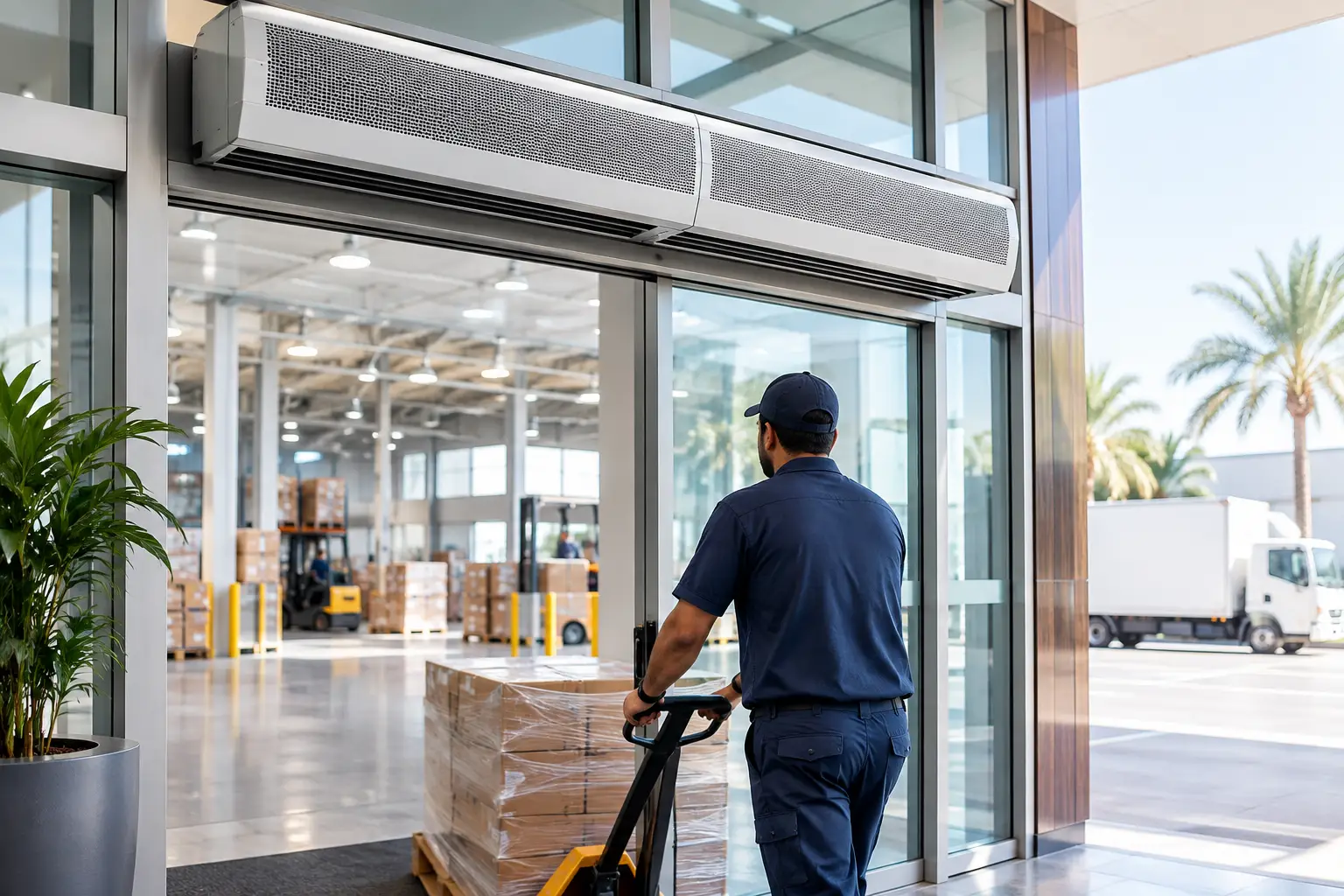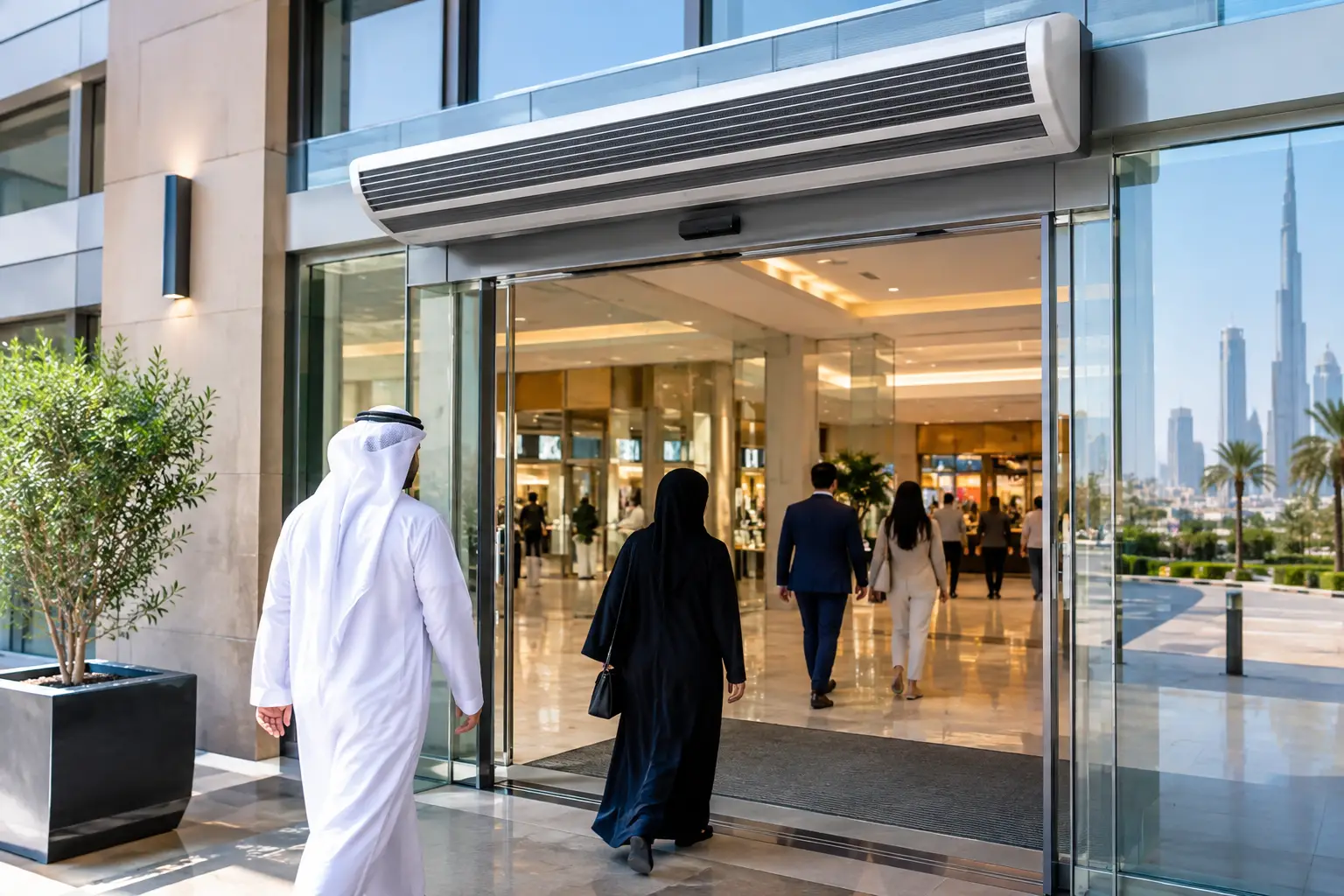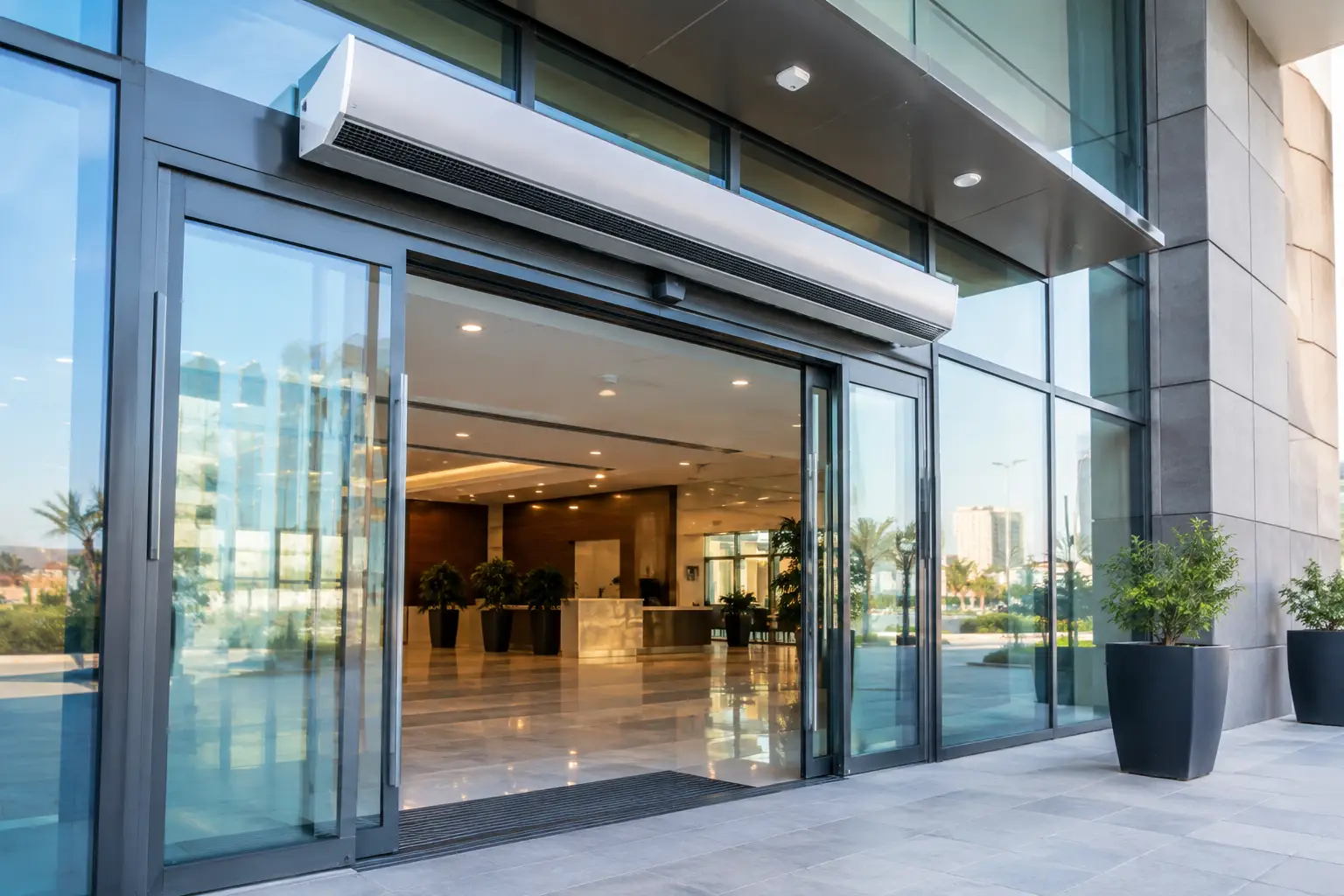
A loading-bay door left open through a Dubai afternoon can place a continuous heat and humidity load on the building’s cooling system. At a busy supermarket entrance in Riyadh or a logistics facility in Lagos, that load repeats hundreds of times each day. Air curtain payback is the measure of how quickly an air curtain recovers its installed cost through lower cooling demand, improved indoor conditions, and fewer operational disruptions at the entrance.
For commercial and industrial facilities in hot, humid, and dusty climates, the question is not simply whether an air curtain saves energy. The practical question is whether the selected unit creates an effective air barrier at the actual door opening, during real traffic conditions. Correct specification determines whether the investment produces a credible return or becomes an underperforming accessory.
What air curtain payback actually measures
Payback period is typically calculated by dividing the total installed cost by the annual financial benefit:
Payback period = installed project cost / annual savings
The installed project cost includes the air curtain, mounting arrangement, electrical works, controls, commissioning, and any structural provisions required at the entrance. Annual savings may include reduced HVAC energy consumption, but a sound business case can also consider avoided product spoilage risks, lower cleaning demand from dust ingress, improved insect control, and better customer or staff comfort near the doorway.
Not every benefit is easy to convert into a precise currency figure. A food-processing entrance, pharmaceutical receiving area, or cold-storage loading point may justify an air curtain partly because it supports hygiene and temperature-control procedures. In these cases, energy savings remain important, but payback should be evaluated alongside operational risk and compliance requirements.
The factors that drive commercial air curtain payback
The main factors affecting payback are:
- Door dimensions and mounting height
- Traffic volume and door-open time
- Outdoor climate and building pressure
- Cooling requirements and operating profile
Door dimensions and mounting height
An air curtain must project a stable, sufficiently strong airstream across the full opening and down to the floor. A unit selected only by door width can fall short if the mounting height is excessive, the door is exposed to crosswinds, or the opening is unusually tall.
At a high warehouse door, an industrial-grade system with the required throw and discharge velocity may cost more than a compact commercial unit. However, an undersized product that allows hot outside air to pass through will provide weak HVAC savings and extend the payback period indefinitely. The right comparison is not the lowest unit price. It is the cost of achieving effective air isolation at that specific entrance.
Traffic volume and door-open time
A closed door already limits infiltration. The strongest payback cases occur where doors remain open for extended periods or cycle constantly throughout the day. Supermarket entrances, restaurant service doors, mall access points, airport doors, dispatch bays, and factory openings are common examples.
A low-traffic office entrance may still benefit from improved comfort and dust control, but its direct energy payback can be slower. Conversely, a busy loading dock with multiple shifts may justify higher-capacity equipment because every open-door hour exposes the conditioned space to outdoor heat, humidity, dust, and insects.
Outdoor climate and building pressure
In Abu Dhabi, Doha, Muscat, Cairo, and similar markets, high ambient temperature creates a large difference between outdoor and indoor conditions. In coastal locations, humidity can increase the latent cooling load as well. Desert dust and sand add another operational concern, especially where doors face prevailing winds or vehicle routes.
An air curtain does not replace a properly designed HVAC system or a physical door. It reduces the exchange of outside and inside air while people, carts, or goods need access. Its performance also depends on building pressure, nearby exhaust systems, air-conditioning supply patterns, and wind exposure. These factors should be assessed during project design rather than after installation.
The cost and operating profile of cooling
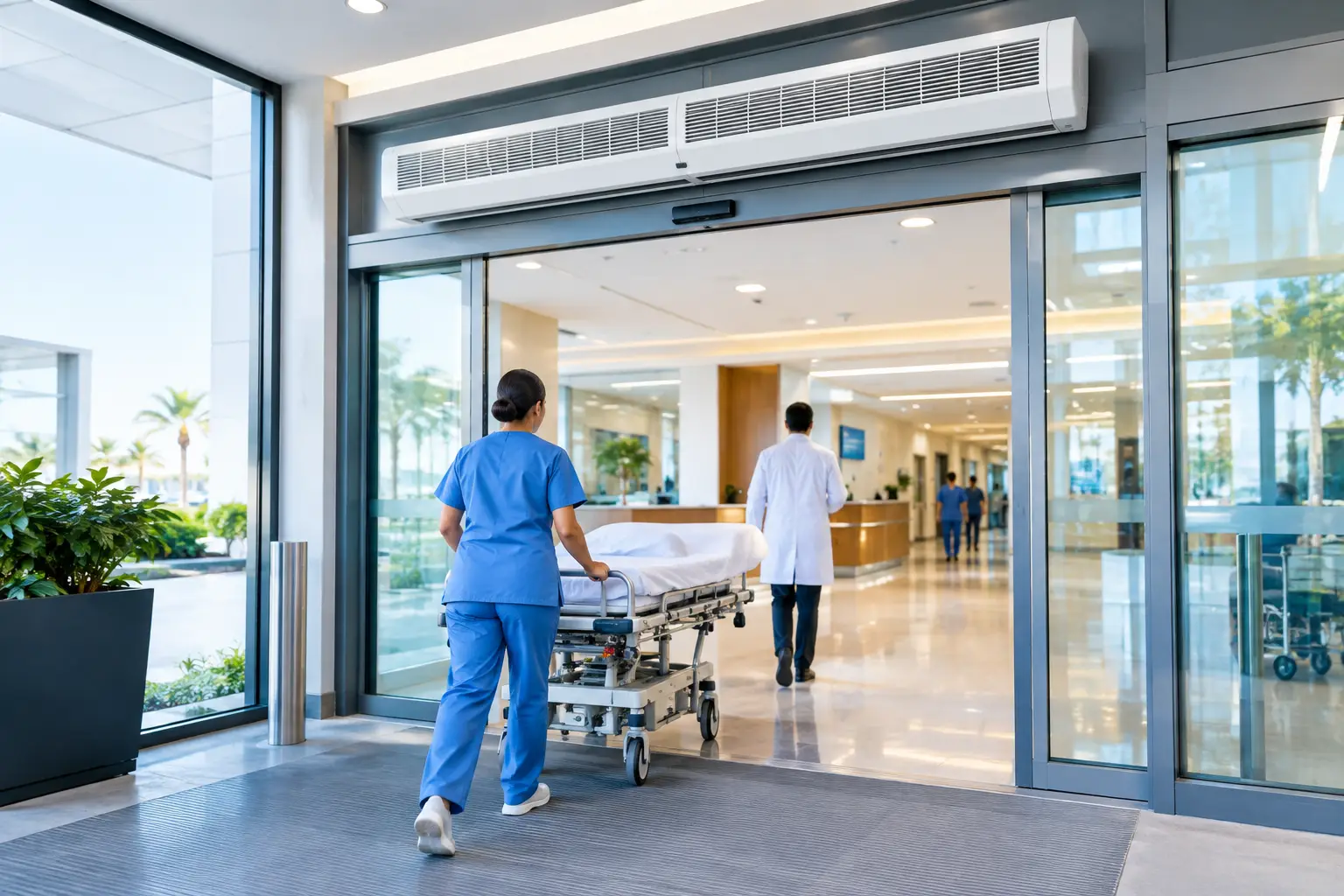
Annual savings depend on how much cooling the facility uses, how long it operates, and the local electricity tariff. A 24-hour supermarket, hospital receiving entrance, or distribution center can generate more value from reduced infiltration than a site with limited daytime operation.
Facility managers should also separate peak-demand concerns from total energy use. Hot outdoor air entering repeatedly through a high-traffic doorway can contribute to uncomfortable zones and force cooling equipment to work harder during the most demanding part of the day. The financial impact may not appear as a single, obvious line item, but it can affect overall HVAC operating performance.
How to estimate payback before specifying equipment
A preliminary assessment starts with operating data, not assumptions. Record the clear width and height of every opening, mounting position, approximate door-open hours, indoor temperature target, and outdoor exposure. Note whether forklifts, delivery vehicles, customer traffic, or automatic doors change the airflow conditions.
The next step is to establish the baseline. Review electricity consumption, HVAC runtime, comfort complaints near entrances, cleaning frequency, pest-control incidents, and any temperature-sensitive processes close to the opening. Where possible, compare similar doors with different traffic patterns. This creates a more defensible estimate than applying a generic savings percentage to the entire building utility bill.
For a significant project, an HVAC or MEP consultant may model infiltration loads and calculate the expected reduction based on local design conditions. This is especially valuable for cold storage, food processing, pharmaceutical facilities, hospitals, and large logistics operations, where the effects of uncontrolled air exchange can exceed the cost of electricity alone.
A practical estimate should include three cases: conservative, expected, and high-traffic. The conservative case assumes modest door-open hours and limited energy savings. The expected case uses typical operating conditions. The high-traffic case reflects peak seasons, delivery windows, or heavy footfall. This approach prevents an investment decision from relying on a single optimistic number.
Why product selection changes the return
Air curtain payback is closely tied to airflow performance, not just rated power consumption. Centrifugal systems are often suited to demanding commercial and industrial openings because they can provide the pressure and throw required where mounting heights, traffic, or exposure are challenging. Recessed ceiling units may be appropriate where architectural integration matters, provided the ceiling void and discharge path support effective coverage.
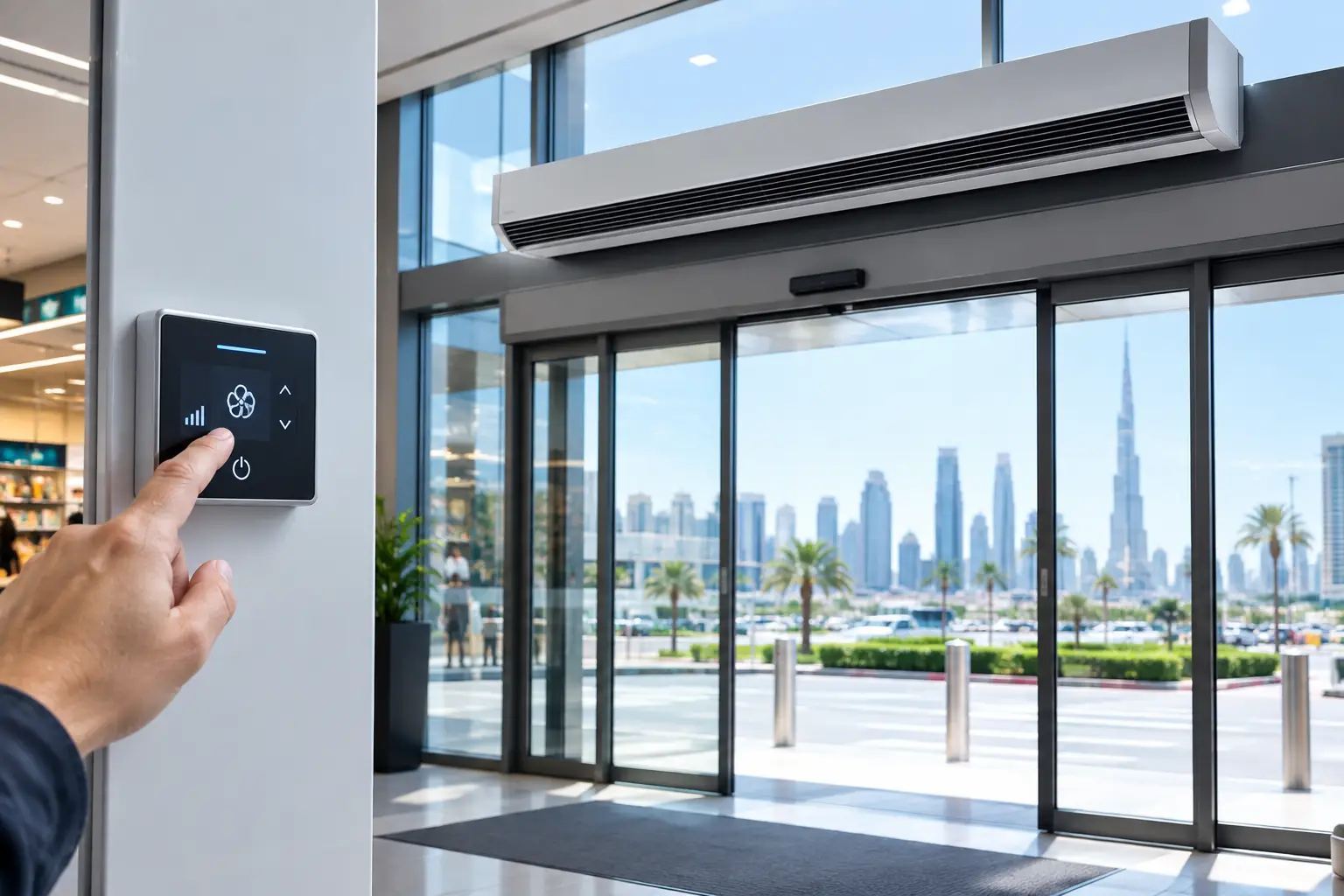
Controls also influence operating cost and effectiveness. Door switches, sensors, interlocks, and variable-speed operation can ensure the air curtain operates when the entrance is in use rather than continuously at full output. The objective is not simply to minimize operating hours. It is to deliver the required air barrier precisely when infiltration risk is highest.
Noise expectations matter as well. A retail entrance, hotel lobby, or hospital reception requires a different acoustic approach than a warehouse or manufacturing bay. Selecting a unit that meets both airflow and noise requirements avoids later compromises, such as reducing fan speed below the level needed to protect the opening.
When the payback case is weaker
An air curtain is not automatically the right solution for every door. Payback can be weak where a door remains closed nearly all day, the opening has severe uncontrolled crosswinds, or installation constraints prevent proper mounting. A damaged or poorly managed door system can also undermine results.
There are cases where a combination of measures is more appropriate: rapid-action doors for logistics routes, vestibules for public entrances, improved door discipline, or revised traffic flow. An air curtain should be specified as part of the entrance strategy, with its role clearly defined.
It is also important not to overstate savings. Energy results vary by climate, door usage, building pressure, equipment performance, and installation quality. A credible proposal explains the assumptions behind the payback calculation and identifies what must be true in operation for the expected return to be achieved.
A stronger return starts with site-specific specification
For a retail entrance, the priority may be keeping conditioned air inside while reducing dust and insect ingress without disrupting customer flow. For a warehouse, the priority may be high-velocity coverage over a tall, frequently open loading door. For a pharmaceutical or food facility, the requirement may include controlling airborne contaminants and maintaining stable indoor conditions during material movement.
The most reliable route to a favorable payback period is to match the air curtain to the opening, climate, traffic profile, and HVAC design. In tropical and desert environments, those details directly affect cooling losses and operating costs.
For a project-specific air curtain payback assessment, provide the door dimensions, mounting height, operating schedule, site location, and traffic conditions to FreezeeX for a consultation and quotation. A properly specified entrance air barrier can protect indoor conditions from the moment the door opens, where the cooling load is often at its highest.