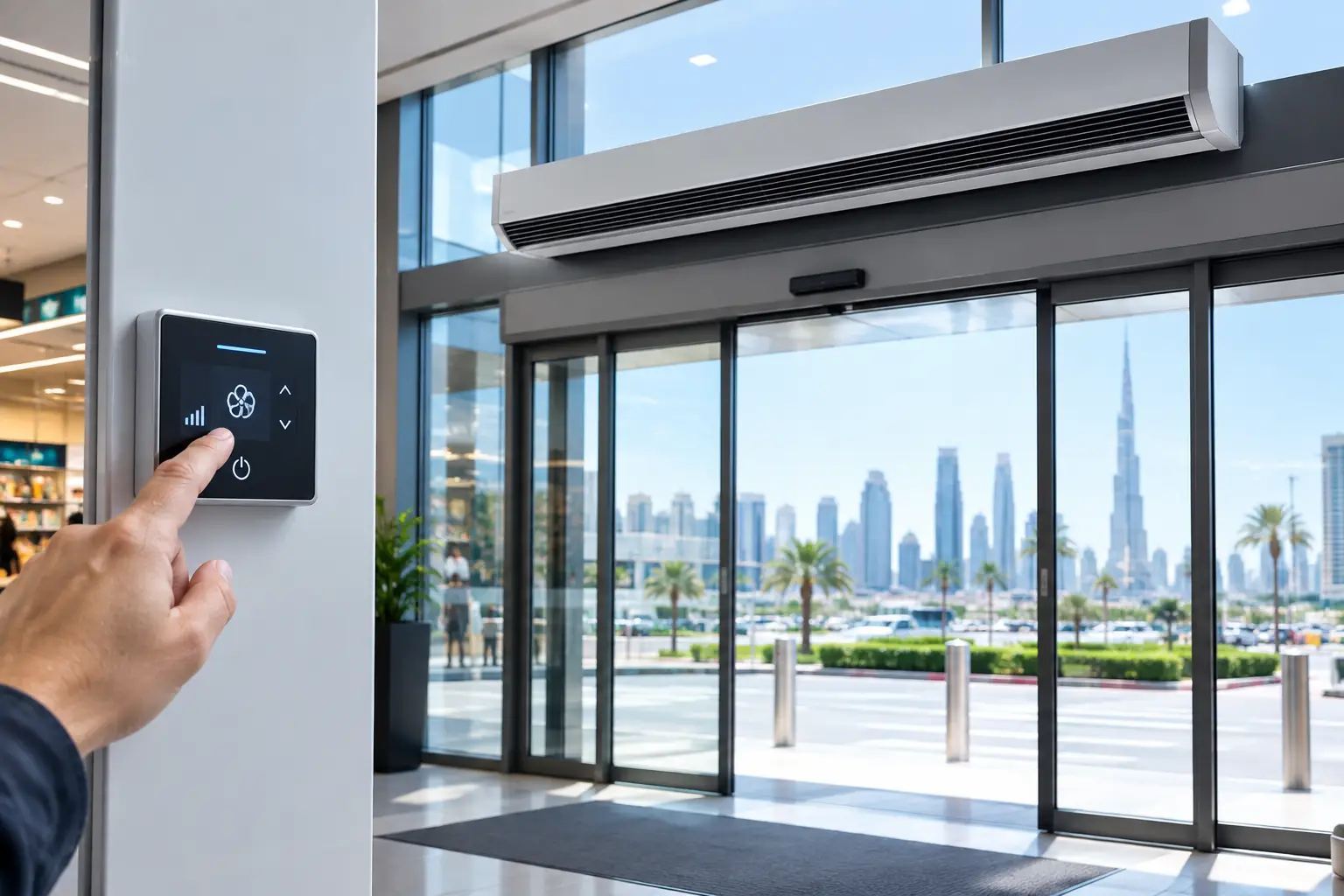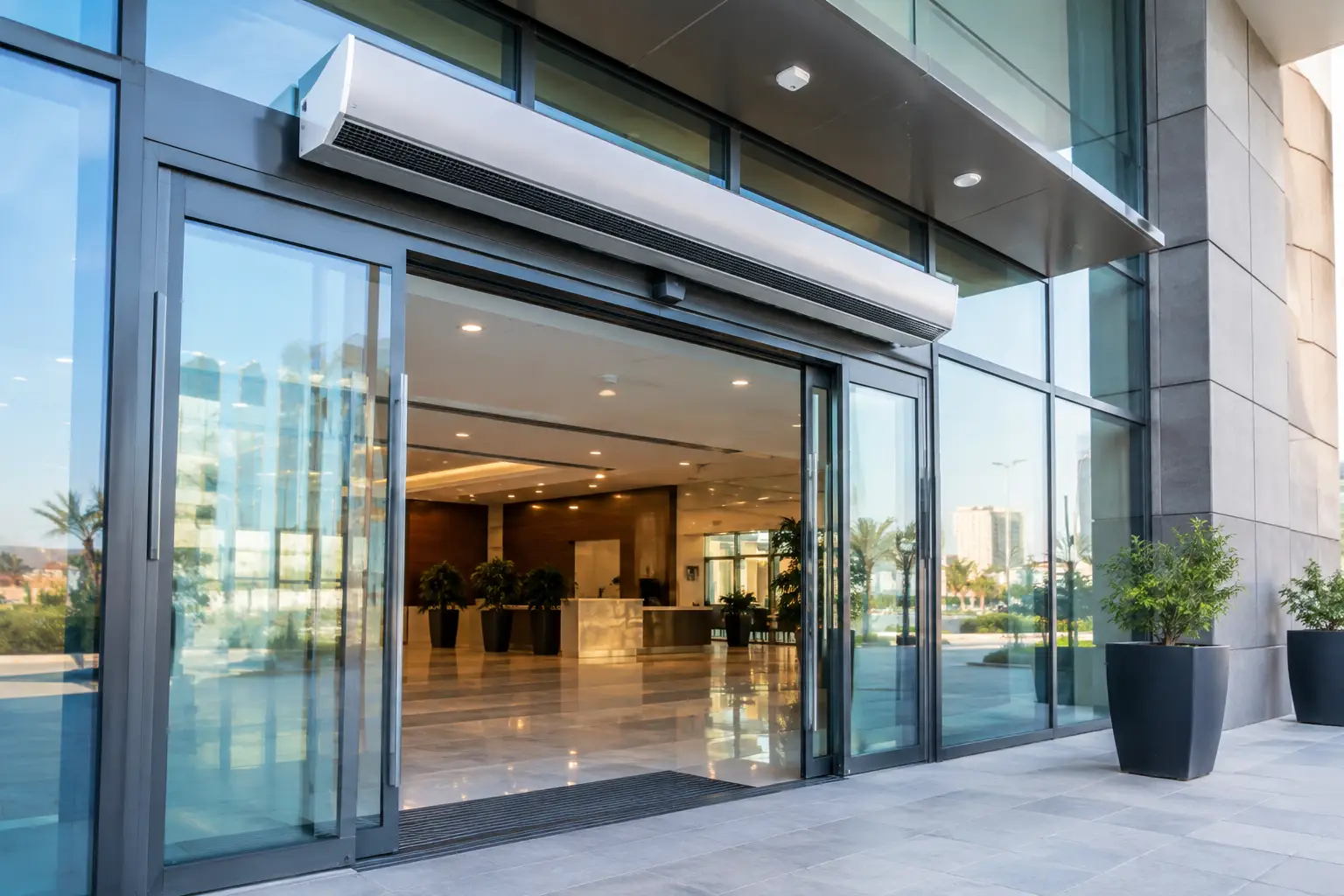
A busy entrance can become one of the largest uncontrolled loads on a commercial cooling system. This high traffic doorway guide explains how facility teams, MEP consultants, and contractors can specify air curtains for entrances that remain open throughout the day, from supermarket receiving doors in Dubai to logistics facilities in Riyadh and hotel lobbies in Doha.
At high-traffic doors, the issue is not simply that cooled air escapes. Outdoor heat, humidity, dust, insects, fumes, and airborne contaminants can enter every time the door opens. In tropical, coastal, and desert climates, that infiltration affects occupant comfort, product conditions, indoor cleanliness, and HVAC operating costs. A properly selected air curtain creates a controlled air barrier that supports the building’s primary cooling strategy without obstructing customer, staff, or goods movement.
Why High-Traffic Doorways Need a Different Specification
A doorway used a few times per hour can often be assessed by door size and mounting height alone. A doorway used continuously needs a broader review. Footfall, trolley movement, forklift routes, door-open duration, pressure differences, and nearby loading activity all influence air-barrier performance.
For example, a retail entrance may have constant pedestrian traffic but a relatively stable indoor environment. A warehouse loading door may be open for long periods and exposed to wind, vehicle exhaust, dust, and major temperature differences. Both need air isolation, but they do not need the same unit, airflow profile, or control approach.
The objective is to create an air stream with enough reach and stability to meet the floor or threshold area without becoming excessively noisy or disruptive. More airflow is not automatically better. An oversized or poorly aimed unit can create drafts, increase energy consumption, and still leave gaps where outside air enters.
High Traffic Doorway Guide: Start With the Entrance Conditions
Before selecting an air curtain, document how the entrance actually operates. Architectural drawings establish dimensions, but site conditions determine whether the solution will perform as intended.
Measure the full opening, not only the door leaf
Record the clear width and height of the opening, including any side gaps, transom spaces, roller-shutter clearances, or recessed mounting zones. The air curtain should cover the complete opening width. On wide entrances, several units may be arranged side by side, with careful attention to overlap so the air barrier remains continuous.
Mounting height is equally important. As height increases, the discharge air must travel farther before reaching the lower part of the opening. This usually calls for a higher-performance centrifugal unit rather than a light-duty commercial model.
Assess traffic patterns and door behavior
A sliding supermarket door that cycles every few seconds behaves differently from a hotel entrance with revolving-door traffic or a factory shutter opened for deliveries. Identify whether the door is normally open, sensor-operated, manually operated, or subject to extended open periods.
Also consider the people and equipment using the doorway. Pedestrian entrances require comfortable airflow and acceptable sound levels. Industrial openings must tolerate forklifts, pallet movement, and possible impact risks while sustaining a stronger air stream. A loading bay exposed to traffic emissions may require the air curtain to support a broader indoor air-quality strategy rather than serve as the only protective measure.
Account for outdoor exposure
Entrances facing direct sun, prevailing winds, dusty yards, vehicle lanes, or humid coastal air face higher infiltration pressure. In locations such as Abu Dhabi, Muscat, Kuwait City, Lagos, or Nairobi, local heat and humidity conditions can materially change the equipment requirement.
Wind is especially relevant. Strong crosswinds can deflect the discharge stream before it reaches the threshold. Recessed mounting, vestibules, canopies, or an adjusted discharge angle may improve results, but these measures must be considered during design rather than after commissioning.
Match the Air Curtain to the Application
Air curtains are application-specific equipment. The right choice depends on the doorway’s duty cycle and the operational consequence of infiltration.
For retail stores, malls, restaurants, hotels, and office entrances, a commercial air curtain often provides the needed balance of appearance, quiet operation, and effective climate separation. Recessed ceiling air curtains can suit finished lobbies and architectural entrances where equipment should remain visually discreet. Commercial centrifugal and HiFi-style configurations are appropriate where dependable airflow and controlled noise are priorities.
For warehouses, factories, workshops, logistics centers, and large delivery openings, industrial centrifugal air curtains are generally more suitable. Their higher-pressure airflow is designed for larger mounting heights and demanding operating conditions. Durable construction and accessible service arrangements matter because these areas often have dust exposure and long daily operating hours.
Cold storage and food-processing facilities require an even more careful approach. The air curtain must help limit warm, humid air entry that can increase condensation, affect temperature control, and add load to refrigeration systems. Door dimensions, temperature differential, traffic frequency, hygiene requirements, and air movement inside the facility should all be reviewed as part of the specification.
Hospitals, pharmaceutical plants, and clean operational areas require attention to airborne contaminants and pressure relationships. An air curtain can help reduce uncontrolled entry through active doors, but it should be coordinated with the facility’s wider ventilation, filtration, and pressure-control design. It is not a substitute for required cleanroom or infection-control measures.
Airflow Performance Matters More Than Motor Size
Motor power alone does not describe whether an air curtain will protect a busy opening. Specifiers should focus on discharge velocity, effective throw, airflow volume, outlet geometry, and the unit’s ability to maintain a stable air stream at the required mounting height.
Centrifugal blower designs are commonly selected for demanding commercial and industrial entrances because they can provide stronger, more controlled discharge performance. The outlet direction also matters. A slight outward angle may help resist incoming hot air, while an incorrect angle can leave the lower doorway unprotected or force conditioned air outside.
Noise must be evaluated in context. A unit suited to a loading bay may be inappropriate above a reception desk, even if it has sufficient throw. For customer-facing spaces, selection should balance acoustic comfort with air-barrier effectiveness. For industrial locations, performance durability and coverage may take greater priority.
Controls Should Follow Door Activity
Running an air curtain continuously is sometimes appropriate for entrances that remain open. However, integrating operation with door contacts, sensors, building controls, or speed settings can reduce unnecessary runtime where traffic is intermittent.
The control strategy should reflect the application. A sensor-operated retail door can activate the unit before or as the door opens. A warehouse door may require a manual override or sustained operation during loading. A facility with different day and night traffic patterns may benefit from variable operating modes.
Coordination with the HVAC system is essential. Air curtains reduce the infiltration load at the doorway, but they do not replace correct air-conditioning capacity, supply-air distribution, or building pressure management. The strongest results come when the entrance is treated as part of the overall HVAC design.
Installation Details That Affect Results
Even a correctly selected unit can underperform if its installation does not follow the opening geometry. The air curtain should be mounted as close as practical to the opening, positioned to cover its full width, and installed at a height within its rated operating range. Structural support, electrical supply, access for inspection, and clearance around the intake should be resolved before installation.
Avoid placing signage, bulkheads, lighting features, or architectural elements where they obstruct the intake or discharge path. At recessed entrances, confirm that the ceiling void provides sufficient space and that the grille layout does not restrict airflow. For multiple-unit arrangements, align the outlets precisely and avoid unprotected gaps between units.
Maintenance planning is also part of specification. In dusty commercial and industrial environments, filter nets and air inlets require periodic inspection to prevent reduced airflow. Facility teams should select equipment with practical access based on the ceiling height, operating schedule, and site safety procedures.
A Practical Specification Checklist
For a quotation or design review, provide the opening width and height, mounting location, traffic type, expected door-open duration, outdoor exposure, indoor temperature target, and any special concerns such as dust, insects, humidity, fumes, or hygiene. Photos and drawings are particularly useful for identifying wind exposure, obstructions, recessed areas, and adjacent HVAC outlets.
It also helps to state whether the project is a retail entrance, warehouse bay, cold room door, food-processing opening, hospital access point, or hotel lobby. This allows the recommended air curtain category, controls, and mounting arrangement to be matched to the actual operational risk rather than chosen from a generic size chart.
For high-traffic entrances in hot, humid, and desert environments, the right air curtain is a performance decision, not an accessory. Request a FreezeeX consultation and quotation with your doorway dimensions and operating conditions to develop an air-isolation solution that supports comfort, cleanliness, and HVAC efficiency over the long term.