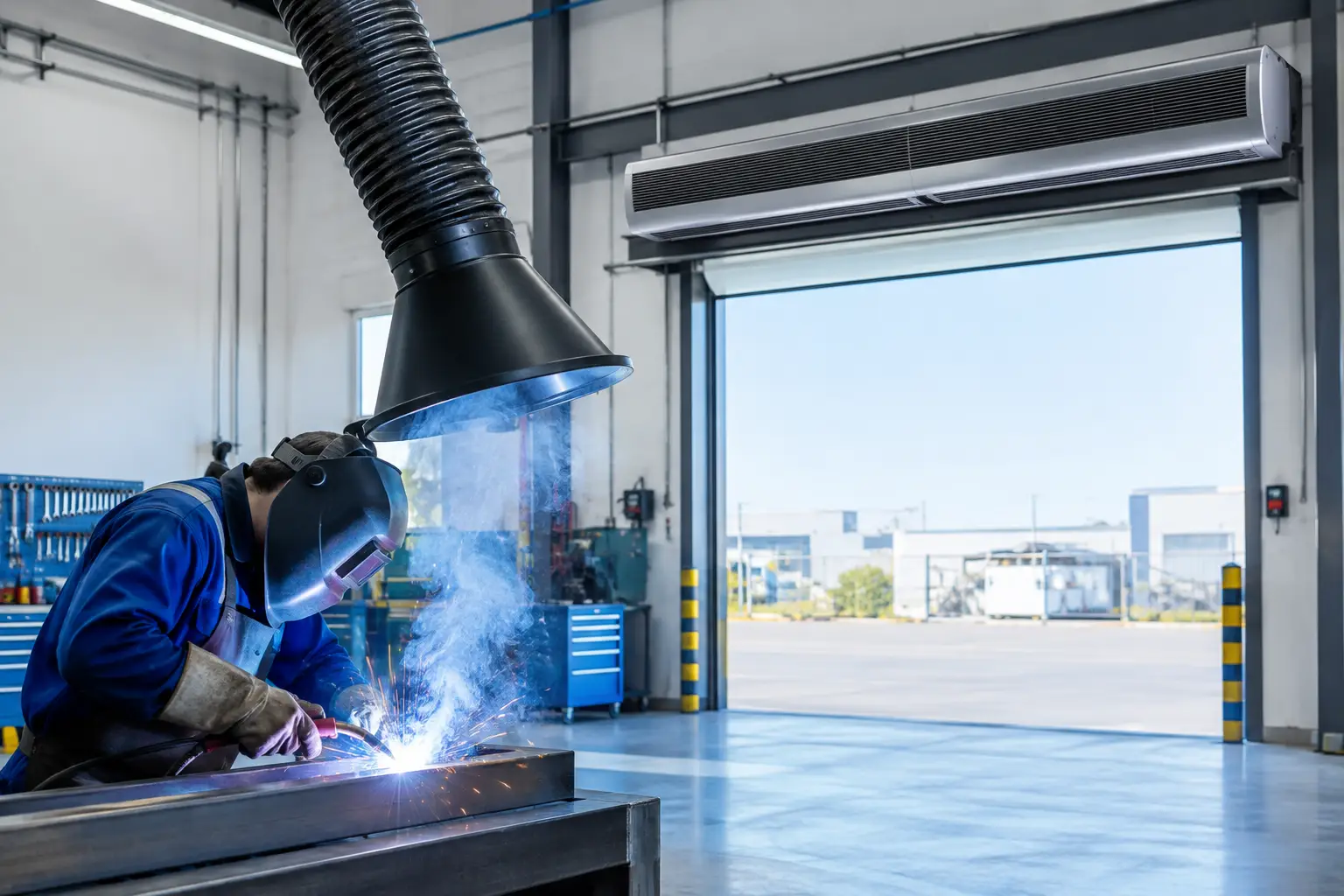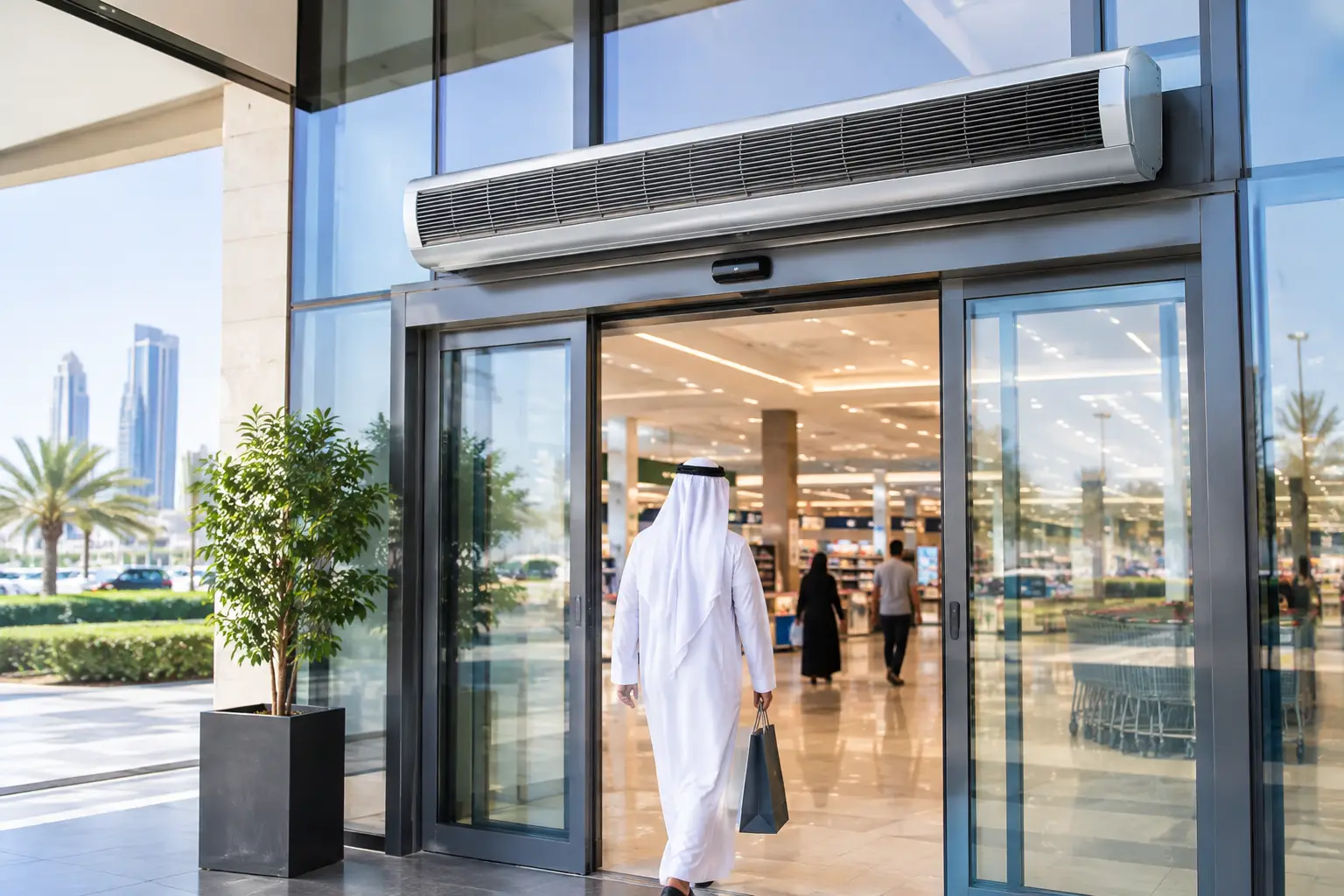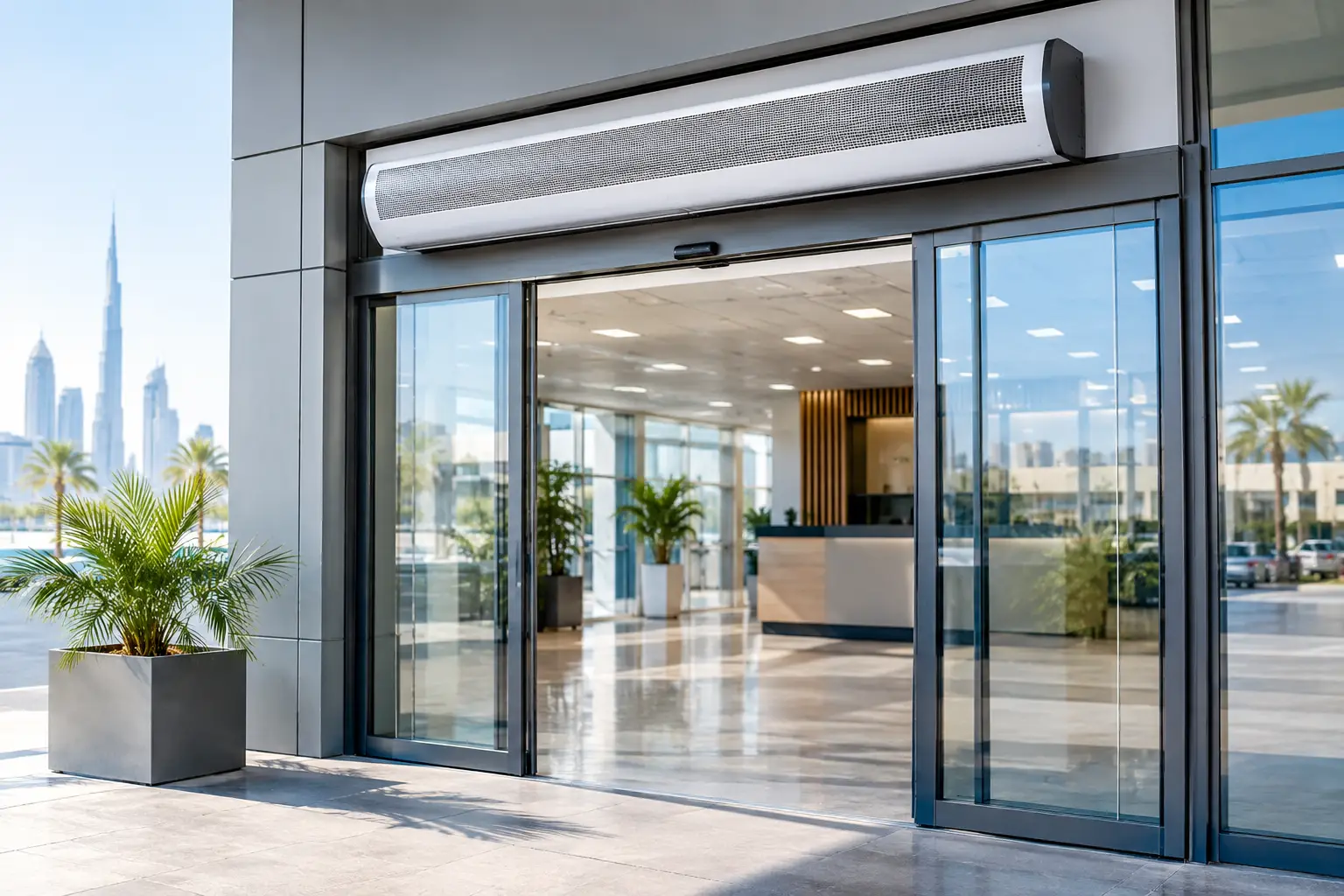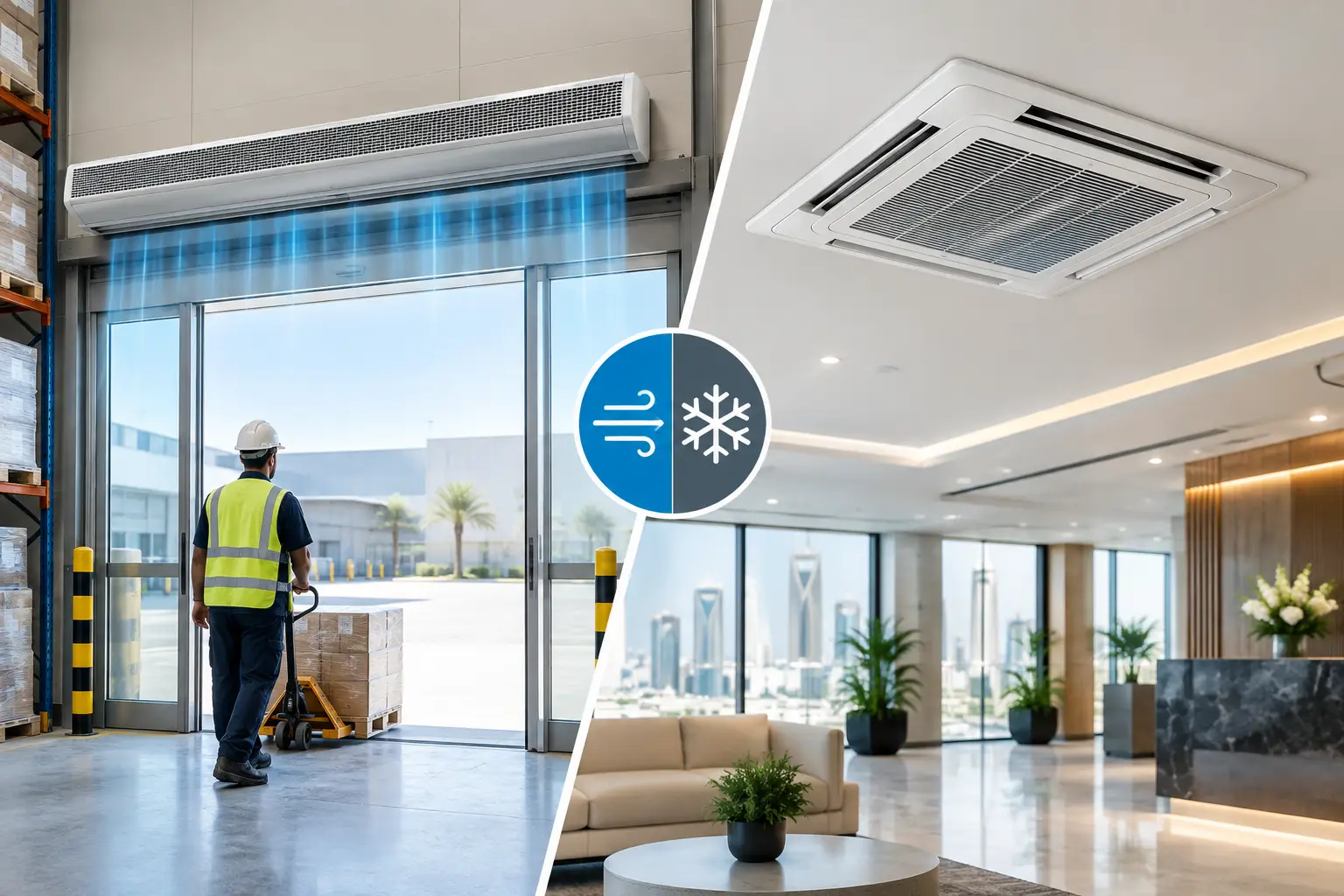
A loading-bay door opens every few minutes at a manufacturing plant in Dubai. Forklifts move between the yard and production floor, while hot, dust-laden outdoor air enters through a six-meter opening. The facility already has localized extraction for process-generated dust, yet housekeeping teams still find fine dust near packing lines and electrical panels. This factory dust control example illustrates a frequent gap in industrial air-quality planning: controlling dust created inside the facility is not the same as stopping dust from entering through busy external doors.
For factories across the GCC, MENA, and Africa, open-door dust ingress can undermine product quality, employee comfort, HVAC performance, and cleaning schedules. An industrial air curtain can form part of a practical entrance-control strategy, but it must be selected and installed for the actual opening, traffic pattern, and site conditions.
The Factory Dust Control Example: A Busy Loading Bay
Consider a food-packaging facility with a production hall held at a controlled indoor temperature. The hall connects directly to a loading yard exposed to desert dust, vehicle movement, and high ambient temperatures. The loading door remains open during pallet transfers for approximately five to eight minutes at a time, with more than 50 opening cycles per shift.
The plant’s initial response was to increase internal cleaning and adjust its HVAC operation. Neither approach addressed the source of the problem. Dust was entering at the doorway whenever the pressure difference, wind direction, and forklift movement disrupted the indoor air boundary. Conditioned air was also escaping, creating warmer zones near the entrance and increasing the load on the cooling system.
The solution involved separating two different dust-control objectives. First, the facility retained its internal process extraction for dust generated by equipment and handling activities. Second, it specified an industrial air curtain at the loading-bay opening to create a high-velocity air barrier across the doorway. This barrier reduces the amount of airborne dust, hot air, humidity, and insects that can pass into the production space while vehicles and personnel move through the entrance.
An air curtain does not filter a production area or replace dust extraction. Its role is entrance air isolation. That distinction matters when preparing an MEP specification or assessing whether a proposed solution will address the real operational problem.
Why Dust Enters Even When the Factory Is Clean
Dust ingress is influenced by more than the visible condition of the loading yard. In hot, dry environments, airborne particles remain easily disturbed by vehicle traffic and wind. In humid coastal locations, dust may combine with moisture and adhere to floors, stock, sensors, and equipment surfaces.
At an open factory door, several forces can pull contaminants indoors. Hot external air can move toward cooler conditioned spaces. Wind can push dust through the opening. Forklifts create a wake that carries air and particulates with them as they pass through. In some buildings, nearby extraction systems may also contribute to negative pressure if supply air is not properly balanced.
A fixed strip curtain may slow some air movement, but it can be impractical where vehicle traffic is frequent and can become damaged or obstruct visibility. Keeping doors shut is effective only when operations allow it. At a high-throughput loading bay, the usable solution must protect the opening without slowing logistics.
How an Industrial Air Curtain Changes the Result
An industrial air curtain projects a controlled stream of air from the top of an opening toward the floor. Properly sized airflow helps maintain a separation zone between outside and inside air. The objective is not to create an impenetrable wall. Rather, it is to reduce cross-flow and the volume of dust and heat entering during normal door use.
In this example, the facility selected an industrial centrifugal air curtain because the opening was high, wide, and exposed to variable outdoor conditions. Centrifugal fan designs are suited to demanding commercial and industrial entrances because they can deliver the pressure and air throw needed to reach the floor from higher mounting positions.
The result is operationally meaningful. Less dust settles near the entry zone, cleaning teams spend less time responding to repeated contamination, and the HVAC system loses less cooled air each time the bay is open. The production area also experiences fewer temperature swings near the doorway, which can be relevant for packaging, food processing, pharmaceutical handling, and other controlled operations.
Performance still depends on realistic expectations. A very wide opening, crosswinds, recessed mounting, or unusually high forklift traffic can reduce barrier effectiveness. For that reason, the air curtain must be engineered around the site rather than selected solely by door width.
What Should Be Specified Before Selecting a Unit
A successful factory entrance system begins with a site assessment. The specification team should document the clear opening width and height, mounting space above the door, door operating schedule, traffic type, and any adjacent extraction or supply-air systems. These details determine whether one unit, multiple units, or a different mounting arrangement is required.
The outdoor environment is equally important. A factory in Riyadh or Abu Dhabi may face severe heat and airborne sand, while a coastal facility in Doha, Muscat, or Lagos may need to manage both humidity and dust. The selected equipment should be designed for continuous commercial operation in tropical and desert climates, with durable construction and airflow performance appropriate to the exposure level.
Air velocity at the discharge, air throw to the floor, and installation height are critical technical variables. If airflow loses momentum before reaching the lower part of the opening, dust can pass underneath the barrier. If the discharge angle is poorly set, the stream may be pushed outward or inward rather than forming an effective seal. These are specification and commissioning considerations that should be reviewed by the project engineer or HVAC contractor.
Control strategy also affects energy use. In many applications, the air curtain should operate only when the door is open, using a door contact or an appropriate control arrangement. This prevents unnecessary runtime while ensuring the barrier activates when the risk of dust ingress is highest. Facilities with long-duration open doors may require continuous operation during active loading periods.
Where This Approach Fits and Where It Does Not
Entrance air curtains are particularly useful at factory loading bays, material receiving doors, dispatch areas, packaging hall entrances, warehouse-to-production transitions, and personnel doors exposed to dusty outdoor conditions. They can also help protect cleaner internal zones from contaminants moving through internal openings.
However, an air curtain is not the correct standalone response to every dust issue. If dust originates from cutting, grinding, powder handling, or bulk material transfer inside the building, localized capture and filtration remain essential. If a door is rarely opened, an improved door seal or operational change may provide a more economical result. If the opening has extreme wind exposure, a wider or higher-pressure air curtain arrangement may be necessary, sometimes alongside a vestibule or loading-dock enclosure.
The right approach is usually layered: control dust at the source, reduce transport through the building, and protect vulnerable entrances. This avoids overloading a single system with a problem it was not designed to solve.
Operational Benefits Beyond Cleaner Floors
The most visible benefit is often reduced dust accumulation around the entrance. Yet facility managers should also consider the wider operating impact. Limiting hot outside air entering a conditioned factory helps stabilize indoor temperatures and can reduce unnecessary HVAC demand. Lower humidity ingress may also support packaging consistency and reduce condensation risk in controlled environments.
For maintenance teams, less airborne dust entering from the yard can mean fewer cleaning interventions around sensitive panels, conveyors, sensors, and stock staging areas. For quality teams, the benefit is a more controlled transition between outdoor logistics activity and indoor production.
These gains should be measured against the electrical consumption and installation cost of the air curtain. In high-traffic, climate-exposed openings, the value typically comes from avoiding repeated cooling loss and contamination rather than from a single isolated benefit. In lower-traffic applications, the payback case may depend more heavily on product sensitivity, cleaning costs, and HVAC operating hours.
A Better Starting Point for Factory Projects
For industrial facilities, the productive question is not simply, “Do we need an air curtain?” It is, “What is entering through this opening, how often is it open, and what level of separation does the process require?” Answering those questions produces a specification that supports actual factory operations instead of relying on a generic door-mounted unit.
FreezeeX can review entrance dimensions, mounting conditions, traffic volume, and climate exposure to recommend an industrial air curtain configuration suited to demanding factory environments. Request a consultation or quotation with your door schedule and site details to assess a dust-control approach that supports cleaner operations without disrupting material flow.