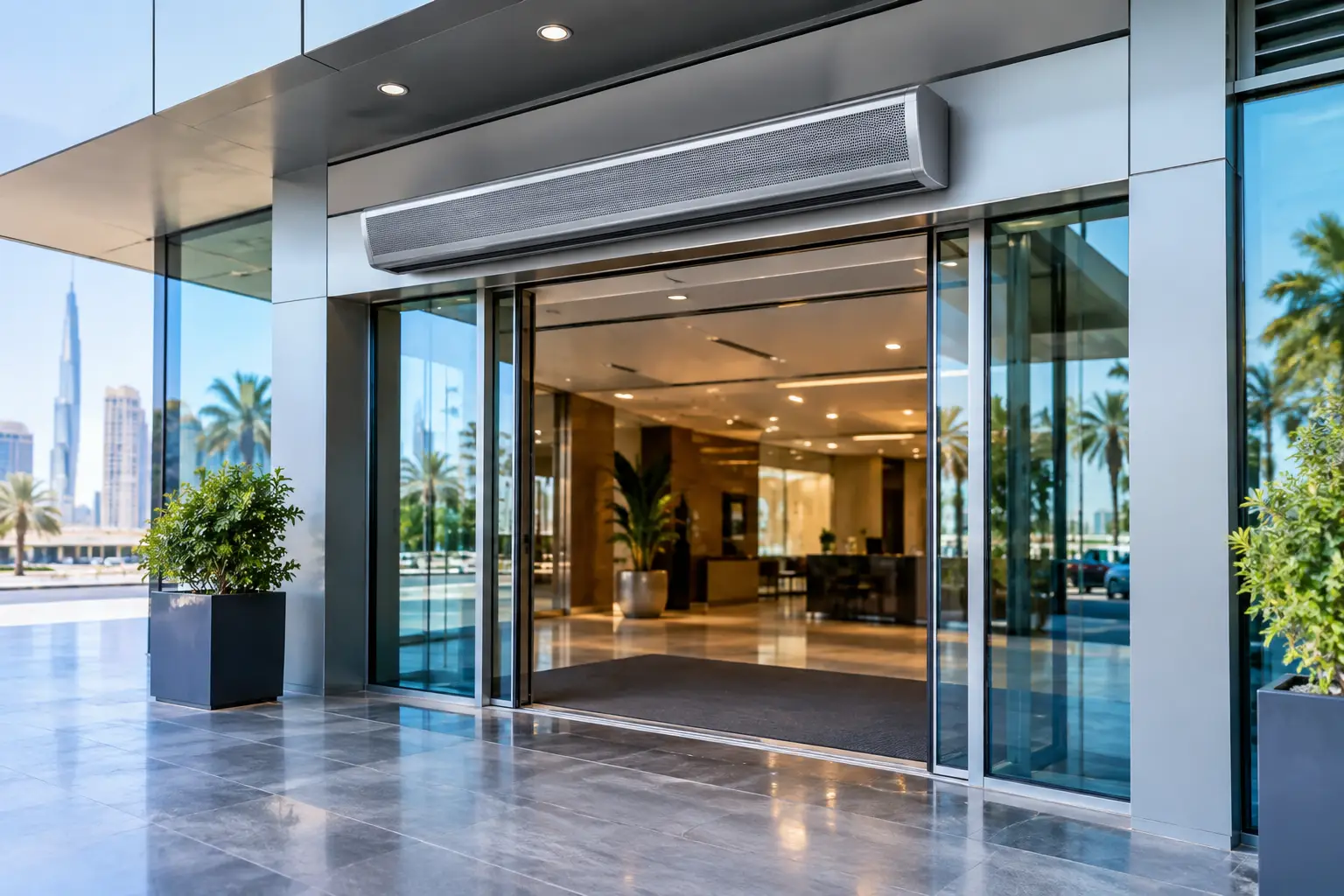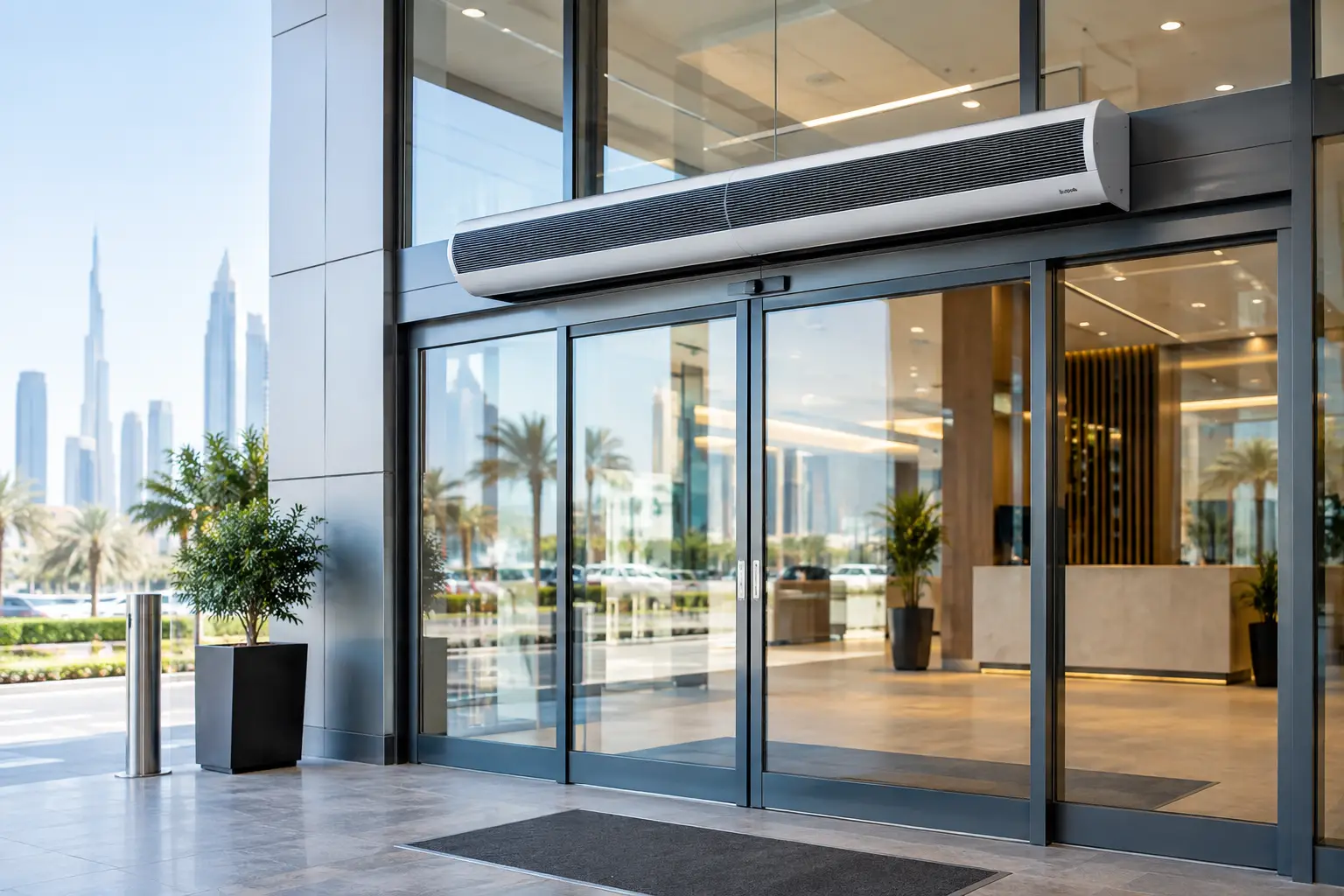
A busy supermarket entrance in Dubai can lose a surprising amount of conditioned air every time its doors remain open. The same opening can admit humid air, dust, insects, and outdoor heat that place additional load on the HVAC system. A commercial hifi air curtain review should therefore look beyond appearance or a single airflow figure. The real question is whether the unit can create dependable air isolation at the specific doorway, under actual traffic and climate conditions.
For consultants, contractors, and facility managers, the Commercial HiFi Plus category is typically relevant where a commercial entrance needs effective separation without introducing unnecessary noise into customer-facing areas. It can be a strong fit, but only when the unit is sized, mounted, and selected for the application rather than treated as a standard accessory.
What a Commercial HiFi Air Curtain Review Should Assess
A meaningful review begins with the door opening. Width and height determine the length of air curtain required and the distance the air stream must travel before it reaches the floor. A unit that performs well over a low retail doorway may not maintain an effective barrier over a taller hotel entrance, loading access point, or wide supermarket opening.
Key factors to assess in a Commercial HiFi air curtain:
- Doorway width and mounting height
- Airflow reach and coverage across the opening
- Outdoor temperature, humidity, wind, and pressure conditions
- Noise levels in occupied areas
- Blower and airflow distribution performance
- Door traffic and operating pattern
- Installation and ceiling constraints
- Control and maintenance requirements
The next consideration is pressure. In hot, desert, and humid climates, an open entrance is affected by outdoor temperature, humidity, wind, and building pressure differences. If an exhaust system, supply-air imbalance, or prevailing outdoor wind pulls air through the doorway, the air curtain needs sufficient throw and velocity to resist that infiltration. This is why catalog performance alone is not a complete selection method.
A Commercial HiFi Plus air curtain should be reviewed on its ability to balance three connected requirements: air-stream reach, coverage across the full opening, and acceptable sound levels in occupied areas. In a retail shop, reception lobby, restaurant, or healthcare entrance, that balance often matters more than pursuing maximum airflow.
Airflow Performance: The Primary Test
An air curtain works by projecting a controlled stream of air across an opening. It is not a door replacement and does not create a perfectly sealed boundary. Its value comes from reducing the exchange of conditioned indoor air and harsh outdoor air while allowing people, trolleys, and goods to pass without delay.
For a commercial HiFi air curtain review, assess whether the proposed model has enough discharge velocity and throw for the mounting height. If the stream loses momentum before reaching the floor, warm air, dust, and humidity can pass underneath it. If the unit is oversized for a modest entrance, it may create noticeable drafts near the threshold or add noise without delivering proportional benefit.
Door use also changes the requirement. A pharmacy or boutique may have intermittent foot traffic and a relatively controlled opening. A hypermarket, airport terminal, or restaurant with constant entries needs a more resilient air barrier. Warehouses and logistics facilities often face taller doors, frequent loading movement, and greater pressure variation, which may call for the Industrial Centrifugal Series rather than a customer-facing commercial HiFi configuration.
The practical review question is simple: does the selected air curtain match the opening and the operating pattern? A reliable answer requires door dimensions, mounting height, entrance orientation, local climate exposure, and expected traffic volume.
Why blower design affects the result
The internal blower arrangement influences how evenly air is distributed across the doorway and how the unit behaves over longer operating hours. For commercial entrances, consistent coverage is important because weak sections along the opening can become pathways for heat, dust, or insects.
Specify the unit based on verified manufacturer performance data, including air volume, outlet velocity, throw, sound level, and electrical requirements. Where an installation has suspended ceilings or architectural constraints, confirm whether a recessed ceiling air curtain is appropriate. A surface-mounted Commercial HiFi Plus unit may offer easier access for planned inspection, while a recessed design can better suit a finished lobby ceiling. The decision depends on access, aesthetics, and performance, not aesthetics alone.
Noise Is an Operational Requirement, Not a Luxury
“HiFi” naturally suggests attention to acoustic comfort, and noise should be evaluated carefully in public-facing environments. However, no commercial air curtain is silent. Air movement and motor operation produce sound, particularly at higher speed settings.
The relevant comparison is not simply the stated sound pressure level. Consider where people stand, how long the air curtain operates, background noise in the space, and whether the entrance leads directly into a quiet environment. A hotel reception, clinic, executive office entrance, or premium retail store may require a lower-noise selection than a busy food court or supermarket entrance.
Sound data should also be reviewed in context. A measurement taken at one distance under test conditions may feel different after installation, especially when hard ceiling surfaces reflect sound. For projects with strict acoustic expectations, request the stated test distance, operating speed, and mounting recommendation as part of the submittal review.
Climate Fit Across GCC, MENA, and Africa
In Riyadh, Doha, Muscat, Cairo, Lagos, and Nairobi, entrance conditions vary, but the commercial problem is familiar: outdoor air carries heat, humidity, dust, or contaminants into an air-conditioned building. A properly specified air curtain reduces this ingress and helps the HVAC system maintain a more stable indoor environment.
Desert locations place special emphasis on heat and airborne dust. In coastal and tropical areas, high humidity can quickly affect comfort near the entrance and increase latent cooling demand. A facility with food handling, pharmaceuticals, or healthcare operations may also prioritize limiting insects and airborne contamination at the threshold.
This does not mean every entrance needs the same unit. A standard retail door may suit a Commercial HiFi Plus solution, while a factory entrance exposed to heavy dust, vehicle movement, or large openings may need a more industrial configuration. For cold storage and temperature-controlled logistics zones, selection must account for the larger temperature differential, door cycles, and the need to minimize moisture transfer. The application should drive the recommendation.
Installation Conditions Can Change Performance
An air curtain can be correctly selected on paper and still underperform when installed in the wrong position. The discharge should be aligned with the opening, with a clear path to the floor. Structural beams, deep door recesses, signs, lighting features, and sprinkler coordination can interfere with airflow or limit mounting height.
The unit should cover the full opening width. Gaps at either side reduce the barrier’s effectiveness, particularly when wind or building pressure is present. For wider entrances, multiple units may need to be arranged as a continuous line with coordinated controls.
Control strategy is equally relevant. Continuous operation may be reasonable at a constantly open entrance, while door-activated or building-management-system control can reduce unnecessary run time at lower-traffic locations. The right choice depends on operating hours and the need to maintain consistent protection during peak periods. Controls should support the air curtain’s purpose, not create delayed starts that leave the entrance exposed when the door opens.
Operating Cost and Maintenance Considerations
Air curtains use electrical energy, so their operating cost should be considered honestly. The potential return comes from reducing conditioned-air loss and limiting the extra HVAC load created by repeated door openings. Savings vary with climate, entrance traffic, indoor setpoint, HVAC capacity, and how long the doors remain open.
A commercial HiFi unit is most likely to justify its operation where the entrance is frequently open and the difference between indoor and outdoor conditions is significant. In extremely hot or humid settings, the HVAC benefit can be material. At a low-traffic doorway that stays closed most of the day, the value case may be more about dust, insects, and customer comfort than cooling-load reduction alone.
Maintenance planning should be incorporated into the specification. Facility teams need safe access for routine cleaning and inspection, especially in dusty environments. A neglected intake area can restrict airflow and compromise the very performance the system was selected to provide. Confirm access clearances, control locations, and service responsibilities before handover.
When the Commercial HiFi Plus Series Is the Right Fit
The Commercial HiFi Plus range deserves consideration for customer-facing commercial entrances where airflow performance and acoustic comfort both matter. Typical applications include retail stores, supermarket fronts, hotel entrances, restaurants, office lobbies, and healthcare reception areas with conventional commercial door heights.
It may be less suitable where the opening is unusually high, exposed to persistent wind, used for heavy vehicle traffic, or located in a demanding industrial process area. Those conditions can require higher-duty centrifugal equipment or a different installation approach. Selecting by product name alone is a common specification mistake; selecting around the doorway’s actual duty is the more dependable method.
Before requesting a quotation, prepare the opening width and height, mounting location, door type, operating hours, estimated traffic, HVAC conditions, and any concerns about heat, humidity, dust, insects, smoke, or fumes. FreezeeX can review these details and recommend an air curtain configuration suited to tropical and desert-climate performance. Request a project consultation and quotation based on the entrance conditions, not just the unit length.