A restaurant entrance beside a busy roadway, a warehouse door near vehicle loading bays, or a mall entrance exposed to neighboring tenant exhaust can quickly draw smoke indoors. Can air curtains stop smoke? They can reduce the entry of light, outdoor smoke and fumes through an open doorway, but they are not a fire-safety smoke barrier and should never be specified as one.
For facility managers and MEP consultants, that distinction matters. An air curtain creates a high-velocity air stream across an opening, helping separate indoor and outdoor air while the door is in use. When correctly selected, it can limit smoke migration caused by wind, pressure differences, and traffic movement. Its performance depends on the smoke source, doorway geometry, air pressure, and airflow design.
Can air curtains stop smoke from entering a building?
Air curtains can help prevent nuisance smoke from entering through frequently open commercial doors. Typical examples include tobacco smoke from outdoor gathering areas, vehicle exhaust near logistics doors, cooking odors from adjacent operations, dust-laden smoke from nearby activity, and low-level fumes at industrial entrances.
The air stream acts as an aerodynamic barrier. Rather than physically sealing the opening, it reduces the exchange of air between two zones. This can make it harder for contaminated outdoor air to cross the threshold while preserving access for customers, staff, carts, and goods.
However, an air curtain cannot guarantee that no smoke will enter. Fine smoke particles move with airflow, and strong pressure differences can overcome an undersized or poorly installed unit. A door exposed to crosswinds in Dubai, Riyadh, Doha, or coastal locations with high humidity requires a different approach than a sheltered retail entrance.
The practical answer is: air curtains can substantially reduce smoke infiltration in normal operational conditions, but they are only one part of an entrance air-control strategy.
What an air curtain cannot do
An air curtain is not a substitute for a fire-rated door, smoke curtain, fire damper, fire alarm system, or engineered smoke-control system. During a fire event, smoke behavior is governed by heat, buoyancy, compartment pressure, building layout, and emergency smoke-extraction design. These conditions are outside the purpose of a standard commercial or industrial air curtain.
Hot smoke rises rapidly, spreads through leakage paths, and may be driven by significant pressure changes. Even a powerful air stream at a doorway is not designed to contain smoke from a fire or protect evacuation routes. Fire and life-safety requirements must be addressed by the project fire consultant, code authority, and smoke-management design team.
This limitation should be clear in tender documents and project discussions. Specify an air curtain for day-to-day environmental separation and contaminant reduction, not as a life-safety smoke-control device.
Where air curtains are most effective against nuisance smoke
Air curtains perform well where smoke entry is intermittent and linked to a regularly open external door. Retail stores, supermarkets, hotel service doors, airport access points, restaurant entrances, factories, and loading areas can all benefit when the unit is matched to the opening.
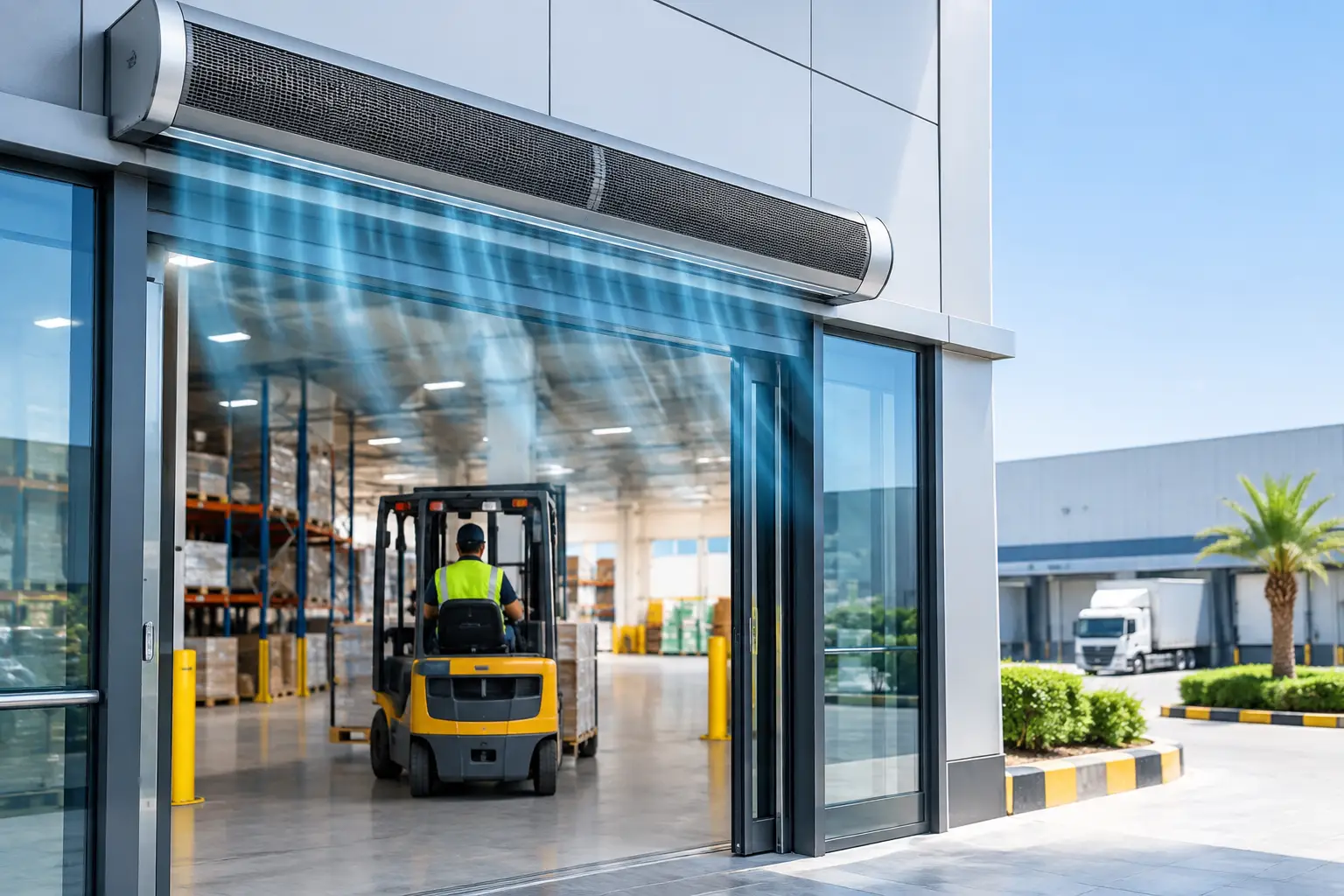
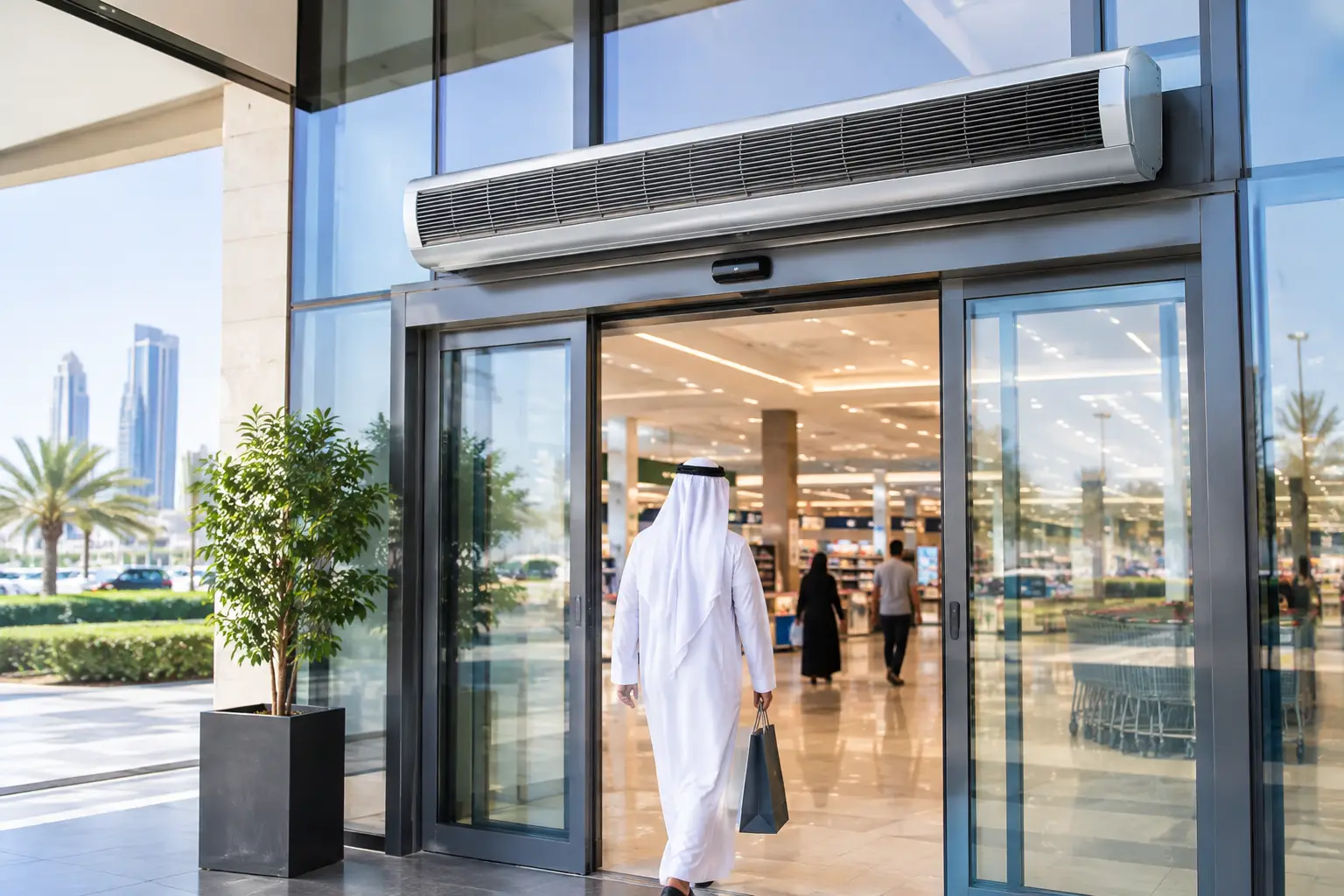
At a supermarket entrance, the objective may be to reduce outdoor smoke, dust, humidity, and hot air while maintaining customer comfort and protecting conditioned air. At a warehouse, the focus may be vehicle fumes and airborne dust entering through a high-traffic shutter door. In a food processing or pharmaceutical facility, the concern may be maintaining cleaner pressure-separated zones while allowing frequent personnel movement.
The result is rarely smoke control alone. The same air barrier can reduce cooling loss, humidity load, dust ingress, insects, and odor transfer. This broader operating benefit is particularly relevant in hot and desert climates, where every open entrance places additional demand on the building’s cooling system.
The factors that determine smoke-blocking performance
Air velocity must reach the floor
A curtain that looks powerful at the discharge grille may lose momentum before reaching the threshold. If the airstream does not form a continuous barrier from the mounting height to the floor, smoke and warm outdoor air can pass beneath it.
Door height is therefore a primary selection factor. Standard commercial entrances may suit a commercial unit, while warehouses, factories, and logistics facilities with taller openings often need an industrial centrifugal system engineered for greater throw and air volume.
The unit must cover the entire opening
Gaps at either side of the doorway are weak points. Smoke will follow the easiest available path, especially when an entrance is exposed to wind or a negative indoor pressure condition. The air curtain should extend across the full clear opening width, with sections properly aligned where multiple units are required.
Building pressure changes the outcome
An air curtain works with the building’s pressure conditions, not independently from them. If exhaust systems, extraction hoods, or large return-air demands create strong negative pressure indoors, outside air and smoke will be pulled toward the entrance. The air curtain can reduce this effect, but it may not fully overcome a major imbalance.
For this reason, HVAC engineers should review door use, adjacent extract systems, supply-air volumes, and pressure relationships before finalizing equipment. A properly balanced building gives the air curtain a far better chance of maintaining separation.
Wind and traffic are real design loads
A calm, recessed entrance is easier to protect than a loading door facing prevailing winds. Forklifts, pallet movement, automatic doors, and frequent vehicle traffic also disturb the air barrier. In exposed sites, a higher-performance unit, revised mounting arrangement, or vestibule may be appropriate.
This is one reason generic sizing by door width alone can lead to disappointing results. The right selection considers mounting position, door height, opening cycle, local climate, and the severity of the contaminant source.
Selecting the right air curtain for smoke and fumes
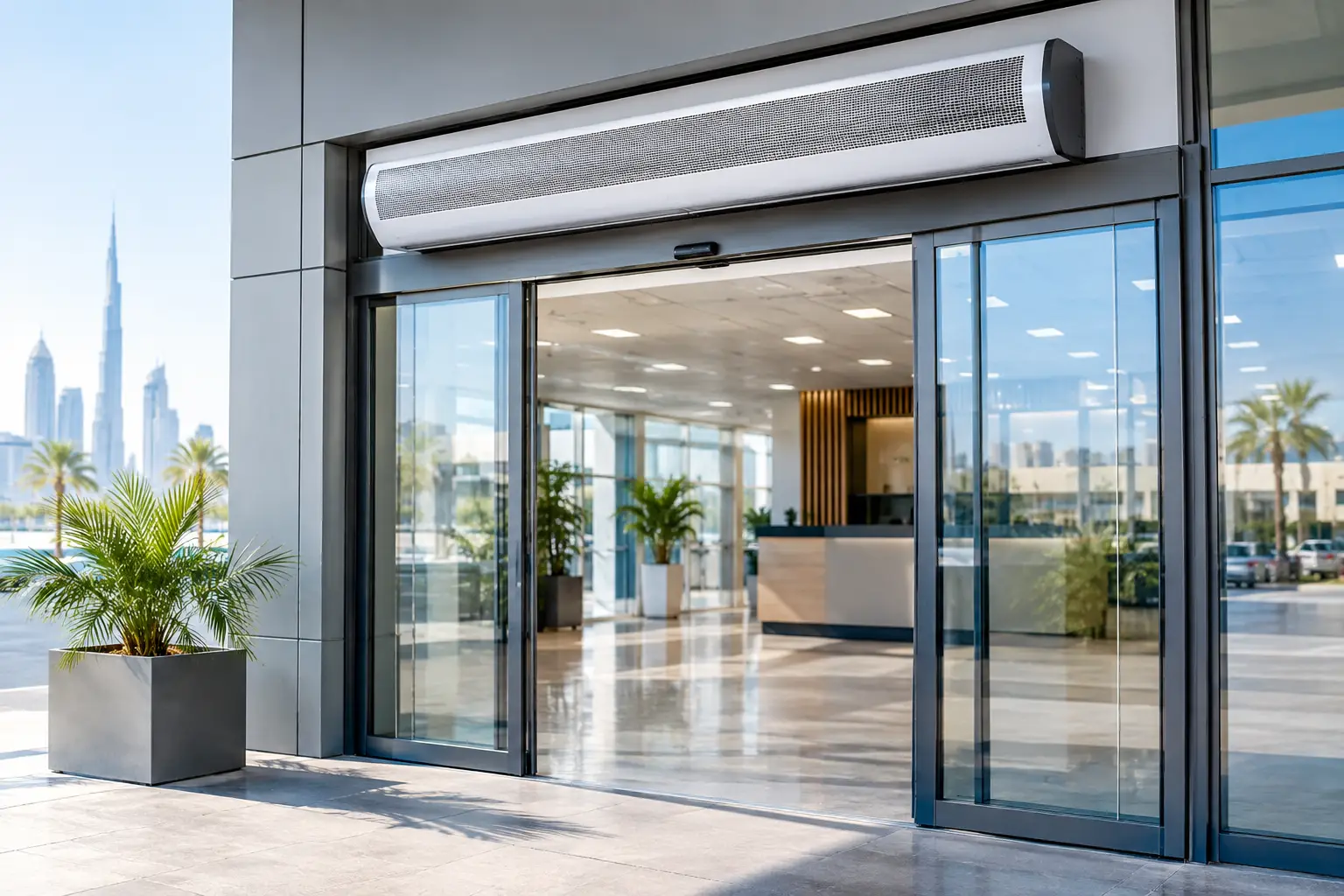
For commercial doorways with moderate traffic, a centrifugal or high-performance commercial air curtain can provide controlled airflow with a professional appearance. Recessed ceiling models are useful where architects require a discreet installation while preserving effective coverage at the entrance.
For warehouses, factories, logistics centers, and large service openings, industrial centrifugal air curtains are generally more suitable. Their higher airflow capability and durable construction support larger entrances and demanding operating conditions. The exact model should be based on the installed height and environmental exposure, not simply the available electrical supply or a preferred unit length.
When smoke or fumes are a persistent operational issue, provide the consultant or supplier with clear site information: opening width and height, mounting location, door operating pattern, nearby exhaust sources, vehicle activity, prevailing wind exposure, indoor cooling conditions, and the type of smoke or contaminant involved. This allows the proposed system to be evaluated against the actual pressure and airflow challenge.
Air curtains and indoor air quality strategy
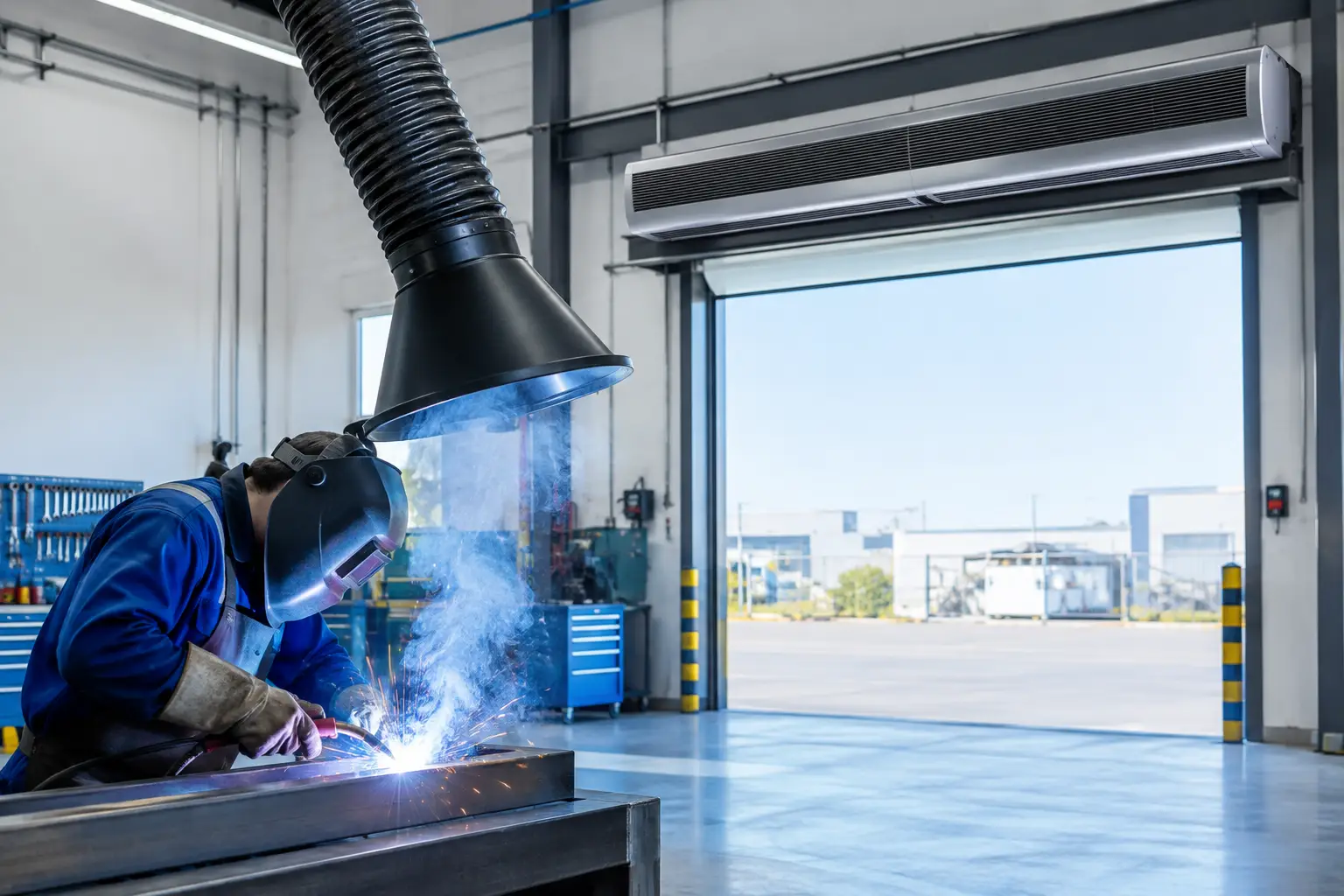
An air curtain should be viewed as an entrance-control measure within a wider indoor air quality plan. It can reduce what enters through an open door, but it does not remove contaminants already inside the building. If smoke is generated indoors, such as from a process area or kitchen operation, source capture and professionally designed extraction remain the priority.
Likewise, if a neighboring business or loading area produces frequent exhaust, operational controls may be needed alongside the air curtain. Relocating vehicle idling, improving door scheduling, using automatic door controls, or addressing excessive negative pressure can materially improve results.
The value of the air curtain is that it protects the opening without forcing a business to keep doors closed. For high-traffic operations, that supports access, comfort, and cooling efficiency at the same time.
Specify for the climate, not just the doorway
In the GCC, MENA, and African markets, smoke infiltration often arrives with heat, humidity, dust, and outdoor pollutants. A system selected only for mild conditions may not maintain a stable air barrier when exposed to extreme ambient temperatures, sand-laden winds, or continuous commercial traffic.
FreezeeX air curtain selection is based on the full operating environment, including entrance dimensions, mounting height, traffic volume, climate exposure, and HVAC conditions. That consultation-led approach helps avoid underspecification, particularly at large industrial openings and heavily used public entrances.
For a planned project or an existing entrance with persistent smoke and fume ingress, request a technical consultation and quotation with the site conditions documented. The right air curtain will not replace fire smoke control, but it can make an open commercial doorway far more resistant to the everyday contaminants that compromise comfort, cleanliness, and cooling performance.