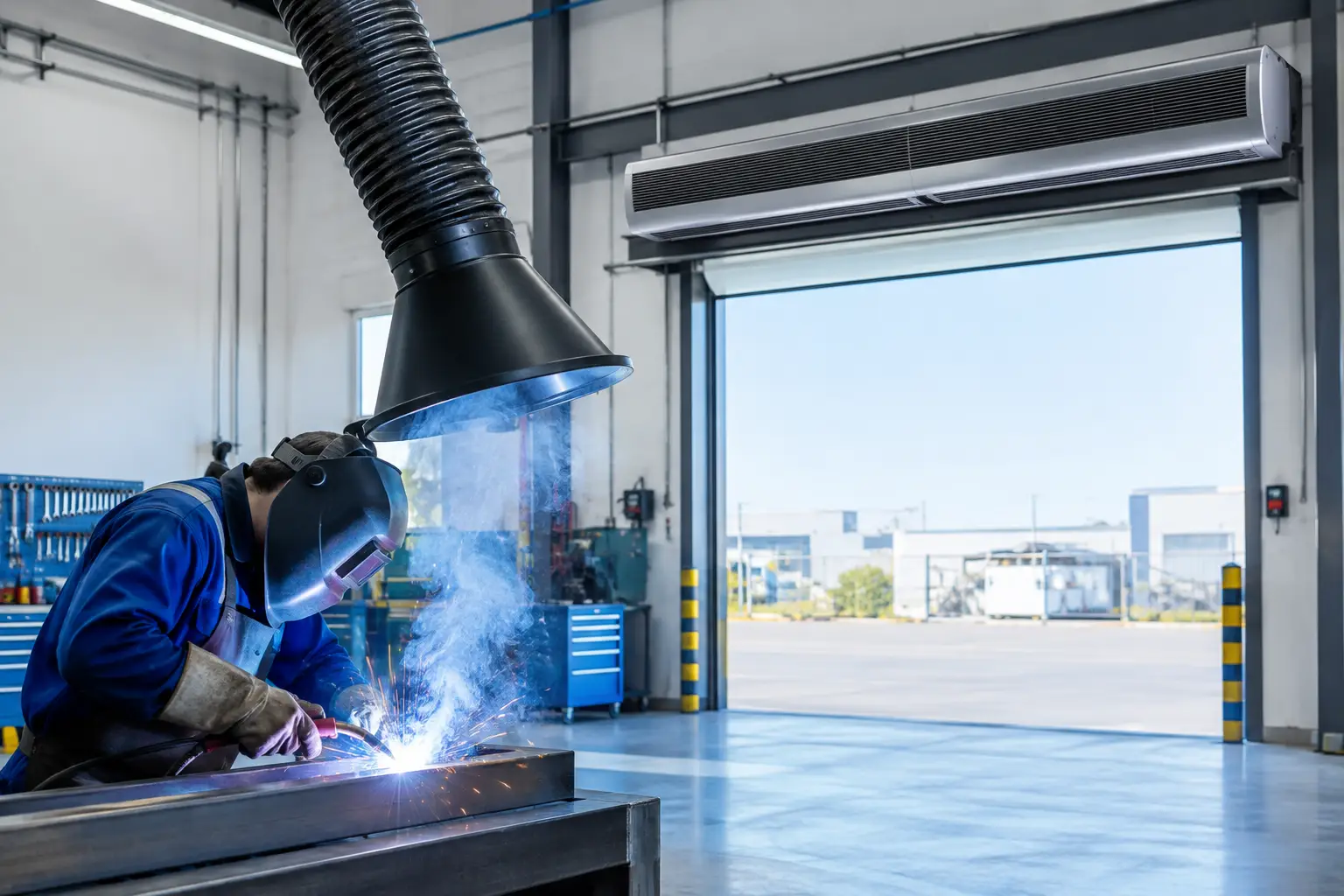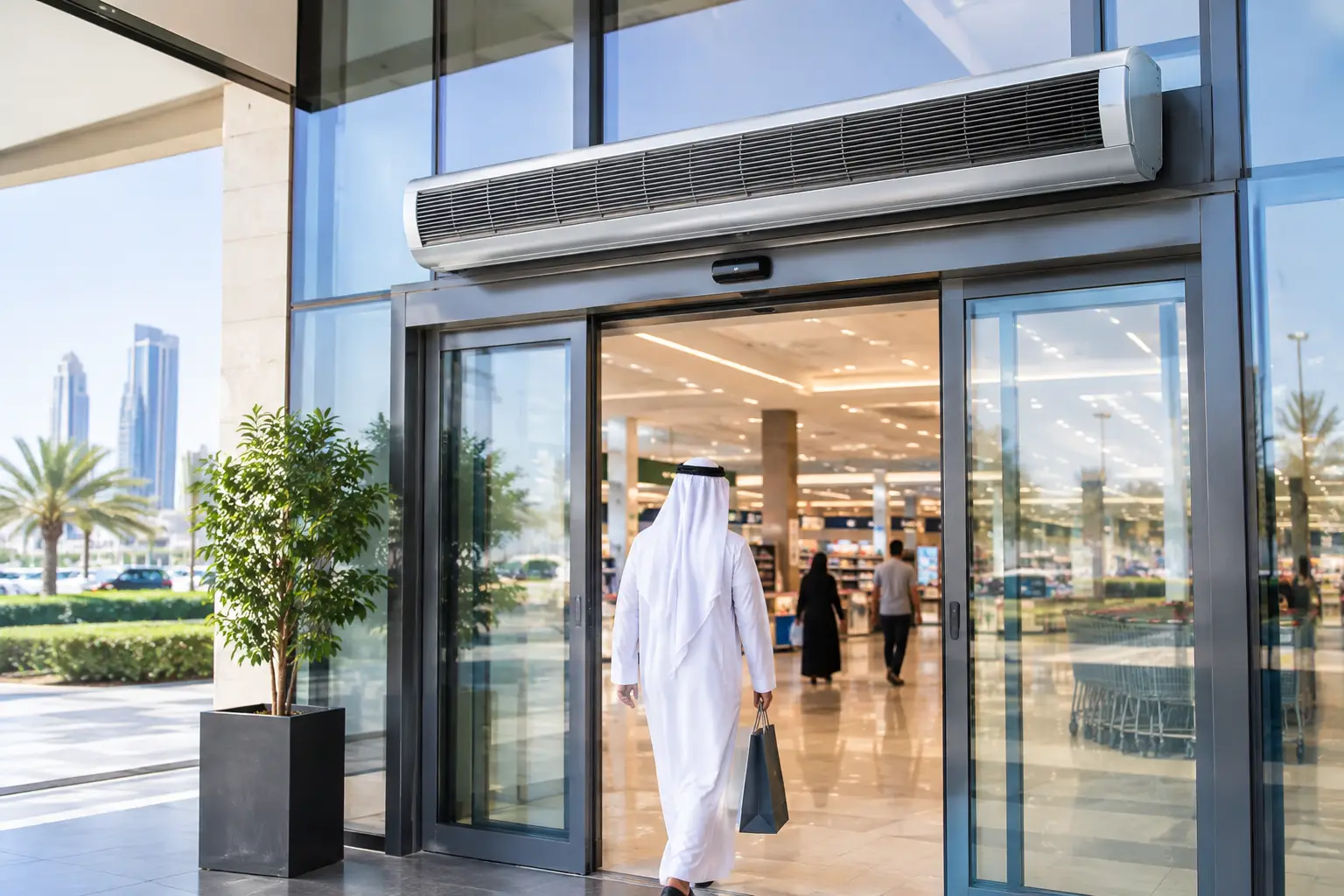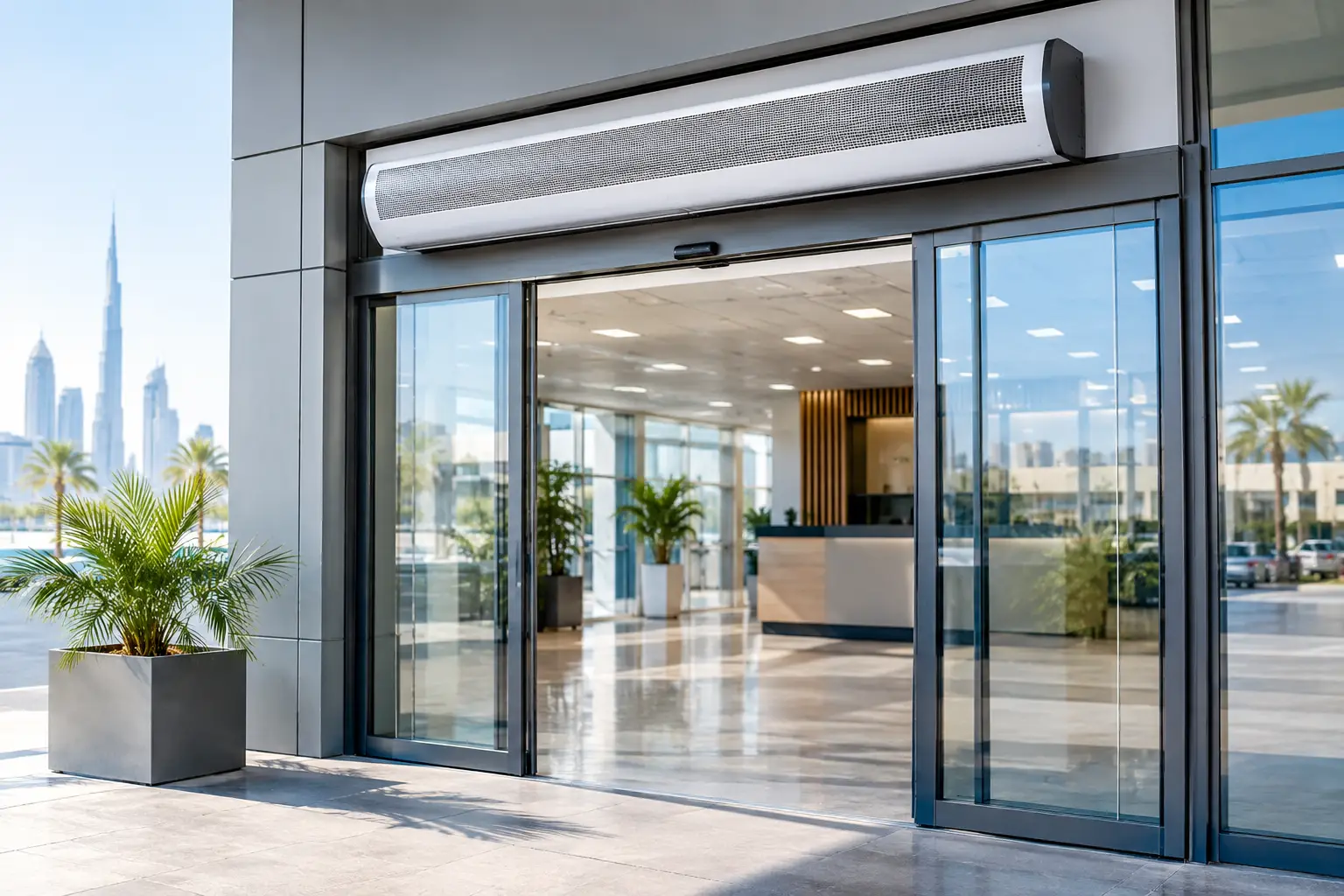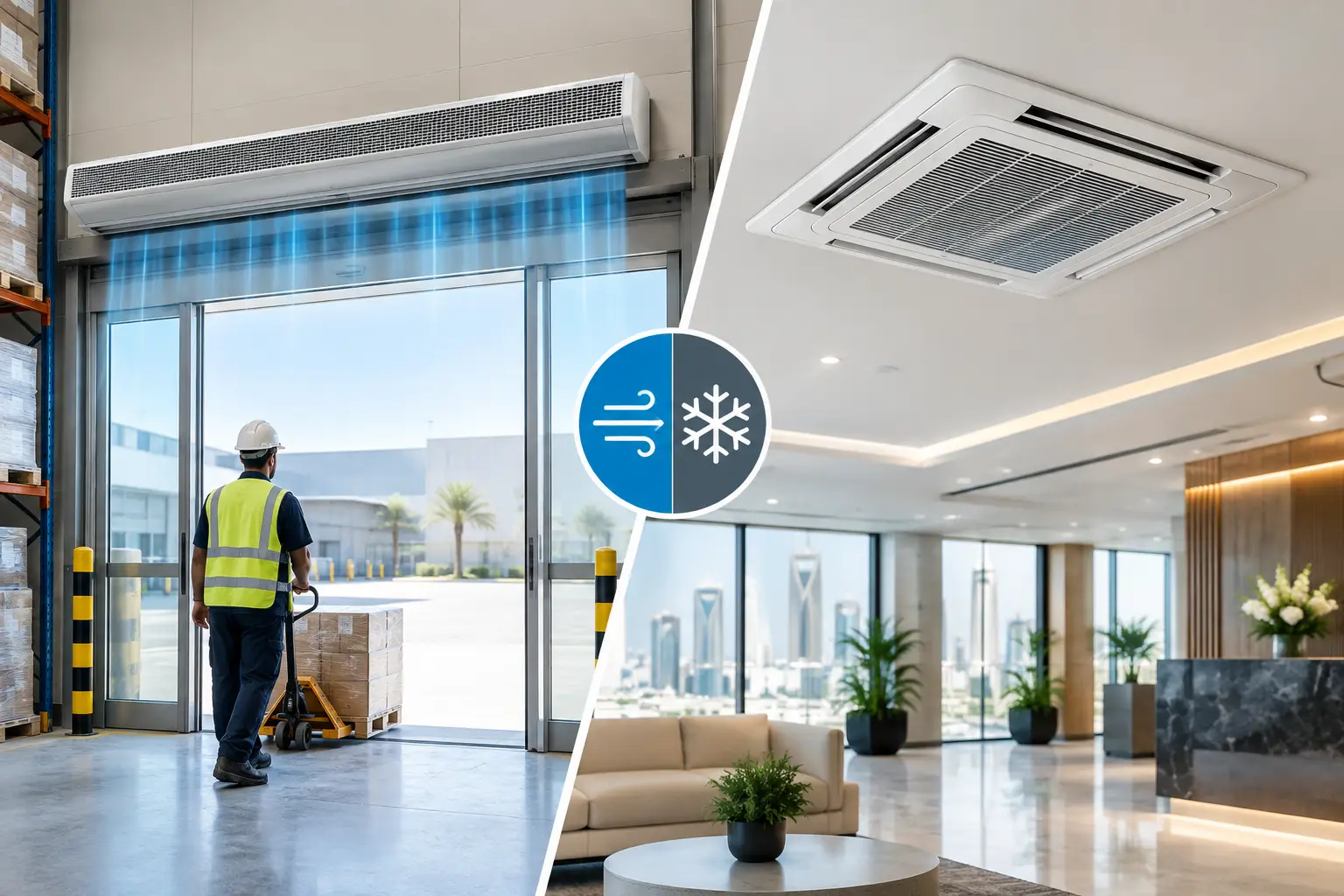
A supermarket loading door in Dubai can open dozens of times an hour. Each opening admits hot air, fine dust, humidity, and insects while conditioned air spills outward. Desert entrance protection is therefore not simply a door accessory decision. It is an operational control point that affects cooling demand, indoor cleanliness, customer comfort, and the stability of sensitive areas behind the entrance.
For commercial facilities across the UAE, Saudi Arabia, Qatar, Oman, Kuwait, Bahrain, and wider MENA and African markets, the challenge is intensified by high ambient temperatures, airborne sand, and frequent traffic. A correctly specified commercial air curtain creates a high-velocity air barrier across an open doorway. It helps separate indoor and outdoor air without forcing staff, visitors, pallets, or trolleys to wait for a physical door to close.
Why desert entrance protection needs engineered airflow
An open entrance is a pressure and temperature pathway. Cool, conditioned indoor air naturally moves toward hotter exterior conditions, while outdoor heat, dust, and moisture move inward. The result is often felt far beyond the doorway: uneven temperatures near customer areas, higher HVAC runtime, dust accumulation on merchandise or equipment, and discomfort for employees positioned close to the entrance.
A commercial air curtain addresses this exchange with a directed stream of air from above the opening. The aim is not to create a visible wall. It is to deliver sufficient air speed and coverage at floor level to resist the infiltration caused by heat, wind, and movement through the opening.
That distinction matters in desert environments. A low-output unit may provide some relief at a narrow, sheltered retail door, but it can lose effectiveness at a high warehouse shutter or an entrance exposed to prevailing wind. Airflow performance, discharge angle, mounting height, and door width must work together. Selecting solely by doorway width is a common specification error.
The operational cost of an unprotected opening
Cooling loss is often the most obvious concern, particularly in heavily air-conditioned supermarkets, malls, hotels, and retail stores. Yet heat transfer is only part of the issue. Fine dust can affect housekeeping frequency, merchandise presentation, filters, and equipment reliability. Humidity may create discomfort or condensation risks around cold displays and controlled spaces. In restaurants, food facilities, and waste-adjacent service doors, insect control is equally significant.
For hospitals, pharmaceutical operations, and food processing areas, entrance protection also supports cleaner internal conditions. An air curtain is not a replacement for a validated cleanroom barrier or a sealed-door protocol. It can, however, reduce the airborne load entering through frequently used access points when specified as part of the facility’s overall hygiene and pressure-control approach.
Match the air curtain to the opening, not the building type
A product category should follow entrance conditions rather than a generic label such as “retail” or “industrial.” Two warehouses may have the same floor area but require very different solutions if one has a three-meter personnel entrance and the other operates a high, open loading shutter with forklift traffic.
For standard commercial entrances, a recessed ceiling air curtain can preserve a clean architectural appearance while protecting the conditioned zone. It is usually appropriate where the ceiling void, mounting arrangement, and access for service have been considered early in the design. Surface-mounted commercial centrifugal and HiFi-style units are often practical for storefronts, restaurants, hotel entrances, and supermarket doors where accessible installation and reliable coverage are priorities.
Industrial centrifugal systems are better suited to demanding openings such as warehouses, factories, workshops, logistics centers, and loading areas. Their purpose is to project airflow over greater mounting heights and handle frequent door cycles. For entrances with variable use or more complex operating demands, dynamic air curtain configurations may offer a better fit, depending on the required control strategy and site conditions.
A specification should examine four connected factors:
- Clear opening width and height, including whether the door is fully open during operation.
- Mounting position, available headroom, and whether a recessed or exposed installation is appropriate.
- Traffic pattern, from intermittent customer movement to continuous forklift and pallet access.
- Environmental exposure, including wind, dust, ambient heat, humidity, and nearby vehicle or process fumes.
These details determine whether one unit, multiple modules, or a higher-duty industrial arrangement is needed. They also help establish the practical limits of performance. A highly wind-exposed loading bay may need an air curtain alongside operational controls such as dock shelters or faster door-closing practices. No entrance system should be presented as a cure for extreme external wind without reviewing the site.
Air velocity, coverage, and mounting height
The most useful performance question is straightforward: does the air stream retain enough velocity by the time it reaches the floor? A unit installed too high, or selected with insufficient throw, leaves a weak zone at the lower part of the doorway. That is where dust, insects, and hot air can pass through most easily.
Centrifugal fan designs are frequently favored for commercial and industrial entrance protection because they can generate the pressure needed for controlled, directed discharge. The correct discharge angle also matters. It may need adjustment to account for the relationship between indoor and outdoor pressure, prevailing wind, and the tendency of cool indoor air to escape.
Wide entrances require continuous coverage. Gaps between units, incomplete overlap, or an air curtain that is narrower than the clear door opening undermine the barrier. For architects and MEP consultants, this is why entrance dimensions should be finalized before air curtain selection is issued for procurement. For facility managers, it is a reason to review changes in door operation before replacing an existing unit like for like.
Where protection delivers the clearest value
High-traffic public entrances often show immediate comfort benefits. In a mall retailer or hotel lobby, staff near the door experience less direct heat intrusion, and the HVAC system has less outdoor air to recover from each opening. In supermarkets and hypermarkets, air curtains can help protect the front entrance, receiving zones, and back-of-house doors where operational traffic is constant.
At warehouses and logistics centers, the calculation is more demanding. Door openings are larger, traffic is heavier, and outdoor exposure is often severe. Here, industrial-duty airflow and mounting strategy matter more than cosmetic considerations. The objective is to minimize unnecessary infiltration while keeping vehicle and goods movement efficient.
Food processing, cold storage access areas, and pharmaceutical facilities have additional priorities. These sites may need to manage temperature differentials, insects, dust, and hygiene at the same time. The air curtain must be coordinated with door discipline, pressure relationships, cleaning procedures, and the facility’s required operating conditions. The strongest result comes from treating the entrance as a controlled transition zone rather than an isolated piece of equipment.
Specify for desert conditions and maintain performance
Desert-climate performance depends on more than motor capacity. Sand and dust exposure make accessible filter nets, sensible service access, and regular inspection important to long-term airflow delivery. A unit that is physically installed but restricted by accumulated debris cannot provide the designed barrier at the doorway.
Noise should also be evaluated realistically. A quiet unit may suit a boutique, reception area, or hospital public entrance, while a higher-output industrial model may be acceptable over a loading door where ambient operational noise is already higher. The right decision balances acoustic expectations against required air projection. Under-specifying airflow to reduce perceived noise can create higher cooling losses and poorer protection.
Controls should reflect how the door is used. Door contacts, occupancy patterns, linked operating schedules, and coordinated HVAC operation can reduce unnecessary runtime while ensuring the air curtain operates when the doorway is actually open. This is particularly valuable in facilities where entrances cycle heavily during specific delivery periods but remain closed for much of the day.
Before approving a system, confirm the opening dimensions, mounting height, exterior exposure, indoor temperature target, door-use frequency, and the contaminants of concern. This information gives engineers and contractors a defensible basis for selection rather than relying on a nominal model size.
For projects in Dubai, Riyadh, Doha, Muscat, Cairo, Lagos, Nairobi, or Casablanca, request a FreezeeX consultation and quotation based on the actual entrance conditions. A properly matched air curtain can provide practical desert entrance protection while supporting cooling efficiency, cleaner interiors, and uninterrupted commercial traffic.