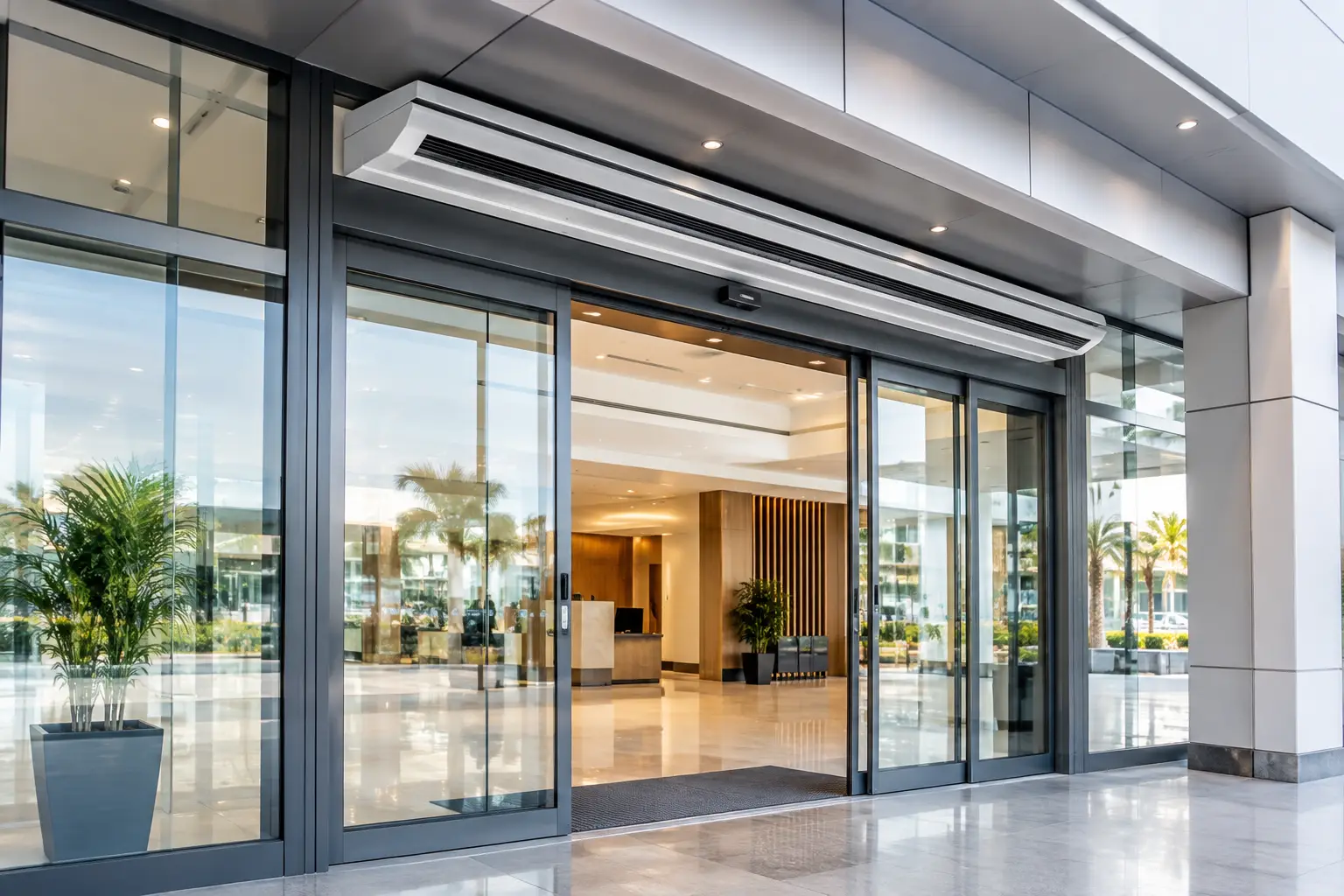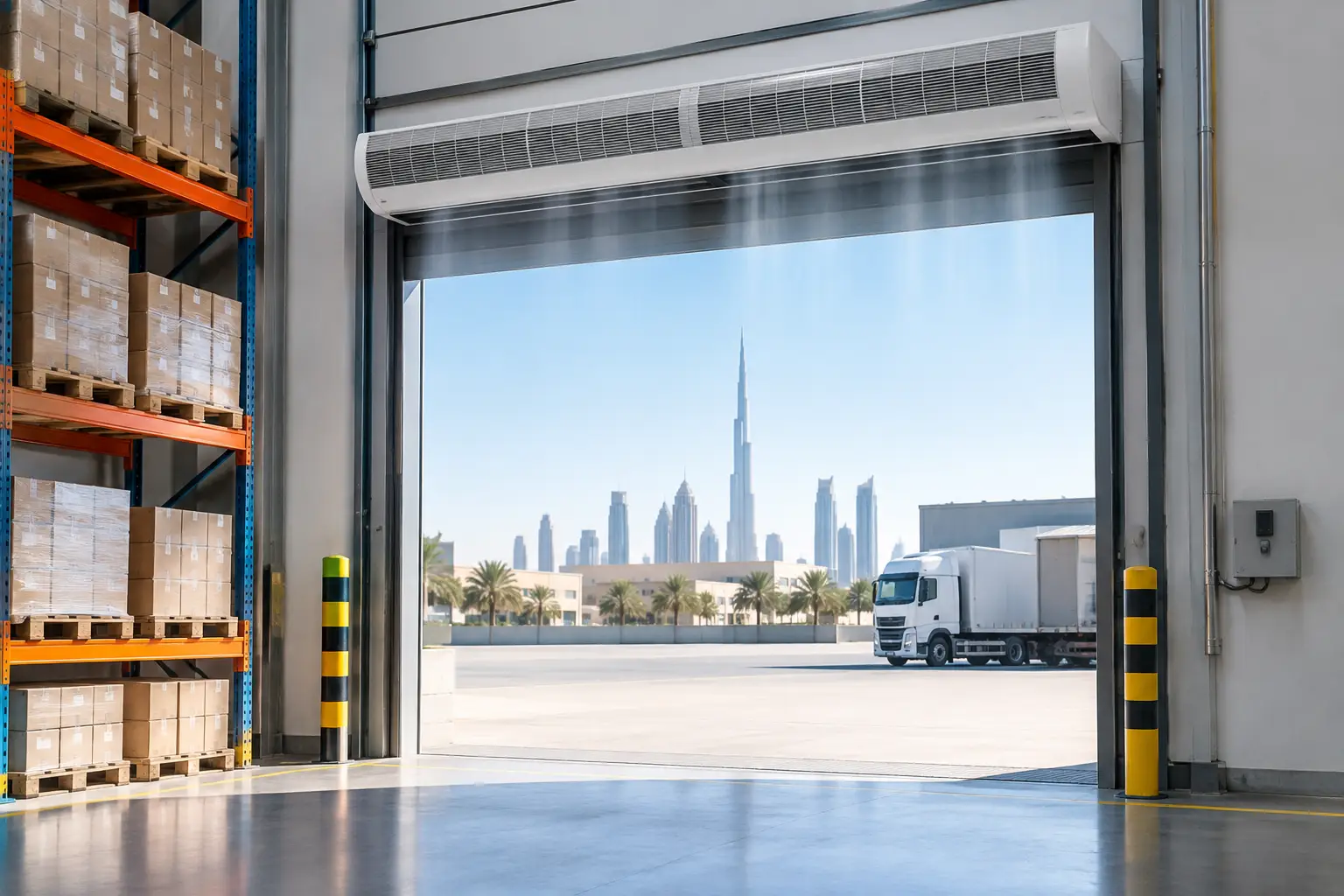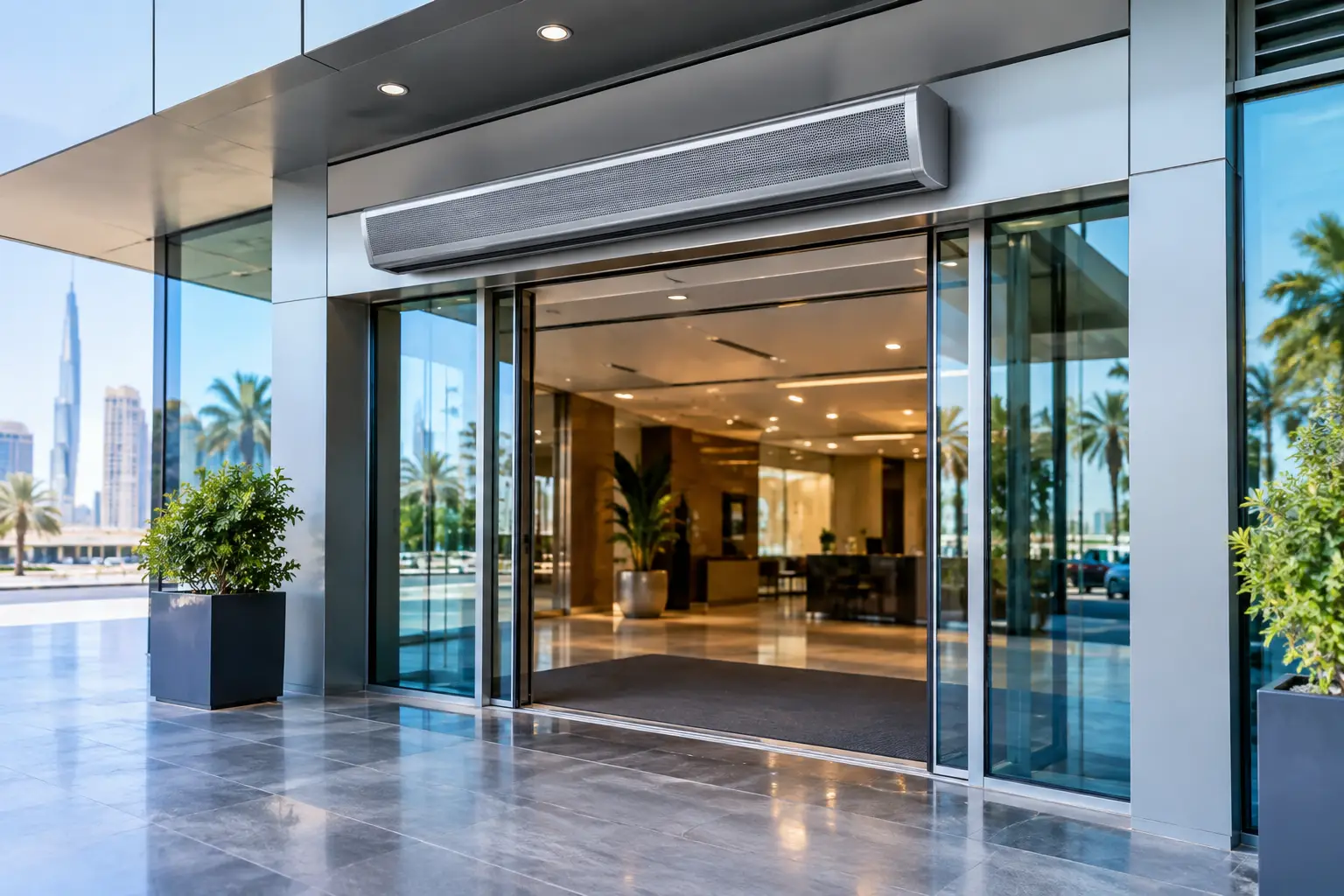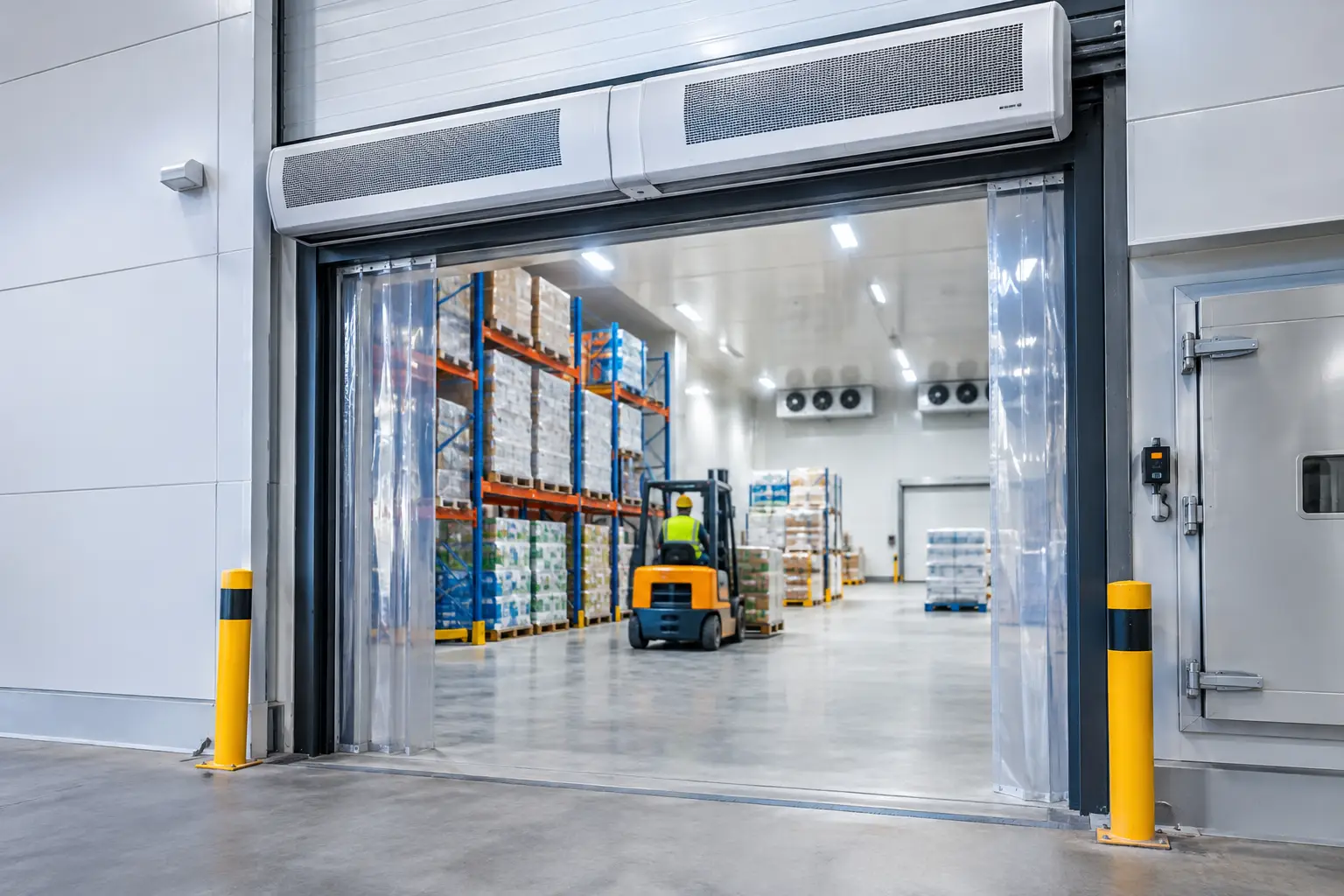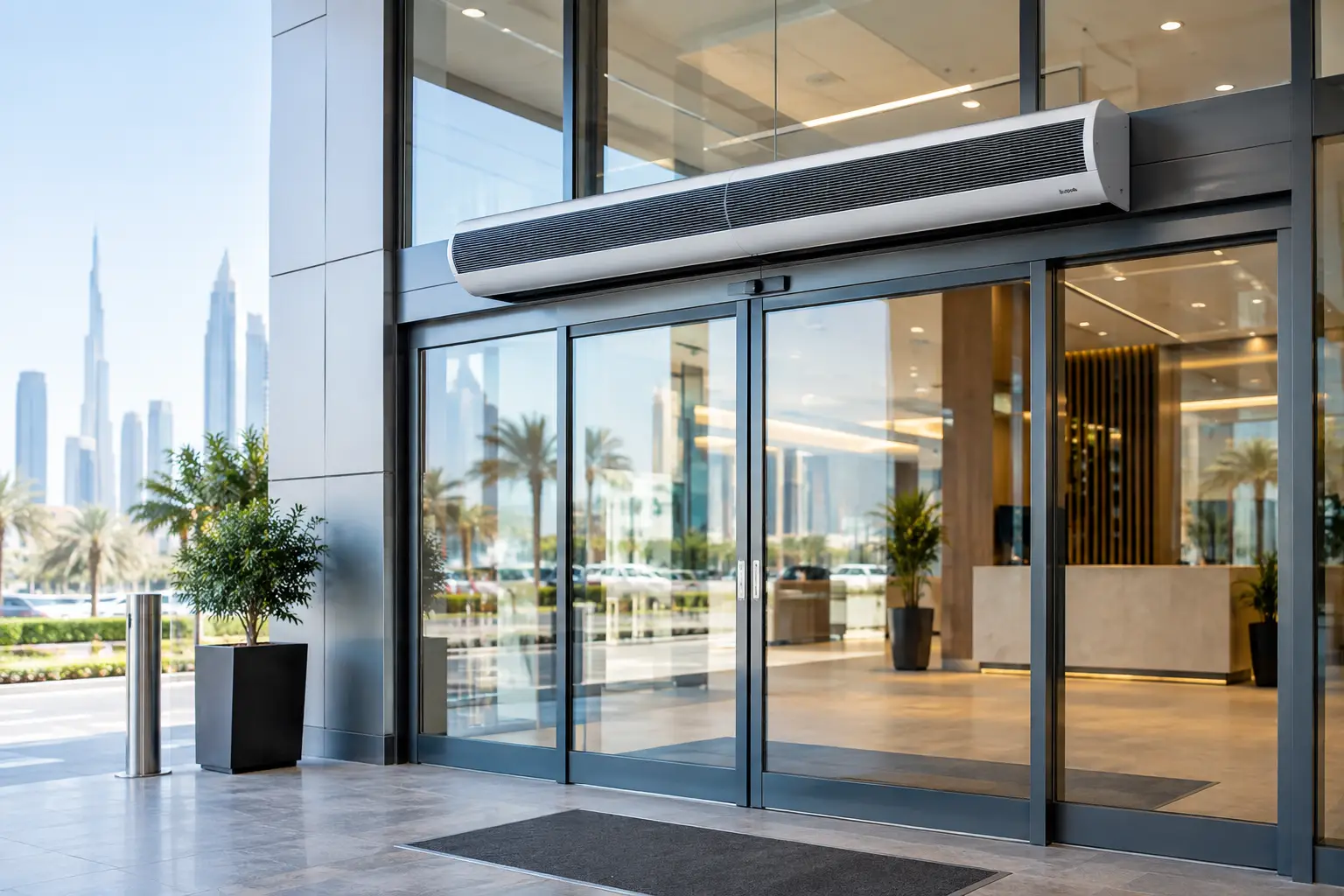
A supermarket entrance in Dubai can admit a surprising amount of moisture every time its doors open. The same applies to loading bays in Jeddah, hotel service entrances in Doha, and food facilities in Lagos. So, do air curtains reduce humidity? Yes, but indirectly: they reduce the volume of humid outdoor air entering through an open doorway. They are not a replacement for mechanical dehumidification, but they can significantly reduce the moisture load that an HVAC system must remove.
For commercial and industrial facilities in hot, tropical, and coastal climates, this distinction matters. Humidity control is not only about comfort. Excess moisture can create floor condensation, compromise cold-room performance, increase cooling energy demand, affect stored goods, and make entrances feel warm even when conditioned spaces are adequately cooled.
How Air Curtains Reduce Humidity at Commercial Doors
An air curtain produces a high-velocity, directed stream of air across an opening. This stream forms an aerodynamic barrier between indoor and outdoor conditions while people, trolleys, and goods can still pass through. When correctly selected and installed, it reduces air exchange at the doorway.
At a humid entrance, the primary benefit is lower infiltration. Rather than allowing warm, moisture-laden outside air to flow freely into an air-conditioned space, the air curtain disrupts that movement. Less incoming humid air means less latent load on the cooling system and less moisture available to condense on cold surfaces.
The effect is especially valuable where doors remain open for long periods or cycle frequently. A retail storefront with continuous customer traffic, a warehouse dispatch door, or a restaurant receiving entrance can lose conditioned air rapidly without a properly designed barrier. Door openings are often the weakest point in an otherwise well-controlled building envelope.
An air curtain does not remove water vapor already present indoors. That role belongs to the building’s air-conditioning and dehumidification strategy. Instead, it helps prevent a portion of the problem from crossing the threshold in the first place.
Why Humid Air Raises HVAC Costs
Cooling incoming outdoor air involves two separate loads. The sensible load is the heat that raises air temperature. The latent load is the moisture that must be removed to achieve the required indoor humidity level.
In the GCC, coastal cities such as Dubai, Abu Dhabi, Doha, Muscat, and Kuwait City can experience periods of high outdoor humidity alongside extreme heat. In tropical African markets, including Lagos, Nairobi, and Accra, moisture ingress can be a persistent operational concern. Every uncontrolled door opening can introduce both heat and water vapor, forcing the HVAC system to work harder.
This is why an entrance air curtain should be evaluated as part of the broader cooling strategy, not merely as a comfort accessory. By reducing infiltration, it can help stabilize indoor conditions, lower compressor run time, and reduce the risk of humid air reaching sensitive zones.
The benefit is often most visible near the entrance. Staff and customers may notice fewer warm, sticky drafts, while facility teams may see less condensation around refrigerated displays, cold-storage doors, and nearby supply grilles. Actual energy savings depend on door size, operating hours, outdoor conditions, interior setpoints, and the performance of the existing HVAC system.
Where Air Curtains Have the Strongest Humidity-Control Value
Air curtains are particularly useful at entrances where physical doors cannot remain closed during normal operation. The application determines the required airflow pattern, mounting arrangement, and duty level.
Retail, Supermarkets, and Shopping Malls
High-traffic pedestrian entrances admit outdoor air repeatedly throughout the day. A commercial air curtain can reduce humid-air infiltration without creating a barrier to customer access. For supermarkets and hypermarkets, this is also useful near refrigerated display areas, where moisture can contribute to condensation and increased refrigeration demand.
A recessed ceiling unit may suit a premium retail entrance where appearance and lower visual impact matter. For wider or busier doors, a commercial centrifugal-flow system can provide the stronger, more stable air stream needed to reach the floor effectively.
Warehouses, Logistics Centers, and Factories
Large openings create a more demanding air-separation challenge. Forklift traffic, pallet movement, tall doors, crosswinds, and frequent dispatch activity can all weaken a light-duty installation. Industrial centrifugal air curtains are typically better suited to these conditions because they are designed to project airflow across larger openings and withstand heavier operating cycles.
Humidity reduction at these entrances can protect conditioned work areas, packaging zones, and inventory locations. It can also limit condensation risks where warm humid air approaches chilled rooms or temperature-controlled production areas.
Cold Storage and Food Processing Facilities
Here, moisture control has direct operational consequences. When humid outside air enters a cold area, it can condense or freeze on surfaces, increase refrigeration load, and affect sanitation and safety conditions. An air curtain can reduce the exchange of warm, humid air during active door use while maintaining access for staff and goods.
It must be specified carefully. Door dimensions, temperature difference, opening duration, traffic type, and the pressure conditions on both sides of the door all influence the result. A poorly sized unit may create an inconsistent air stream that does not reach the floor, leaving gaps for infiltration.
Hospitals, Hotels, and Airports
These facilities need open, welcoming access while managing indoor comfort and air quality. Air curtains help reduce heat, dust, insects, and humid air entering through public entrances and service doors. In humid climates, they can support more consistent lobby, corridor, and back-of-house conditions without relying on doors being closed at all times.
An Air Curtain Is Not a Dehumidifier
This is the most important specification point. An air curtain reduces the source of moisture infiltration at an entrance. It does not extract moisture from the indoor air or correct a building-wide humidity problem caused by undersized HVAC equipment, poor duct insulation, indoor processes, water leaks, or inadequate outdoor-air treatment.
If indoor relative humidity remains elevated when doors are closed, the issue should be assessed at the HVAC-system level. Air curtains are most effective when paired with correctly sized cooling and ventilation equipment, functioning door seals, and sensible operational practices.
For example, an air curtain may substantially reduce moisture entering a restaurant service door, yet the kitchen or dishwashing area may still require separate humidity-management measures. Likewise, a logistics facility may benefit at dock doors, but humidity in a temperature-controlled storage room depends on the entire enclosure and refrigeration design.
What Determines Humidity Reduction Performance?
Air curtain performance is not defined by motor power alone. The unit must produce a continuous, sufficiently strong air stream from one side of the opening to the other. For most commercial applications, the critical design objective is full coverage across the doorway and effective throw to floor level.
Several factors should be considered during specification:
- Door height and width: Taller and wider entrances need greater airflow reach and often require multiple units or an industrial series.
- Mounting position: A unit installed too high, too far back from the opening, or obstructed by signage may lose air-stream effectiveness.
- Wind and pressure differences: External wind, stack effect, and indoor pressure conditions can push humid air through weak points in the air barrier.
- Traffic intensity: Constant pedestrian flow differs greatly from forklifts or large vehicle movement through a loading bay.
- Indoor and outdoor conditions: A coastal humid climate, a dusty desert environment, and a chilled processing area place different demands on the system.
- Airflow direction and adjustment: The discharge angle should be set to counter anticipated infiltration, rather than blowing straight down without regard for site conditions.
This is why a generic, one-size selection can underperform. A practical assessment should consider the actual opening, operational schedule, surrounding air movement, and HVAC objective. FreezeeX evaluates these conditions to recommend an appropriate commercial or industrial air curtain configuration for the site.
Can Air Curtains Prevent Condensation?
They can help reduce condensation, particularly near cold surfaces located close to open doors. By limiting humid-air infiltration, an air curtain lowers the amount of moisture that can reach cold display cases, cold-room thresholds, chilled preparation zones, and air-conditioned entrance areas.
However, condensation is influenced by surface temperature and dew point. If a surface is colder than the dew point of the surrounding air, condensation can still form. Air curtains reduce the likelihood by limiting moisture entry, but they cannot overcome severe building-pressure problems, damaged insulation, or inadequate dehumidification.
For cold-storage applications, this makes air curtains a useful part of a layered control approach. The goal is to minimize warm, humid air transfer during door openings while keeping operations moving efficiently.
Selecting the Right System for Humid and Desert Climates
In demanding regional conditions, a commercial air curtain should be selected for more than nominal door width. Facility teams should consider motor durability, airflow stability, mounting constraints, operational hours, dust exposure, and maintenance access. A system that performs acceptably at a sheltered office entrance may be unsuitable for a dusty warehouse door or a humid supermarket loading area.
Centrifugal designs are often preferred where stronger pressure capability and a more controlled air stream are required. Recessed models can suit finished commercial entrances where architectural integration matters. Industrial-duty units are generally the right direction for higher doors, intensive traffic, and applications where air separation directly affects cooling retention or process conditions.
The practical question is not simply whether an air curtain reduces humidity. It is whether the selected unit can maintain an effective air barrier under the actual conditions at your doorway.
For a project in a humid coastal city, a tropical operating environment, or a hot and dusty desert location, request a consultation and quotation based on your entrance dimensions, mounting height, traffic pattern, and HVAC requirements. The right air curtain can reduce moisture infiltration at the point where conditioned air is most often lost.