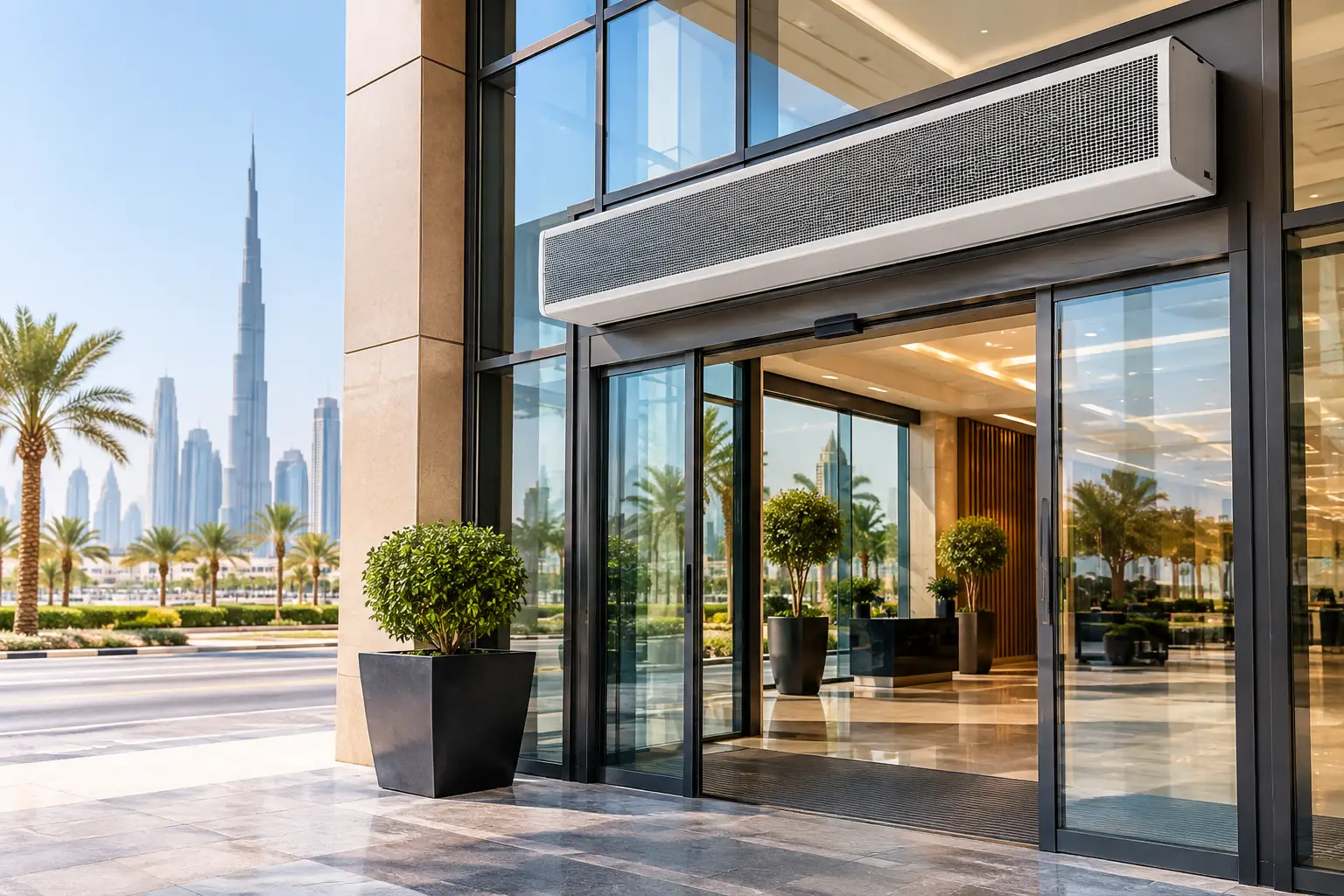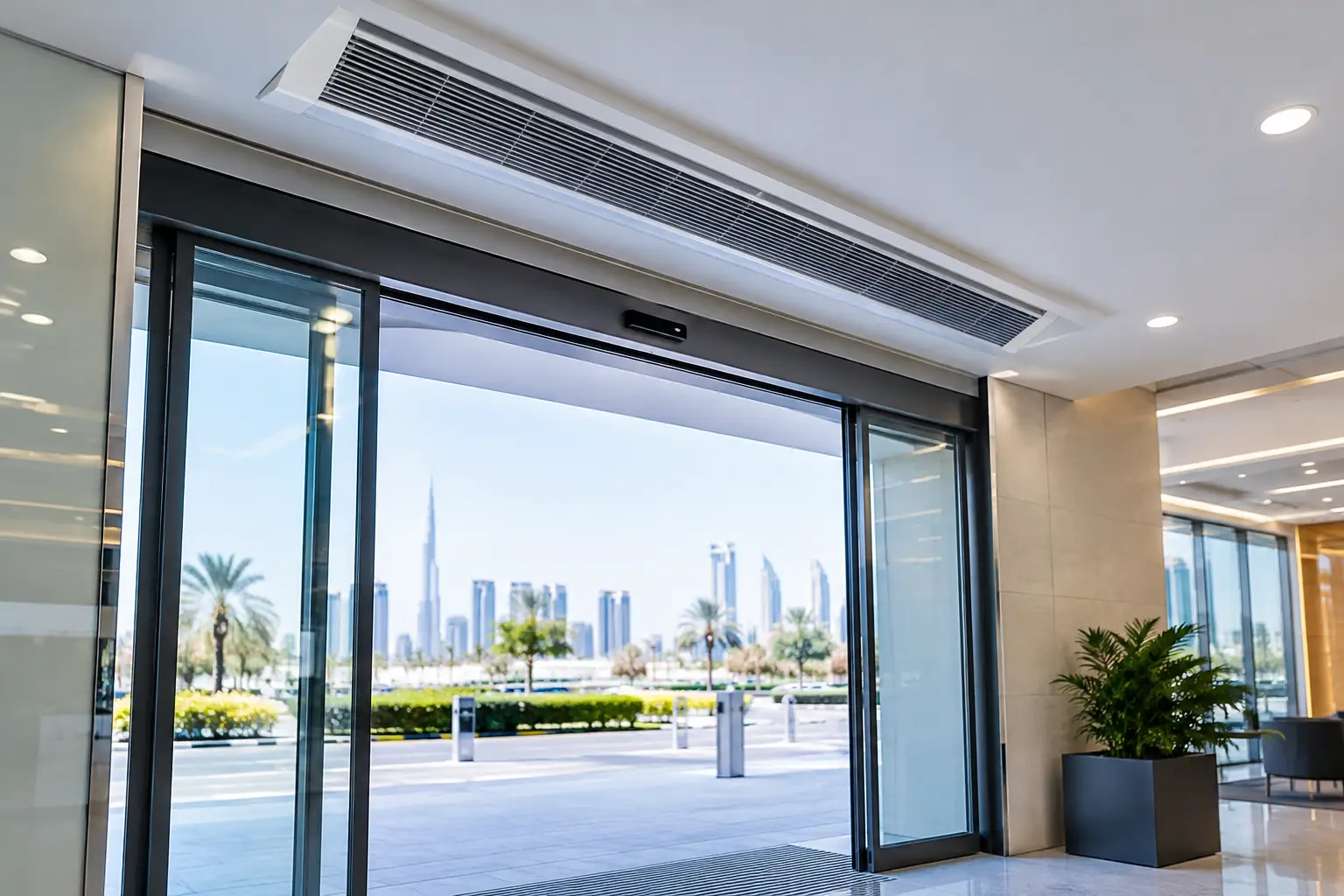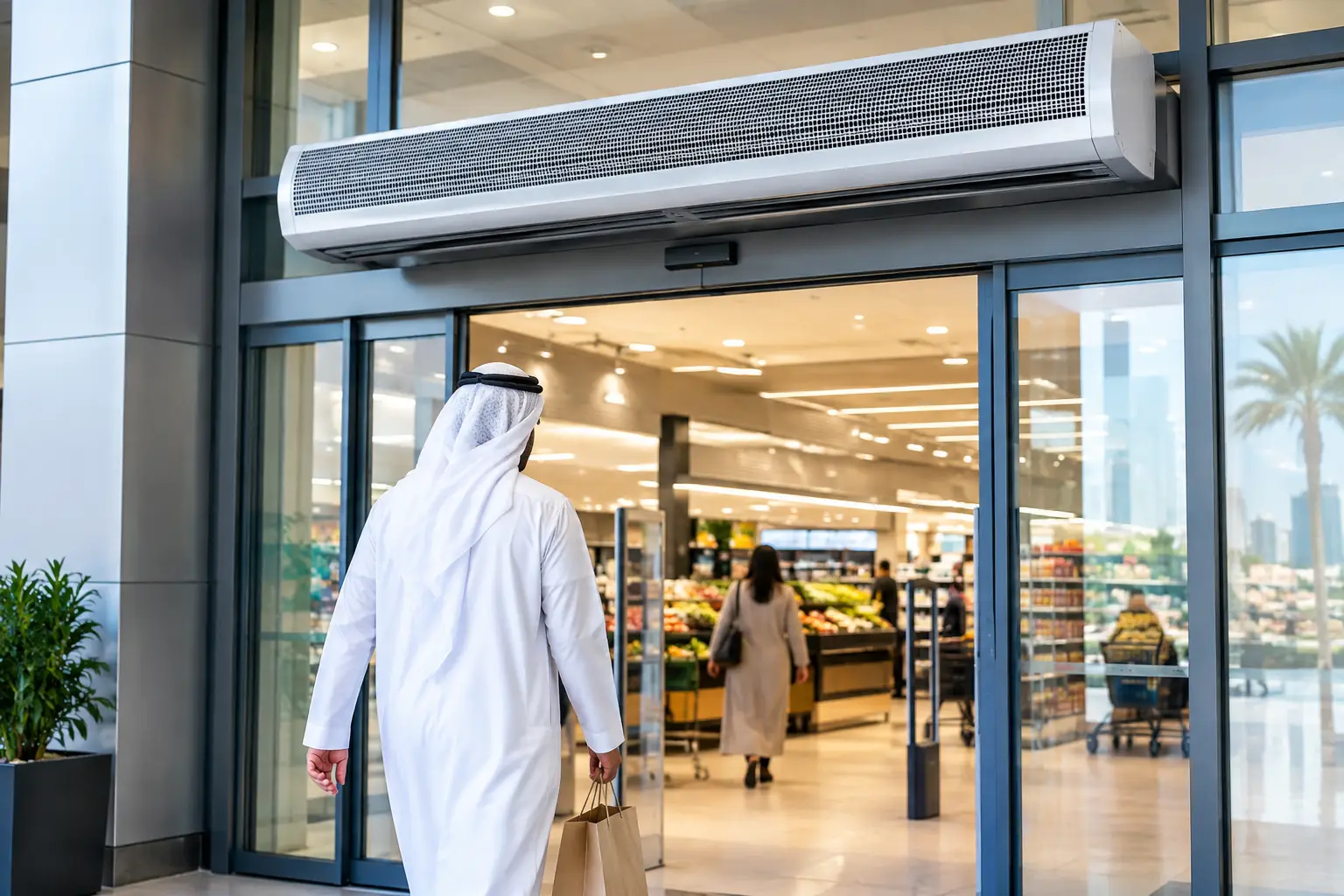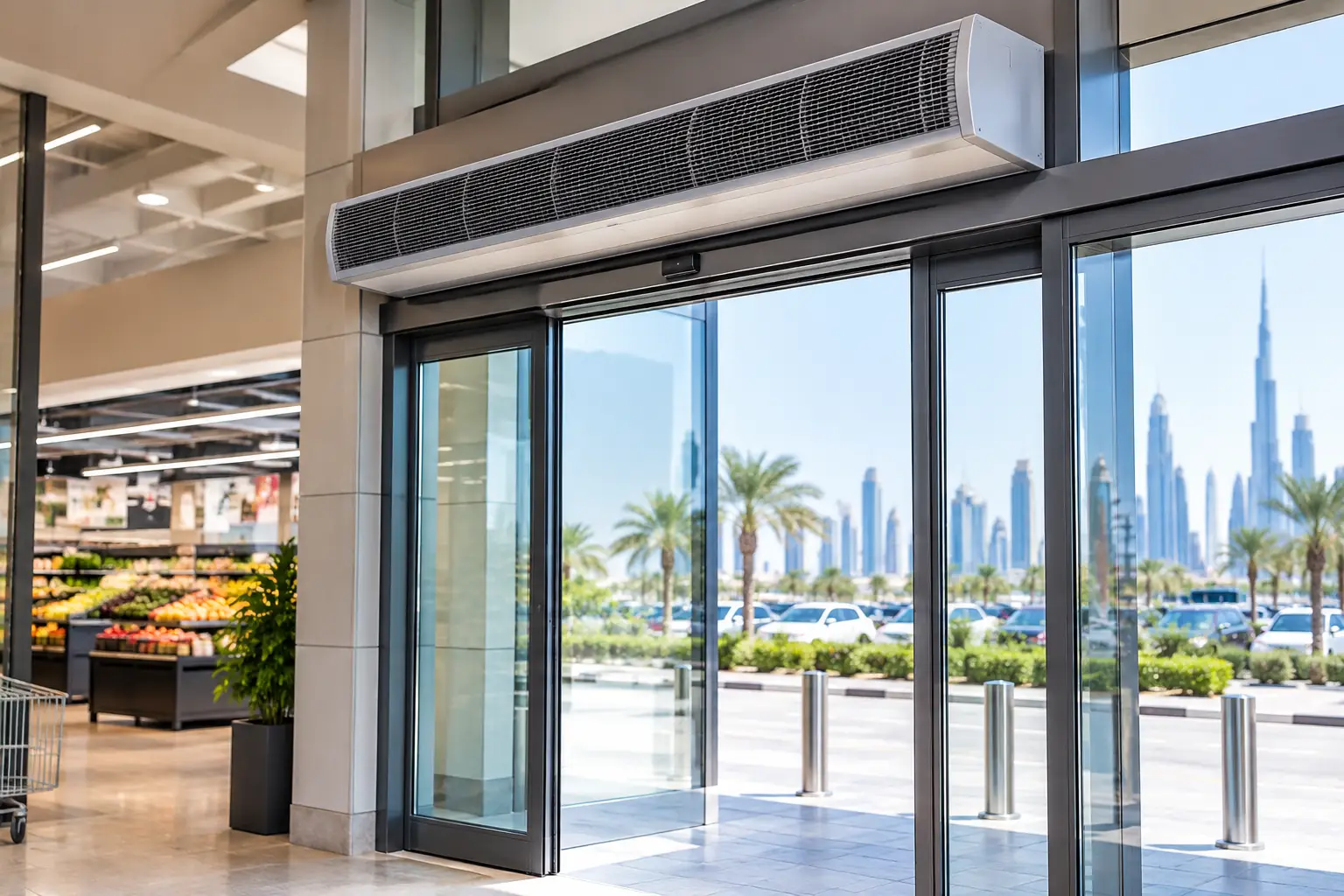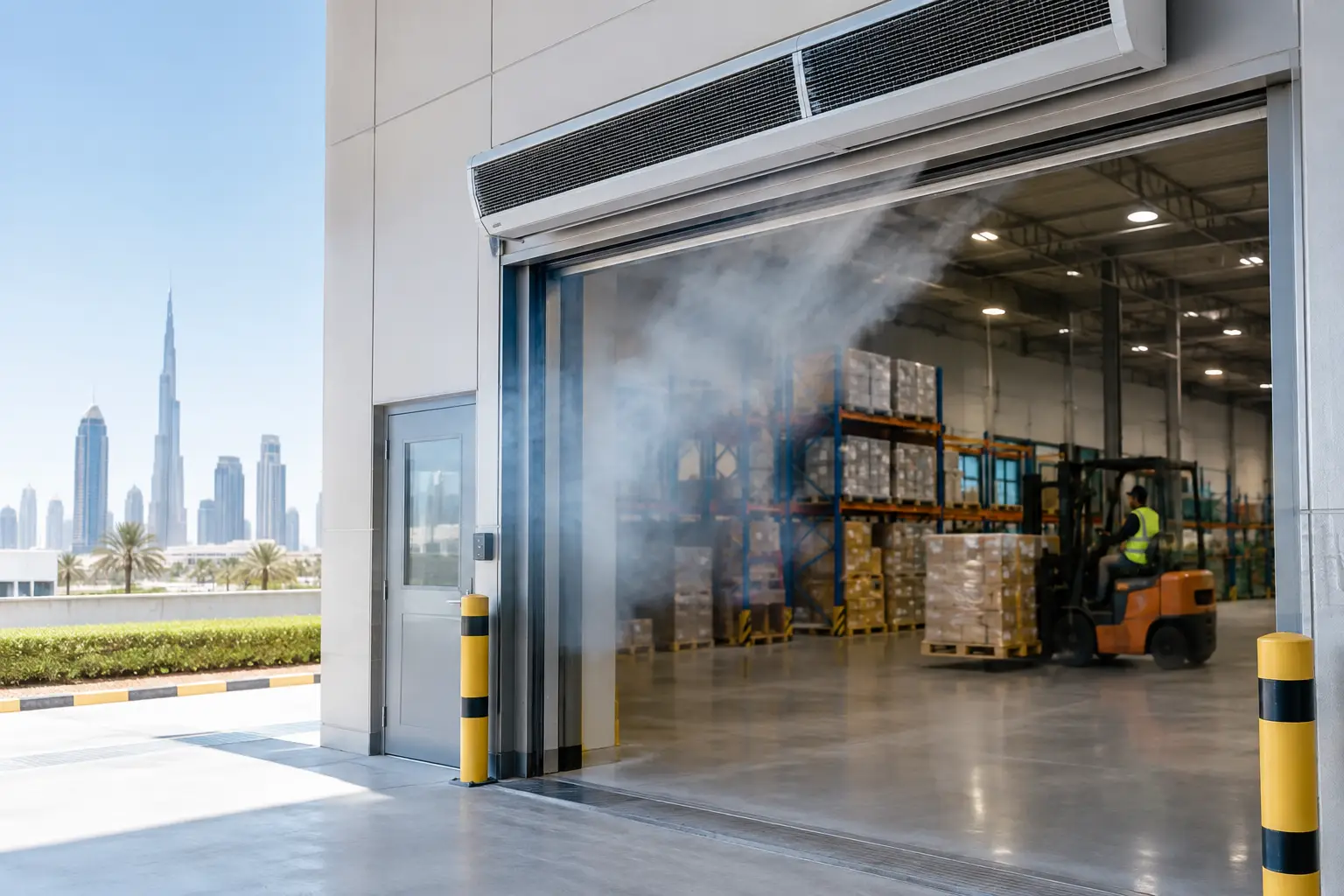
A pharmaceutical entrance can become a contamination and energy-loss pathway in seconds. Each time a loading door, personnel entrance, or material transfer point opens, hot air, dust, moisture, insects, and airborne particles can move toward controlled areas. Properly specified pharmaceutical air barriers create a high-velocity air stream across that opening, helping facilities control ingress without slowing necessary operations.
For pharmaceutical plants in Dubai, Riyadh, Doha, Cairo, Lagos, and other hot or dusty markets, the value is not limited to cooling retention. The air barrier must support the facility’s contamination-control strategy, work with pressure relationships between rooms, and withstand frequent daily use. It is an entrance-control component, not a standalone cleanroom system.
Why Pharmaceutical Entries Need Air Barriers
Pharmaceutical facilities manage different levels of control. A warehouse receiving area has different requirements from a secondary packaging room, a personnel airlock, or an area adjacent to classified manufacturing. Yet open doors remain a common weak point across all of them.
When outside conditions are hot, humid, or dusty, an open entrance introduces a significant thermal and particulate challenge. The resulting air exchange can raise the sensible and latent load on the HVAC system, make nearby work areas less stable, and increase the burden on filtration systems. In facilities that rely on controlled pressure cascades, a large open doorway can also disturb intended airflow patterns.
An air barrier limits this exchange by projecting a continuous sheet of air from the door head toward the floor. When correctly selected, that stream provides resistance to incoming air while allowing people, carts, and pallet-handling equipment to pass through. This is particularly useful where a conventional door cannot remain closed because of frequent traffic.
The critical phrase is “correctly selected.” A unit that looks adequate at the door head but loses velocity before reaching the floor will not provide meaningful separation. Likewise, excessive or poorly directed discharge air can create unwanted turbulence near a sensitive entrance. Pharmaceutical projects need a measured engineering approach rather than a one-size-fits-all installation.
What Pharmaceutical Air Barriers Can and Cannot Do
Air barriers are often specified for environmental separation, but their role needs to be clear. They can help reduce the entry of external heat, dust, humidity, insects, odors, and some airborne contaminants through frequently open entrances. They can also reduce conditioned-air loss, helping commercial HVAC systems operate more efficiently during busy periods.
They do not replace HEPA filtration, mechanical airlocks, interlocked doors, gowning procedures, cleaning protocols, or validated cleanroom airflow design. Where a room is classified or governed by strict GMP procedures, the facility’s contamination-control plan and validation requirements determine whether an air curtain is appropriate and where it may be located.
For example, an industrial air curtain can be highly effective at a raw-material receiving entrance or packaging dispatch door. At the boundary of a highly controlled processing suite, a closed-door airlock or purpose-designed transfer system may be the more appropriate primary control. The selection depends on the area classification, process sensitivity, door-open duration, pressure regime, and facility risk assessment.
Where Air Barriers Deliver the Most Value
The strongest applications are usually high-traffic transitions between external or semi-controlled areas and conditioned internal spaces. These include receiving bays, warehouse doors, dispatch areas, secondary packaging entrances, staff access points, and corridors leading from general production support areas.
At a pharmaceutical warehouse, an air barrier can reduce the hot, dusty air pulled inside when receiving doors open for deliveries. In a packaging hall, it can help preserve indoor comfort and reduce airborne nuisance contaminants near a personnel entrance. At cold storage or temperature-managed stock areas, it can reduce warm, humid air infiltration that adds load and may contribute to condensation risk.
Facilities should not assume that every opening requires the same solution. A narrow personnel door with intermittent use needs a different unit from a six-meter loading bay with forklifts moving continuously. Door geometry and operation are as important as the product category.
Air Barrier Selection Starts With the Opening
An effective specification begins with a site assessment. Width and mounting height establish the basic coverage requirement, but they are only the starting point. The design team should also consider door type, opening frequency, crosswinds, nearby exhaust or supply-air diffusers, room pressure, and whether forklifts or tall loads pass beneath the unit.
Airflow Reach and Discharge Velocity
The air stream must retain sufficient velocity at the floor or threshold to resist infiltration. High doors require more throw, while wide openings often need multiple units arranged continuously with no untreated gaps. Centrifugal air curtains are commonly suited to demanding commercial and industrial entrances because they can provide the pressure and airflow reach needed for higher mounting conditions.
The discharge angle also matters. It may be adjusted toward the exterior to counter outside air pressure or toward the interior where internal pressure conditions dictate. This should be established during commissioning, not guessed during procurement.
Pressure Relationships and Cleanroom Strategy
Pharmaceutical facilities often use pressure differences to direct airflow from cleaner spaces toward less-clean areas. An air barrier should support that intent, not overpower it. Engineers should review differential pressure targets and nearby supply and return locations before selecting fan capacity or discharge direction.
A strong air stream across an open door is useful, but it cannot compensate for an incorrectly designed pressure cascade. Where a doorway connects areas with very different cleanliness requirements, the project team should first determine whether operational controls or a physical airlock are necessary.
Climate and External Exposure
Desert dust, elevated ambient temperatures, coastal humidity, and wind exposure place higher demands on entrance equipment. In GCC and African markets, an external doorway may experience intense heat and pressure fluctuations throughout the day. Units should be selected for the real operating environment, including mounting protection, duty cycle, and the need for service access.
For exposed loading areas, industrial-duty equipment is generally more appropriate than a light commercial model. In finished public-facing spaces, a recessed or lower-profile design may be preferable, provided it still delivers the required performance at the installed height.
Integrating the Unit With Facility Operations
The air barrier should operate when the door is open, not simply run continuously without regard to traffic. Door-contact controls, automated door interfaces, and appropriately set run-on times can help maintain protection while managing electrical consumption and noise exposure.
For busy logistics doors, continuous operation during working hours may be justified. For a staff entrance with limited traffic, activation through the door control can be more practical. The right control method depends on usage patterns and on how quickly the doorway needs protection after opening.
Maintenance planning also deserves attention. Dust accumulation on intake screens or internal components can reduce airflow over time, especially in industrial and desert environments. Facilities should include air barrier inspection and cleaning within planned maintenance schedules, alongside verification of discharge direction, fan operation, mounting integrity, and controller response.
Specification Questions for Consultants and Facility Managers
Before requesting a quotation, prepare the opening dimensions, mounting height, photographs or drawings of the entrance, and details of what is on each side of the door. It is also useful to identify traffic volume, door-open time, ambient conditions, room temperature, and any pressure-control requirements.
For regulated spaces, include the room classification and the facility’s contamination-control objectives. This allows the air barrier to be evaluated as part of the wider environmental-control design rather than as an isolated product decision.
A practical specification should address airflow performance, installed height, noise expectations, controls, electrical requirements, construction durability, and maintenance access. It should also state the intended operational outcome, whether that is limiting dust ingress at a receiving bay, reducing cooling loss at a packaging entrance, or improving separation at a high-traffic warehouse door.
Choosing the Right Air Barrier Category
Commercial centrifugal units are often appropriate for standard personnel and service entrances where dependable airflow and frequent operation are required. Recessed ceiling models can suit finished pharmaceutical support spaces where appearance and clear headroom matter. For tall warehouse doors, loading bays, and intensive operational areas, industrial centrifugal systems are generally the more suitable starting point because of their airflow reach and durable construction.
The final choice should never be based on door width alone. A model that performs well at a three-meter mounting height may not protect a five-meter opening, and a powerful industrial unit may be unnecessary or acoustically unsuitable for a low-traffic internal entrance. Matching capacity to the application protects both performance and operating cost.
For pharmaceutical facilities operating in desert and tropical climates, entrance protection should be treated as part of the building’s environmental-control plan. Request a FreezeeX consultation and quotation with your door dimensions, mounting conditions, and operational requirements to identify an air barrier that supports cleaner entries, lower cooling loss, and reliable daily performance.