
A service workshop entrance is rarely closed for long. Vehicles, parts carts, technicians, customers, and delivery teams move through it all day, creating a direct path for outdoor heat, dust, humidity, and airborne pollutants. An air curtain for service workshop entrances creates a controlled high-velocity air stream across that opening, helping separate the conditioned work area from the demanding environment outside.
For workshops in Dubai, Abu Dhabi, Riyadh, Doha, Muscat, Cairo, Lagos, and other hot or dusty markets, the challenge is not simply maintaining a comfortable temperature. It is limiting the continuous load placed on the building’s cooling system while keeping operations moving. The right air curtain supports that objective without requiring doors to remain shut during active service periods.
Why service workshop entrances need air isolation
Workshop doors are typically wider and used more frequently than standard commercial entrances. A vehicle service bay may have a rolling shutter or sectional door open for much of the day. Equipment workshops can face similar conditions at loading points, inspection lanes, and parts receiving areas.
When a large opening is exposed to hot outdoor air, the indoor cooling system must work harder to offset heat gain. In humid locations, moisture enters with that air and can make the workspace feel uncomfortable even when the thermostat setting appears correct. In desert environments, dust and sand can also enter, increasing cleaning requirements and affecting the working environment.
An air curtain does not replace a physical door. It provides an active air barrier when the opening must remain in use. Correctly specified units direct air downward across the full width of the doorway, reducing air exchange between indoor and outdoor zones while allowing people and vehicles to pass without delay.
This distinction matters. A small commercial unit installed over an oversized workshop opening may produce airflow, but it may not maintain an effective barrier near floor level. Workshop projects require selection based on door geometry, mounting height, pressure conditions, and traffic patterns rather than nominal width alone.
Key benefits of an air curtain for service workshop operations
The most immediate benefit is reduced cooling loss at frequently opened entrances. By limiting the infiltration of hot external air, an air curtain can help the HVAC system maintain more stable indoor conditions. The operational result is often fewer temperature swings near the bay entrance and less strain during peak traffic hours.
Air isolation also helps reduce the entry of dust, insects, humidity, and light airborne debris. This is valuable in workshops where service quality, equipment cleanliness, and staff comfort depend on a more controlled working environment. Facilities that handle precision components, lubricants, electrical equipment, or clean packaging may see particular value in reducing dust transfer from outdoor areas.
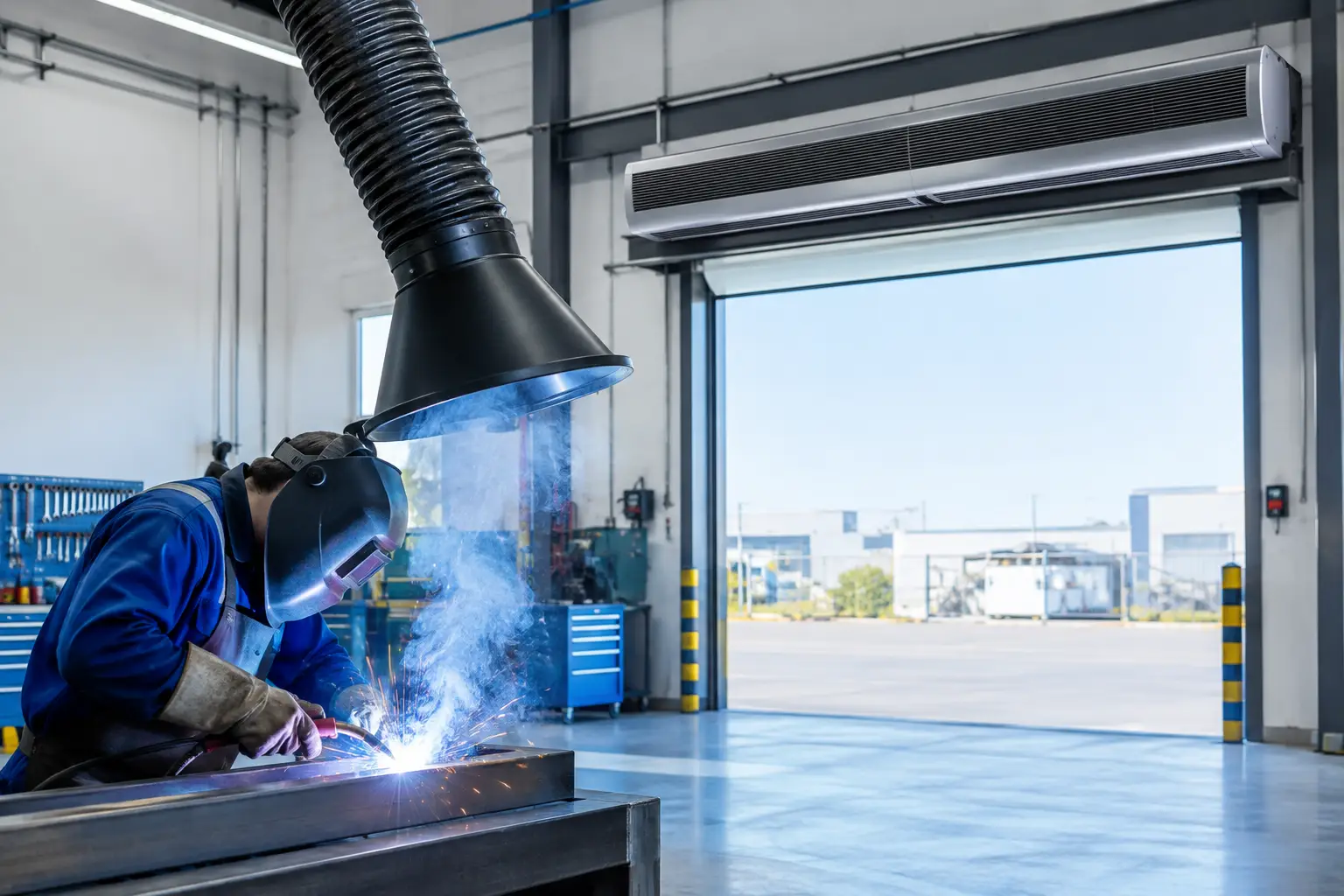
Fumes require a more careful assessment. An air curtain can help limit the inward movement of outdoor dust and pollutants, but it is not a substitute for properly designed extraction or ventilation where workshop processes generate fumes indoors. If the site has welding, paint-related work, combustion emissions, or chemical processes, the entrance air curtain should be coordinated with the wider ventilation strategy.
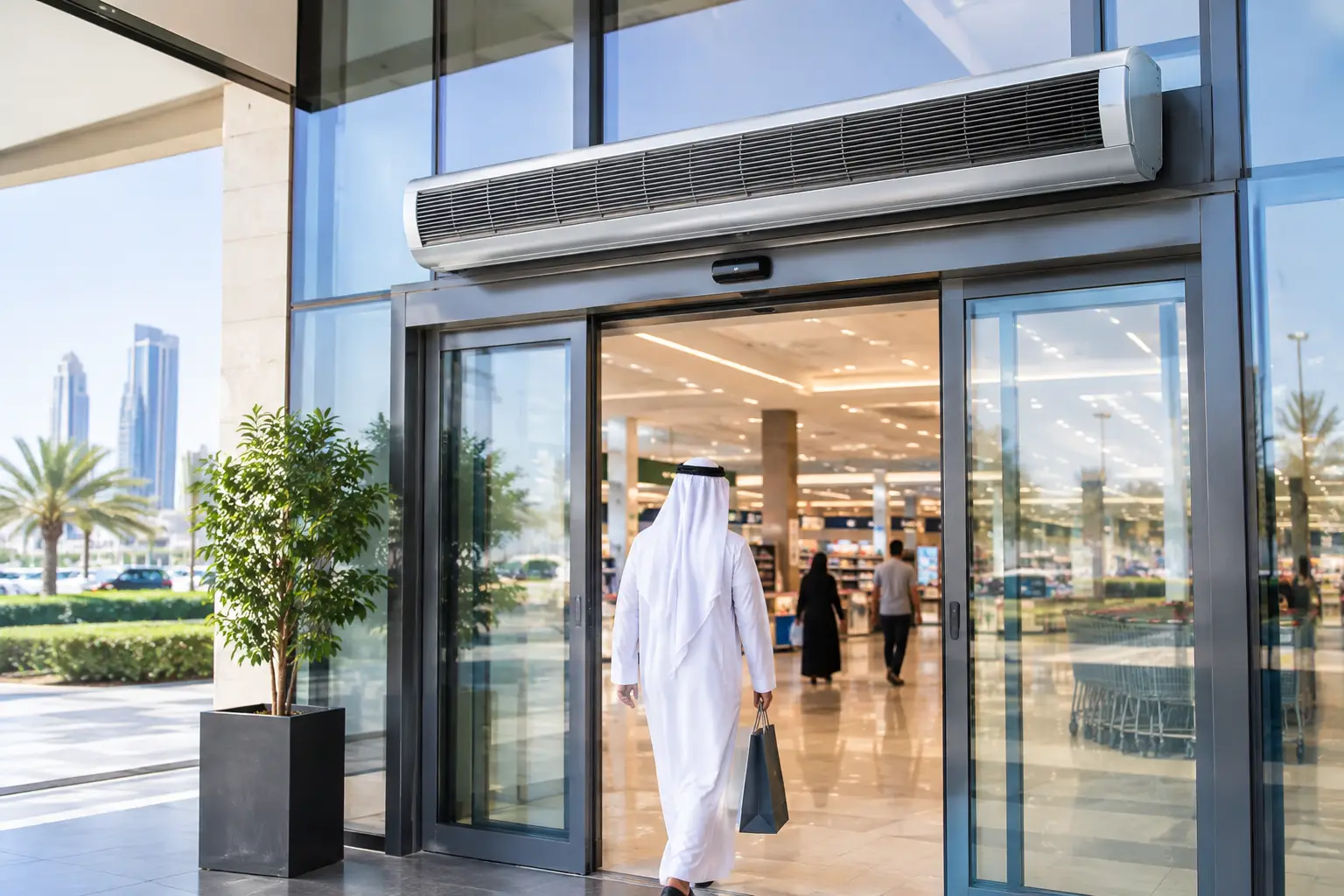
At customer-facing service centers, air curtains can also improve the experience around reception-facing workshop doors. Staff do not have to choose between keeping a door closed for cooling control and opening it for fast service access. That practical flexibility is one reason air curtains are commonly considered for high-traffic commercial and industrial entrances.
What determines the right system
A suitable system starts with the actual opening, not a generic product category. Door width, door height, and mounting position determine the airflow reach required. A unit must create a continuous air stream across the opening, so gaps between units or inadequate discharge velocity can weaken performance.
Mounting height and door configuration
An air curtain installed at a low pedestrian entrance has very different requirements from one mounted above a high vehicle bay. As mounting height increases, the system needs enough throw and air volume to reach the floor zone with useful velocity. For tall workshop doors, an industrial-grade centrifugal air curtain is often more appropriate than a light-duty commercial model.
The door type also matters. Rolling shutters, sectional overhead doors, fast-action doors, and open-sided bays all create different operating conditions. If a shutter opens only for short intervals, the air curtain can be interlocked with the door controls. If the entrance remains open for extended periods, the air curtain must be selected for sustained operation and the site’s external pressure conditions.
Traffic volume and operating hours
A workshop with a few scheduled deliveries each day has a different airflow requirement from a service center processing vehicles continuously. High traffic increases the time an opening is exposed and can create turbulence that disrupts the air barrier.
For heavy-use entrances, evaluate duty cycle, expected opening duration, and whether several doors are open at the same time. The air curtain should be specified to support actual operating behavior, not an idealized schedule that rarely happens in practice.
Climate and site exposure
Climate performance is central across the GCC, MENA, and African markets. A workshop facing direct afternoon sun in Dubai or Riyadh may experience far greater heat pressure than a sheltered loading entrance. Coastal humidity in Doha, Muscat, or Lagos adds another layer of cooling demand, while exposed sites in desert areas need stronger protection against dust and sand.
Wind is another important variable. A strong crosswind or negative building pressure can deflect the air stream, reducing separation performance. In these cases, airflow direction, discharge angle, installation position, and system capacity should be reviewed as part of the project design. The answer is not always a larger unit. Sometimes the right response is a different mounting arrangement or coordination with the building’s air balance.
Choosing between commercial and industrial air curtains
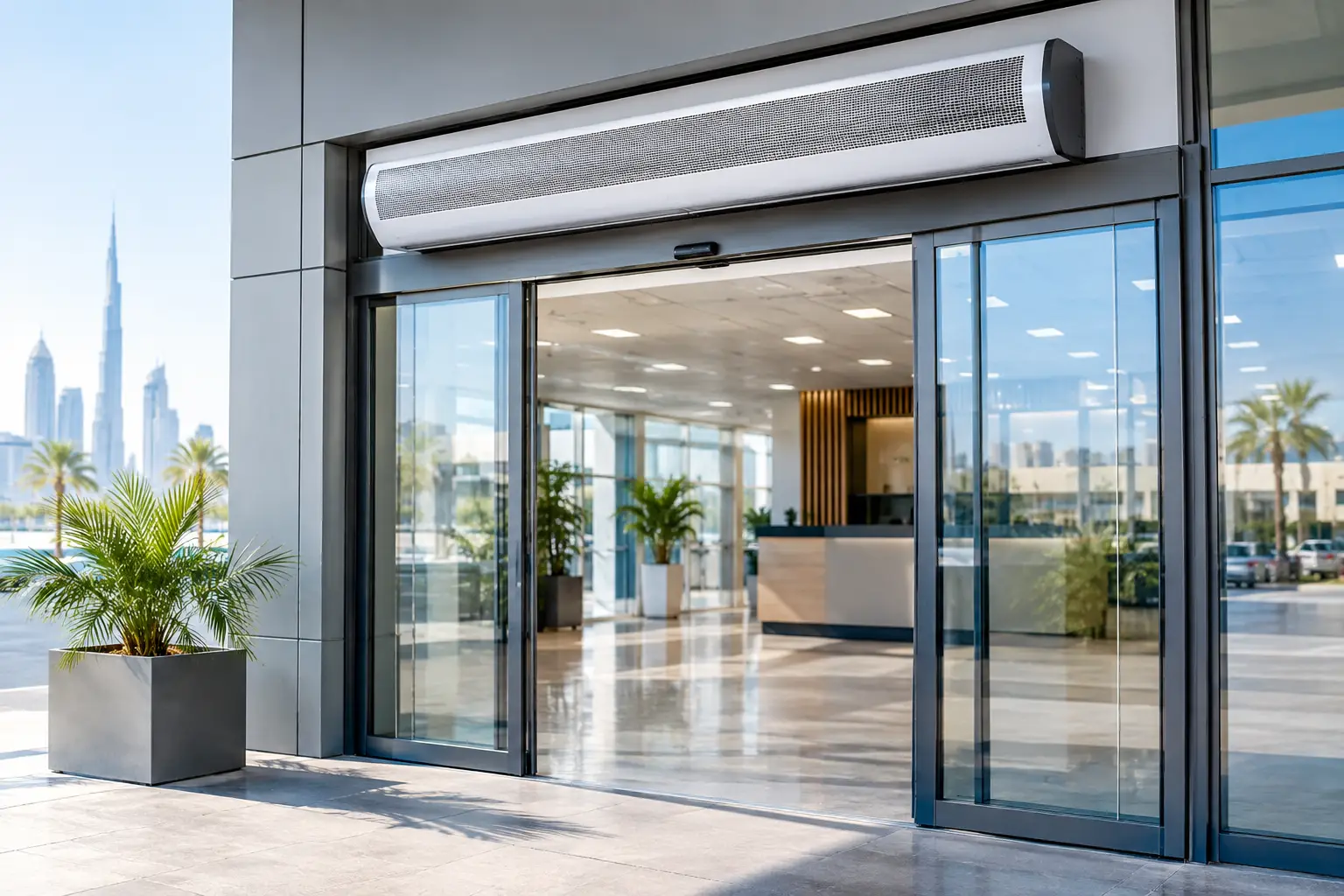
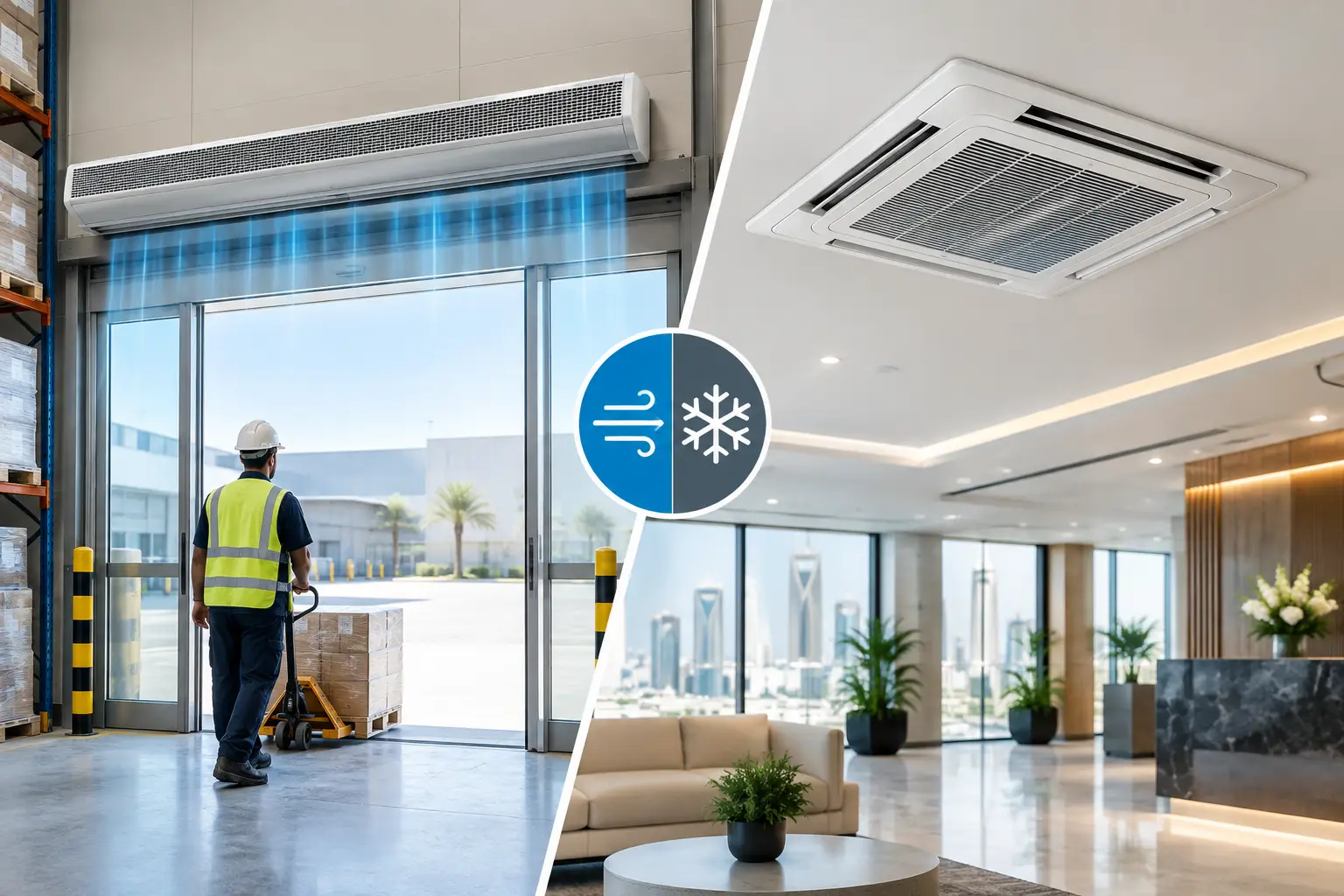
The correct category depends on the entrance, not the label of the facility. A small reception entrance within a workshop complex may be suitable for a commercial centrifugal or HiFi-style air curtain. A high, wide vehicle bay or industrial service door generally requires a more powerful centrifugal system designed for longer air throw and demanding operating conditions.
Industrial centrifugal units are typically the stronger option where doorway height, external heat, dust exposure, and continuous traffic place greater demands on the equipment. Their airflow characteristics make them better suited to heavy-duty openings, provided they are sized and installed correctly.
Noise should also be considered, particularly where the workshop has customer waiting areas, inspection desks, or offices close to the entrance. Higher output generally brings a trade-off between air performance and sound level. A good specification balances the required barrier strength with the acoustic conditions of the work area.
For projects where visual integration matters, recessed ceiling air curtains may suit enclosed customer entrances or finished service reception zones. They are not automatically the right choice for an exposed high-bay workshop door, where accessibility, mounting height, and airflow reach usually take priority.
Design details that are often missed
The strongest air curtain specification can underperform if basic site details are overlooked. The unit should cover the full clear opening width, and its discharge must not be obstructed by shutters, tracks, signage, lighting, or structural elements. The installation should also allow safe professional access for inspection and planned maintenance.
Control strategy deserves equal attention. Door-contact activation can reduce unnecessary running time for intermittently used doors, while manual or building-management controls may suit entrances that stay open throughout a shift. Variable speed settings can be useful where conditions change between morning deliveries, peak service periods, and quieter hours.
Coordinate the air curtain with the HVAC engineer early in the project. Its purpose is to reduce infiltration load at the entrance, but the wider cooling system still needs to account for occupancy, equipment heat, solar gain, and process conditions. Treating the air curtain as part of the entrance climate-control design produces more dependable results than adding it after complaints about heat or dust arise.
When an air curtain may need additional measures
An air curtain is highly effective when it is matched to the opening and operating conditions, but it is not a universal remedy. Very high wind exposure, unusually tall doors, constantly open bays, or major pressure imbalances may require a combined approach. This can include door management procedures, improved vestibule or partition design, and proper adjustment of the building’s air balance.
Likewise, workshops with process-generated contaminants need dedicated ventilation and extraction designed for those hazards. The air curtain protects the doorway boundary; it does not replace systems intended to capture pollutants at their source.
For a service workshop in a tropical, humid, or desert climate, the most useful next step is a site-specific review of the entrance dimensions, mounting height, traffic pattern, and HVAC conditions. FreezeeX can provide a consultation and quotation for an air curtain solution that matches the actual bay environment, helping keep the workshop productive while reducing unnecessary cooling loss.


3 Responses
Clear and practical explanation, especially in highlighting real workshop challenges like heat, dust, and constant traffic. It connects technical details with real-world use cases in a way that’s easy to understand
Thank you for your thoughtful feedback. We’re glad the article effectively connected technical concepts with practical workshop challenges. Our goal is to provide useful, real-world guidance that helps businesses choose the right air curtain solutions for demanding commercial and industrial environments.