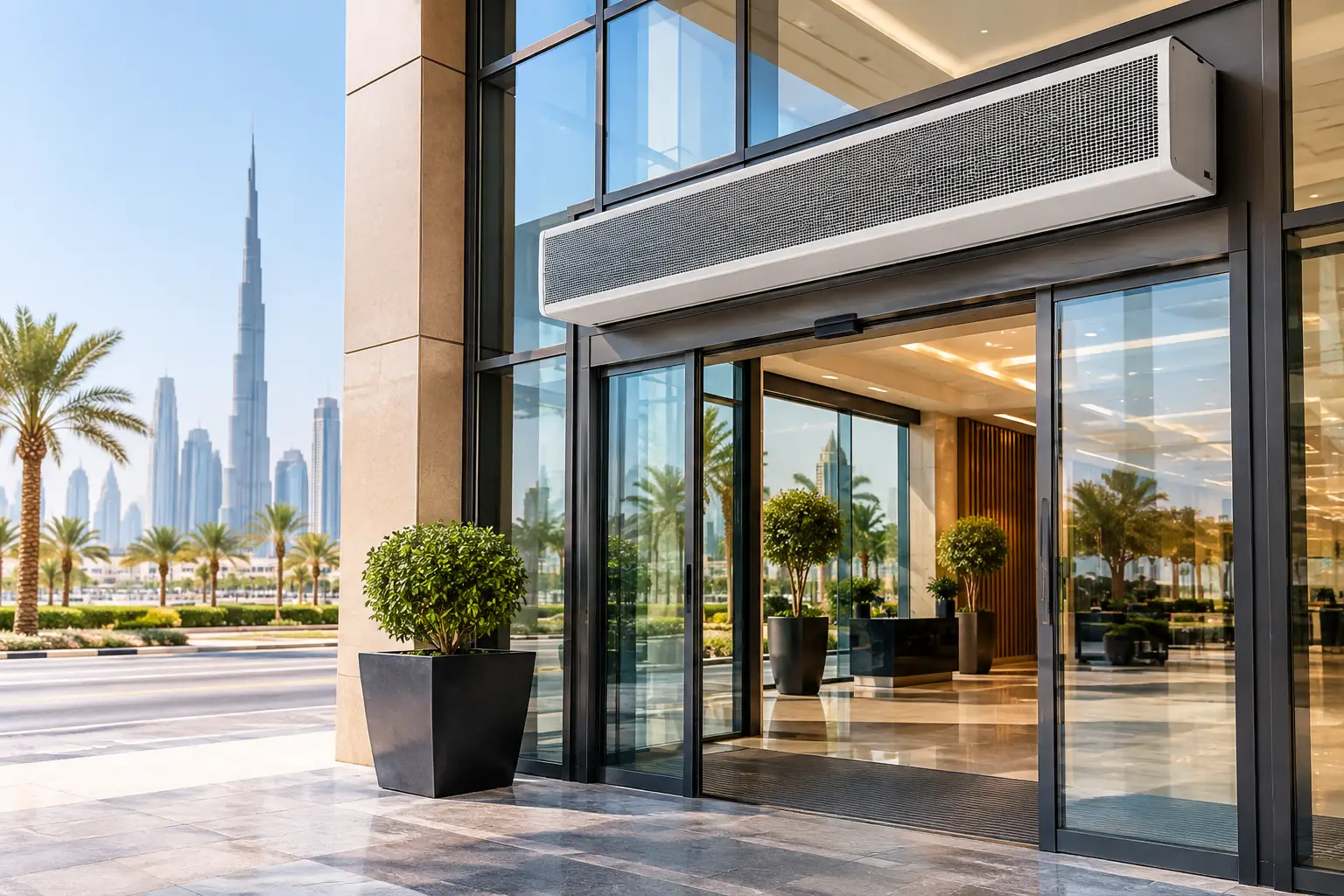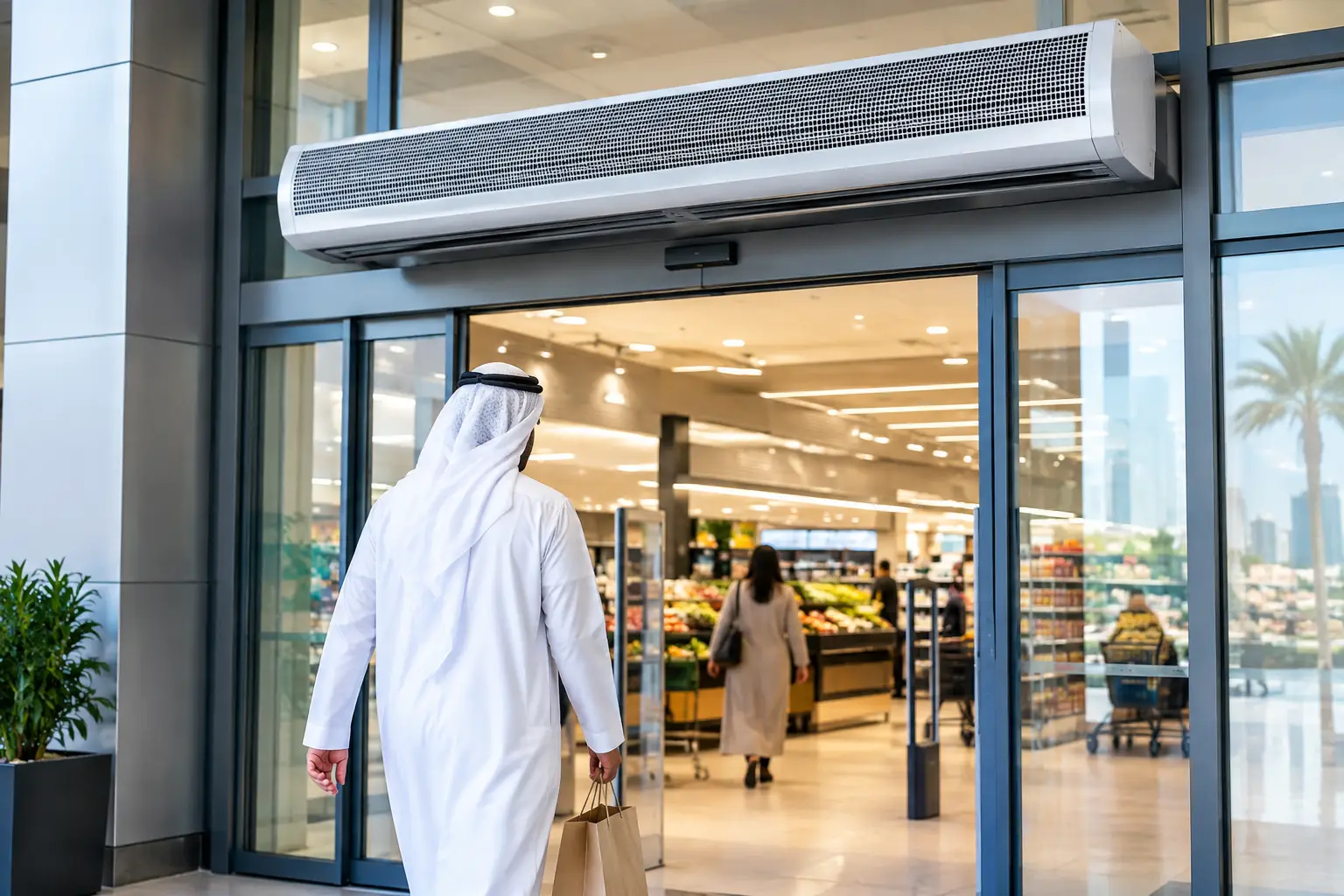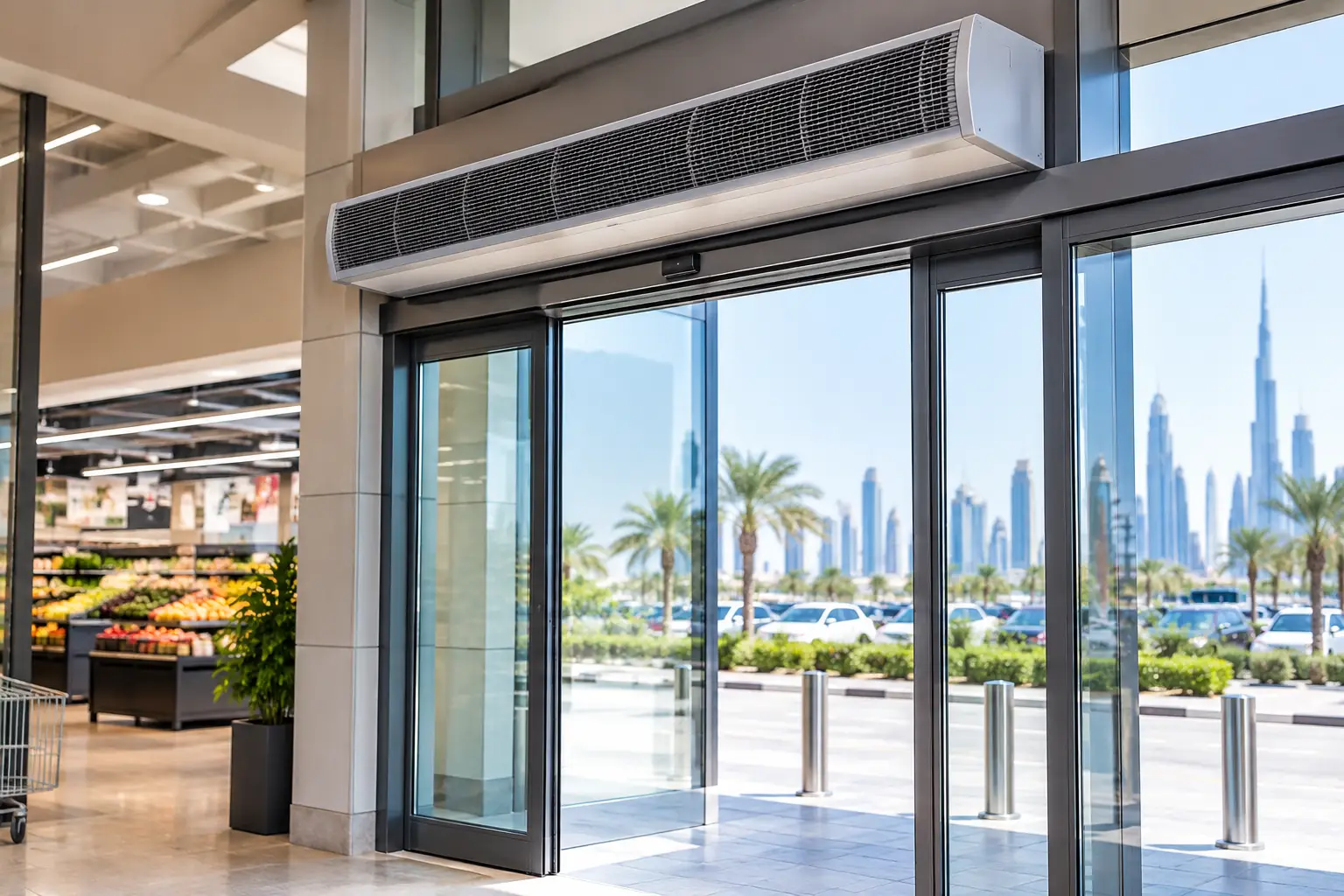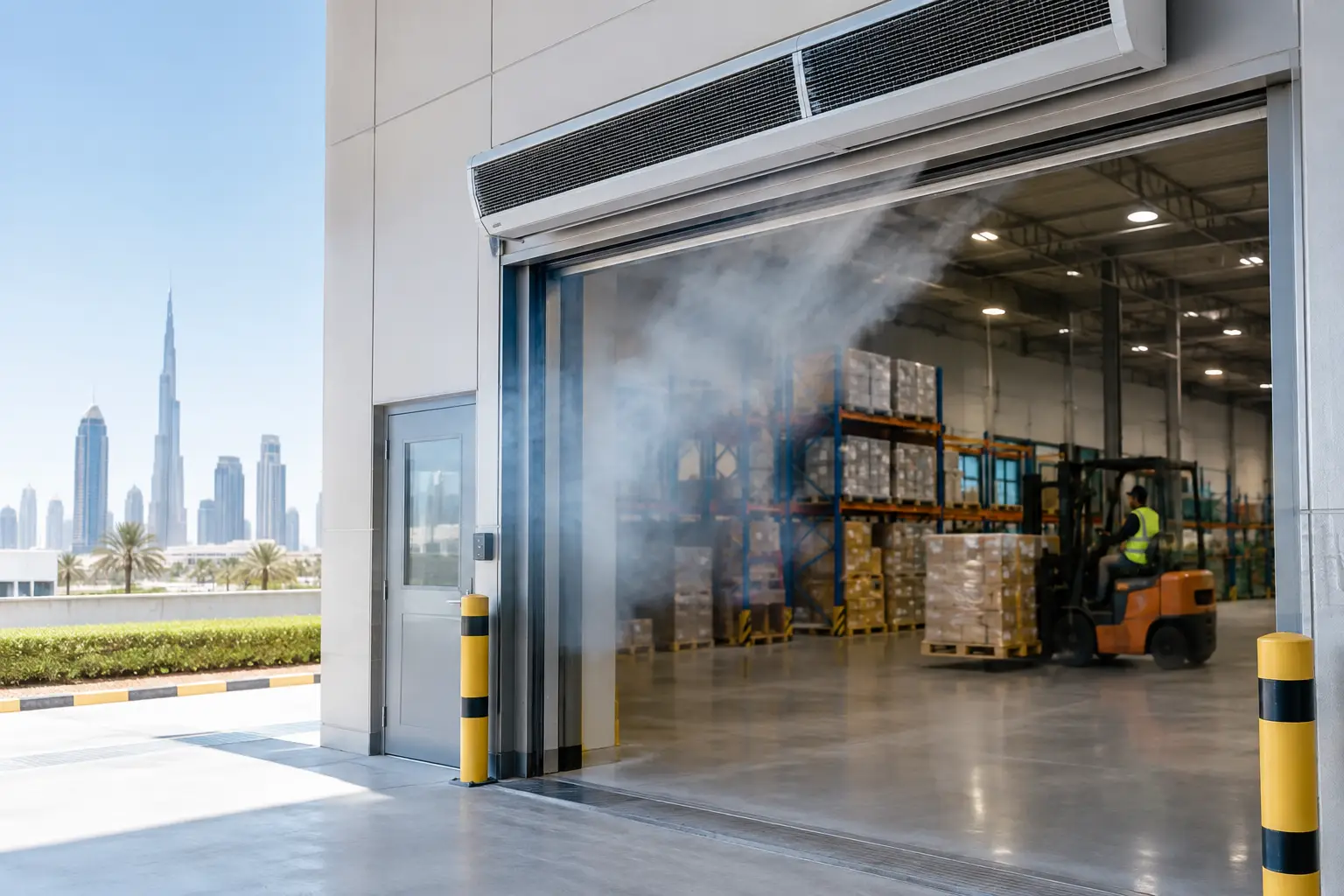
A busy entrance can drain cooled air faster than an undersized HVAC system can recover it. In supermarkets, cold rooms, hotels, loading areas, and industrial plants across hot and dusty regions, that loss shows up quickly – higher energy bills, more humidity, more insects, and less control at the door. That is why knowing how to select commercial air curtains matters at the specification stage, not after complaints start.
The right unit does more than blow air downward. It creates a stable air barrier that matches the opening, the traffic pattern, and the environmental pressure at the entrance. If the unit is too weak, mounted incorrectly, or chosen without considering local heat and dust conditions, it will run but underperform. For facilities in desert and tropical climates, selection has to be more precise.
How to select commercial air curtains starts with the opening
The first step is the door itself. Width and height are the obvious measurements, but they are not the only ones that matter. A standard retail entrance, a recessed lobby door, and a warehouse shutter can all have the same width while requiring completely different air curtain performance.
Door height is especially critical because air velocity drops as air travels from the discharge grille to the floor. A unit that performs well above a low commercial doorway may not maintain a protective air stream across a taller opening. This is where many projects go wrong. Buyers compare only nominal size, then discover that a unit sized for a shopfront cannot control infiltration at a tall industrial access point.
You also need to look at whether the door is single, double, sliding, or roller shutter, and whether it stays open for long periods or opens in short cycles. High-frequency entrances need stronger and more consistent air separation than low-use doors. If carts, pallets, or people move through continuously, the air curtain has to recover quickly after disturbance.
Measure more than width and height
Pressure conditions around the doorway affect performance. A building with strong negative pressure, nearby exhaust systems, or crosswinds at the entrance may require a more powerful unit or a different installation approach. In hot coastal cities with humidity and inland desert zones with heavy dust, the barrier has to resist very different forms of infiltration. Selection should reflect that reality.
Match the unit type to the application
Commercial air curtains are not one category. The correct model depends on architecture, traffic level, and operating conditions.
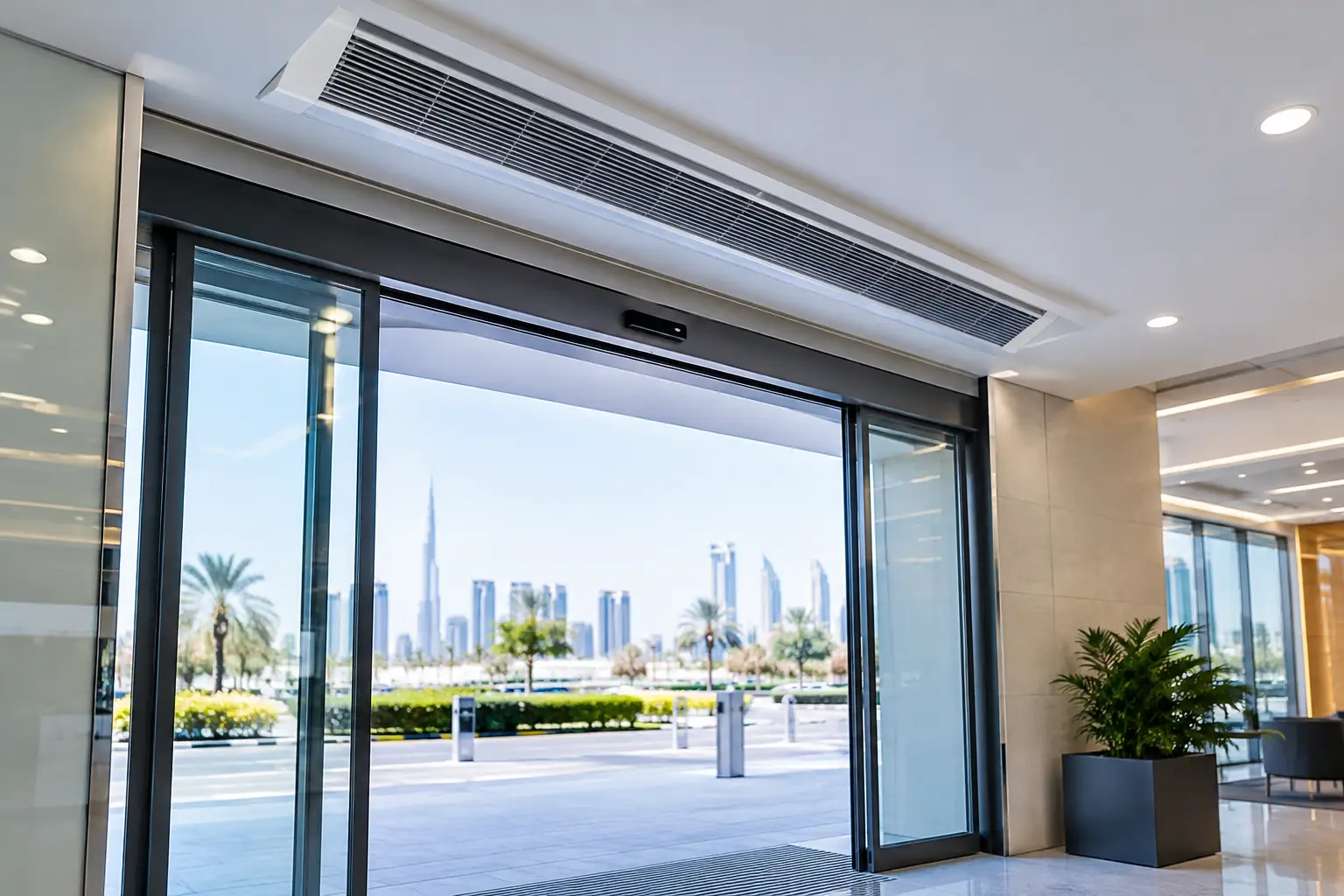
For customer-facing spaces such as retail stores, hotels, restaurants, and office entrances, appearance and noise level usually matter alongside performance. Ceiling-recessed models are often chosen where visual integration is important. Exposed commercial units are common where service access and straightforward mounting are priorities.
For back-of-house openings, warehouses, workshops, and plant entrances, the focus shifts toward throw, durability, and resistance to harsh operating conditions. Industrial centrifugal units are often better suited to taller or more demanding doorways because they deliver stronger, more stable airflow. In facilities that deal with dust, vehicle movement, or wide open doors, a light-duty commercial unit is rarely enough.
Cold storage applications require even tighter thinking. The goal is not only comfort at the entrance. It is controlling temperature transfer, condensation risk, and refrigeration loss. A unit serving a chilled area or cold room has to be selected around the temperature difference, door cycle frequency, and moisture load. In high-humidity markets, poor selection can lead to fogging, wet floors, and unnecessary cooling strain.
Airflow matters more than motor size
When buyers ask how to select commercial air curtains, the most useful answer is this: focus on delivered airflow and air velocity at the opening, not just basic power ratings. Bigger motors do not automatically mean better entrance protection.
What matters is whether the unit can project a uniform air stream across the full width and height of the opening. Gaps in coverage weaken the barrier. So does turbulence caused by poor fan design or incorrect mounting height. This is why blower type, outlet geometry, and installation position matter as much as raw capacity.
Centrifugal designs are often preferred in demanding commercial and industrial applications because they can provide stronger pressure characteristics and more controlled discharge. For high-traffic sites in hot climates, that control is valuable. The unit has to hold the air line in place against heat, dust, and repeated door disturbance.
Don’t oversize blindly
There is a trade-off here. An oversized unit can increase noise, use more power than necessary, and create discomfort if airflow is too aggressive for the space. In hospitality, premium retail, and office lobbies, excessive air velocity can become a user experience problem. The target is effective separation, not maximum blast.
Consider climate, not just the building type
A hotel in Dubai, a supermarket in Lagos, a factory in Riyadh, and a distribution point in Nairobi may all need air curtains, but they do not face the same entrance conditions. Ambient heat, humidity, airborne dust, and insect pressure change what good performance looks like.
In desert climates, the barrier must help resist hot air and fine dust entering every time the door opens. In tropical climates, humidity control becomes just as important as temperature control. The wrong unit may reduce some heat transfer but still allow moisture-heavy air to move indoors, forcing HVAC systems to work harder and reducing comfort.
This is why climate-adapted selection matters. Equipment intended for mild environments may not hold performance in harsh regional conditions. Specifiers should ask how the unit performs in sustained heat, heavy traffic, and contaminated air environments, not only what the catalog states under ideal test conditions.
Installation details can make or break performance
Even a well-selected unit can underperform if it is installed poorly. The discharge should cover the full opening width. If one unit is too short for a wide entrance, using multiple synchronized units is usually better than leaving dead zones at the sides.
Mounting height must stay within the unit’s effective range. Set it too high and the air stream may lose integrity before reaching the floor. Mount it too far back from the face of the opening and outside air can slip around the barrier before it forms properly.
Electrical coordination and control strategy also matter. Some sites benefit from door-triggered operation, while others need continuous running during business hours. In cold storage or heavy-traffic commercial settings, control logic should support the operational pattern rather than simply turning the unit on and off with no consideration for flow stability.
Think about maintenance before you specify
Air curtains are often selected for performance and price, then ignored until maintenance becomes difficult. That is short-term thinking.
In dusty and high-use environments, service access matters. Filters, intake protection, motor access, and general cleanability affect long-term reliability. If a unit is installed in a recessed architectural detail with poor access, routine cleaning may be skipped. Over time, that can reduce airflow and weaken the barrier.
Noise should also be evaluated realistically. Lower sound levels are more important in hospitality, healthcare-adjacent commercial spaces, and premium retail. In industrial settings, noise tolerance may be higher, but not if the unit is near workstations or service counters. Good selection balances acoustic expectations with the airflow needed for the job.
How to select commercial air curtains for better ROI
Commercial buyers usually start with capital cost, but lifecycle value is the better metric. A lower-priced unit that fails to control infiltration is not cheaper once cooling loss, discomfort, hygiene issues, and early replacement are included.
A properly selected air curtain can reduce HVAC load, support cleaner indoor conditions, limit insect ingress, and improve consistency at entrances that would otherwise be hard to manage. For hypermarkets, hotels, cold chain operators, and industrial facilities, that translates into measurable operational benefit. The return depends on the application, but the logic is consistent: correct fit protects energy performance.
This is also where consultation matters. Product range alone does not solve the problem. The unit has to be matched to the opening dimensions, site conditions, traffic pattern, and climate. A quote based only on door width is rarely enough for a serious project.
If you are specifying an entrance in a high-temperature, high-humidity, or dust-heavy environment, take the time to assess airflow requirements properly. FreezeeX supports contractors, consultants, and facility teams with climate-specific recommendations for commercial and industrial sites across the GCC, MENA, and Africa. Request a consultation or quote based on your actual door conditions, and you will get an air curtain system sized for performance, not guesswork.