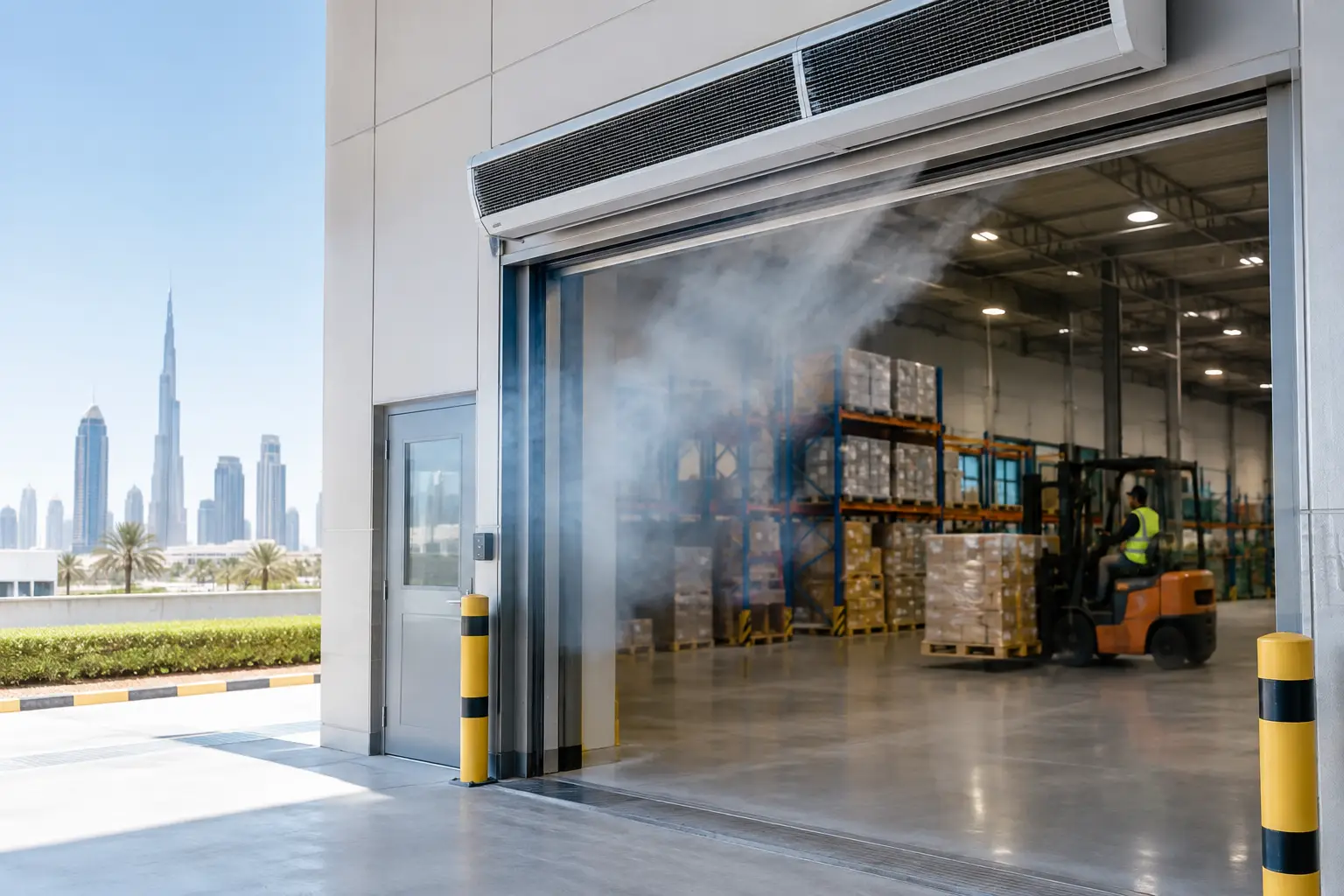
A loading-bay door left open during a hot afternoon can turn a controlled facility into an expensive cooling loss point within minutes. The question of where should air curtains be installed is not simply about placing a unit above every door. It is about identifying entrances where outside heat, humidity, dust, insects, or airborne contaminants are actively disrupting operations.
For facilities in Dubai, Riyadh, Doha, Cairo, Lagos, Nairobi, and similar hot-climate markets, the strongest air curtain applications are usually high-traffic openings connected to conditioned, hygienic, or temperature-sensitive spaces. Correct placement creates powerful air isolation at the exact point where a building loses control of its indoor environment.
Install Air Curtains at External Entrances
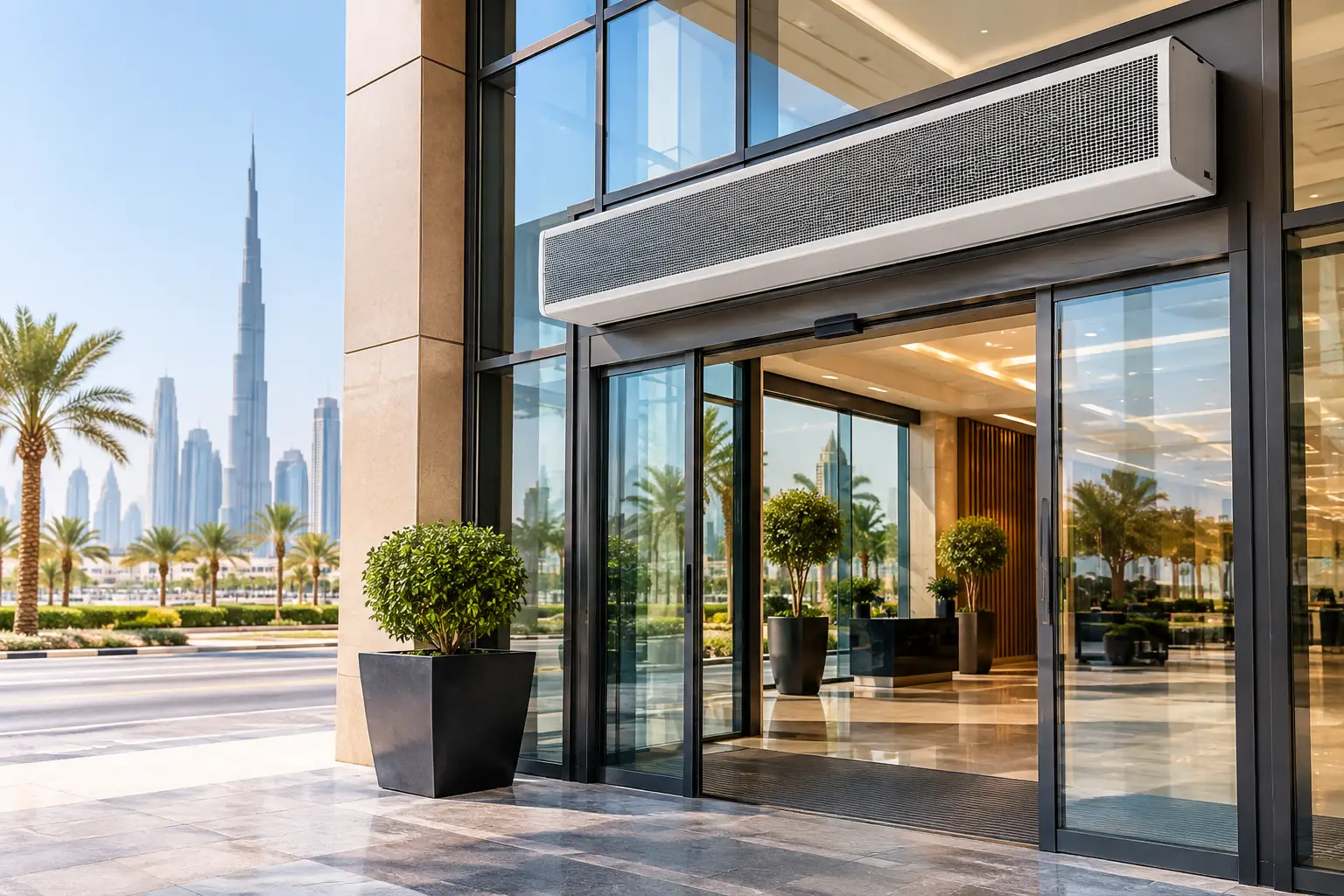
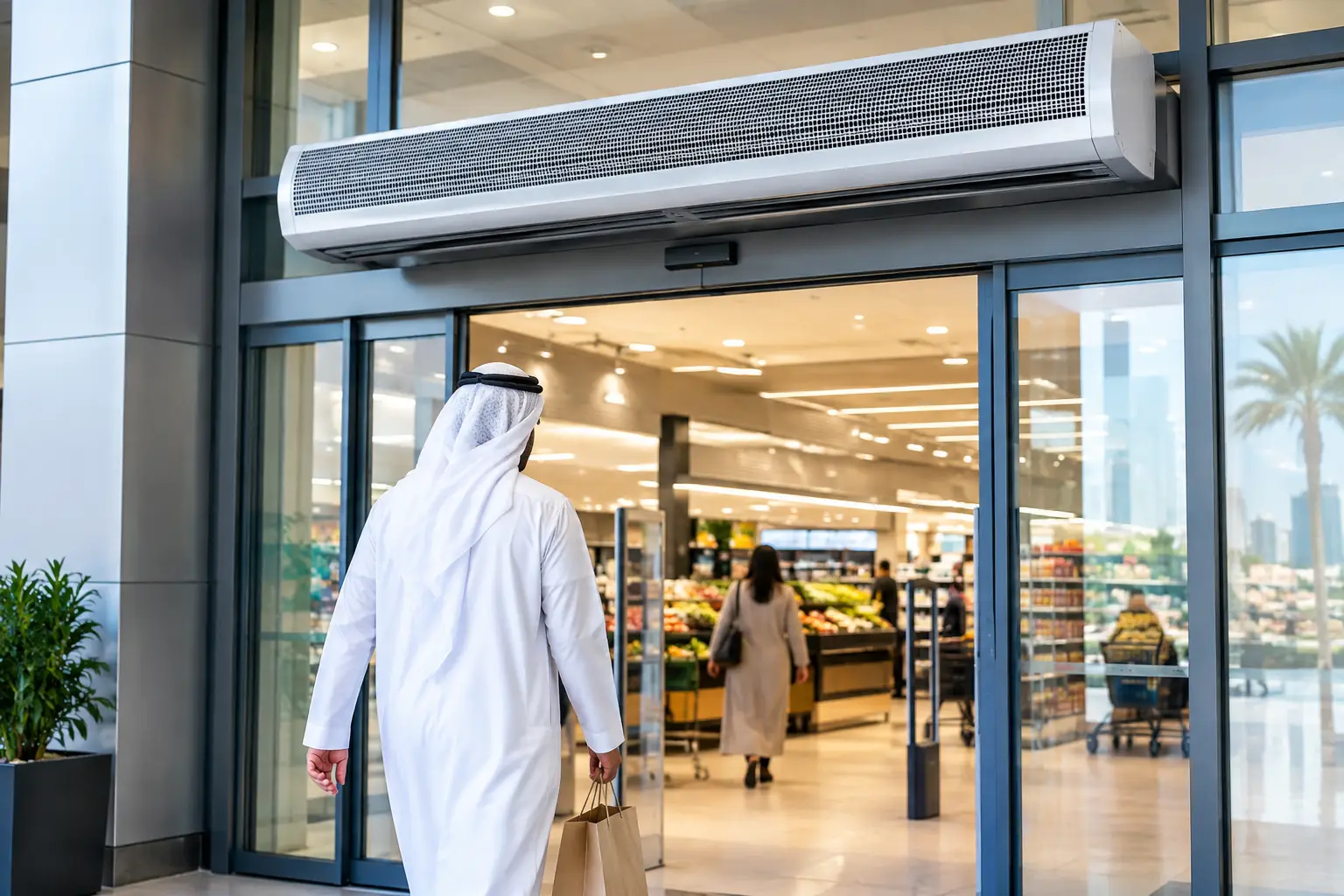
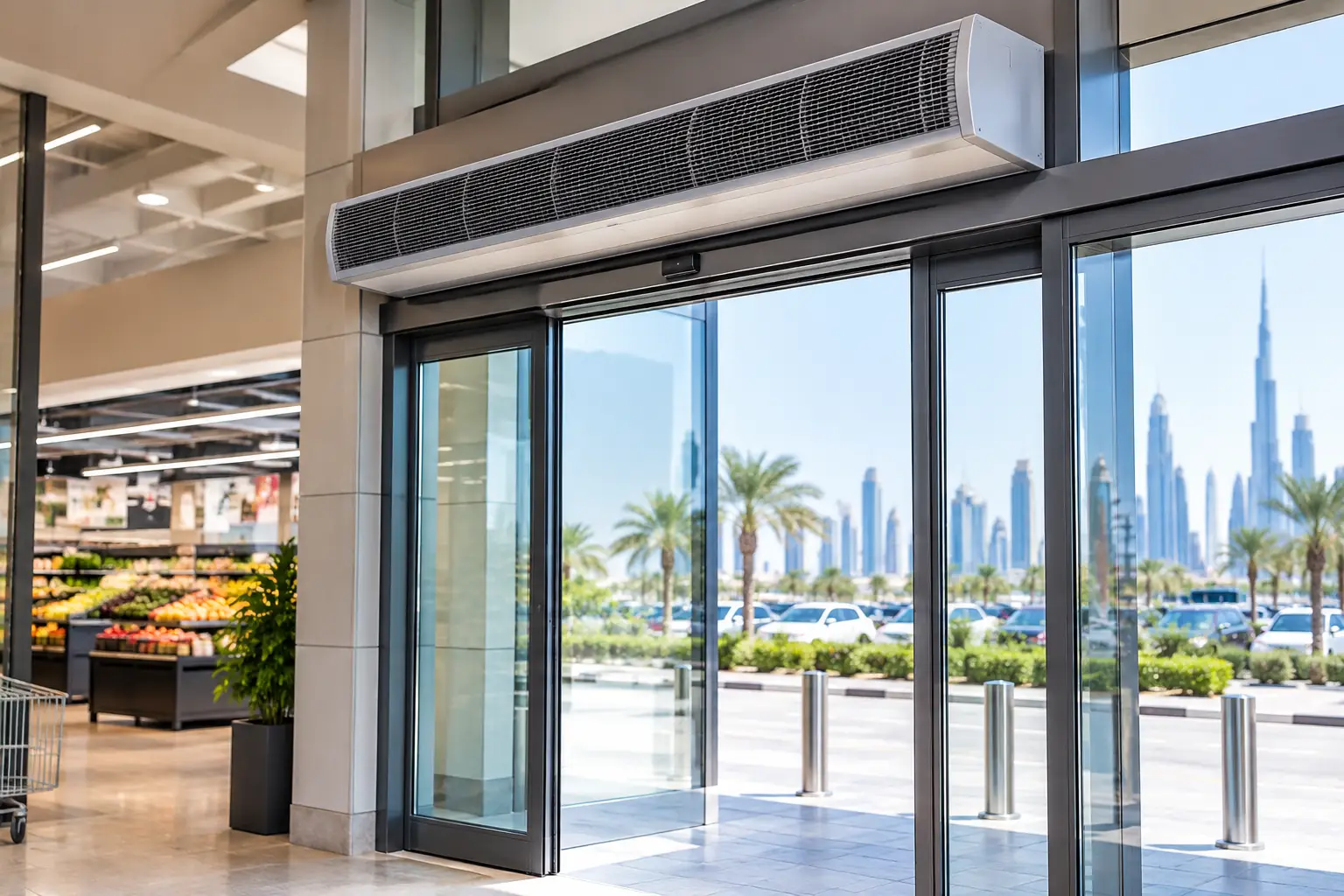
The primary location for an air curtain is above an external pedestrian entrance that opens directly to an air-conditioned interior. Retail stores, hotel lobbies, office towers, hypermarkets, malls, restaurants, and healthcare facilities all benefit when a properly selected unit forms a downward air barrier across the full width of the opening.
These entrances face a constant pressure difference between hot outdoor air and cooler indoor air. Each door cycle allows heat and humidity to enter, forcing the cooling system to recover. In dusty urban and desert environments, the same opening can bring in fine sand and airborne debris. An air curtain reduces this exchange while allowing people, carts, and customers to pass without a physical barrier.
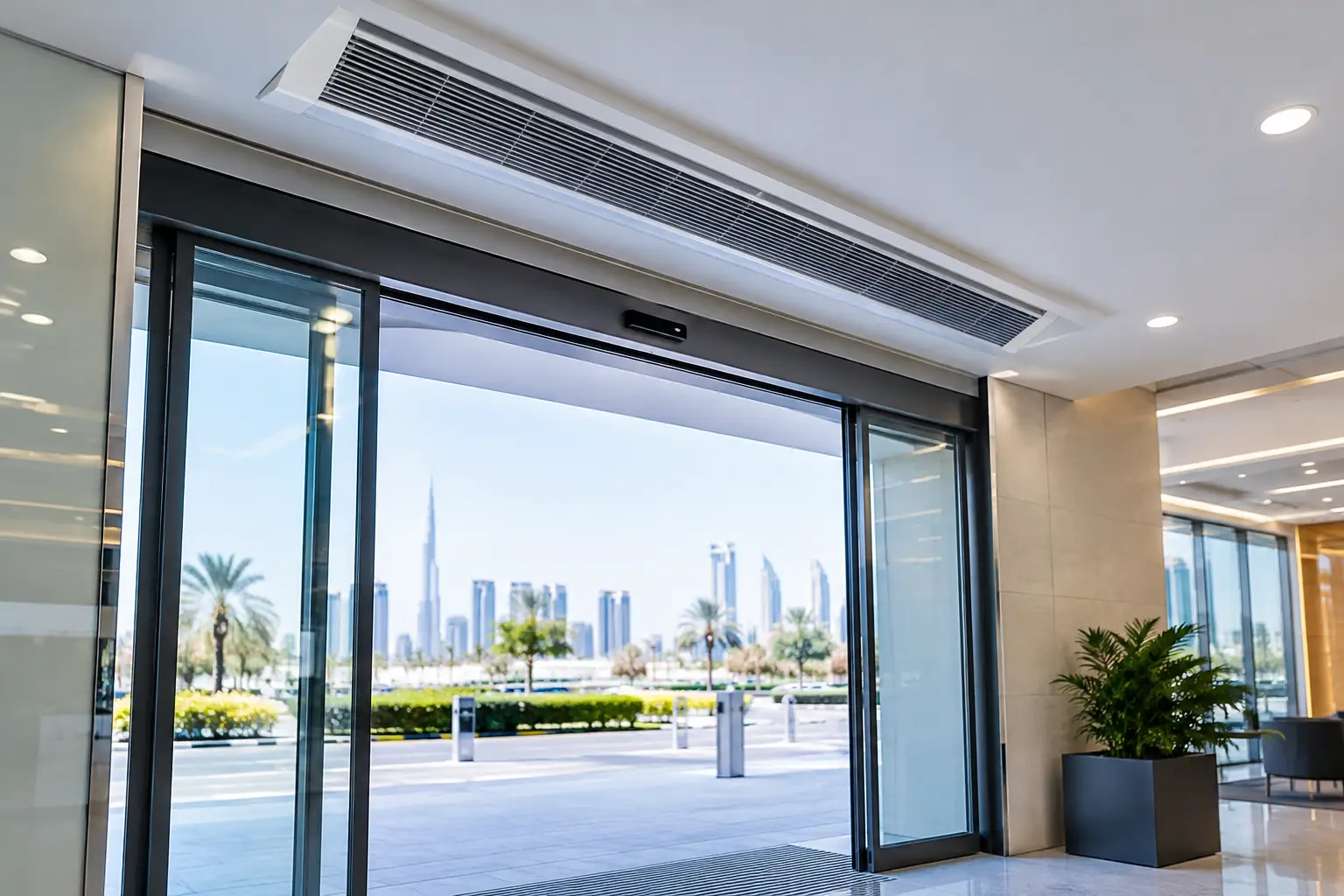
Placement matters. The unit should be mounted on the interior side of the opening, directly above the door, with airflow projected downward as close as practical to the doorway line. It must cover the entire clear opening width. A unit that is too narrow leaves side gaps, and those gaps become paths for hot air and dust infiltration.
For premium commercial interiors, recessed ceiling air curtains can preserve a clean architectural finish. In busy retail, hospitality, and office entrances, commercial centrifugal or HiFi systems may provide the controlled airflow and lower perceived noise level required for customer-facing spaces.
Use Air Curtains at High-Traffic Service Doors
Service entrances are often more demanding than front doors. Staff access doors, delivery doors, back-of-house restaurant openings, and warehouse-to-office connections may remain open longer and receive repeated traffic throughout the day. That makes them a frequent source of cooling loss and dust entry.
A commercial air curtain is particularly effective at these openings when operational teams need a clear route for staff, trolleys, or deliveries. However, the equipment must match the door height, width, traffic pattern, and exposure level. A lightly used side entrance does not need the same airflow performance as a receiving door that opens continuously during peak delivery hours.
Where the opening connects a hot, dusty exterior to a clean preparation area, the air curtain also supports hygiene management. It is not a substitute for sanitation procedures or sealed doors after operating hours, but it is a practical first line of defense against airborne particles and flying insects during active use.
Protect Cold Storage and Temperature-Controlled Zones
Cold storage doors, refrigerated loading areas, food distribution rooms, and temperature-controlled processing zones are among the most valuable locations for air curtains. At these openings, uncontrolled air exchange can create several operational problems at once: cooling loss, condensation, fogging, slippery floors, temperature instability, and higher refrigeration demand.
The best installation point is typically above the doorway separating the controlled zone from a warmer adjacent space, such as a dispatch area, loading dock, or production floor. The air stream should reach the floor with enough force to maintain separation despite movement from forklifts, pallet jacks, and personnel.
This is not a one-size-fits-all application. Large openings, frequent forklift movement, and major temperature differences require an industrial-grade solution and proper airflow calculation. Installing an undersized commercial unit on a high-bay cold-room door can create a false sense of protection while allowing substantial thermal transfer around and beneath the airstream.
For cold-chain operators in high-humidity coastal and tropical markets, selection must also consider moisture control. The goal is not only to retain cold air, but to reduce the humid air entering a space where it can condense on surfaces and compromise safe operations.
Place Industrial Air Curtains at Loading Bays and Plant Openings
Industrial sites need air curtains wherever large openings expose production, storage, or packing areas to harsh external conditions. Typical examples include loading bays, workshop doors, manufacturing entrances, vehicle access points, logistics hubs, and open dispatch zones.
These applications place more stress on the equipment than a standard retail door. Openings may be wider and taller, traffic may involve forklifts or vehicles, and doors may remain open for long periods. Wind, dust, hot air, and vehicle movement can all interfere with the air barrier.
Industrial centrifugal air curtains are designed for this type of duty. Their role is to project a stable, high-velocity airflow across a larger opening and help protect interior processes without slowing material movement. For sites in desert conditions, where dust loads and outdoor temperatures can be severe, durable construction and dependable blower performance are operational requirements, not optional specifications.
Installers should avoid treating every loading bay as identical. A sheltered dock, an exposed façade, and a door facing prevailing winds will behave differently. In some cases, a larger unit, multiple units across one opening, or a higher-performance industrial range is needed to maintain effective coverage.
Install at Entrances to Hygienic and Customer-Facing Areas
Air curtains make particular sense at entrances where clean presentation and comfort affect business performance. Hypermarket produce areas, hotel service entrances, restaurant receiving points, food preparation transitions, pharmacies, and high-traffic commercial spaces can all benefit from reduced dust and insect entry.
At customer-facing doors, appearance and noise matter alongside airflow. Recessed or refined commercial systems may be appropriate where the unit needs to integrate with a finished ceiling. At back-of-house openings, performance capacity, easy maintenance access, and durability often take priority.
The installation decision should reflect the consequences of outside air entering the facility. If a doorway regularly causes complaints about heat, visible dust near displays, insect activity, or uncomfortable staff workstations, it is a strong candidate for an air curtain assessment.
Where Air Curtains Should Not Be Treated as a Standalone Fix
An air curtain performs best as part of a controlled entrance strategy. It cannot compensate for a damaged roller shutter, a door left permanently open without sufficient airflow capacity, or an opening far wider than the specified coverage. It also cannot correct poor building pressurization or eliminate contamination generated inside the facility.
The location may be right while the selected unit is wrong. Common specification errors include choosing a unit for the door width but not the door height, ignoring crosswinds, mounting the unit too far from the opening edge, or selecting a low-duty model for continuous industrial traffic. These errors reduce air velocity at floor level, where the barrier must remain effective.
A useful rule is to prioritize openings with high traffic, a meaningful indoor-outdoor temperature difference, visible dust or insect exposure, and high cooling or hygiene consequences. An entrance with all four conditions deserves careful evaluation first.
Specify the Installation Around the Opening, Not the Catalog Page
Before selecting an air curtain, assess the clear opening width and height, mounting location, door type, traffic frequency, exposure to wind, indoor temperature target, and the type of contamination being controlled. For a warehouse, that may mean dust and heat. For cold storage, it may mean moisture and thermal loss. For hospitality or retail, comfort, presentation, and insect control may be equally important.
The correct installation height is especially critical. Airflow loses velocity as it travels downward. A high opening may require a more powerful unit or a purpose-designed industrial system to ensure the air stream reaches the floor with sufficient force. Wide openings may require multiple units installed side by side, rather than one unit placed in the center.
Controls should match site operations as well. Door-activated operation can reduce unnecessary runtime at intermittent openings, while continuous operation may be more appropriate at entrances with constant traffic. The right control approach balances energy use with the need for uninterrupted protection.
FreezeeX supports contractors, consultants, and facility teams with application-led recommendations for tropical and desert-climate conditions. Request a consultation or project quote with your opening dimensions, operating hours, and site conditions to specify an air curtain that protects the space where it matters most.