
If you’re asking what size air curtain do I need, the wrong answer usually shows up fast – warm air pushing indoors, dust crossing the entrance, insects getting through, and HVAC systems working harder than they should. In commercial and industrial buildings, sizing is not a cosmetic decision. It determines whether the unit creates a real air barrier or just moves air around the doorway.
For facility managers, MEP contractors, and procurement teams, the right size depends on more than door width. Mounting height, traffic volume, pressure differences, and local climate all affect performance. In hot, humid, and dusty markets such as the GCC, North Africa, and parts of Sub-Saharan Africa, those factors matter even more because the air curtain is protecting cooled indoor space against harsh outdoor conditions for long operating hours.
What size air curtain do I need for my opening?
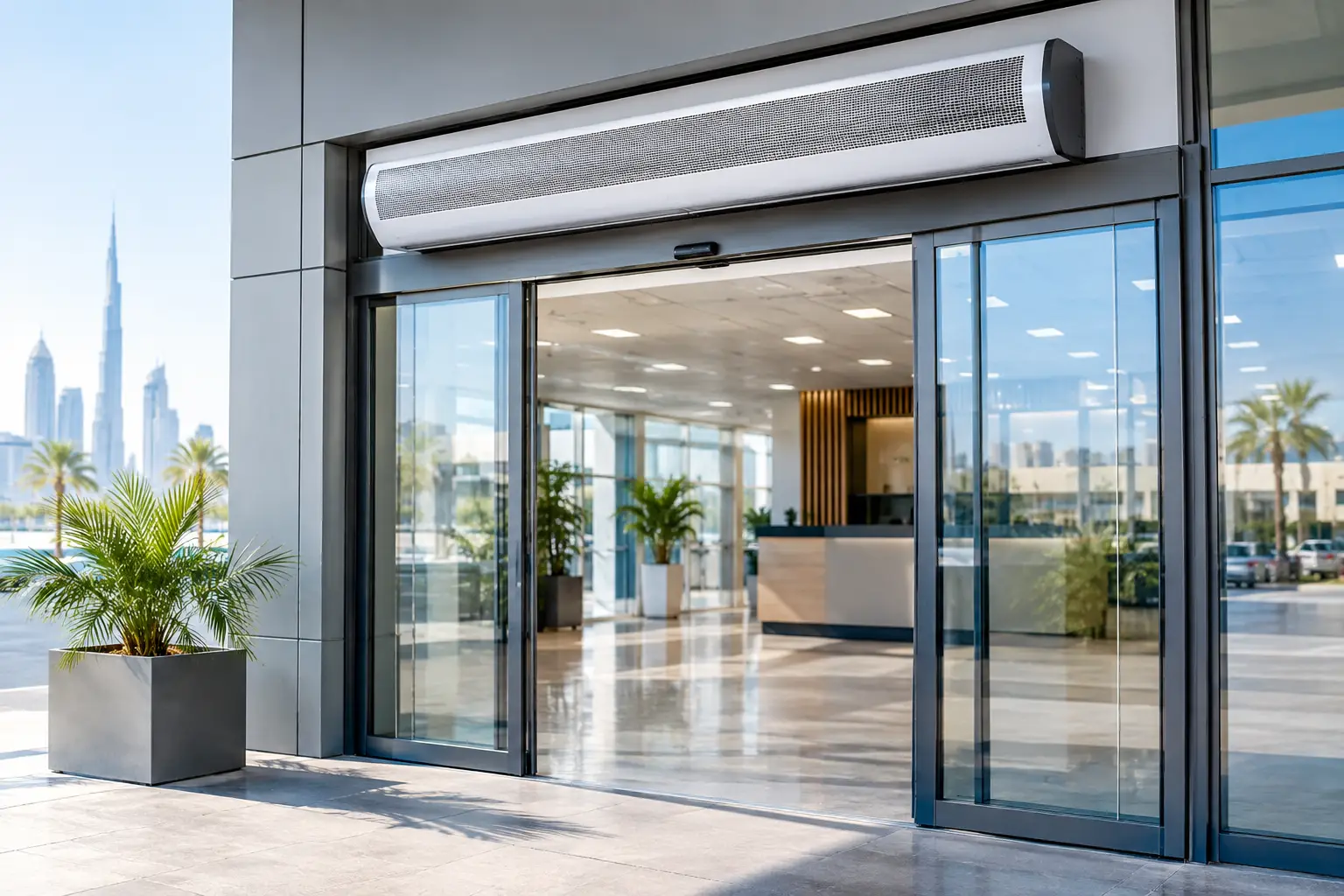
Start with the opening itself. In most projects, the air curtain should cover the full clear width of the entrance. If the unit is narrower than the opening, untreated gaps at the sides will let outside air, dust, and flying insects pass through. That weakens the entire barrier.
As a rule, the selected air curtain should be equal to or slightly wider than the door opening. If the entrance is too wide for a single unit, multiple units are often installed side by side to create continuous coverage. This is common in hypermarkets, logistics facilities, hotel entrances, and industrial loading access points where the opening is wider than standard commercial doors.
Width alone, however, is only the starting point. A 1.5-meter-wide doorway at a low mounting height is a different application from a 1.5-meter-wide doorway in a warehouse with a high lintel, frequent forklift movement, and strong pressure shifts.
Door height matters as much as door width
The second sizing factor is mounting height. Air curtains are designed to project an air stream from the unit down to the floor or to the occupied boundary zone with enough velocity to resist infiltration. As the installation height increases, the unit needs more throw and more air volume.
This is where many specifications go wrong. Buyers focus on matching the unit to the width of the door but overlook whether the discharge air can remain effective all the way down. A compact commercial unit may look suitable on paper, but if it is mounted too high, the air stream will dissipate before it creates proper separation.
For standard commercial entrances, a lighter-duty model may be suitable. For taller entrances in retail, hospitality, workshops, or service corridors, a stronger centrifugal or higher-performance commercial unit is often needed. For industrial doors, plant access points, and logistics openings, the air curtain typically needs significantly higher airflow and stronger pressure stability.
In practical terms, the question is not just what size air curtain do I need, but what size and performance class does this opening require.
Air velocity is what makes the barrier work
An air curtain is not sized correctly just because it physically fits above the door. It has to generate the right air velocity at the opening. That velocity must be strong enough to push downward and outward against incoming hot air, dust, humidity, and insects.
In desert and tropical climates, this becomes a performance issue, not a minor detail. A building in Dubai, Riyadh, Lagos, or Nairobi may face intense heat, crosswinds, frequent door cycles, and heavy indoor-outdoor temperature differences. If the velocity is too weak, the barrier breaks down during real operating conditions.
That is why specifiers should review the manufacturer’s effective mounting height, airflow rate, and discharge performance together. Higher airflow is not always better if it creates excessive noise or discomfort at the entrance, but undersized airflow is almost always a false economy. A cheaper unit that cannot maintain separation will increase cooling loss and reduce the operational value of the system.
The opening type changes the sizing decision
Not every doorway behaves the same way. A glass retail entrance, a hotel lobby, a cold room access point, and a warehouse shutter door all create different sizing requirements.
For a customer-facing commercial entrance, the priority is usually climate separation with acceptable noise levels and an appearance that fits the interior. For a cold storage door or food handling facility, the focus may be temperature retention, humidity control, and hygiene. For an industrial site, the unit may need to withstand long hours, airborne dust, and heavier external pressure conditions.
High-traffic sites also need more attention. If the door stays open for extended periods or cycles constantly, the air curtain becomes a primary line of defense rather than a secondary support to the door. In that case, sizing should be more conservative. Stronger performance is usually justified because the entrance is exposed more often.
Site conditions can force you to go up a size
Real-world conditions often push a project beyond the basic door dimensions. If the building has negative pressure, nearby exhaust systems, or strong wind exposure, the air curtain may need more power than a simple width-and-height calculation suggests.
This is especially relevant in industrial kitchens, workshops, factories, and large commercial buildings where pressure imbalance is common. The same applies to entrances that open directly to parking areas, loading yards, or streets with strong dust movement. In these environments, stepping up to a higher-capacity unit is often the difference between acceptable performance and constant infiltration complaints.
Humidity is another factor. In coastal and tropical markets, outside air carries moisture that increases latent load on the cooling system. An undersized air curtain allows more humid air indoors, which can affect comfort, condensation risk, and cooling efficiency. That means sizing decisions should reflect the climate profile of the site, not just the door dimensions on the drawing.
Choosing between commercial and industrial air curtains
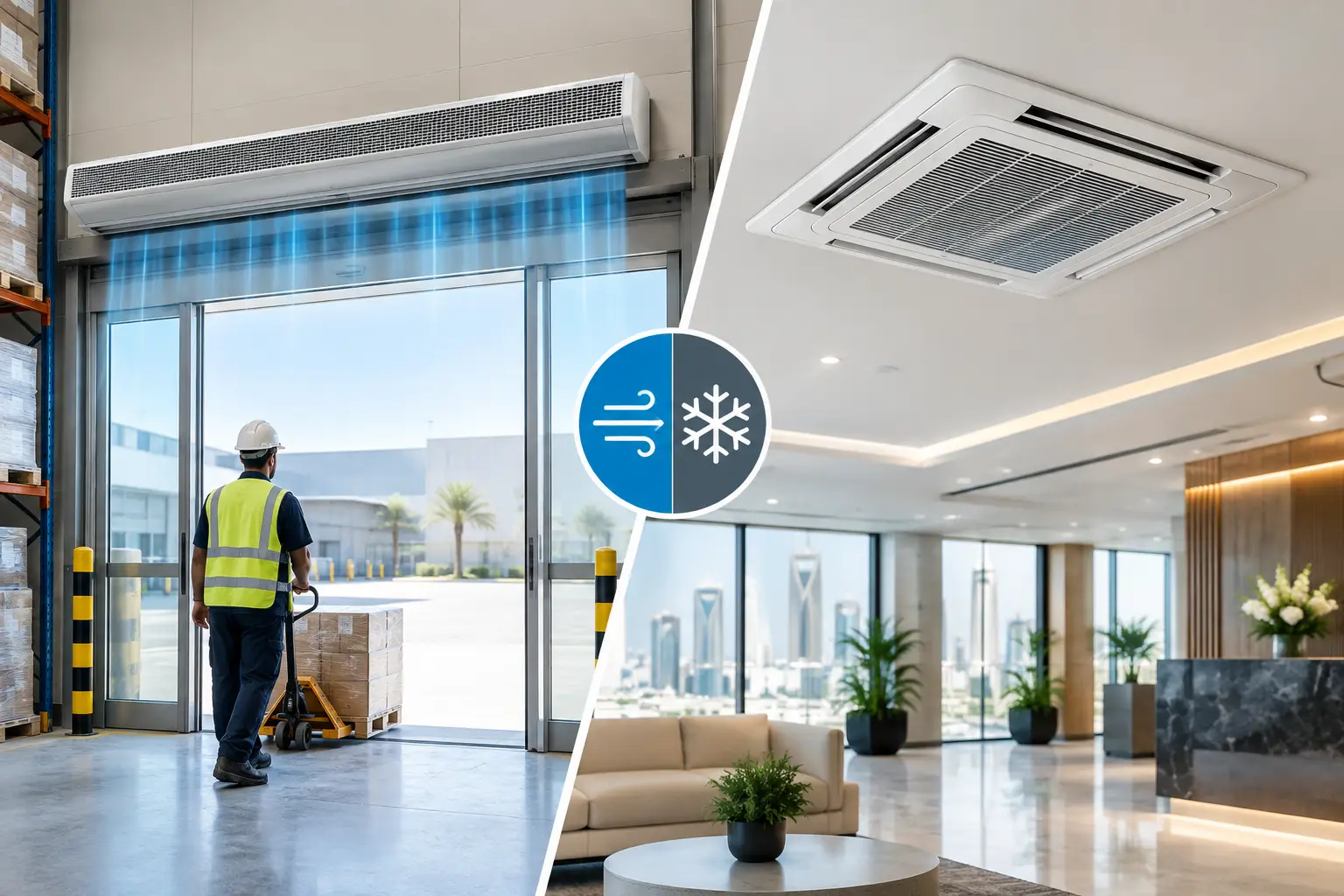
One of the most useful ways to size correctly is to place the project in the right equipment category first.
Commercial air curtains are typically suitable for offices, retail stores, restaurants, clinics, hotel entrances, and similar locations where the opening height is moderate and the aesthetic requirement is higher. These units can be very effective when matched correctly, especially for standard pedestrian doors.
Industrial air curtains are built for larger openings, higher mounting positions, stronger pressure resistance, and harsher operating conditions. They are more appropriate for factories, workshops, warehouses, distribution spaces, and heavy-use service entrances. They are also the better fit where dust, heat, and long daily operating hours are part of the normal environment.
There is a middle ground as well. Some projects look commercial from the front but behave like industrial applications because of traffic levels or external conditions. Large-format retail, hypermarkets, transport-connected buildings, and mixed-use service entrances often fall into this category. These sites need careful product selection rather than defaulting to a basic commercial model.
Common sizing mistakes
The most common mistake is choosing a unit based only on door width. The second is ignoring mounting height. After that, buyers often underestimate environmental pressure, wind, and humidity.
Another mistake is specifying a unit that matches the architectural opening but not the actual clear operational opening. If the active doorway is wider or taller than expected, the air curtain will be undersized from day one. In other cases, the selected unit may be technically powerful enough but installed too high or too far back from the opening to perform as intended.
Noise expectations can also distort sizing decisions. Some buyers try to avoid a higher-capacity unit because they assume it will be too loud. In reality, the better approach is to choose the right unit type for the application and review the acoustic performance properly. An undersized quiet unit that fails to protect the entrance is not a better result.
How to determine the right size with confidence
The fastest path to an accurate specification is to gather five inputs before selecting a model: clear door width, clear door height, installation height, traffic pattern, and site exposure. Once those are clear, the product category becomes much easier to define.
If the entrance is standard height, pedestrian-focused, and protected from strong external pressure, a commercial unit may be enough. If the opening is taller, busier, or exposed to hot winds, dust, or humidity, move toward a stronger commercial or industrial-grade solution. If the opening is exceptionally wide, plan for multiple synchronized units rather than trying to stretch one unit beyond its effective range.
For projects in harsh hot-weather regions, climate-adapted sizing is worth the attention. A unit that performs well in a mild indoor-facing application may not hold the line at a desert-facing entrance or a humid logistics corridor. That is why specification support matters.
FreezeeX works with contractors, consultants, and facility teams to match air curtain size and performance to the actual site condition, not just the drawing. If you are evaluating an entrance in a retail, hospitality, industrial, or cold storage facility, request a consultation or quote with your opening dimensions and project details. The right air curtain should do more than fit the doorway – it should protect the space, reduce cooling loss, and keep performing in tropical and desert climate conditions.




One Response