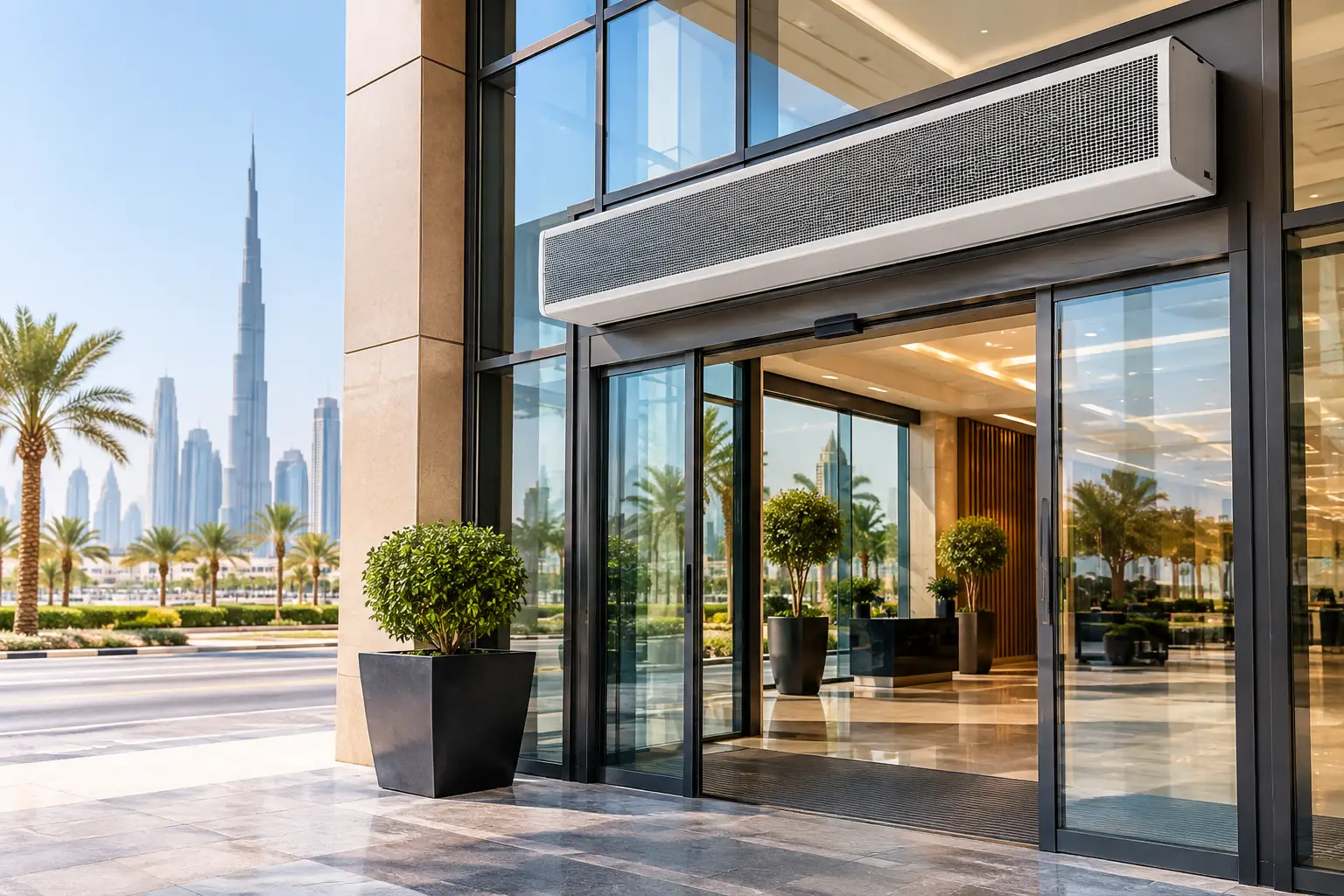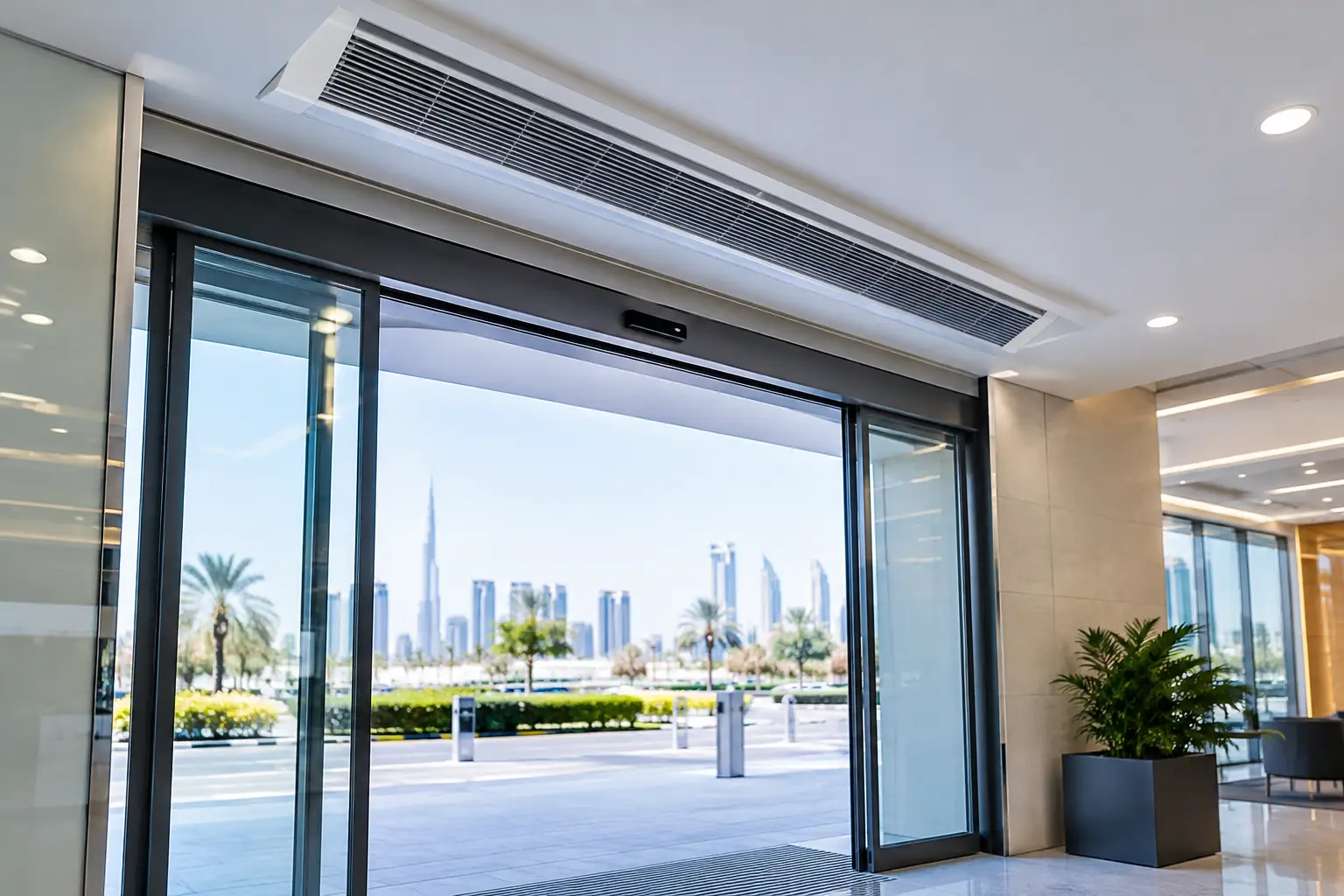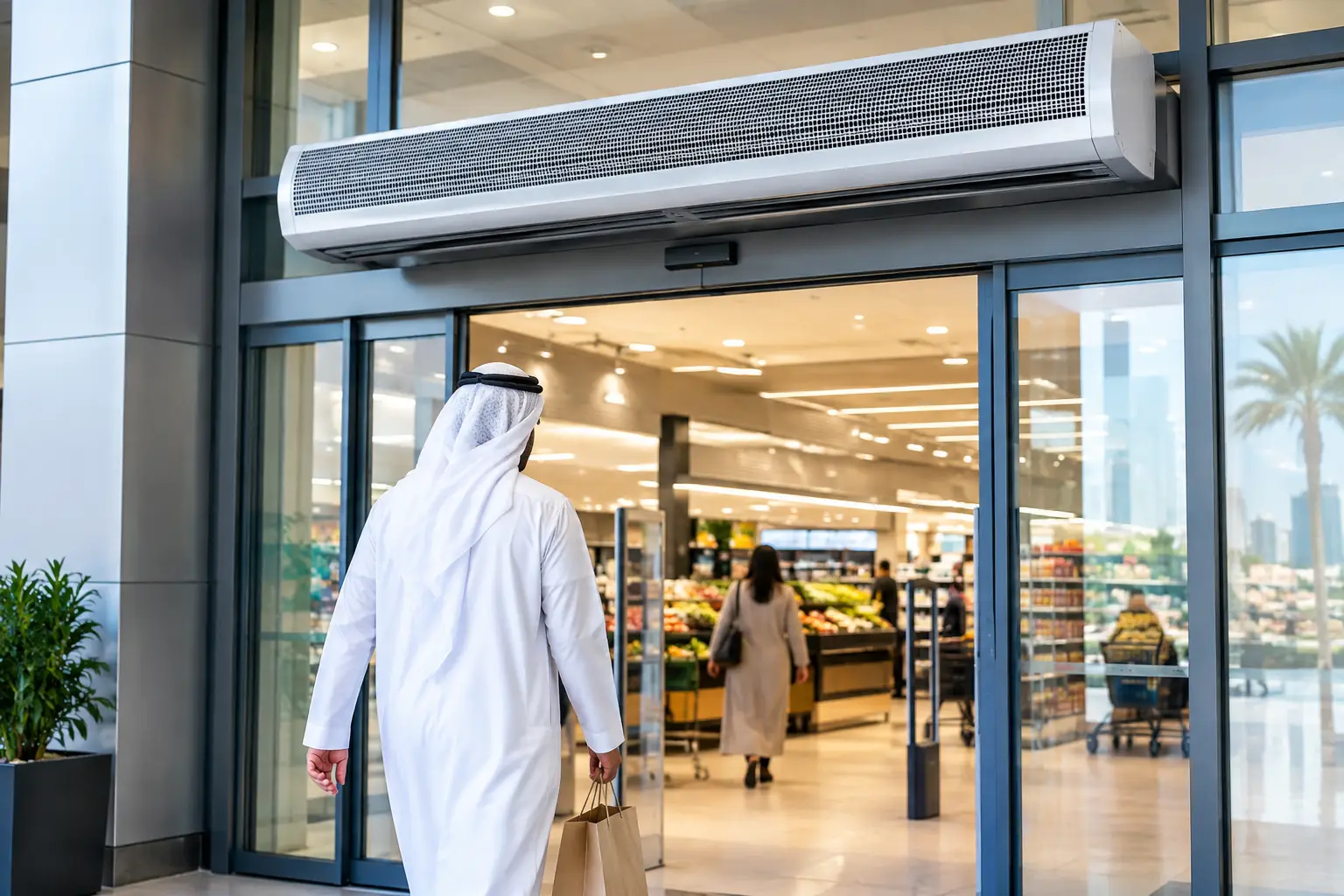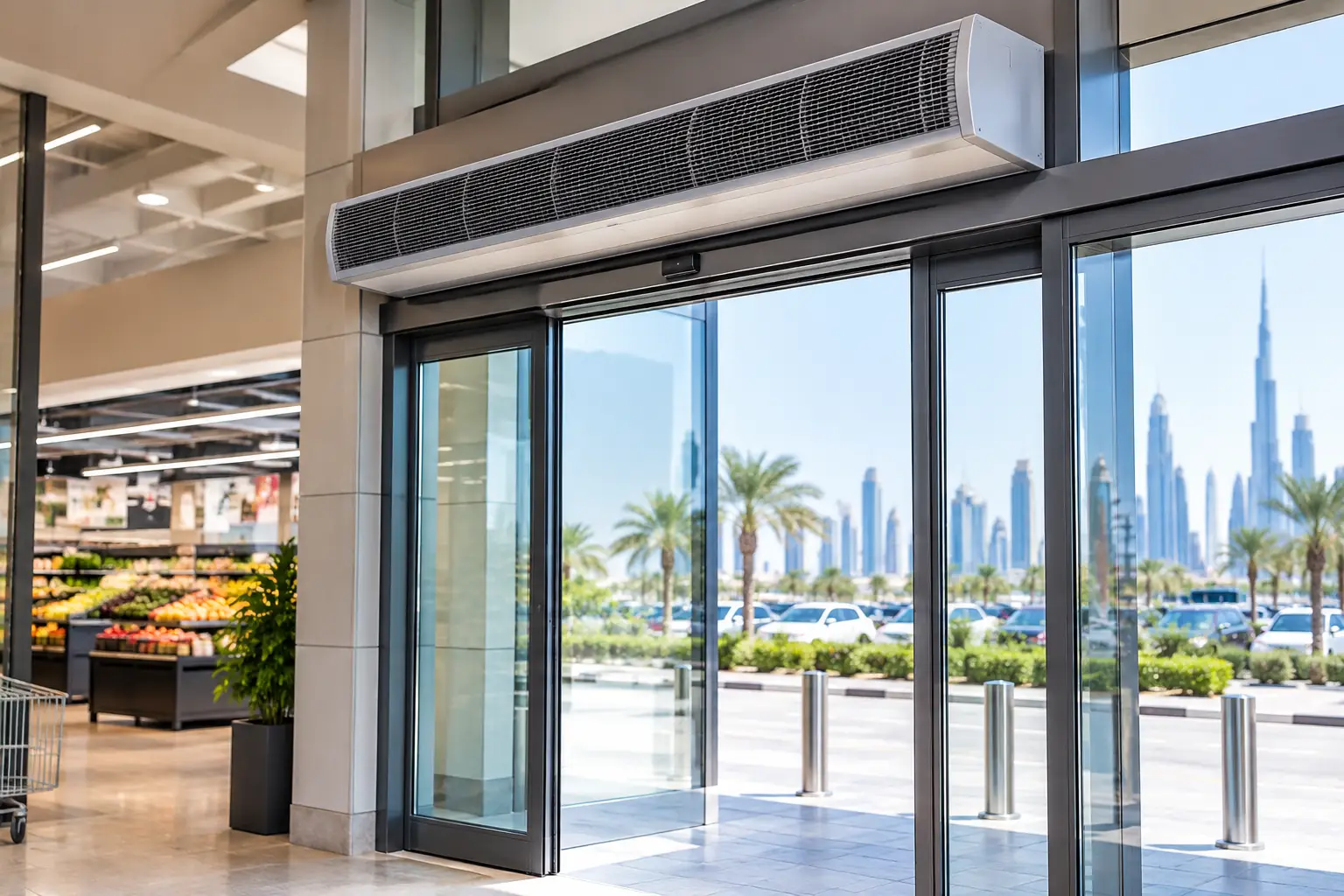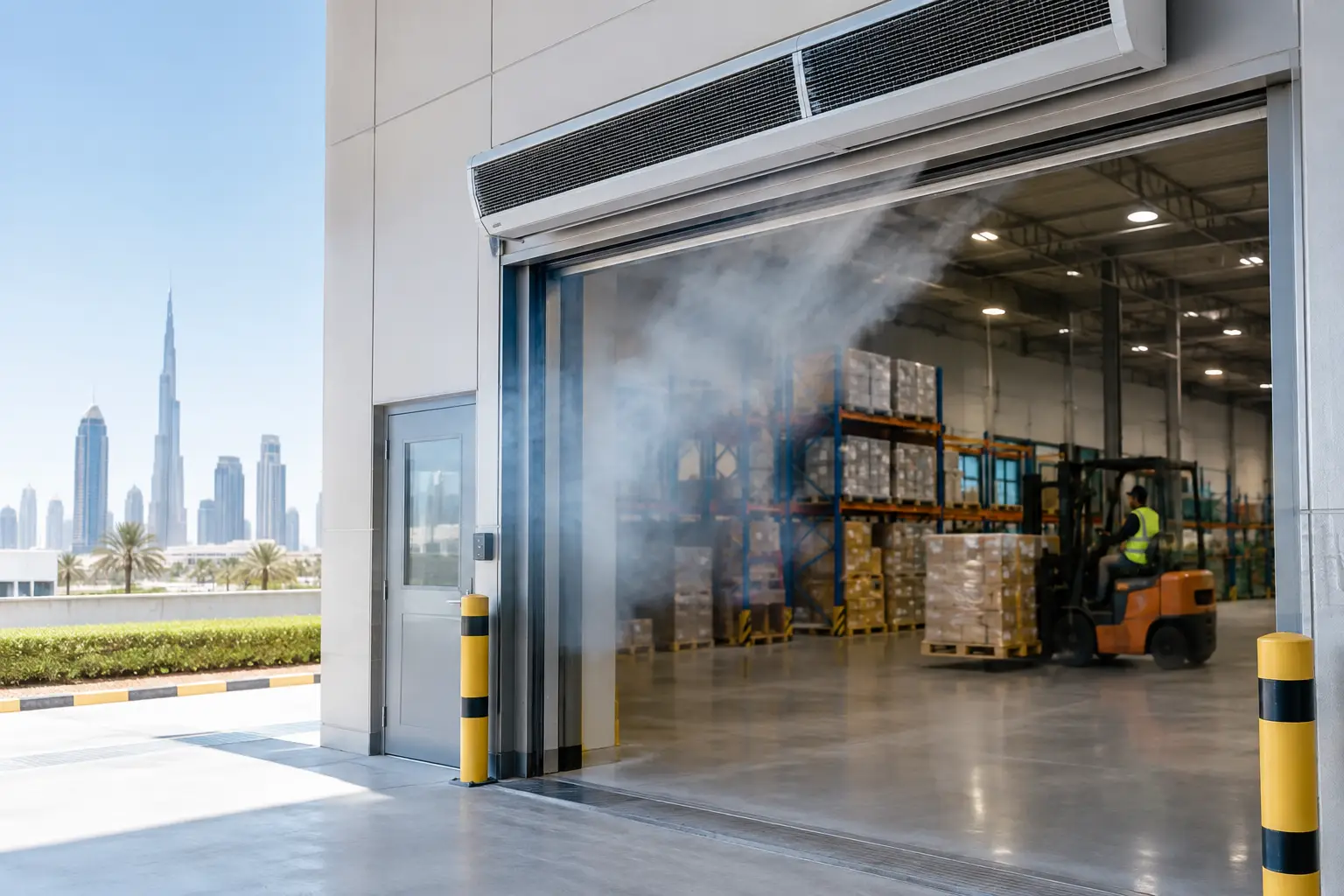
The lobby feels cool until the entrance starts working against you. Every door cycle pulls in heat, dust, humidity, and flying insects, then forces your HVAC system to recover. That is why a facility manager air curtain guide matters – not as a product brochure, but as an operations tool for buildings that cannot afford climate loss at the entrance.
In hot, high-traffic environments, an air curtain is one of the few entrance-control systems that protects indoor conditions without slowing people, carts, or goods. For facility managers in retail, hospitality, cold storage, logistics, commercial offices, and industrial sites, the decision is usually less about whether air curtains work and more about whether the selected unit is strong enough for the opening, traffic pattern, and climate.
What an air curtain actually solves
An air curtain creates a high-velocity air barrier across a doorway. When it is specified correctly, that barrier reduces the transfer of outside air into the conditioned space. In practice, this means less cooled air escaping and less hot air entering.
That matters more in Dubai, Riyadh, Doha, Cairo, Lagos, or Nairobi than it does in milder climates. High ambient heat, dusty surroundings, coastal humidity, and constant door openings create a compounding problem. Your cooling load rises, comfort drops near entrances, and indoor cleanliness becomes harder to maintain. If the site includes food retail, hospitality, healthcare-adjacent spaces, or light industrial production, insect control and hygiene become part of the equation too.
A well-selected air curtain can help reduce all of that. But it is not a magic shield. Performance depends on air velocity, mounting height, opening width, door type, surrounding pressure conditions, and how the unit integrates with the building’s operating pattern.
Facility manager air curtain guide: start with the opening, not the model
One of the most common specification mistakes is choosing by catalog category before understanding the entrance itself. Facility managers usually get better results when they begin with the opening and the operating reality around it.
The first question is the door height and width. A compact commercial entrance and a loading bay do not need the same discharge strength. An underpowered unit at a tall opening will run continuously and still allow heat infiltration. An oversized unit may create noise, drafts, or customer discomfort if the application is a hospitality or front-of-house setting.
The second question is traffic intensity. A hypermarket entrance with nonstop footfall, trolleys, and automatic doors has a very different duty cycle from an office lobby or a staff access point. High-frequency openings usually require stronger, more stable airflow and better motor durability.
The third question is environmental pressure. Buildings in desert or tropical climates often deal with wind exposure, uneven air pressure, humidity spikes, and dust loading. If an entrance faces open parking, service yards, delivery lanes, or road traffic, the air curtain has to resist real disturbances. This is where climate-adapted engineering matters. A unit that performs well in a brochure may still struggle in a harsh GCC or African site if the airflow profile is not designed for those conditions.
Match the unit type to the application
Commercial and industrial air curtains are not interchangeable. They may look similar from a distance, but they are built for different operating demands.
For offices, retail fronts, hospitality entrances, and customer-facing commercial spaces, quieter commercial models are often the right fit. These systems balance effective air separation with lower visible bulk and more acceptable sound levels. Recessed ceiling options are especially useful where aesthetics matter and the installation needs to stay integrated with the ceiling line.
For larger doors, service corridors, workshops, warehouses, and industrial access points, centrifugal industrial units are usually a better choice. They are built for stronger throws, tougher duty cycles, and more demanding entrance conditions. At a loading or dispatch area, appearance is secondary. Air barrier strength and equipment durability matter more.
Cold storage deserves special attention. The objective there is not just comfort. It is thermal control, condensation reduction, and operational efficiency at openings that can quickly leak conditioned air. A weak commercial unit at a cold-room entrance will not deliver the expected result. The air curtain has to be selected around thermal difference, opening dimensions, and traffic movement.
Performance factors that deserve attention
Air velocity and throw
This is the heart of the system. The unit must push a stable air stream from top to floor level, or across the effective opening zone, with enough force to resist infiltration. A higher doorway usually demands a stronger throw. If the air stream breaks before reaching the floor area, performance drops sharply.
Mounting height
Manufacturers rate units by recommended mounting height for a reason. Going beyond that height often leads to disappointing field performance. For facility managers, this is a specification checkpoint, not a minor detail.
Noise level
Noise tolerance depends on the site. In a back-of-house industrial environment, higher sound output may be acceptable if it delivers stronger protection. In a hotel entrance, clinic-adjacent area, or premium retail frontage, acoustic performance carries more weight. The right choice is not always the most powerful unit. It is the unit that delivers enough barrier strength for the space without creating a new operational complaint.
Motor and blower design
Not all airflow is created equal. Commercial centrifugal and industrial centrifugal systems often offer stronger and more controlled delivery than lighter-duty alternatives, especially where openings are taller or climate pressure is harsher. Motor reliability also matters because these units often operate for long daily hours.
Filtration and maintenance access
In dusty environments, filter nets and accessible maintenance design matter more than many buyers expect. Dust buildup can affect airflow efficiency over time. If the unit is difficult to service, maintenance gets delayed, and entrance performance degrades quietly until cooling costs rise.
The real trade-offs facility managers should expect
No serious facility manager wants oversimplified claims. Air curtains work, but the result depends on fit.
If your opening is exposed to strong crosswinds, the unit may need more power or a different configuration than a sheltered entrance. If the building runs strong negative or positive pressure, the air curtain alone may not fix the problem without broader HVAC balancing. If the doorway stays physically open for long periods, the air curtain becomes even more valuable, but also more demanding to size correctly.
There is also the cost question. A stronger industrial-grade unit costs more upfront than a basic commercial model. But if the cheaper option cannot hold the entrance line in a hot, humid, dusty environment, the savings disappear into energy waste, comfort complaints, and premature replacement. For most B2B sites, the right metric is life-cycle value, not lowest initial price.
Facility manager air curtain guide for hot-climate sites
In tropical and desert markets, entrance control is not a finishing detail. It is part of cooling strategy. That changes how air curtains should be evaluated.
A suitable unit for these regions needs to handle high ambient temperatures, frequent door operation, and airborne dust without rapid performance loss. In hospitality and premium commercial environments, it should also maintain a cleaner entrance feel for guests and customers. In industrial and logistics environments, it should protect working conditions while reducing the strain on mechanical cooling systems.
This is why specification support matters. A generic recommendation based only on door width is rarely enough for projects in Abu Dhabi, Muscat, Casablanca, or industrial zones in Nigeria and Kenya. The better approach considers entrance exposure, traffic, ceiling conditions, operating hours, and the severity of local climate. That is where solution-based suppliers add value over commodity sourcing.
When to involve a supplier early
If you are planning a retrofit, involve the supplier before finalizing the mounting arrangement. Ceiling void constraints, power availability, and discharge clearance can affect which unit family is viable. If the project is new-build, early coordination with the MEP and consultant team usually leads to cleaner installation and better performance.
The same applies when a site has multiple entrance types. A front customer entrance, a staff door, and a loading access point often need different air curtain categories. Treating them as one-size-fits-all usually leads to overpaying in one area and underperforming in another.
For buyers managing portfolios across hot-weather markets, standardization can help, but only up to a point. It makes sense to standardize around performance classes and application types rather than forcing one model across every site.
A strong air curtain strategy protects more than cooled air. It supports comfort, hygiene, HVAC efficiency, and entrance reliability in the parts of the building that take the most daily abuse. If you are reviewing entrance performance for a commercial or industrial facility in a tropical or desert climate, request a consultation and quote based on your actual opening sizes, traffic conditions, and site environment. That is how you specify an air curtain system that performs where it counts.