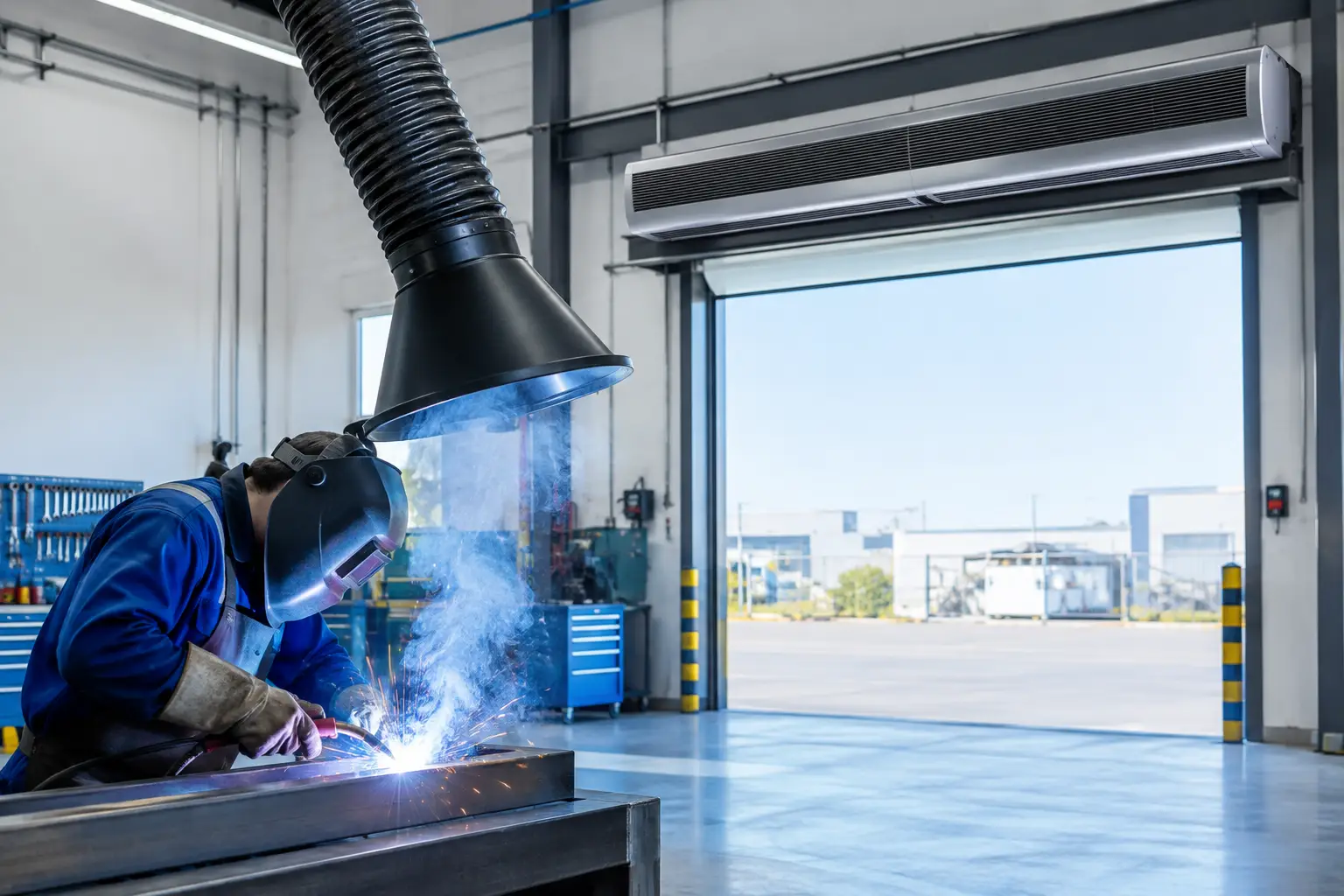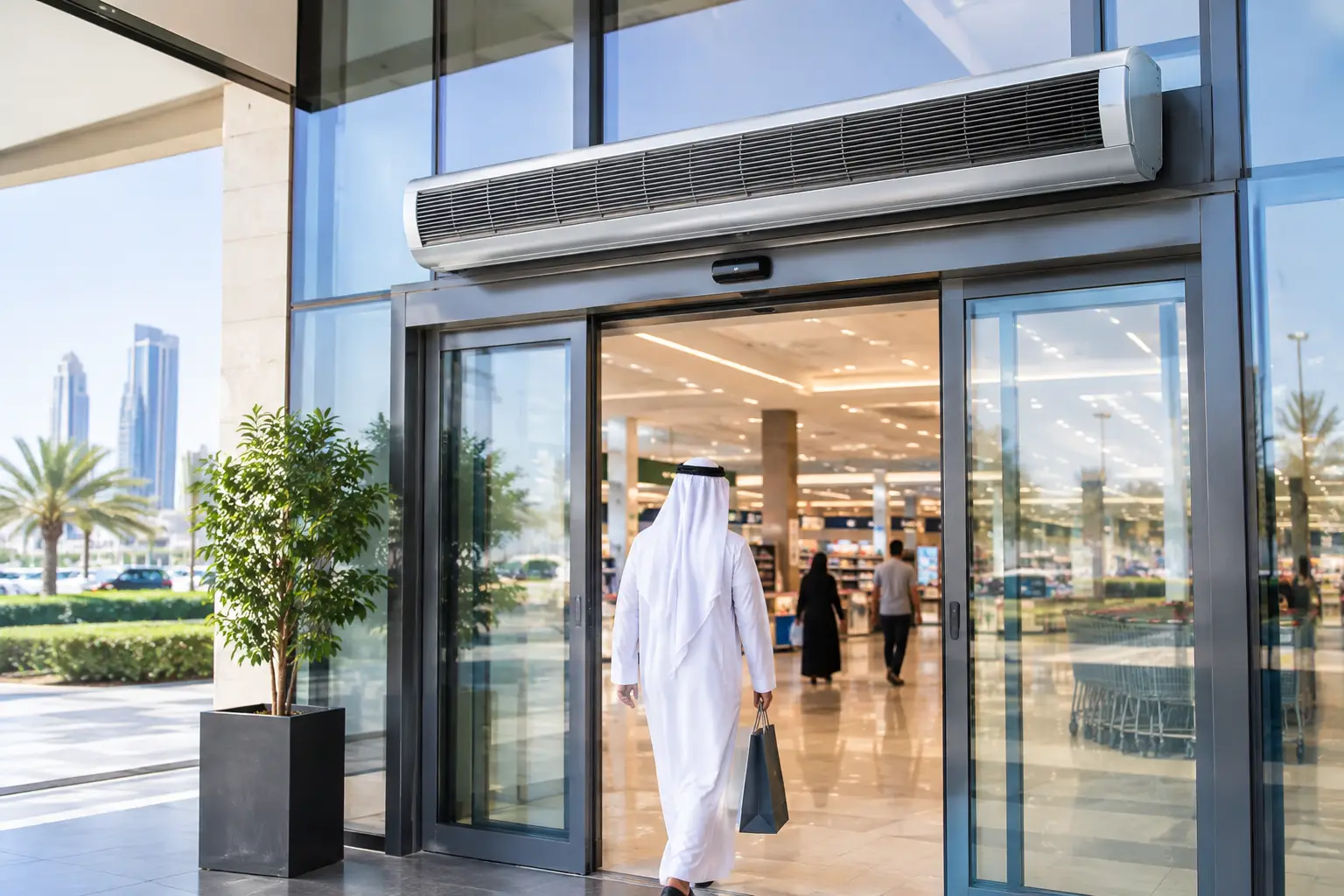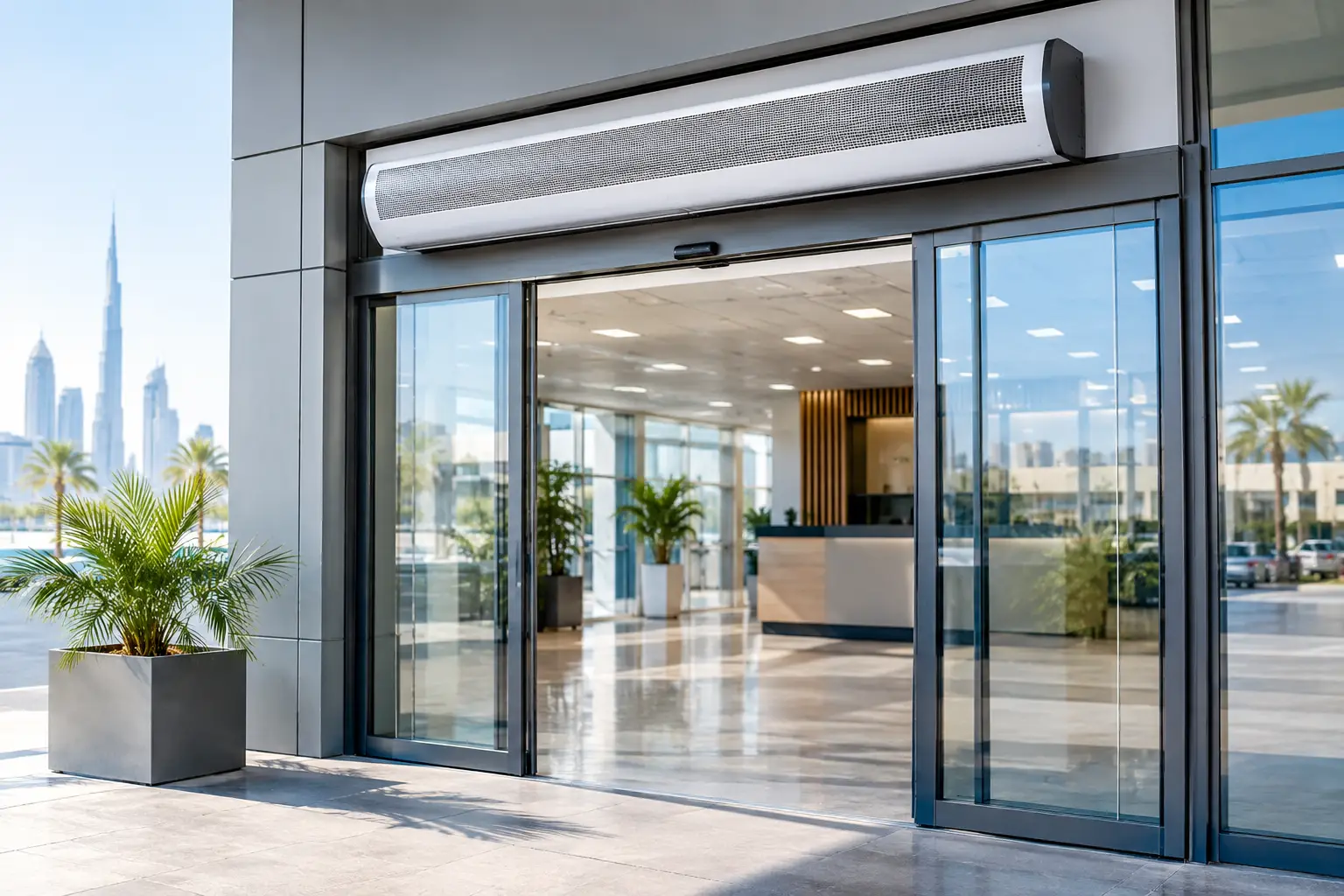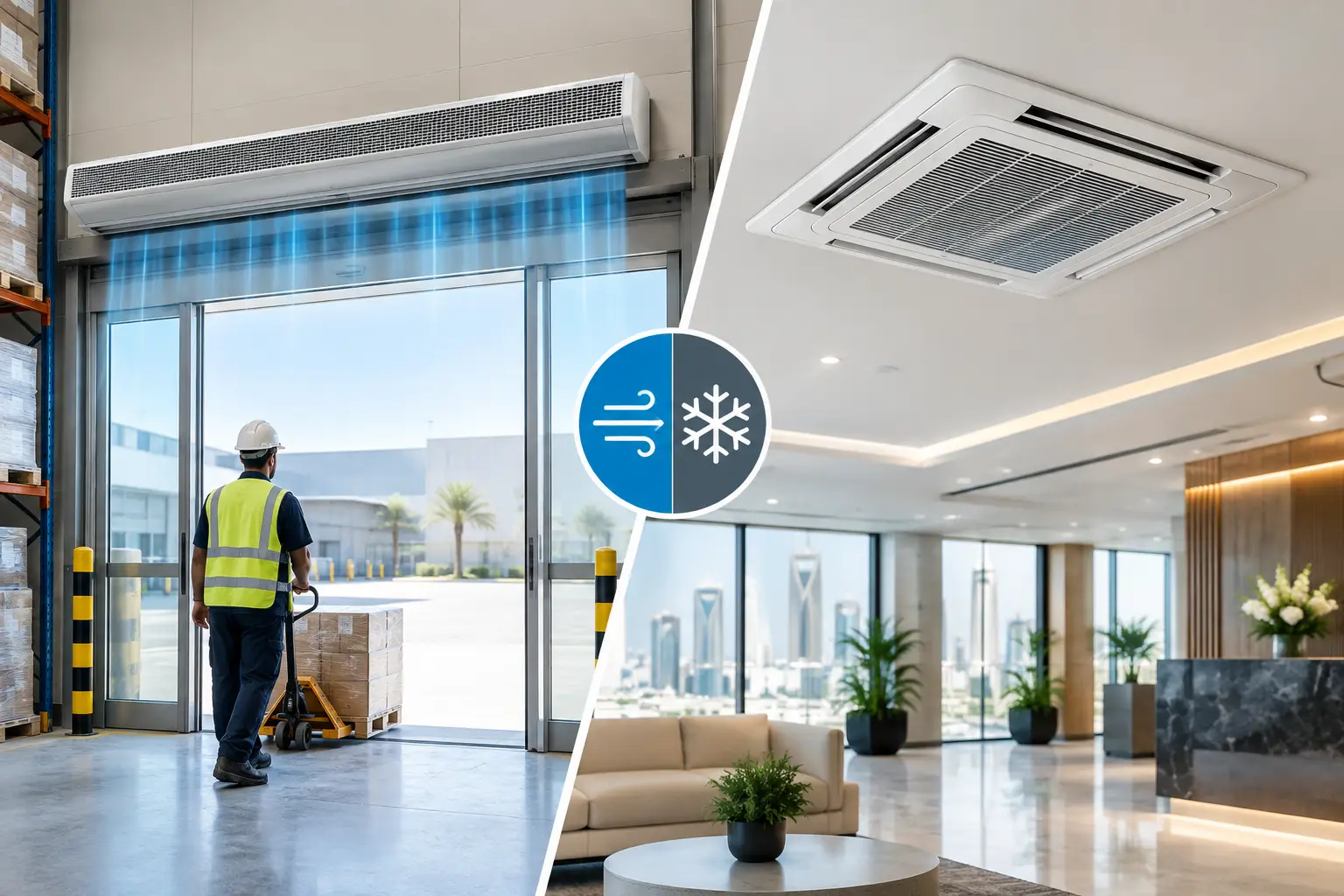
A logistics dock can lose conditioned air faster than the HVAC system can replace it. Every time a shutter door opens for pallets, forklifts, or vehicle loading, hot outdoor air, humidity, dust, and insects have a direct path inside. In Dubai, Riyadh, Doha, Muscat, Cairo, Lagos, and other hot or humid operating environments, that exposure can quickly affect worker comfort, product conditions, and energy consumption.
The best air curtains for logistics are not defined by one model or one airflow rating. They are systems selected around the actual opening, traffic pattern, mounting height, pressure conditions, and climate exposure at the facility. A properly specified air curtain creates a high-velocity air barrier across the doorway, reducing uncontrolled air exchange without slowing operations.
Why Logistics Entrances Need a Different Approach
Logistics facilities place unusually high demands on entrance climate control. A retail entrance may open frequently, but a warehouse or distribution center can have doors open for extended periods while a truck is loaded, inventory is transferred, or a forklift passes through. The opening is also usually wider and higher, which means an undersized unit will not project its air stream to the floor or create sufficient separation at the threshold.
The air curtain must counter more than heat loss. At loading docks, the system may need to limit the entry of dust, sand, humidity, vehicle fumes, and flying insects. In food logistics, pharmaceutical distribution, and temperature-sensitive storage areas, maintaining a more stable internal environment is equally important.
This is why a light-duty commercial air curtain is rarely appropriate for a high-clearance loading opening. The right solution depends on the operating conditions, not simply on the width of the door.
What the Best Air Curtains for Logistics Have in Common
For logistics applications, specification should begin with air performance rather than appearance. The system needs sufficient discharge velocity and air volume to form a continuous barrier from the mounting position to the floor. When the airflow dissipates too early, hot and dusty outside air can pass beneath it.
A suitable logistics air curtain will generally have four characteristics:
- High-capacity centrifugal airflow designed for larger and higher openings
- Heavy-duty construction for frequent, extended operating cycles
- Controls that can coordinate with door operation and facility schedules
- Components selected for dusty, hot, tropical, or humid conditions
Centrifugal blowers are often preferred for industrial doors because they can deliver concentrated, higher-pressure airflow. This matters where the air curtain is installed above a tall roller shutter, sectional door, or loading bay opening. The air stream must remain stable despite crosswinds, dock activity, and pressure differences between indoor and outdoor areas.
The required throw distance is particularly critical. If the installation height is 16 feet but the selected equipment is designed for a much lower commercial doorway, its stated airflow may look adequate on paper while failing at the actual threshold. Facility teams should evaluate effective air throw, terminal velocity at floor level, and the influence of external wind before finalizing a selection.
Match the Air Curtain to the Door and Traffic Pattern
Door dimensions are the starting point, but they are not the entire design brief. A 12-foot-wide loading bay with occasional pallet movement needs a different approach than a 24-foot-wide warehouse opening with continuous forklift traffic.
For medium-height service doors and controlled goods entrances, a commercial centrifugal system may provide the required separation when installed at the correct height. For larger distribution bays, factories, and high-traffic warehouse doors, industrial centrifugal units are typically the more appropriate choice. Their airflow capacity and construction are intended for demanding operating cycles and wider coverage requirements.
Multiple units may be installed side by side on very wide openings. This approach creates continuous coverage across the full entrance rather than leaving weak points between separate air streams. The design must account for overlap, so the barriers meet without creating gaps where air infiltration can occur.
Traffic also affects control strategy. A door that opens briefly every few minutes can use door-activated control to operate only when needed. A busy dispatch bay that remains open during a long loading sequence may require continuous operation at a selected speed. Variable-speed capability can be useful where traffic changes between shifts, although the highest setting is not automatically the best setting. Excessive velocity can create noise, discomfort, or turbulence without improving separation.
Consider the Exposure Outside the Facility
A loading door facing a shaded internal yard experiences different conditions from one exposed to direct afternoon sun, strong winds, or a dusty access road. In desert and tropical climates, this distinction has a direct effect on selection.
High outdoor temperatures increase the thermal load entering through an open dock. Humid coastal conditions can add moisture to conditioned spaces, raising the burden on air-conditioning equipment and creating avoidable comfort issues. Dust and sand can enter warehouses, packaging areas, and sensitive inventory zones. Air curtains do not replace physical doors or dock seals, but they provide active protection during the period when doors must remain open for operations.
Crosswinds deserve special attention. If wind regularly strikes the opening from the side or front, it can deflect the discharge stream and reduce the barrier’s effectiveness. In these cases, an engineer may recommend higher-capacity equipment, a revised mounting position, multiple discharge sections, or changes to the dock layout. Selecting by doorway width alone ignores one of the most common reasons air curtain performance disappoints at loading bays.
Special Cases: Cold Chain, Food, and Pharmaceutical Logistics
Temperature-controlled logistics requires a more precise approach. An air curtain can reduce warm-air infiltration at cold storage and chilled dispatch doors, helping limit temperature fluctuations during frequent access. However, it should be designed as part of the opening strategy, not as a substitute for insulated doors, operational discipline, or correctly designed cold-room systems.
For cold-chain facilities, the primary questions are how long the door remains open, the temperature difference across the opening, and whether humid ambient air can cause condensation or affect stored goods. A system with inadequate velocity may offer little protection, while excessive airflow can disturb lightweight packaging or process conditions. The goal is controlled separation that supports the facility’s temperature and hygiene requirements.
Food and pharmaceutical operations may also prioritize protection from insects, airborne dust, and contaminants. In these applications, equipment selection should consider cleanability, filter arrangements where applicable, access for planned maintenance, and the required relationship between the loading area and adjacent controlled spaces.
Installation Details That Determine Real Performance
An air curtain can be correctly sized and still underperform if it is installed in the wrong location. It should be mounted as close as practical to the opening, with a clear discharge path and no structural beams, signs, or services obstructing the air stream. A recessed ceiling installation may suit a finished commercial dispatch area, but exposed industrial mounting is often more practical for loading docks and warehouses.
The discharge angle must also be set for the site. A slightly outward angle can help resist incoming hot air under certain conditions, while an incorrect angle can pull indoor conditioned air outward or leave the lower part of the opening unprotected. This adjustment should be verified during commissioning, when the door is operating under normal site conditions.
Noise is another operational consideration. Industrial dock areas can tolerate higher sound levels than offices, hospital corridors, or front-of-house retail spaces. Even so, noise should be reviewed where personnel work close to the opening for long periods. The best specification balances air separation, energy performance, and acceptable acoustic conditions.
Build Air Curtains Into the HVAC and Dock Strategy
Air curtains work best when they are treated as part of the facility’s wider entrance-control strategy. Door sensors, building management controls, HVAC zoning, dock shelter design, and operational procedures all influence the result. Running an air curtain while a door is closed wastes energy; leaving it off while the door is open removes its benefit.
For project teams, the specification process should document the clear opening width and height, mounting height, door type, opening frequency, nearby HVAC supply locations, outdoor climate exposure, and any hygiene or temperature-control requirements. This information allows the supplier to recommend capacity and configuration based on operating reality instead of generic assumptions.
For logistics centers operating through extreme heat, humidity, dust, and heavy traffic, the right air curtain is a practical investment in building performance. Request a consultation and quotation from FreezeeX with your entrance dimensions, operating schedule, and site conditions to identify an industrial air curtain configuration built for your facility.