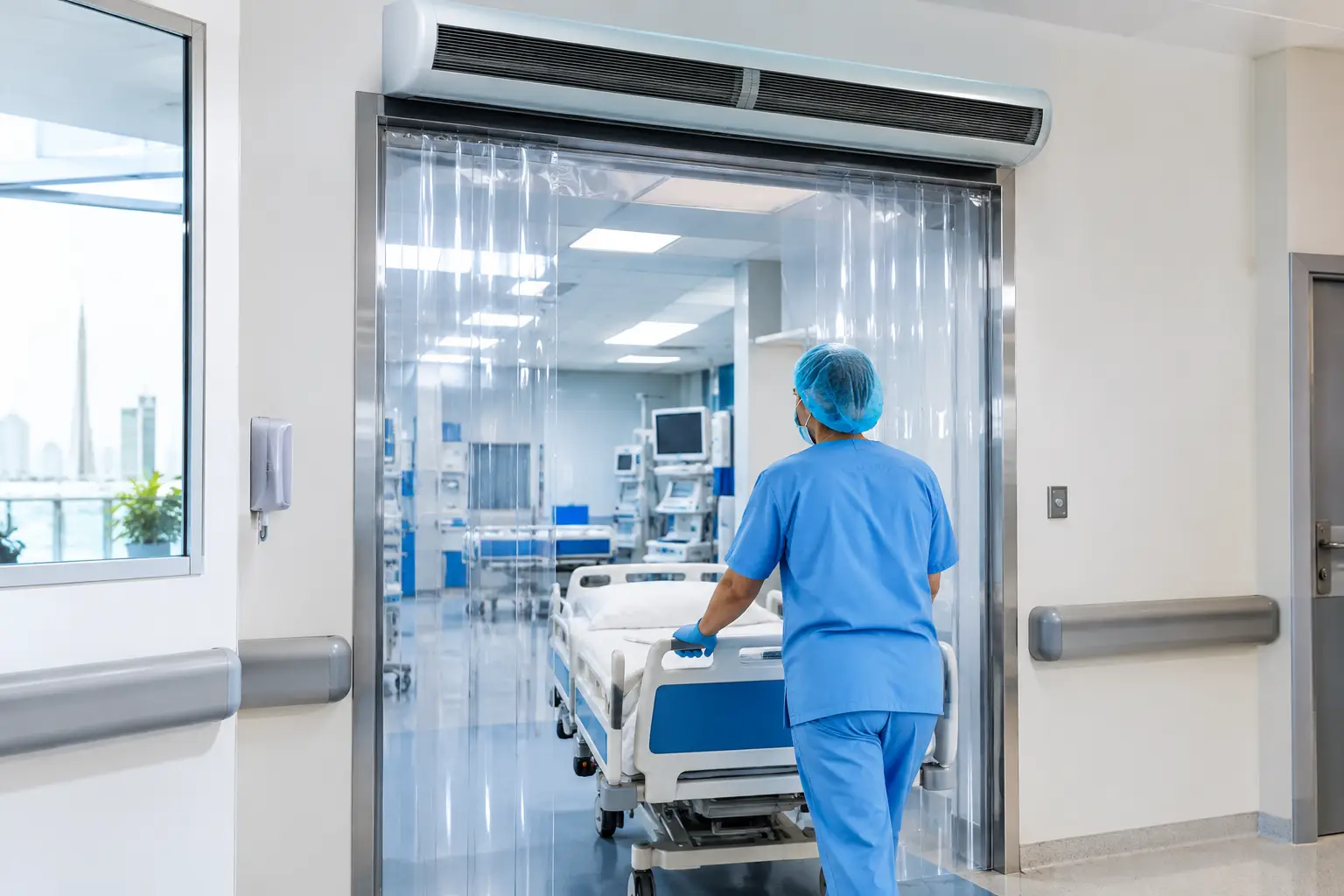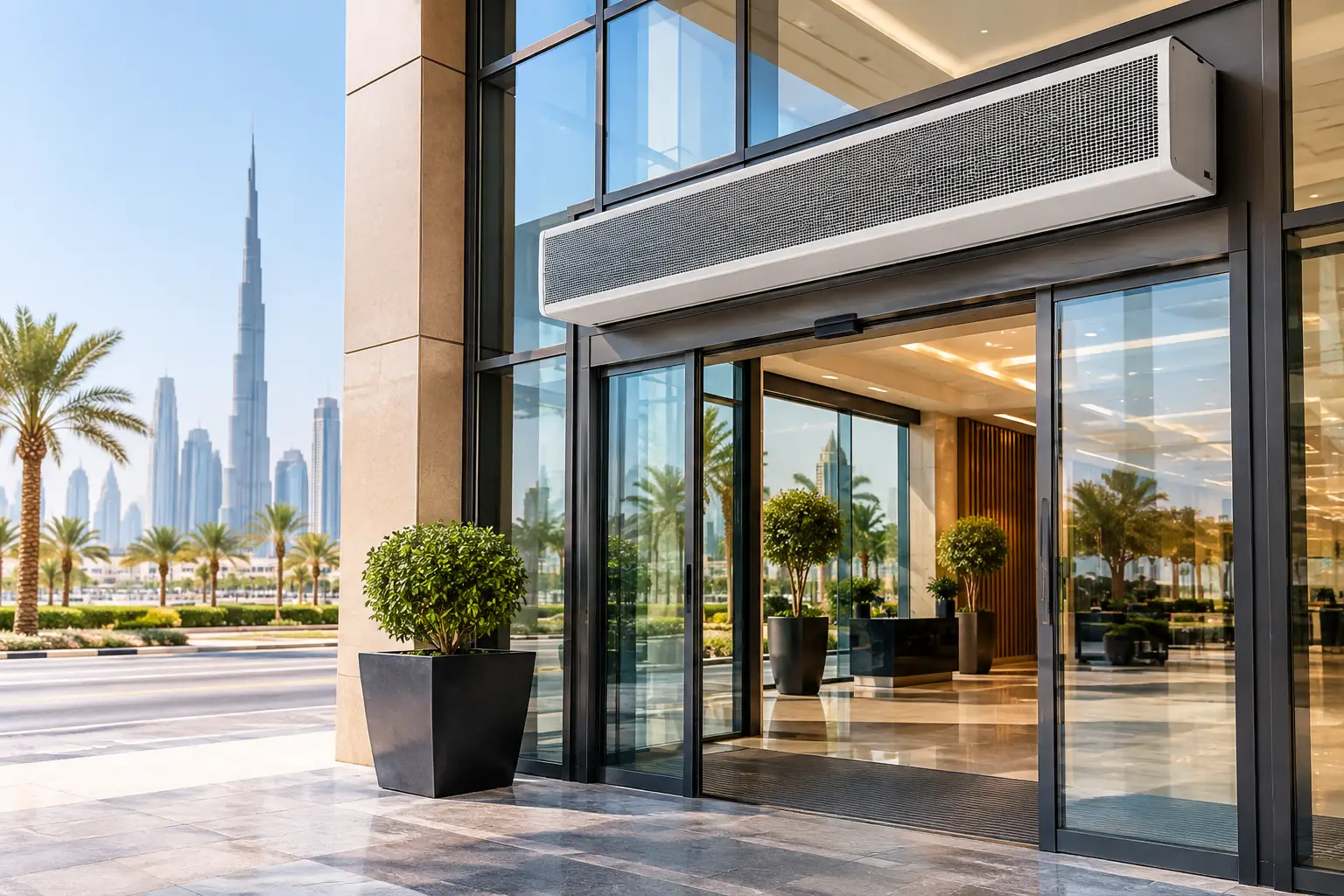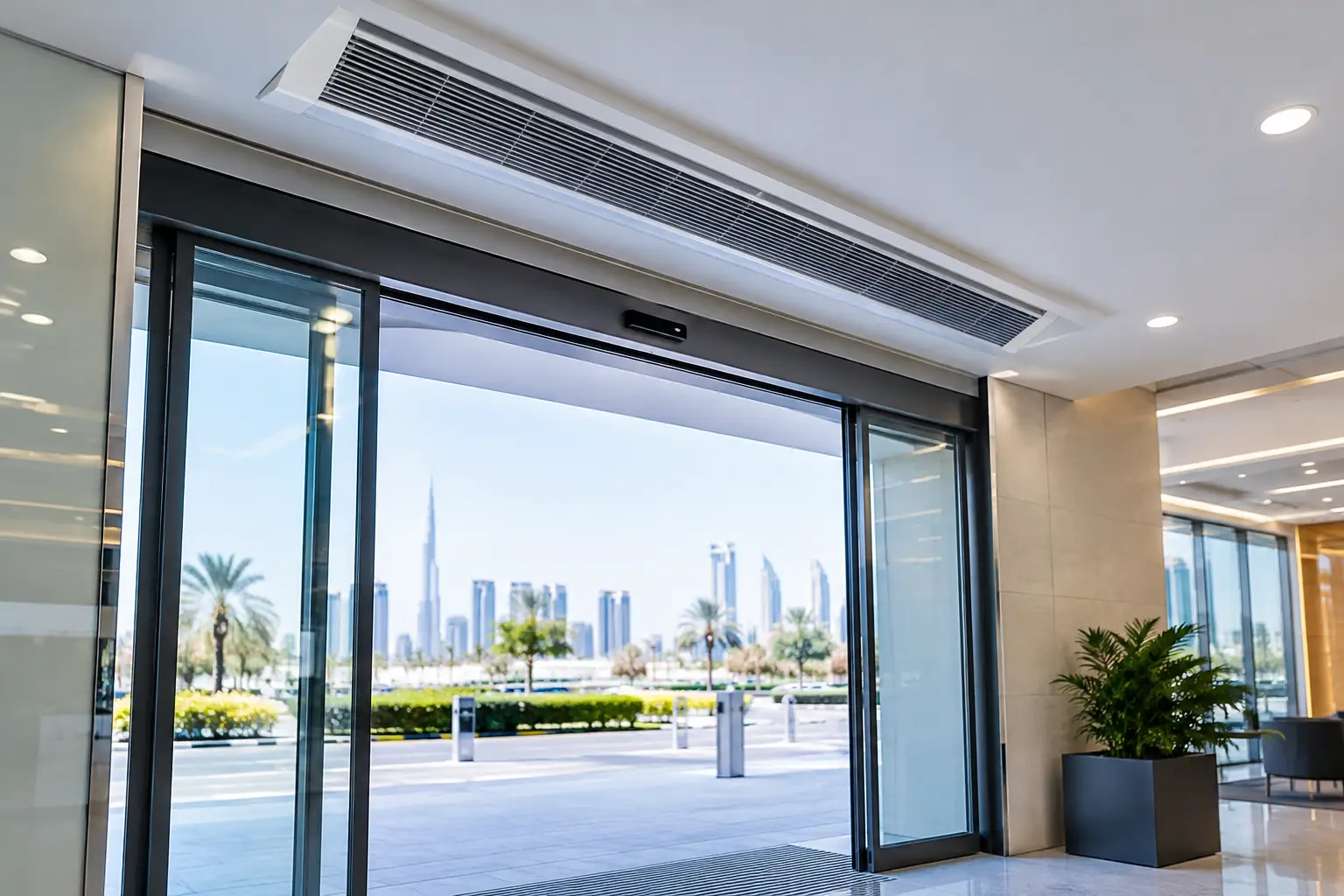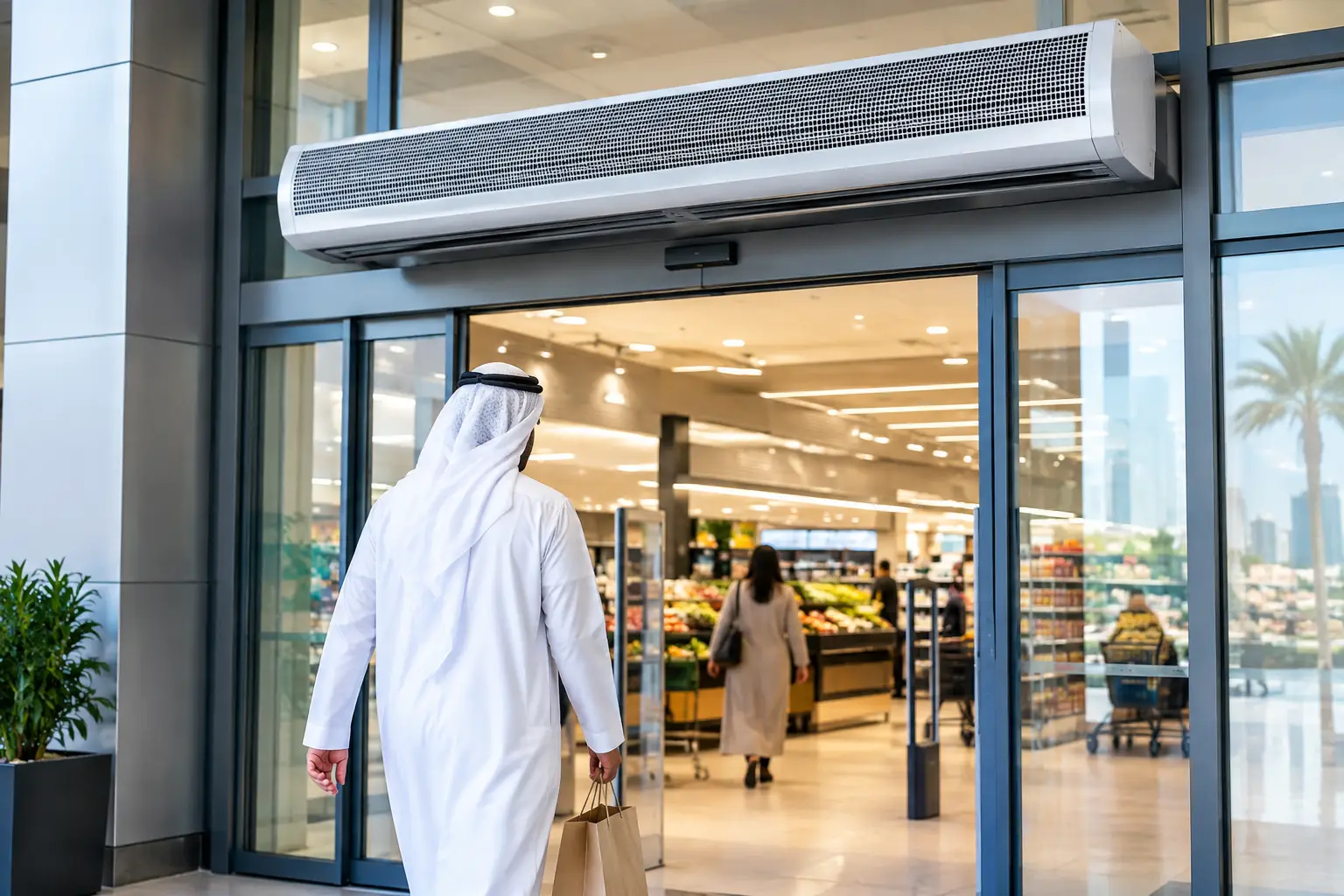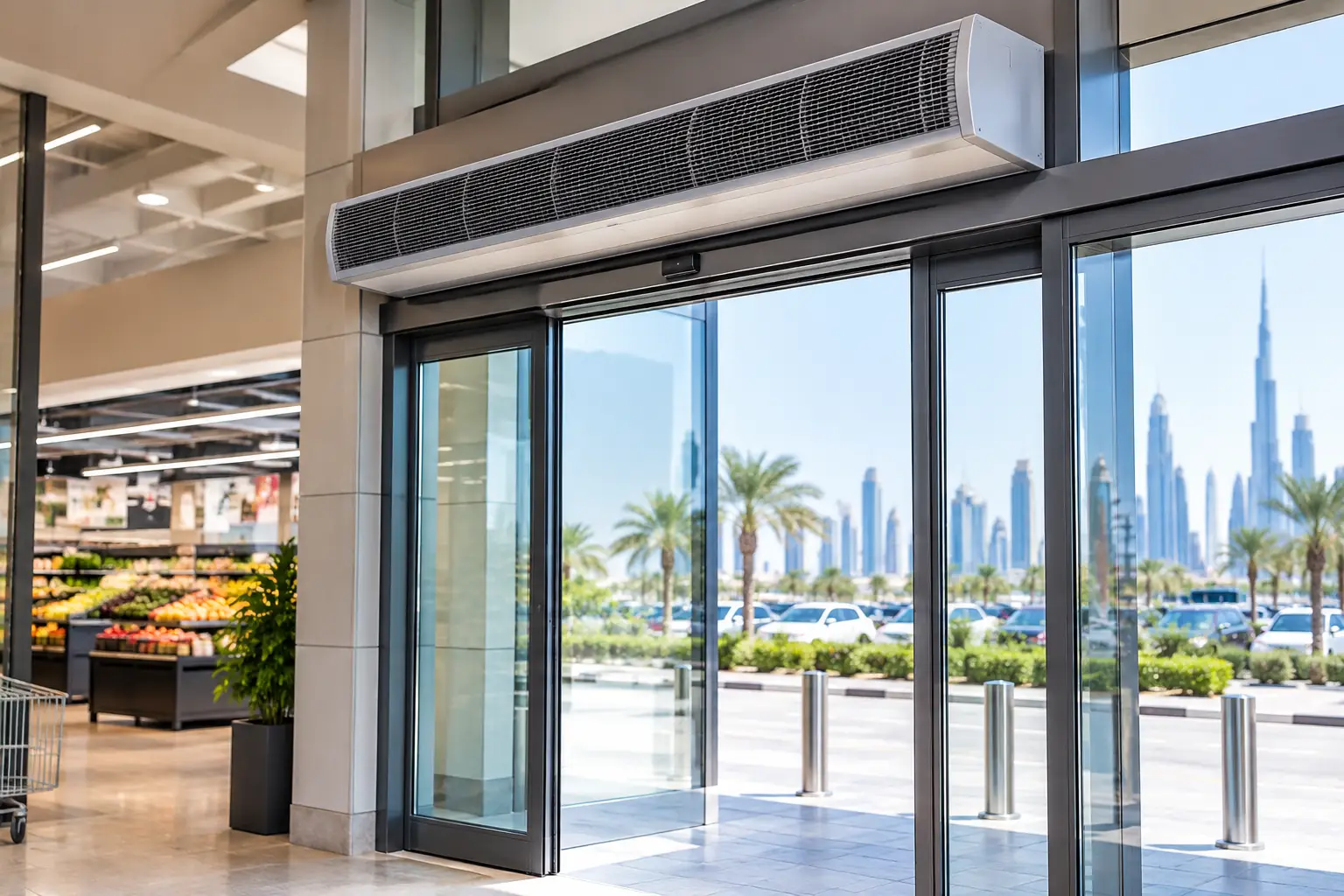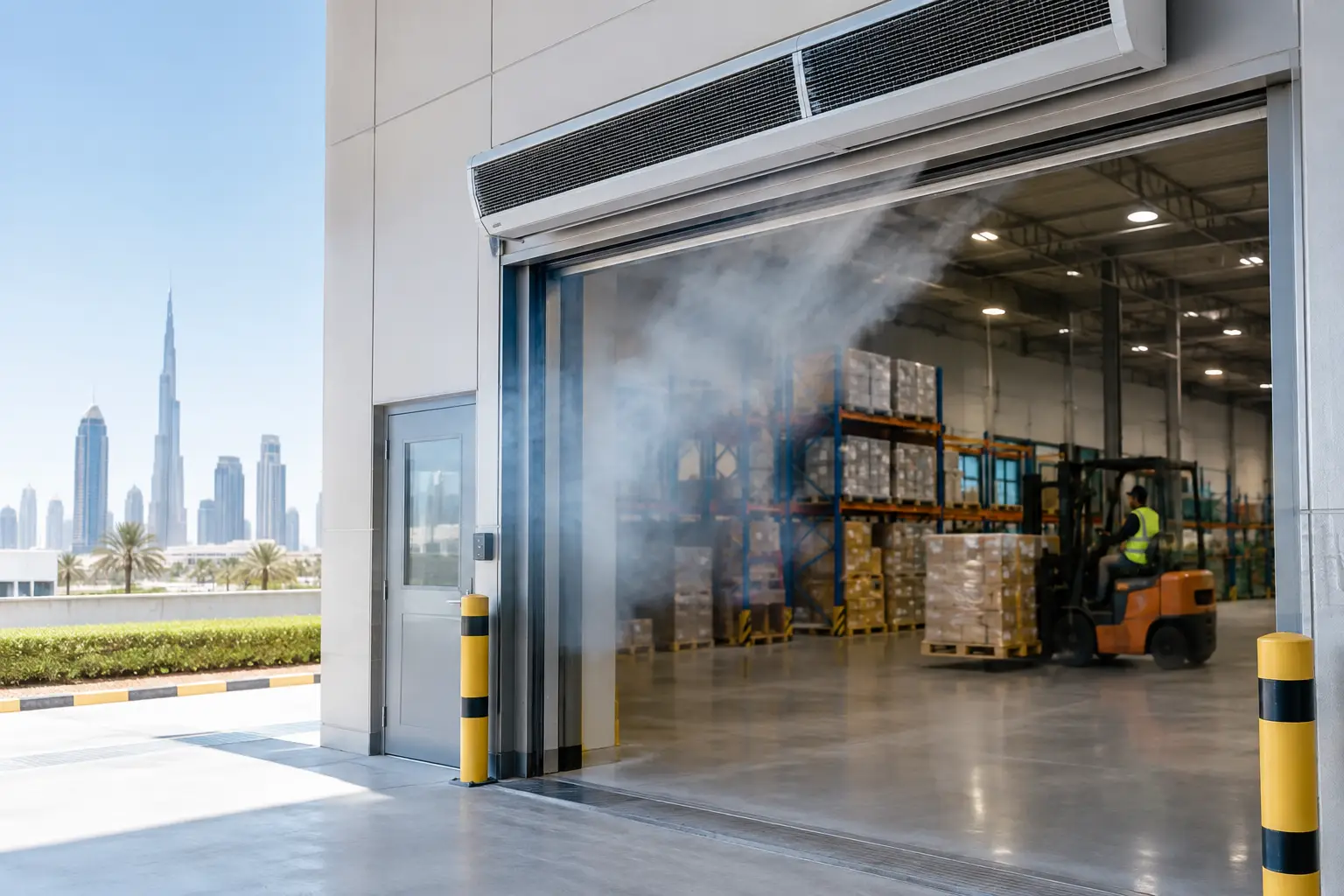
A pharmacy’s entrance is more than a customer access point. Every door opening can pull hot outdoor air, dust, humidity, and insects directly into a cooled retail and dispensing environment. An air curtain for pharmacy entrance applications creates a controlled, high-velocity air barrier across that opening, helping protect indoor conditions without restricting customer flow.
For pharmacies in Dubai, Riyadh, Doha, Lagos, Nairobi, and other hot-climate markets, this is an operational control measure, not a cosmetic accessory. The right unit reduces the cooling load at a frequently used doorway while supporting a cleaner, more comfortable environment for customers and staff.
Why pharmacy entrances need air isolation
Pharmacies often have a difficult combination of conditions: air-conditioned interiors, frequent pedestrian traffic, automatic or manually operated doors, and a strong need for clean presentation. A door may open dozens or hundreds of times per day. In a tropical, humid, or desert environment, each opening creates a pathway for outdoor air and contaminants to enter.
Without an effective air barrier, cooled air escapes and hot air enters. The result can be uneven temperatures near the entrance, uncomfortable queues, more demand on the building’s cooling system, and increased dust accumulation on floors, shelving, and displays. Insect intrusion is another concern, particularly for street-facing pharmacies, clinics with dispensaries, and pharmacy counters inside hypermarkets.
An air curtain does not replace the building’s cooling system, door seals, or hygiene procedures. It strengthens the entrance boundary when the door must remain open. That distinction matters during specification. The goal is controlled air isolation at the doorway, not a claim of sterile indoor air.
What an air curtain for pharmacy entrance must do
The correct unit must deliver an air stream that reaches the floor with enough stability to resist incoming outdoor conditions. This is where many projects go wrong. Selecting a unit only by doorway width or catalog appearance can leave gaps in protection, especially at tall entrances or locations exposed to wind.
For pharmacy use, performance should be judged against the actual doorway and operating pattern. A narrow, low-traffic neighborhood pharmacy has very different requirements from a high-volume pharmacy in a shopping center or a hospital-adjacent dispensary.
Maintain the air barrier at floor level
The air stream must cover the full opening and maintain sufficient velocity near the floor, where outside air can roll inward. Mounting height, door height, discharge angle, and fan performance all affect this result. A unit that looks powerful at the grille but loses its stream halfway down the opening will not adequately isolate the entrance.
High ceilings and oversized glazed doors require particular attention. In these cases, a commercial centrifugal or high-performance system may be more appropriate than a lighter-duty cross-flow design. Centrifugal fan systems are generally better suited to demanding entrances because they maintain pressure and throw more effectively against resistance.
Match the unit to traffic, not just door size
Door width determines how much coverage is needed, but traffic determines the duty level. A pharmacy with a continuous customer flow, delivery activity, or frequent automatic-door cycles needs a unit designed for sustained operation.
A quiet, low-traffic clinic pharmacy may prioritize low sound levels and a compact appearance. A pharmacy at a hypermarket entrance may need stronger airflow, longer operating hours, and controls that coordinate with automatic doors. The specification should reflect the busiest period, not the quietest hour of the day.
Protect comfort without creating a draft
Higher air velocity is not automatically better. If the air stream is poorly directed or oversized for a low mounting height, customers and staff may experience a noticeable draft at the threshold. The most effective installation balances barrier strength with comfort.
This is especially relevant when staff work near the entrance, such as at a greeting point, cashier position, or prescription collection counter. Adjustable discharge vanes and correctly selected fan speed help direct the air where it is needed rather than into the occupied zone.
Pharmacy-specific factors that affect selection
A pharmacy may have a clean retail area, medicine storage zones, consultation rooms, and dispensing counters behind the public entrance. While the air curtain serves the door rather than each internal area, its effect on the entrance environment can support better overall climate stability.
First, consider the type of door. Sliding automatic doors usually work well with air curtains because the unit can be interlocked to run during opening cycles or at a programmed operating speed. Hinged doors may have shorter opening periods but can create sudden pressure changes. Open-front pharmacy counters or entrances that remain open for long hours need a more powerful, continuously rated approach.
Second, assess external exposure. A recessed doorway protected by a mall corridor experiences less wind than a pharmacy facing an open parking area or busy roadside. Wind can deflect the air stream and weaken the barrier. For exposed sites, the equipment selection and discharge angle need to account for prevailing conditions rather than relying on nominal doorway dimensions alone.
Third, account for local climate. In desert markets, airborne dust and extreme heat are the main pressures. In coastal and tropical locations, high humidity can be equally disruptive. A properly specified air curtain helps reduce the volume of untreated outdoor air entering during normal traffic, which supports indoor comfort and reduces unnecessary cooling demand.
Electrical heating is rarely the priority in hot markets
For pharmacy entrances in the GCC, MENA, and much of Africa, ambient heat is the primary challenge. The usual requirement is an ambient air curtain that creates a strong physical air barrier while the building’s cooling system manages the indoor temperature.
Heated air curtains can have a role in specialized applications, but they are generally not the central requirement for hot-weather pharmacy entrances. Specifiers should focus first on airflow volume, discharge velocity, mounting height, coverage, noise level, and control integration. Buying heating capacity that the application does not need can add cost without improving entrance performance.
Installation details that decide real performance
Air curtain performance is highly dependent on installation. The unit should be mounted as close as practical to the opening, with full coverage from one side to the other. Where a single unit cannot span the door width, multiple units should be aligned without gaps.
The discharge angle must be commissioned for the site. A perfectly vertical stream is not always ideal. In hot, dusty, or windy conditions, a slight outward angle may help resist infiltration, but excessive outward deflection can break the air stream before it reaches the floor. This should be adjusted after observing the doorway in operation.
Controls also deserve attention. For many commercial pharmacies, an automatic door contact, occupancy schedule, or building management system connection prevents unnecessary operation after hours while ensuring the air curtain responds when traffic begins. The best control strategy depends on opening frequency and whether the entrance is exposed to outdoor conditions throughout the day.
Noise is another practical consideration. Pharmacies are customer-facing spaces where clear conversation matters. A unit should have enough airflow for the application without creating an intrusive sound level at the counter or waiting area. This is not an argument for undersizing. It is a reason to select a properly engineered system and place it correctly.
When a pharmacy may need a higher-duty system
Some entrances create conditions that exceed the capability of a standard commercial unit. This includes doors taller than typical retail openings, entrances exposed to strong crosswinds, pharmacies integrated with high-traffic hypermarkets, and locations where outdoor temperatures remain extreme for long operating hours.
In these cases, a higher-pressure centrifugal air curtain can provide the airflow stability needed to maintain the barrier. Recessed ceiling models may suit premium interiors where visual integration is essential, provided the ceiling void, service access, and discharge position support the required performance. Appearance should follow airflow requirements, not override them.
FreezeeX supports contractors, facility managers, and project consultants with application-led recommendations for commercial entrances in tropical and desert climates. The right solution is based on the opening dimensions, mounting height, door type, traffic pattern, exposure, and required control method.
A pharmacy entrance should feel cool, clean, and controlled from the moment a customer walks in. Request a consultation or project quote with your doorway details to specify an air curtain that protects that standard through the busiest hours of the day.