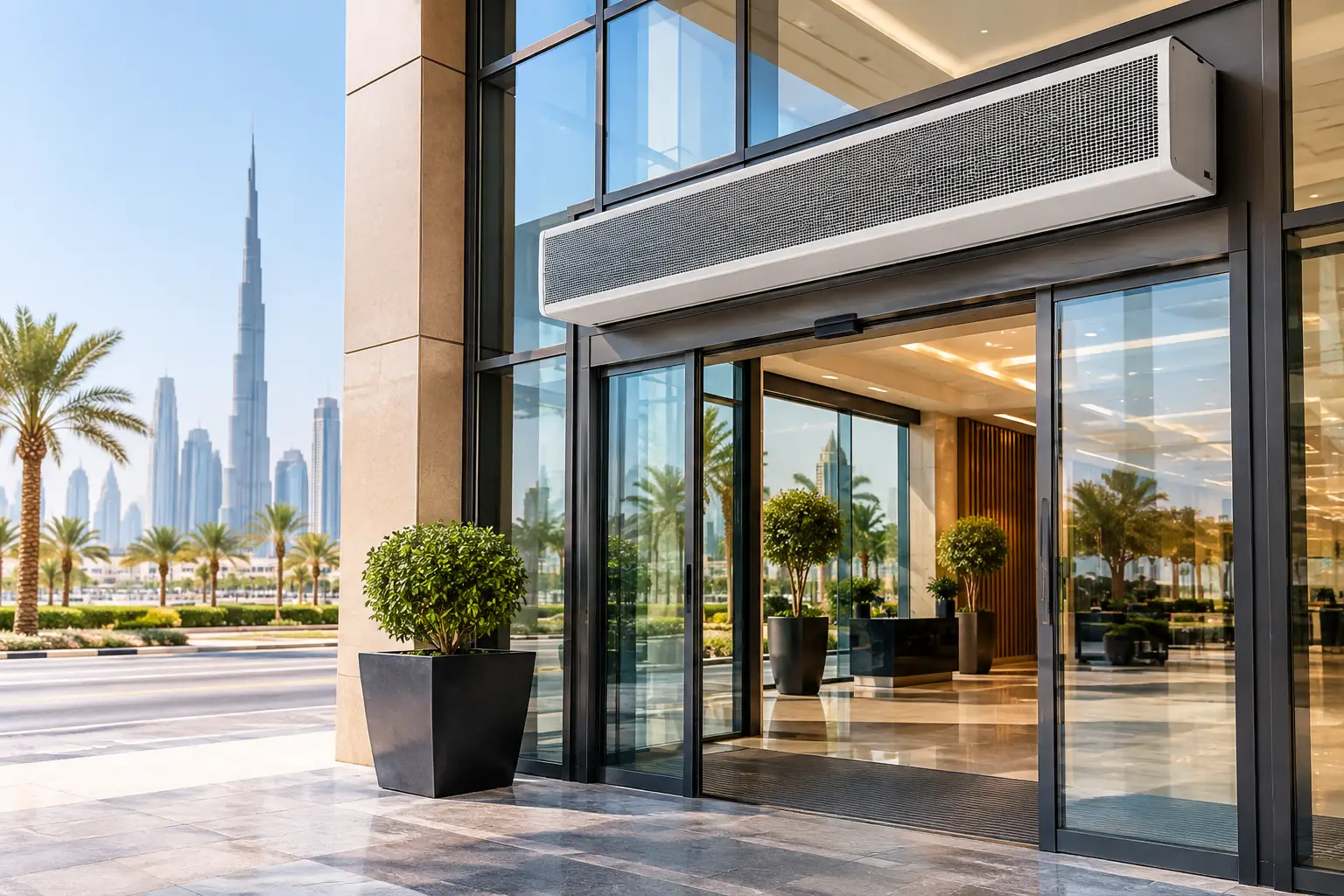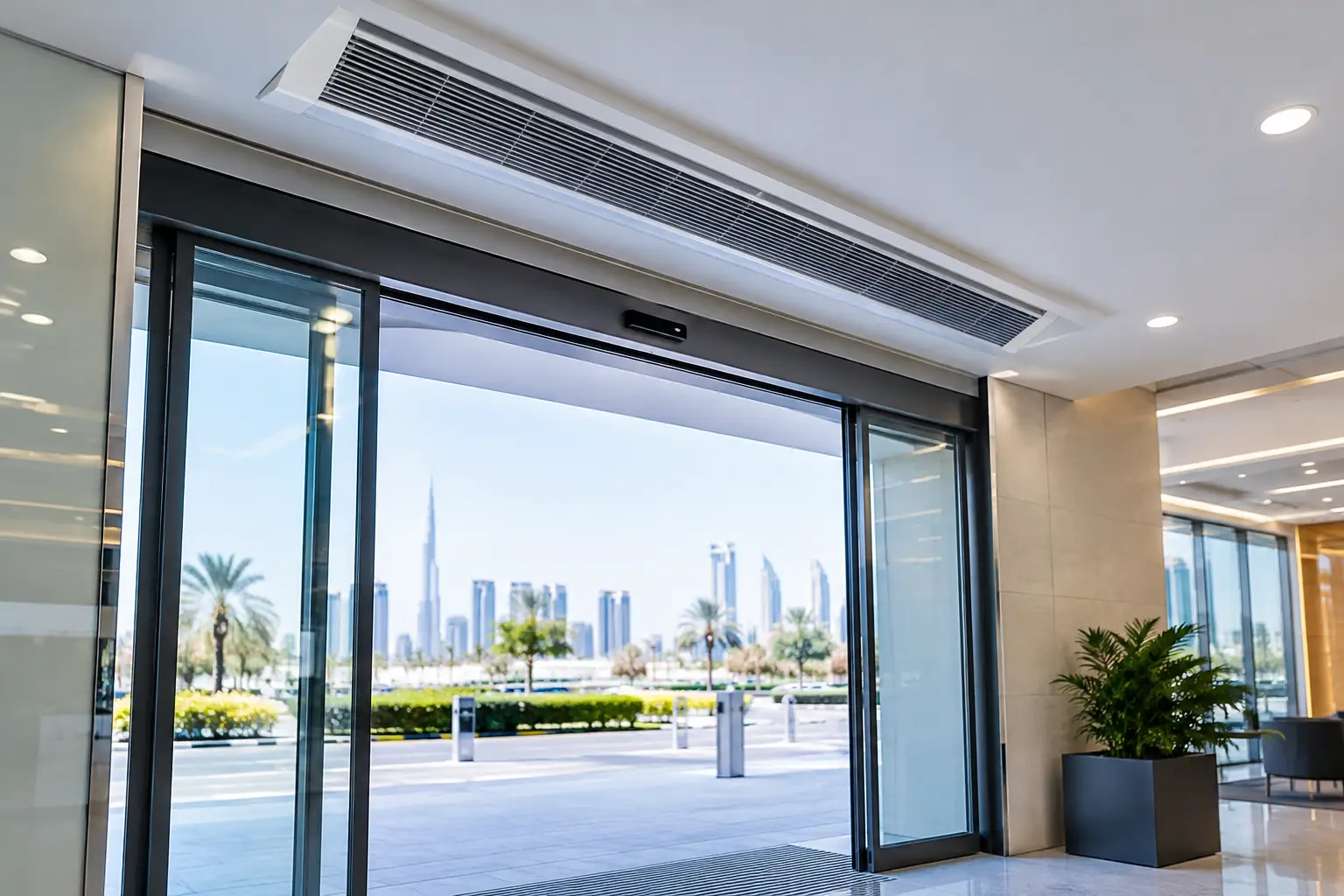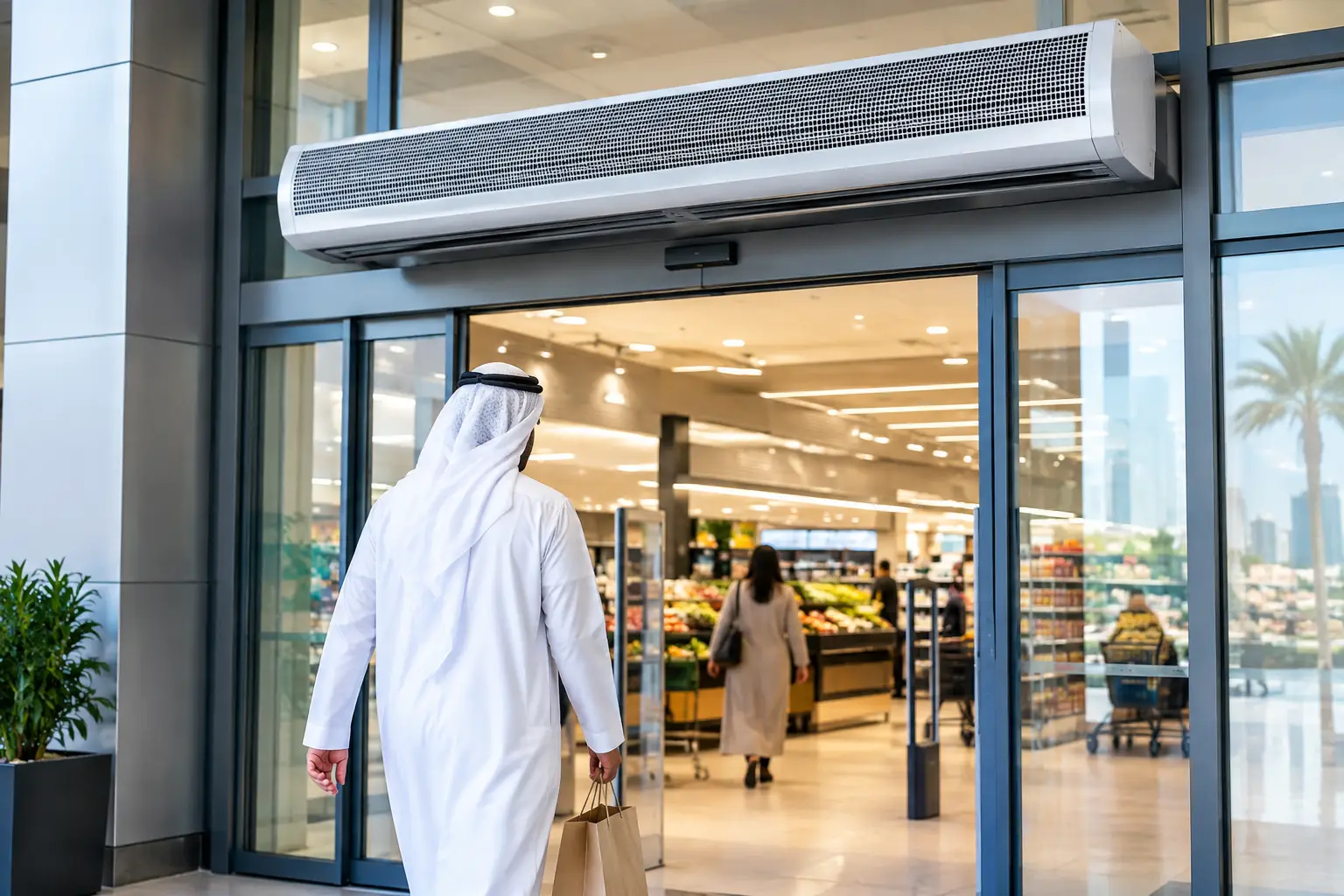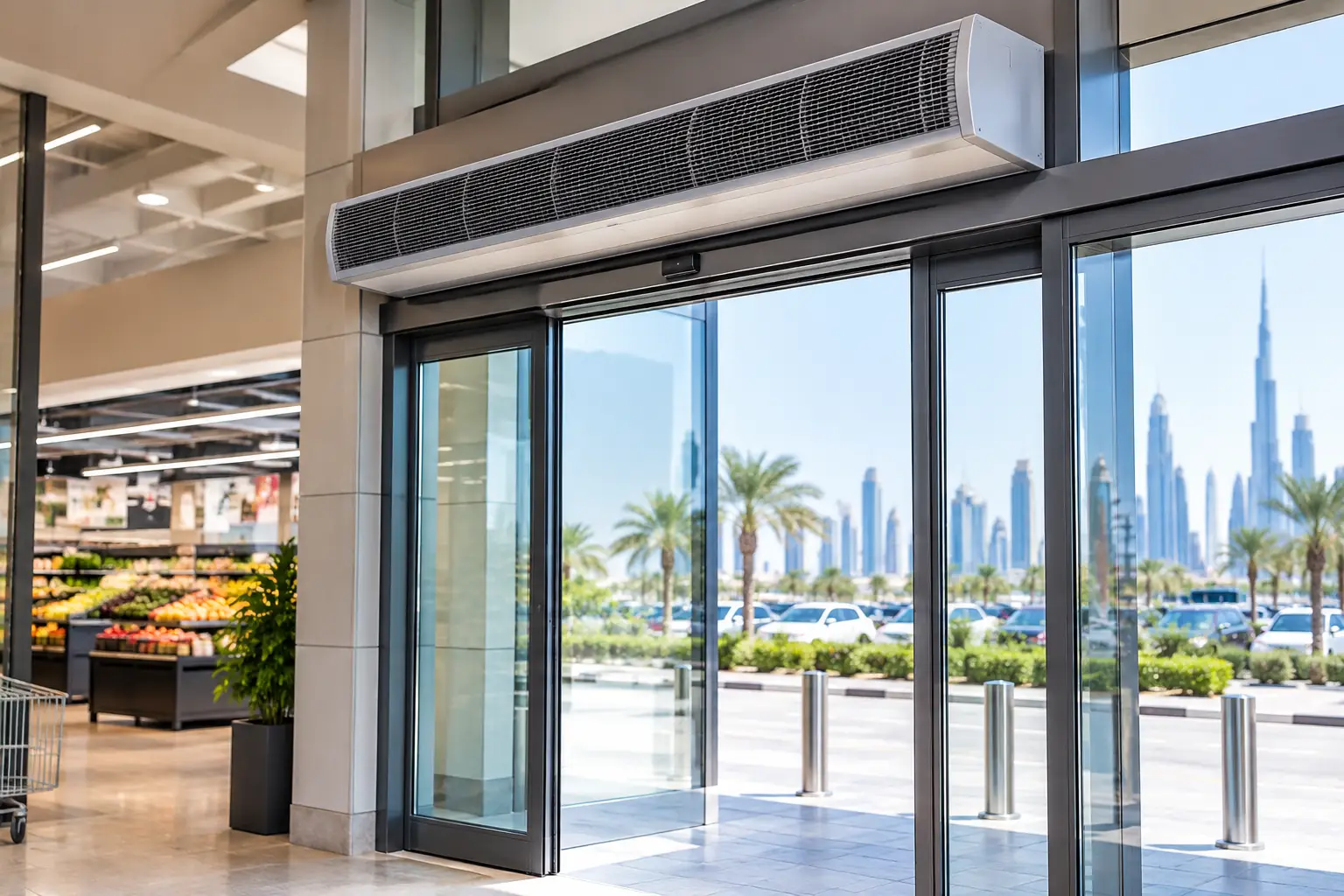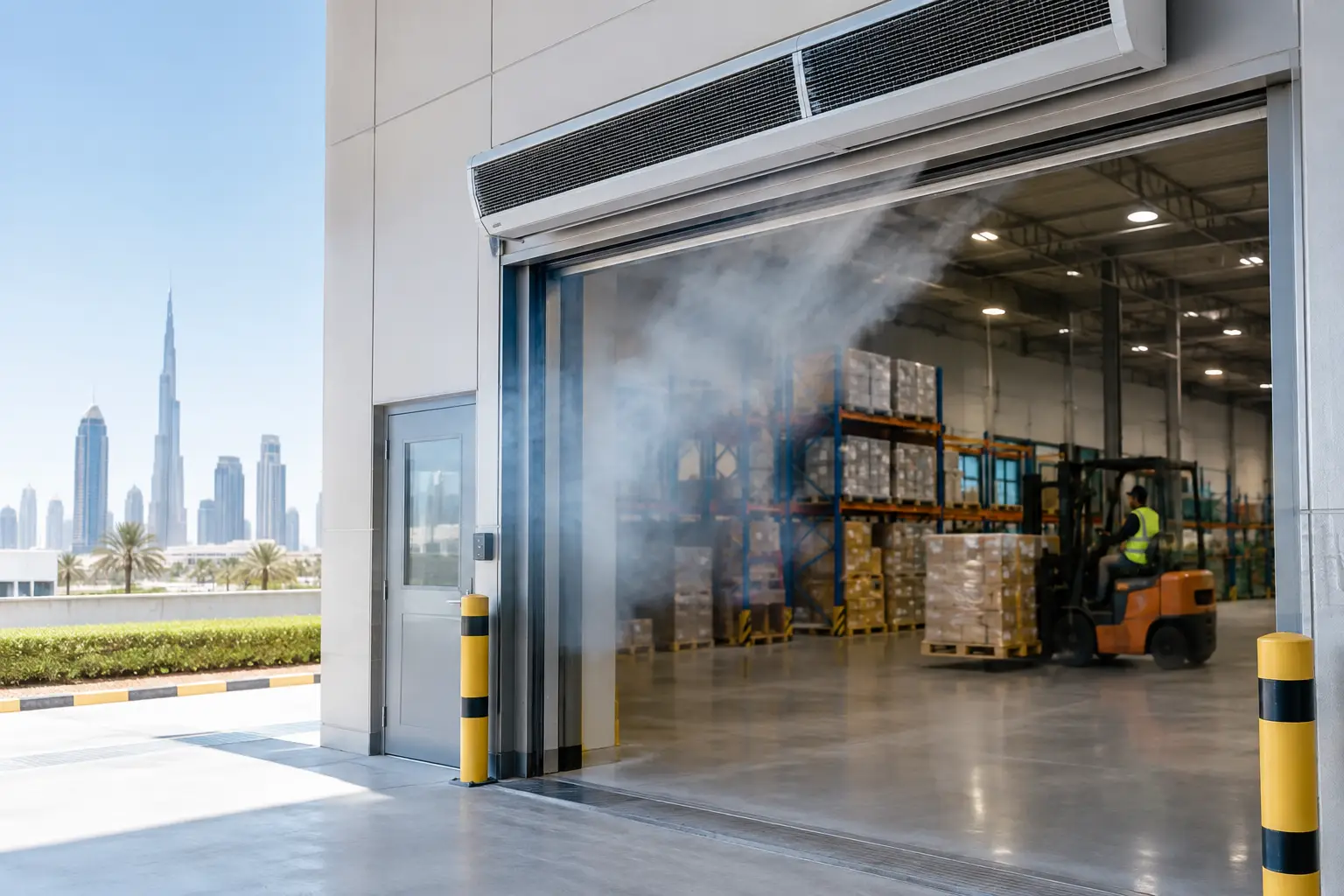
A retail entrance on Sheikh Zayed Road can open hundreds of times before noon. Every opening allows hot air, dust, humidity, and insects to move toward a conditioned interior, forcing the HVAC system to recover repeatedly. Dubai commercial air curtains address that problem at the doorway itself, creating a controlled high-velocity air stream that separates indoor and outdoor conditions while keeping access open for customers, staff, deliveries, and equipment.
For commercial facilities, the value is not simply a cooler entrance. A correctly specified system helps protect indoor comfort, reduce unwanted heat gain, support hygiene controls, and limit the operational burden placed on cooling equipment. The result depends on engineering, however. An air curtain that is undersized, installed too high, or selected without regard to traffic and pressure conditions will not deliver the intended air barrier.
Why Dubai Commercial Air Curtains Matter
Dubai’s climate puts unusual pressure on open entrances. High outdoor temperatures are the obvious concern, but the operating environment is more complex. Fine desert dust, high humidity near coastal areas, strong pressure differences between conditioned spaces and external corridors, and frequent door use can all weaken indoor climate control.
An air curtain works by projecting a continuous stream of air across an opening. This stream is intended to reach the floor or threshold zone with enough momentum to resist outside air infiltration. It is not a physical door, and it cannot make an open entrance completely airtight. Its job is to reduce air exchange while preserving traffic flow.
That distinction matters during specification. A unit chosen solely by doorway width may cover the opening visually but fail at the floor, where infiltration occurs. Door height, mounting position, discharge velocity, ambient conditions, and cross-drafts all affect real performance.
For supermarkets, hotels, retail stores, and mall-facing entrances, the priority is usually comfort, cooling retention, and dust exclusion. For warehouses, loading bays, food processing areas, and factories, the duty may be more demanding: managing large openings, vehicle movement, airborne contaminants, insects, fumes, or temperature separation between zones.
Start With the Entrance, Not the Catalog
The right commercial air curtain is selected around the opening and its operating conditions. HVAC contractors and MEP consultants should first establish the clear opening width and height, whether doors remain open continuously or cycle frequently, and whether the unit will sit exposed above the opening or recessed into the ceiling.
Traffic volume is equally important. A boutique store with a standard glazed entrance has a different requirement from a hypermarket entrance with steady customer flow. A logistics center may have roller shutters open for long periods and forklifts creating localized air movement. In these situations, higher air volume and centrifugal blower performance may be required to maintain effective throw at greater mounting heights.
Pressure conditions deserve attention as well. A heavily air-conditioned building can draw outdoor air inward when doors open. Nearby supply diffusers, exhaust systems, and prevailing winds can also distort the air stream. The air curtain should be coordinated with the broader HVAC design rather than treated as an isolated accessory.
The key specification inputs are:
- Clear width and mounting height of the opening
- Door type, opening frequency, and expected traffic
- Indoor and outdoor temperature and humidity conditions
- Exposure to dust, insects, fumes, or wind pressure
- Ceiling constraints, power availability, noise expectations, and HVAC layout
These details allow a supplier to recommend a system that produces the necessary coverage and discharge performance rather than simply selecting the nearest nominal size.
Selecting a System for the Application
Retail, hospitality, and public entrances
Retail stores, hotels, restaurants, hospitals, and office lobbies generally need a system that is effective without overpowering the entrance experience. Airflow should maintain a clear barrier while noise levels remain appropriate for customers, guests, patients, and front-of-house staff.
A recessed ceiling air curtain can be a suitable choice where architects want a clean ceiling line and the plenum has adequate space for installation and service access. For exposed mounting, commercial units with controlled airflow and appropriate fan technology can provide a practical balance of performance and appearance.
In hospitality and healthcare facilities, air cleanliness is a consideration alongside comfort. An air curtain can help reduce the entry of dust and outdoor contaminants, but it should support – not replace – the building’s filtration, pressure control, and hygiene procedures.
Supermarkets, malls, and high-traffic doors
Busy commercial entrances require sustained performance. Shopping carts, delivery staff, automatic sliding doors, and high customer turnover make a conventional closed-door strategy impractical. Here, air curtains reduce the cooling penalty of keeping access convenient.
Mounting alignment is critical. The discharge should cover the full usable opening, including areas beside automatic door tracks where infiltration often occurs. Multiple modules may be needed for wide entrances, with airflow settings balanced so gaps and uneven streams do not compromise the barrier.
For projects where presentation matters, the Commercial HiFi Plus Series can suit customer-facing applications that require reliable air isolation with controlled acoustic performance. The final selection should still be based on door geometry and site conditions, not appearance alone.
Warehouses, factories, and logistics facilities
Industrial entrances are less forgiving. Taller doors, open shutters, vehicle traffic, dust exposure, and long operating hours demand equipment designed for higher duty. Industrial centrifugal systems are commonly appropriate where a stronger, more stable air stream is needed across larger openings.
These systems can help separate conditioned production or storage areas from hot, dusty loading zones. They are also useful when maintaining operational access matters more than repeatedly closing a shutter between movements. Yet there is a trade-off: high-performance units may require more installation space, electrical capacity, and attention to noise in occupied areas.
Where large openings face outdoor wind or substantial negative pressure, an air curtain may need to be paired with disciplined door-management practices. It reduces infiltration; it does not overcome every site condition indefinitely.
Cold storage and food operations
Cold storage, food processing, and temperature-sensitive distribution operations require especially careful evaluation. The objective may be to limit warm, humid air entering a cold zone, reduce condensation risk around doorways, and support pest-control measures without obstructing material handling.
These applications should be assessed as part of the complete opening strategy. Door opening time, temperature differential, moisture load, sanitation requirements, and traffic patterns influence whether an air curtain is appropriate and what airflow configuration is needed. A high-velocity industrial design may be necessary, but excessive turbulence can be counterproductive in some controlled environments.
Installation Details That Affect Performance
Even a well-selected model can underperform when installation conditions are ignored. The unit should be mounted level and as close to the opening edge as practical, with a discharge direction adjusted to achieve floor-level coverage. If it sits too far inside the building, outdoor air can enter before it reaches the air stream. If it is too far outside, the stream may be disrupted by wind.
Ceiling recesses need enough clearance for airflow, electrical connection, and planned servicing. Exposed units need structural support appropriate to their weight and vibration characteristics. For long doorways, installers should align adjacent units carefully so the discharge remains continuous across the full width.
Controls should also match the operation. Door contacts, building management integration, variable speed settings, and timed operating schedules can reduce unnecessary run time while ensuring the system responds when an entrance is active. The suitable approach depends on whether the door is continuously open, sensor-operated, or used in predictable delivery windows.
Evaluate Total Operating Value, Not Only Unit Cost
A lower initial price can become expensive if the system does not reach the required throw distance or lacks the durability needed for extended commercial operation. Conversely, specifying excessive capacity for a modest entrance can increase capital cost, power consumption, and perceived noise without improving the result.
The practical target is an air curtain sized for the actual thermal and contamination challenge. This supports lower cooling loss, improves comfort close to the entrance, and helps HVAC systems maintain setpoint conditions more consistently. In dusty, tropical, and desert-climate markets, the benefit also includes reducing the amount of outdoor debris and humid air that reaches conditioned spaces.
Maintenance planning should be included at the design stage. Commercial operators need accessible filter nets where fitted, clear service space, and routine inspection of intake areas and fan performance. Dust accumulation can reduce airflow over time, so maintainability is an operational issue, not a minor afterthought.
Specify for Conditions, Then Request a Project Review
Dubai commercial air curtains perform best when they are selected as part of an entrance climate-control plan, with the opening, traffic profile, HVAC behavior, and local climate considered together. A polished retail lobby, a busy supermarket, and a high-bay loading dock may all need air isolation, but they do not need the same equipment.
For a project in Dubai or across the GCC, MENA, and Africa, provide the entrance dimensions, mounting height, site photographs or drawings, operating hours, door type, and the environmental issue you need to control. FreezeeX can review those conditions and prepare a consultation-based recommendation and quotation for a system built to perform in demanding tropical and desert environments.