An open loading-bay door in Dubai at midday can pull heat, dust, and humidity into a conditioned facility within minutes. A commercial air curtain performance review should therefore measure more than whether a unit turns on and produces noticeable airflow. It should establish whether the air stream reaches the threshold, remains stable in real operating conditions, and reduces the unwanted air exchange that raises HVAC load and affects occupant comfort.
For facility managers, MEP consultants, and contractors, the central question is practical: does the installed or proposed unit create effective air isolation for this particular opening? The answer depends on door geometry, mounting height, traffic patterns, external pressure, climate exposure, and the air curtain’s fan and discharge design.
What Commercial Air Curtain Performance Really Means
Commercial air curtain performance is the ability to form a continuous, high-velocity air barrier across an entrance. That barrier limits the movement of outdoor air, dust, insects, humidity, fumes, and airborne contaminants into the building while allowing people, carts, or forklifts to pass without a physical door closing between every movement.
The word “limits” matters. An air curtain is not a sealed partition, and its effectiveness is never a fixed percentage independent of the site. A supermarket entrance with frequent customer traffic behaves differently from a warehouse opening exposed to crosswinds, vehicle movement, and high outdoor temperatures. The performance target must match the operational risk at the doorway.
For a retail store or hotel lobby, the priority is usually comfort and reduced cooling loss. For a food-processing facility, hospital, pharmaceutical operation, or cold storage entrance, airborne contamination control and temperature stability can carry greater weight. In a dusty logistics yard or factory, the main concern may be particulate ingress and protection of indoor working conditions.
The Metrics That Matter in a Commercial Air Curtain Performance Review
A credible review starts with measurable performance factors rather than a nominal motor rating alone. Motor input indicates electrical consumption, but it does not confirm whether the unit can project an effective stream to floor level.
Air velocity at the opening
Discharge velocity is the speed of air leaving the nozzle. It must be sufficient to carry the stream from the mounting point to the threshold. More useful still is the velocity measured at different points along the opening, particularly near floor level where the air curtain must resist incoming air.
Higher velocity is not automatically preferable. Excessive discharge can create noise, drafts, and unnecessary energy use, especially at a low-mounted retail entrance. The correct design combines adequate throw with controllable speed settings and appropriate nozzle geometry.
Coverage and stream uniformity
The air stream must cover the full width of the doorway. Gaps between multiple units, poorly aligned modules, or a unit shorter than the opening can create easy paths for heat and contaminants to enter. This is a common specification issue on wide entrances, roller shutters, and doors with irregular side conditions.
Uniformity also matters. A visibly strong stream at one end of the unit does not compensate for a weak center section or side gap. During assessment, reviewers should observe whether the stream remains continuous across the opening under normal door operation.
Mounting height and effective throw
Every model has a practical mounting-height range. Installing a compact commercial unit above a tall warehouse opening can produce airflow that dissipates before reaching the floor. Conversely, specifying an industrial high-throw system for a modest doorway may introduce unnecessary noise or operating cost.
The relationship between height and throw is particularly important in airports, logistics centers, factories, and loading areas. Centrifugal systems are often selected for demanding applications because their design can deliver the static pressure needed to project air farther and manage higher-resistance conditions.
Airflow volume and static pressure
Air volume, typically expressed as airflow rate, indicates how much air the unit moves. Static pressure reflects the fan’s ability to maintain airflow against resistance. Both influence results, but neither should be evaluated in isolation.
A high airflow figure may look attractive on a schedule, yet provide limited protection if the stream lacks direction or loses momentum in a high doorway. For busy industrial openings, a system with suitable static pressure and a well-controlled discharge pattern may perform more consistently than a larger nominal airflow figure alone.
Noise at the occupied zone
Noise is a functional performance factor, not merely a comfort preference. At a restaurant entrance, reception desk, retail checkout, or hospital access point, persistent fan noise can affect the customer and staff experience. In a warehouse, a higher sound level may be acceptable if it provides necessary environmental separation.
Specifications should assess noise at the actual occupied area, at the selected operating speed, rather than relying only on a catalog value measured under different test conditions. Variable-speed control gives operators useful flexibility during lower-traffic periods.
Site Conditions Can Change the Result
The same air curtain can perform well at one entrance and poorly at another because doorways are pressure boundaries. Wind, stack effect, nearby exhaust systems, supply-air balance, and repeated opening cycles can all disturb the air stream.
In GCC, MENA, and African markets, harsh outdoor conditions add another layer of risk. Extreme solar heat in Riyadh or Dubai, humid coastal conditions in Doha or Muscat, and dusty external environments around industrial sites can increase the pressure on entrance climate control. The system must be selected for the climate it will face, not simply for door width.
A review should examine these conditions during realistic operation. For example, a loading entrance should be assessed while vehicles are moving, shutters are open, and the building HVAC system is operating normally. A calm test with no traffic may overstate real-world performance.
Matching the Air Curtain to the Application
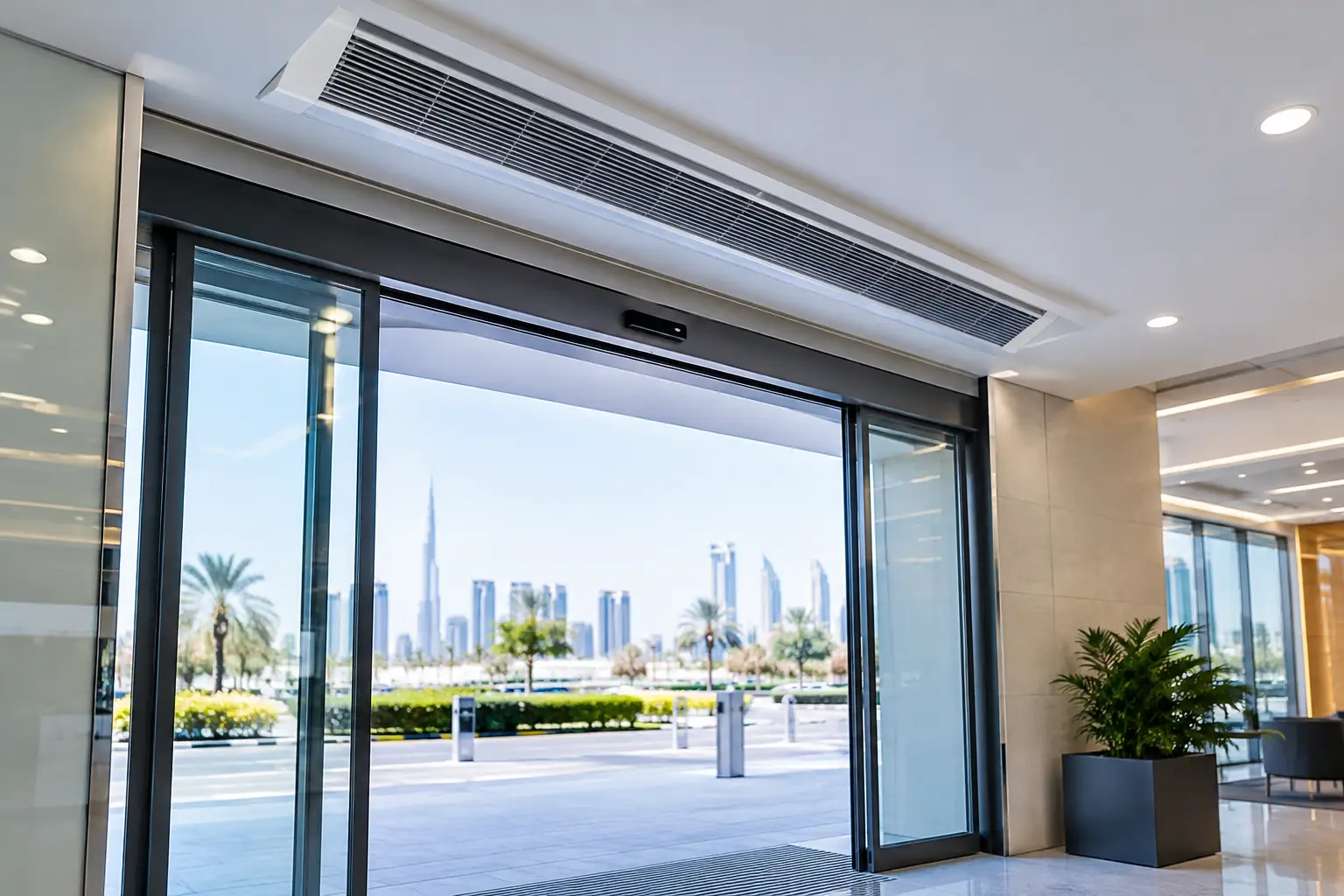
The right product category depends on the entrance and the operational objective. Recessed ceiling air curtains can suit premium retail, hotel, and commercial interiors where visual integration matters and the mounting geometry supports effective throw. Commercial units are typically appropriate for standard doors in stores, restaurants, offices, and supermarkets.
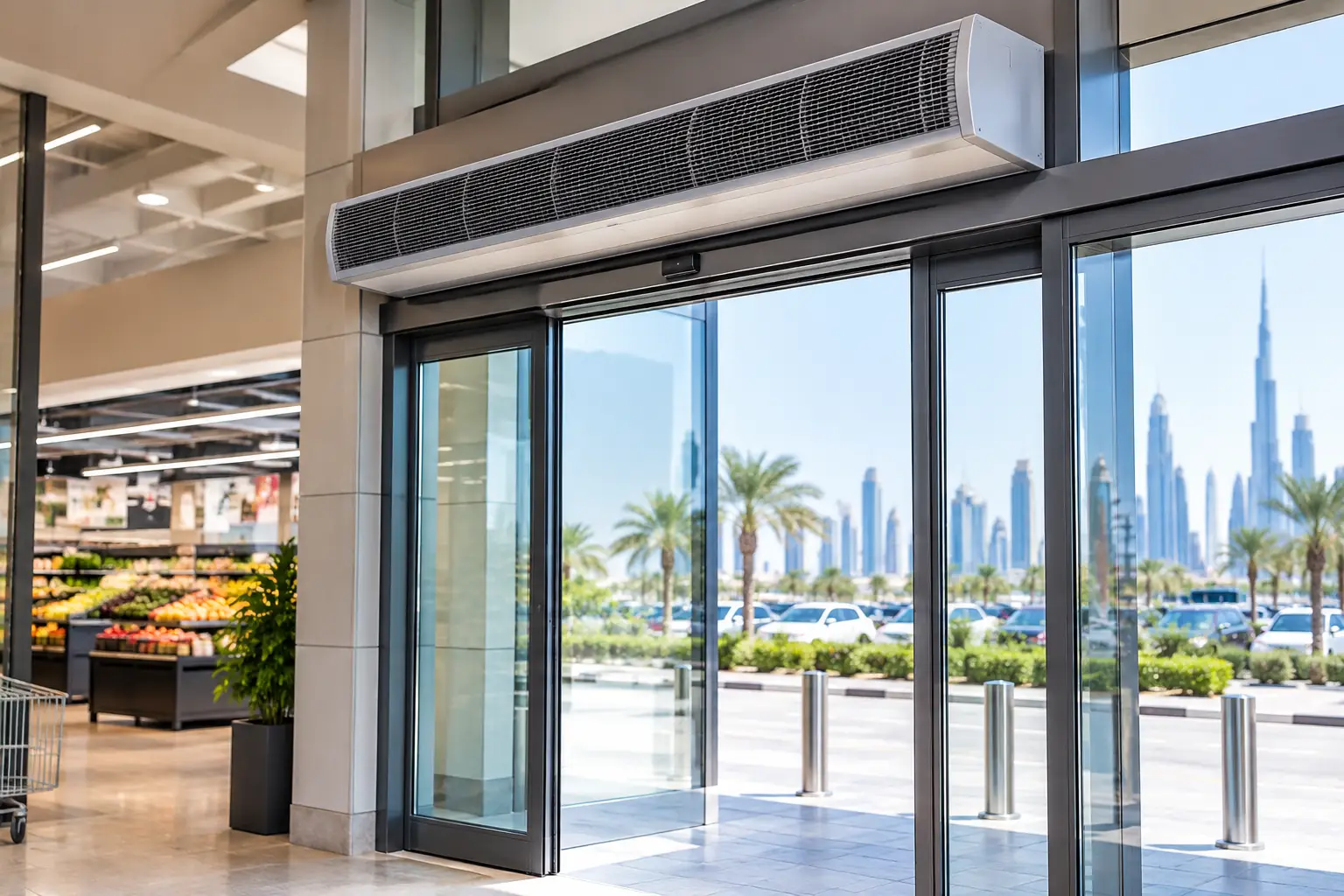
High-traffic or taller openings often need greater airflow control. Commercial centrifugal models can provide stronger air delivery where entrance conditions are more demanding, while industrial centrifugal systems are designed for warehouses, factories, logistics centers, and heavy-use access points. A dynamic, adjustable solution can be valuable where traffic volume changes significantly by hour or season.
For cold storage and temperature-sensitive operations, selection requires additional care. The goal is to reduce warm, humid air entering through open doors without interfering with logistics flow. Door dimensions, operating temperature, product sensitivity, and forklift frequency should all be reviewed as part of the design basis.
How to Review Performance After Commissioning
Performance review should be built into handover and early operation. Start by confirming that units span the intended opening and that mounting height, orientation, and controls match the approved design. Then assess the airflow with the door open under representative site conditions.
Visual observation can reveal obvious stream deflection, but it should be supported by velocity checks across the doorway and at lower levels. Facility teams should also monitor practical indicators over several operating weeks: indoor temperature stability near the entrance, dust accumulation, insect activity, humidity-related condensation, customer complaints, and HVAC run-time trends.
If results are weaker than expected, the solution may involve adjusting fan speed or discharge angle, improving coordination with door controls, correcting gaps between units, or reassessing the size and type of equipment. The right correction depends on the cause. Raising fan speed may help a marginal throw distance, but it will not resolve a fundamentally undersized system at a very tall or wind-exposed opening.
Common Specification Mistakes
The most frequent problem is treating all doorways as equal. Width is easy to measure, so it often receives attention first. Mounting height, crosswinds, traffic intensity, indoor pressure, and external contaminants can have just as much impact.
Another mistake is specifying around initial cost without accounting for operating conditions. A unit that does not maintain an effective barrier can leave the HVAC system absorbing continuous heat and humidity loads. In hot, tropical, humid, and desert climates, that operating penalty can outweigh the apparent saving from a lower-capacity selection.
Finally, do not confuse an air curtain with a replacement for building pressure control or properly designed doors. It works as part of the entrance strategy. Effective results come from coordinated HVAC operation, correct equipment sizing, professional installation, and performance verification.
A well-executed review turns an air curtain from a line item into a measurable part of the facility’s energy and environmental-control plan. For a project in the UAE, Saudi Arabia, Qatar, or across the wider region, request a FreezeeX consultation and quotation based on the actual opening, traffic pattern, climate exposure, and HVAC requirements. The most useful next step is a specification that can be verified at the door, where performance matters.