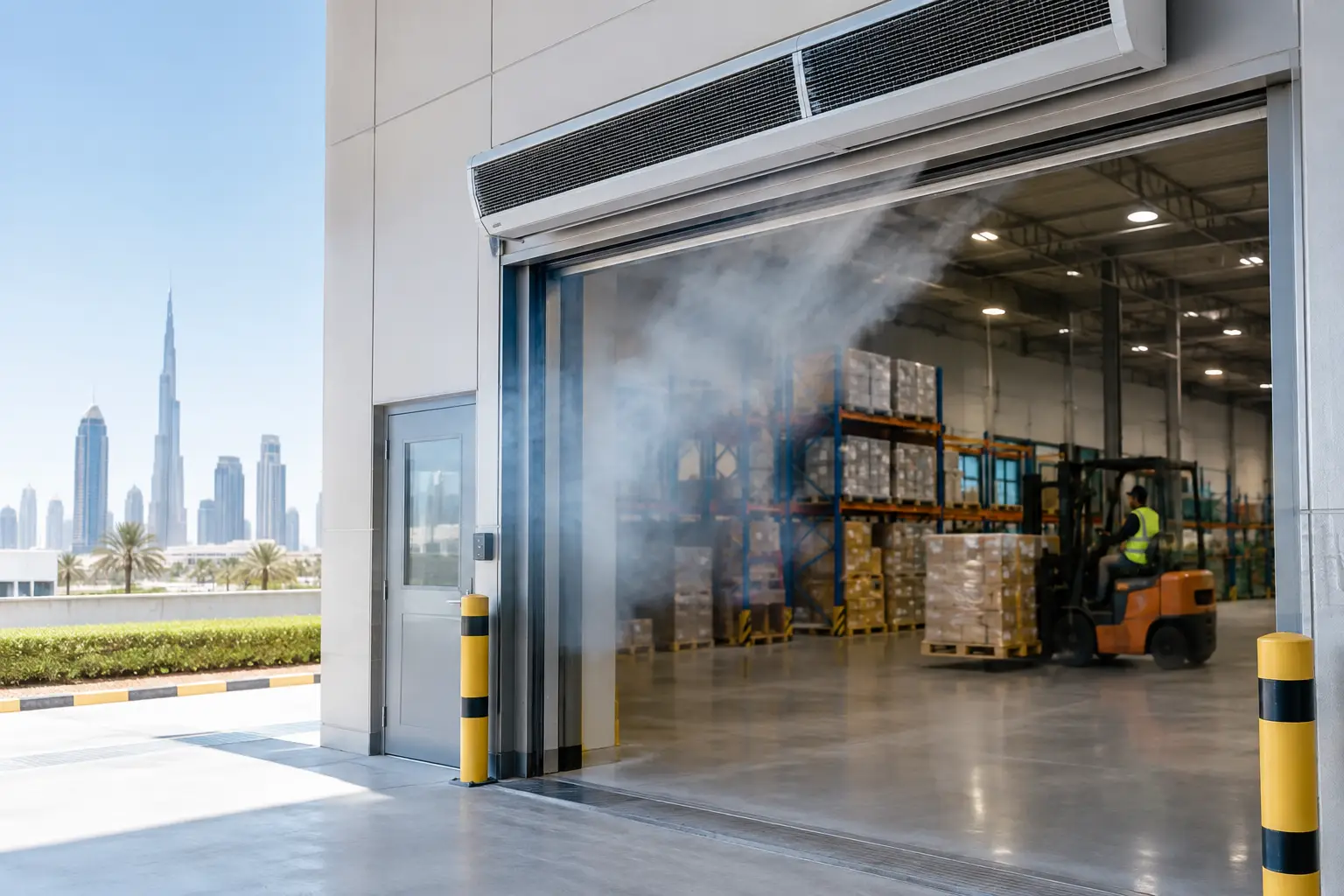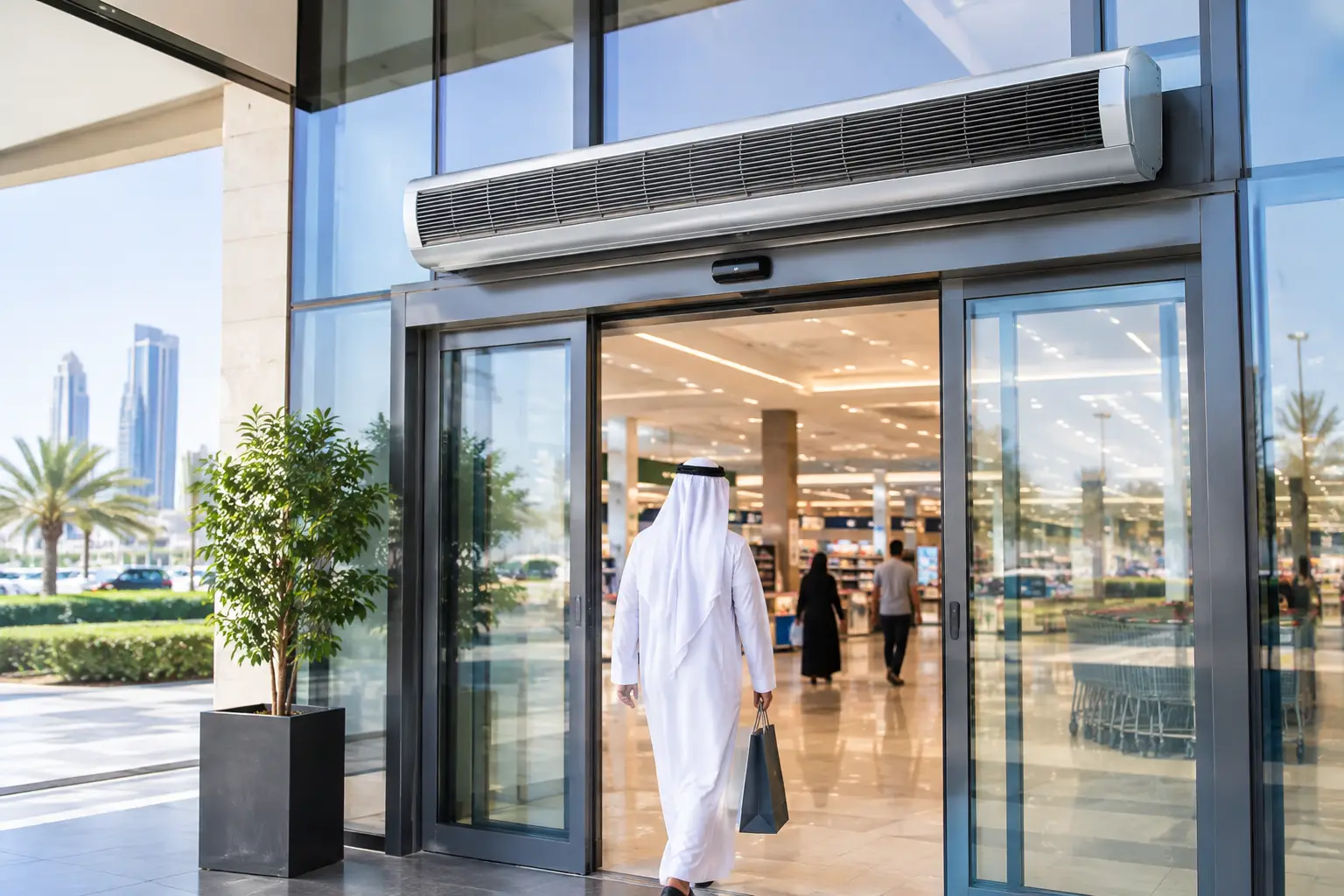
A loading-bay door opens, a delivery vehicle idles nearby, and smoke or exhaust haze is suddenly drawn into the facility. For a supermarket, hospital, warehouse, airport, or food-processing site, controlling smoke ingress is not simply an indoor-comfort issue. It can affect air quality, staff and visitor experience, product handling conditions, and the workload placed on HVAC filtration.
The right response starts with a clear distinction: an air curtain can help limit day-to-day smoke, fumes, dust, humidity, and hot-air infiltration through an open entrance. It is not a substitute for code-required smoke-control systems, fire-rated barriers, fire doors, or emergency pressurization strategies. Treating these functions separately protects both building performance and life-safety compliance.
Controlling Smoke Ingress Is an Airflow Problem
Smoke follows airflow and pressure differences. When a conditioned building is at lower pressure than its surroundings, outside air can be pulled through every available opening. A frequently used entrance creates the largest and least predictable opening of all.
In Dubai, Riyadh, Doha, Muscat, Cairo, Lagos, and other hot or dusty markets, this challenge often arrives with more than smoke alone. Vehicle exhaust, sand, fine dust, humidity, heat, and airborne odors can enter together. At a restaurant receiving entrance, a warehouse dock, or a retail storefront near traffic, an open door can become a direct pathway for contaminants.
An air curtain creates a directed high-velocity air stream across the doorway. Properly specified, that stream acts as an aerodynamic barrier between indoor and outdoor air masses while people, carts, and goods pass through. It reduces the exchange rate rather than creating a physical seal, which is why equipment selection and installation geometry matter.
The objective is not to claim that an air curtain makes an open door airtight. The objective is to reduce contaminant transfer and cooling loss enough to support stable indoor conditions during normal operations.
Where Smoke Ingress Creates Operational Risk
The business impact depends on the application. In a retail store or mall, visible haze and odors near an entrance can undermine customer comfort. In hotels and hospitals, outside pollutants can affect reception areas, corridors, and waiting spaces where clean, controlled indoor air is expected.
For industrial facilities, the concern is frequently more direct. Warehouses and logistics centers may have dock doors exposed to truck traffic, diesel exhaust, dust, and high outdoor temperatures. Food-processing and pharmaceutical operations must manage contamination pathways carefully, particularly where product movement requires doors to remain open for extended periods.
Cold storage entrances have an added pressure on performance. Warm, humid outside air entering through a doorway can carry odors and airborne contaminants while increasing condensation and cooling demand. The air curtain must be selected for the opening size, temperature differential, door-use pattern, and surrounding traffic conditions rather than selected only by width.
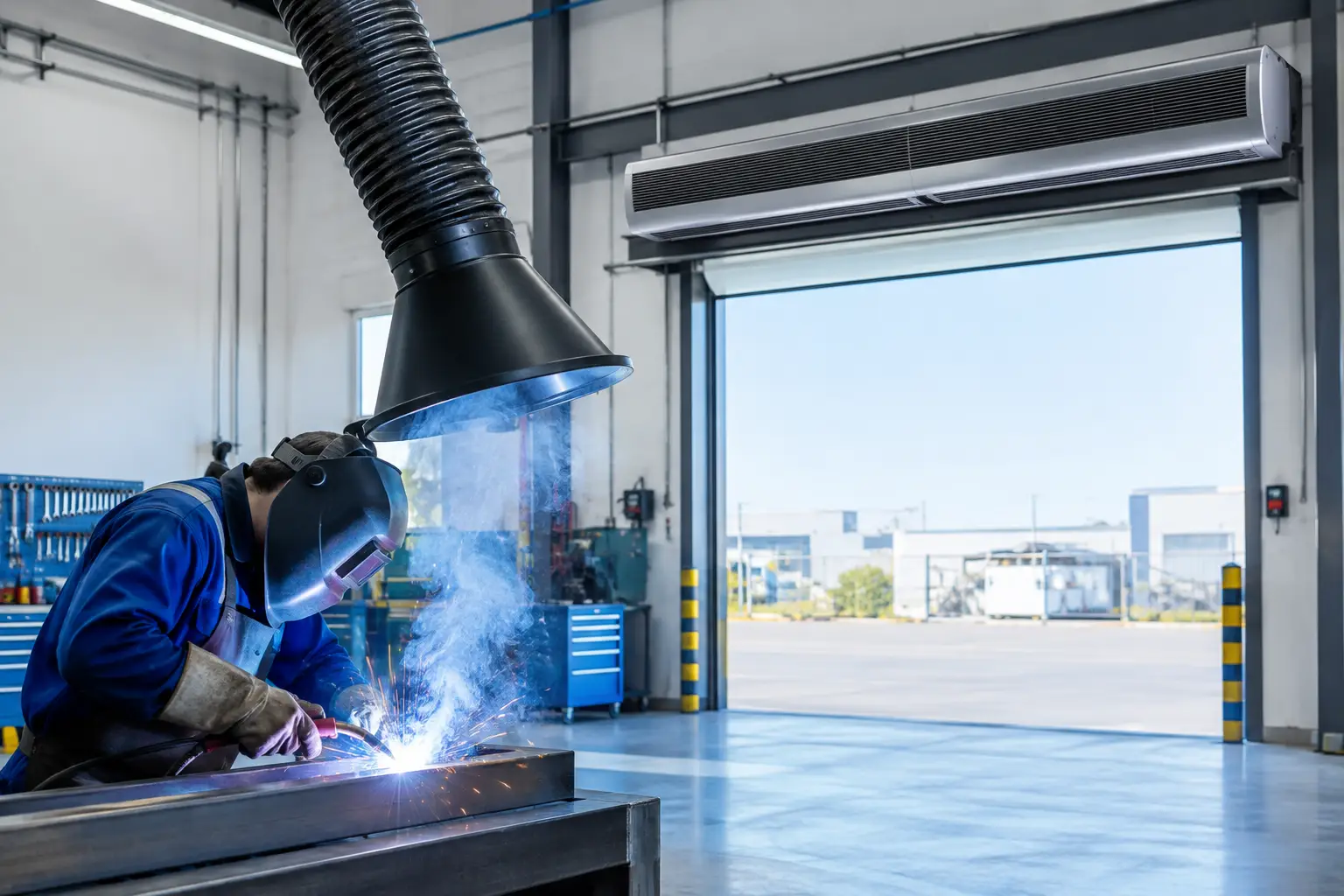
Smoke can also travel from adjacent operational zones. A restaurant service entrance near cooking areas, a factory doorway close to a process zone, or a parking interface adjoining a commercial lobby may require a focused assessment of airflow direction. In these cases, the source, local pressure conditions, and occupancy pattern are as relevant as the doorway itself.
Air Curtains and Fire Smoke Control Are Different Systems
This distinction should be written clearly into project discussions and specifications. Commercial air curtains are designed for entrance climate separation and the reduction of everyday airborne intrusion. They may help limit nuisance smoke or exhaust from outdoors during normal building operation, but they should never be presented as a fire-smoke containment measure.
During a fire event, the building’s approved fire alarm logic, smoke extraction, stair or lobby pressurization, smoke dampers, and compartmentation requirements govern how systems respond. Any air curtain installed near a protected opening must be coordinated with the MEP engineer, fire consultant, and local authority requirements. Its operating sequence may need to be shut down or controlled differently during an alarm condition.
This is especially relevant for healthcare facilities, airports, malls, and high-occupancy venues, where entrance systems interface with detailed life-safety strategies. A practical air-quality measure must never interfere with the building’s required emergency response.
What Determines Whether an Air Curtain Will Reduce Ingress
A short, low-powered unit over a tall loading door will not provide meaningful separation. Likewise, a correctly sized unit can underperform if it is mounted too high, offset from the opening, or disrupted by crosswinds and nearby mechanical airflows.
Four factors deserve early review:
- Doorway dimensions and mounting height: Air velocity must remain effective when it reaches floor level or the threshold area. Tall warehouse and industrial openings generally require higher-output equipment than standard retail doors.
- Crosswinds and pressure imbalance: Wind exposure, nearby vehicle movement, building exhaust, and an under-pressurized interior can deflect the air stream or pull contaminants around it.
- Traffic and door-open duration: A door that opens briefly every few minutes behaves very differently from a dispatch entrance that remains open through a working shift.
- Contaminant source and concentration: Light outdoor haze requires a different approach from an entrance located beside idling trucks, a waste-handling area, or a heavily polluted roadway.
Airflow volume alone is not the answer. The design must balance air speed, throw, coverage, noise limits, motor duty, and the possibility of drafts affecting occupants near the entrance. For customer-facing spaces, noise and appearance may be central selection criteria. For loading docks and factories, throw distance, durability, and continuous-duty capability often take priority.
Selecting Equipment for Commercial and Industrial Entrances
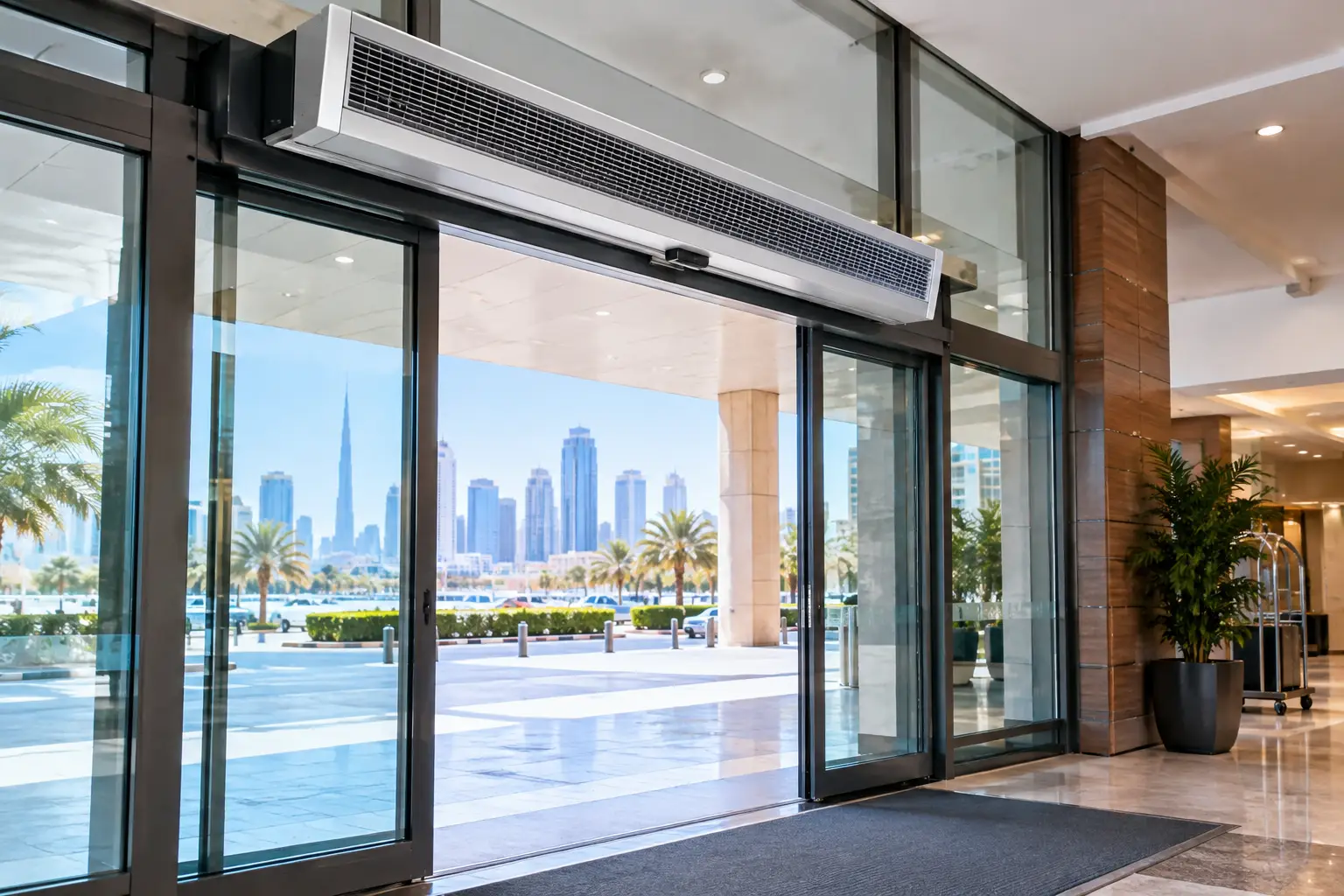
For recessed entrances in hotels, offices, premium retail, and commercial lobbies, a recessed ceiling air curtain can preserve the visual line of the entrance while delivering an effective barrier. The ceiling void, mounting height, access for servicing, and facade exposure should all be verified before specification.
High-traffic retail and supermarket openings commonly benefit from commercial centrifugal designs that maintain stable airflow while doors are repeatedly used. Where entrance aesthetics and lower perceived noise matter, a commercial HiFi configuration may be appropriate, provided the mounting height and local pressure conditions remain within its operating range.
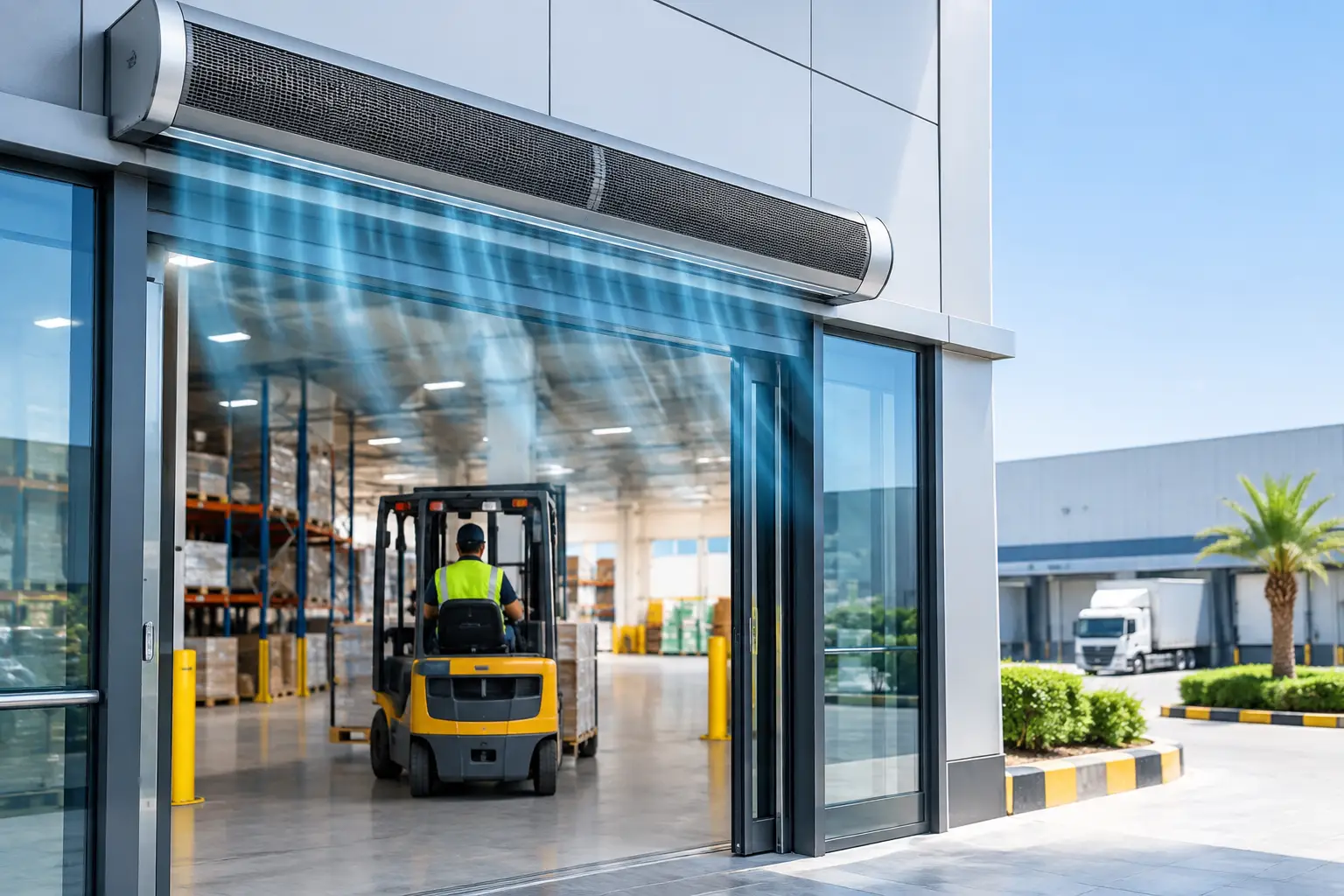
Warehouses, factories, logistics hubs, and large-format receiving doors require a more demanding approach. Industrial centrifugal air curtains are generally better suited to high mounting positions, broad openings, dust exposure, and sustained operating cycles. For variable site conditions, a dynamic air curtain arrangement may offer more control over output, but the expected operating logic should be defined during design rather than left to site adjustment.
FreezeeX evaluates these factors as a combined entrance-performance question. The recommended solution should account for doorway width, installation position, traffic level, indoor setpoint, external heat and humidity, and whether the facility faces desert dust, tropical moisture, traffic fumes, or a mix of these conditions.
Improve the Doorway, Not Just the Equipment
Even a correctly selected air curtain has limits when the entrance itself is poorly managed. Doors held open unnecessarily, damaged seals around adjacent shutters, poorly positioned exhaust points, and unbalanced supply air can all increase the pressure driving contaminants indoors.
Facility teams should first identify when the issue occurs. Is smoke ingress strongest during delivery periods, peak customer traffic, certain wind directions, or HVAC operating changes? A simple site observation can reveal whether the airflow is entering at the floor, across the top of the opening, or around one side of the doorway. That information helps engineers select the appropriate discharge angle, mounting arrangement, and equipment class.
Where external vehicle emissions are the main concern, operational controls matter as well. Designated vehicle waiting zones, reduced idling near entrances, and better separation between dock traffic and pedestrian doors can lower the contaminant load before it reaches the air curtain. Air isolation performs best when it supports a broader entrance-control plan.
Specify for Actual Climate and Operating Conditions
A generic entrance unit may look adequate on a schedule but perform poorly in a hot, humid, or dusty environment. Desert heat can intensify the cooling penalty of open doors, while humidity adds latent load and can make indoor comfort harder to maintain. In tropical locations, frequent rain, moisture, and high outdoor temperatures require equipment selected for sustained commercial duty.
For projects across the GCC, MENA, and Africa, provide the consultant or supplier with the clear opening dimensions, mounting height, door-use schedule, nearby pollutant sources, HVAC operating conditions, and photographs or drawings of the entrance. This allows the air curtain to be specified as part of the building’s airflow strategy, not as an afterthought.
If smoke, exhaust, dust, or hot outdoor air is entering through a busy commercial doorway, request a FreezeeX consultation and quotation based on the actual site conditions. A properly matched air curtain can support cleaner entrances and lower cooling loss while meeting the demands of tropical and desert-climate operations.