A loading-bay door held open during production can undermine an otherwise well-designed workshop fume control strategy. It allows hot outdoor air, dust, vehicle emissions, humidity, and airborne contaminants to enter precisely when the facility is trying to keep welding fumes, solvent vapors, or process dust contained. In high-heat and dusty markets such as the UAE, Saudi Arabia, Qatar, and across Africa, entrance conditions deserve the same engineering attention as the process area itself.
Workshop fume control is not one piece of equipment. It is a coordinated approach that captures contaminants where they are generated, manages airflow through the building, and protects the boundary between controlled work zones and outdoor conditions. Industrial air curtains have a defined role in this approach: they create an air barrier at frequently used openings to reduce uncontrolled air exchange without restricting traffic.
Start With the Source of the Fumes
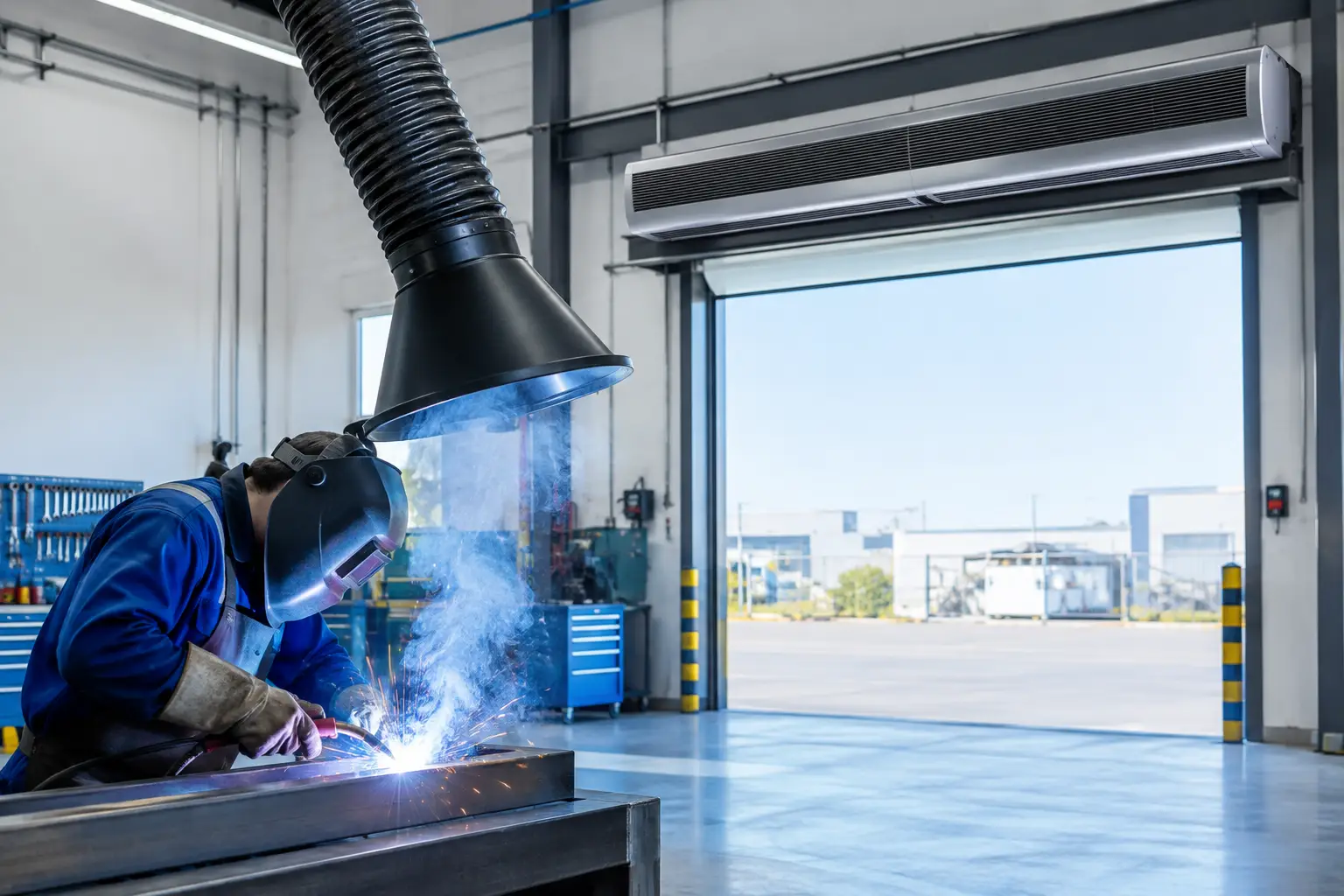
The first principle is simple: contaminants should be controlled as close as practical to where they are released. Welding stations, cutting equipment, chemical preparation areas, spray processes, and vehicle service bays all create different contaminants at different temperatures and volumes. A general room air movement strategy cannot reliably substitute for source capture.
For example, a welding bay needs collection close to the arc because fume rises and disperses quickly. A solvent-handling process may require containment and extraction designed for vapor behavior and the materials in use. Dust from grinding or cutting must be captured before it settles on equipment, products, and HVAC components.
This distinction matters when evaluating air curtains. An air curtain is not a fume extraction system and should never be specified as a replacement for local capture. Its value is at the entrance: limiting the outside air, dust, insects, heat, and external fumes that would otherwise enter during door operation. It also helps maintain more predictable indoor conditions, allowing the primary ventilation and filtration design to perform as intended.
Why Open Doors Complicate Workshop Fume Control
A workshop door is rarely just an access point. In a factory, fabrication shop, logistics workshop, or maintenance facility, it may stay open for forklifts, deliveries, equipment movements, and staff circulation. Each opening can create a major pathway for air infiltration, especially when there is a large temperature difference between the conditioned workspace and the outdoor environment.
In desert and tropical climates, that incoming air often carries a significant heat and moisture load. Fine dust can enter with it, increasing cleaning requirements and placing extra demand on filters. Near loading areas or vehicle routes, outdoor exhaust contaminants can also migrate indoors. These conditions can disrupt pressure relationships and dilute the performance of a carefully planned fume-control system.
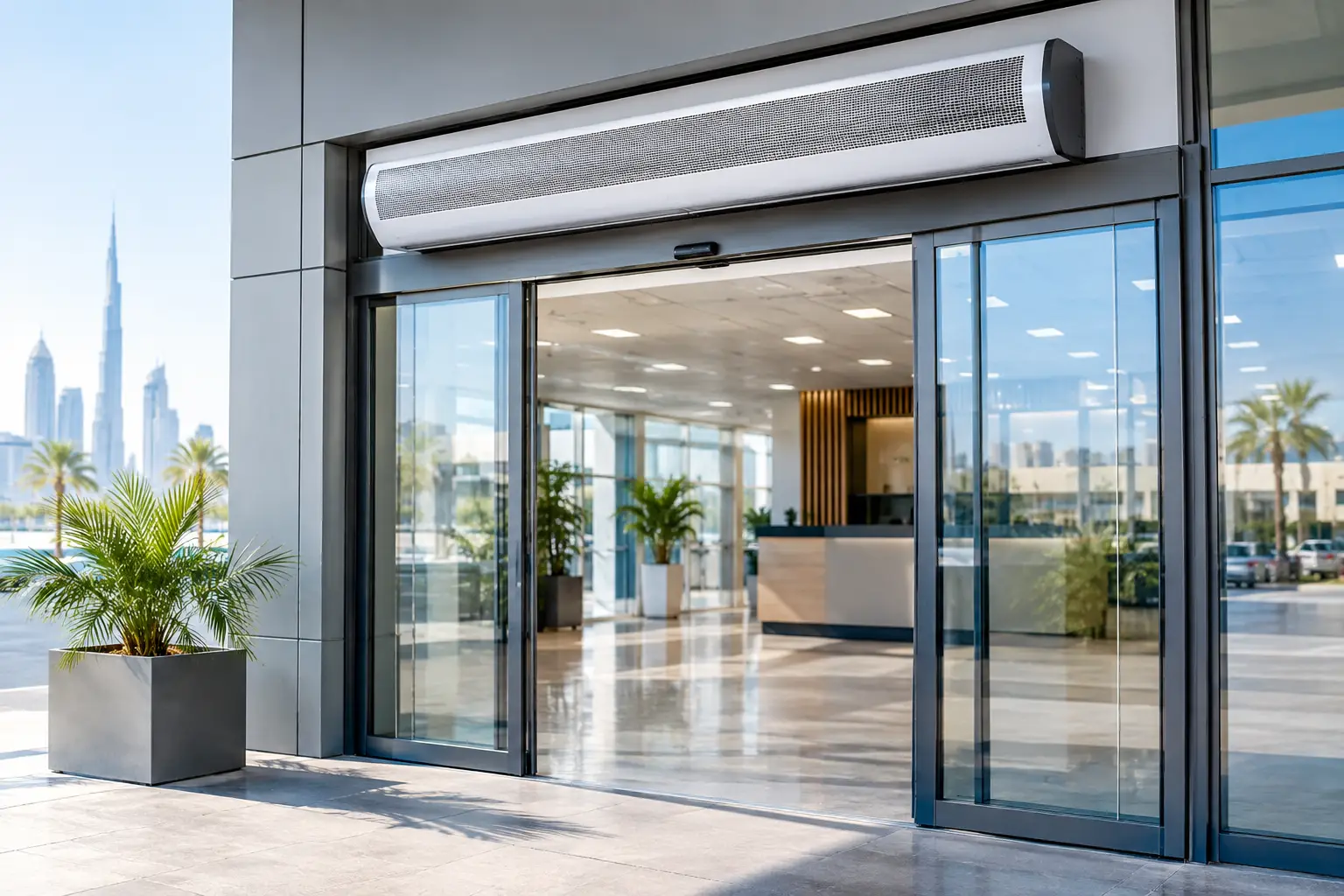
A correctly selected industrial air curtain directs a high-velocity air stream across the full opening. The stream acts as a physical air separation zone while the door remains open. It does not create an airtight seal, and performance depends on site conditions, but it can materially reduce uncontrolled exchange compared with an unprotected opening.
Where Air Curtains Add Value in Workshops
Air curtains are most effective where a facility needs open-door access but cannot accept constant exposure to outdoor conditions. In workshops, this commonly includes vehicle bays, goods-receiving doors, dispatch areas, transfer openings between dirty and clean zones, and entrances connecting production spaces to external yards.
At a vehicle service or industrial maintenance bay, an air curtain can reduce hot, dusty air and external emissions entering from the apron while vehicles move through the opening. It supports indoor comfort for personnel and helps prevent the workspace from becoming dependent on continuous HVAC recovery after every door cycle.
In fabrication and manufacturing facilities, air curtains can also help separate process zones from adjacent circulation or loading areas. This does not replace physical partitions where contaminant control demands them. However, when a full-height door must remain open, a properly designed air barrier can reduce crossflow and protect the controlled side of the opening.
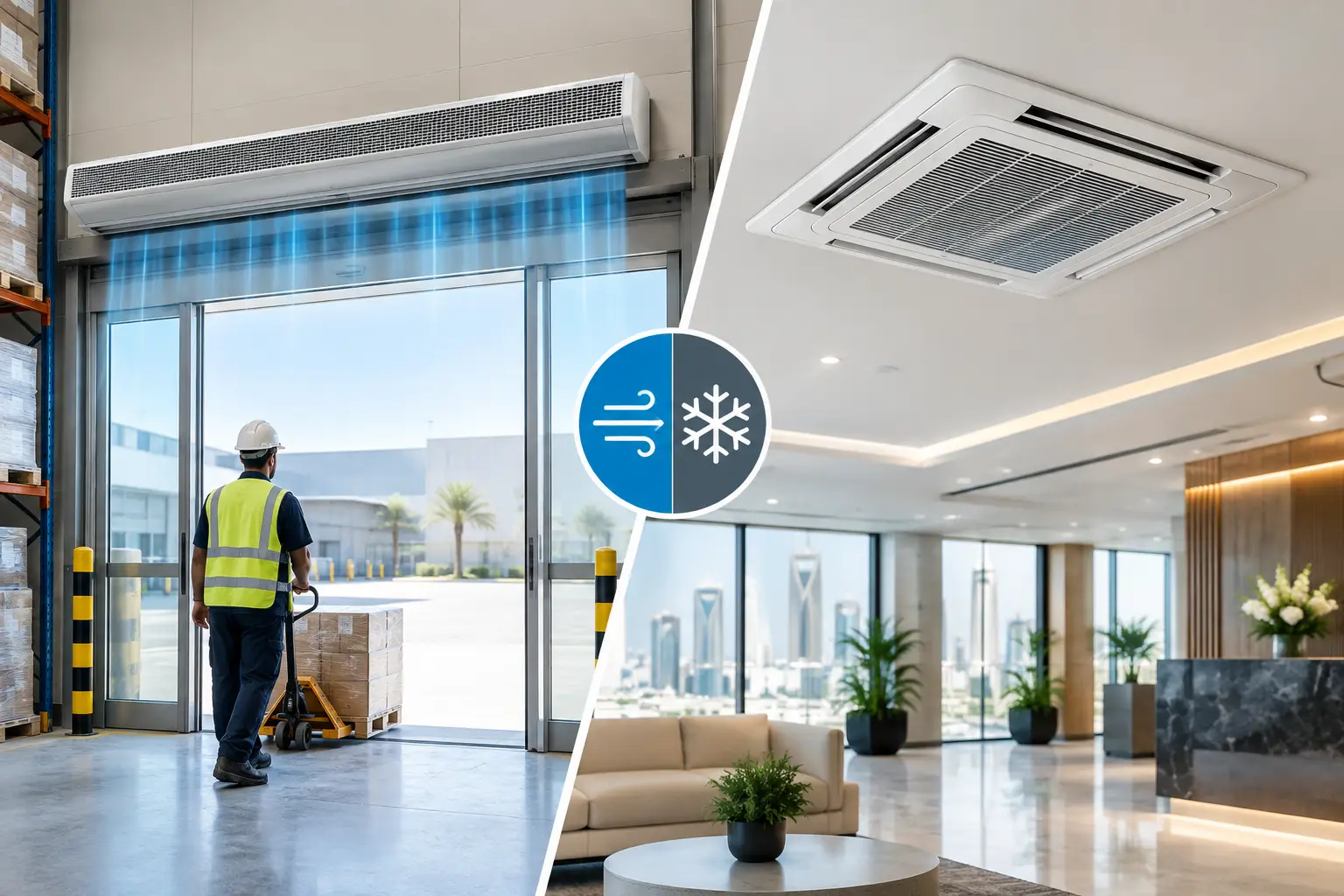
The same principle applies to workshops attached to warehouses or distribution centers. Dust, humidity, and heat entering through a high-traffic loading door can affect worker comfort, stored materials, and the performance of nearby ventilation systems. The right air curtain provides an operational boundary without slowing material handling.
Selecting an Industrial Air Curtain for the Opening
Air curtain selection should be based on the opening and operating conditions, not on motor power alone. Width, height, mounting position, door type, traffic frequency, exposure to wind, and indoor pressure conditions all affect the required airflow pattern and throw.
For wide or tall workshop doors, industrial centrifugal systems are generally more appropriate than light-duty commercial units. Centrifugal blowers are designed to maintain airflow performance under demanding installation conditions and are suited to larger openings, higher mounting heights, and continuous commercial use. The goal is consistent air coverage at the threshold, not simply moving a large volume of air near the header.
Specify the air curtain with the actual clear opening dimensions, including any shutters, rails, dock equipment, or structural elements that affect the airstream. A unit mounted too high or selected with insufficient throw may lose effectiveness before the air reaches floor level. Conversely, excessive air velocity can be uncomfortable for personnel or interfere with sensitive nearby processes. The correct balance depends on the site.
Wind exposure requires special attention. A door facing an open yard, truck route, or prevailing desert wind may need a stronger configuration than a sheltered internal loading opening. In these situations, site assessment is essential because external pressure can distort the air barrier. Facility managers should also consider whether the door is open continuously, opened in short cycles, or only used at scheduled intervals.
Airflow Balance Matters as Much as Equipment Choice
An industrial workshop needs a deliberate airflow plan. If extraction removes large volumes of air without adequate replacement air, the building can become excessively negative. That pressure difference may pull hot, dusty outdoor air through every gap and make open doors even harder to control.
If supply air is introduced carelessly, it can push fumes away from capture points and toward occupied areas. The aim is not maximum airflow everywhere. It is directional airflow that supports the contaminant-control process: clean air enters from cleaner zones, moves through occupied areas, and is removed near contaminant sources.
Air curtains help stabilize this arrangement at access points by reducing the scale of uncontrolled infiltration. They are especially useful when the facility needs to preserve air-conditioned conditions near workstations, protect quality-sensitive work areas, or reduce dust entering from outdoor operations. They should be considered one layer of a broader design that includes source capture, filtration, make-up air, door management, and commissioning.
Practical Specification Questions for Project Teams
Before including an air curtain in a workshop fume-control design, the project team should establish four things: the exact opening dimensions, the mounting height and available clearance, the direction and severity of outdoor wind exposure, and the door’s real operating schedule. These factors determine whether a recessed, commercial, or heavy industrial configuration is appropriate.
It is also necessary to identify what the air curtain is expected to block. Heat, dust, humidity, insects, and external fumes are different but related challenges. A workshop near a dusty yard may prioritize particle intrusion, while a workshop beside a vehicle circulation lane may be more concerned with external emissions and pressure-driven infiltration.
Noise expectations should be discussed early, particularly where the opening is close to inspection stations, assembly benches, or customer-facing service areas. Industrial performance involves a trade-off: greater throw and air velocity may be required at tall or exposed openings, while quieter operation may be more suitable for enclosed internal doors.
Build the Entrance Into the Control Strategy
The strongest workshop fume-control plans treat doors as active parts of the ventilation system rather than unavoidable leaks. Source capture remains the priority for process contaminants, while entrance air control protects the indoor environment from external disruption and reduces unnecessary HVAC load.
For facilities operating through extreme heat, humidity, or airborne desert dust, FreezeeX can assess the opening, traffic pattern, mounting arrangement, and climate exposure to recommend an industrial air curtain configuration suited to the project. Request a consultation and quotation to align the entrance air barrier with your wider fume-control and building-performance objectives.