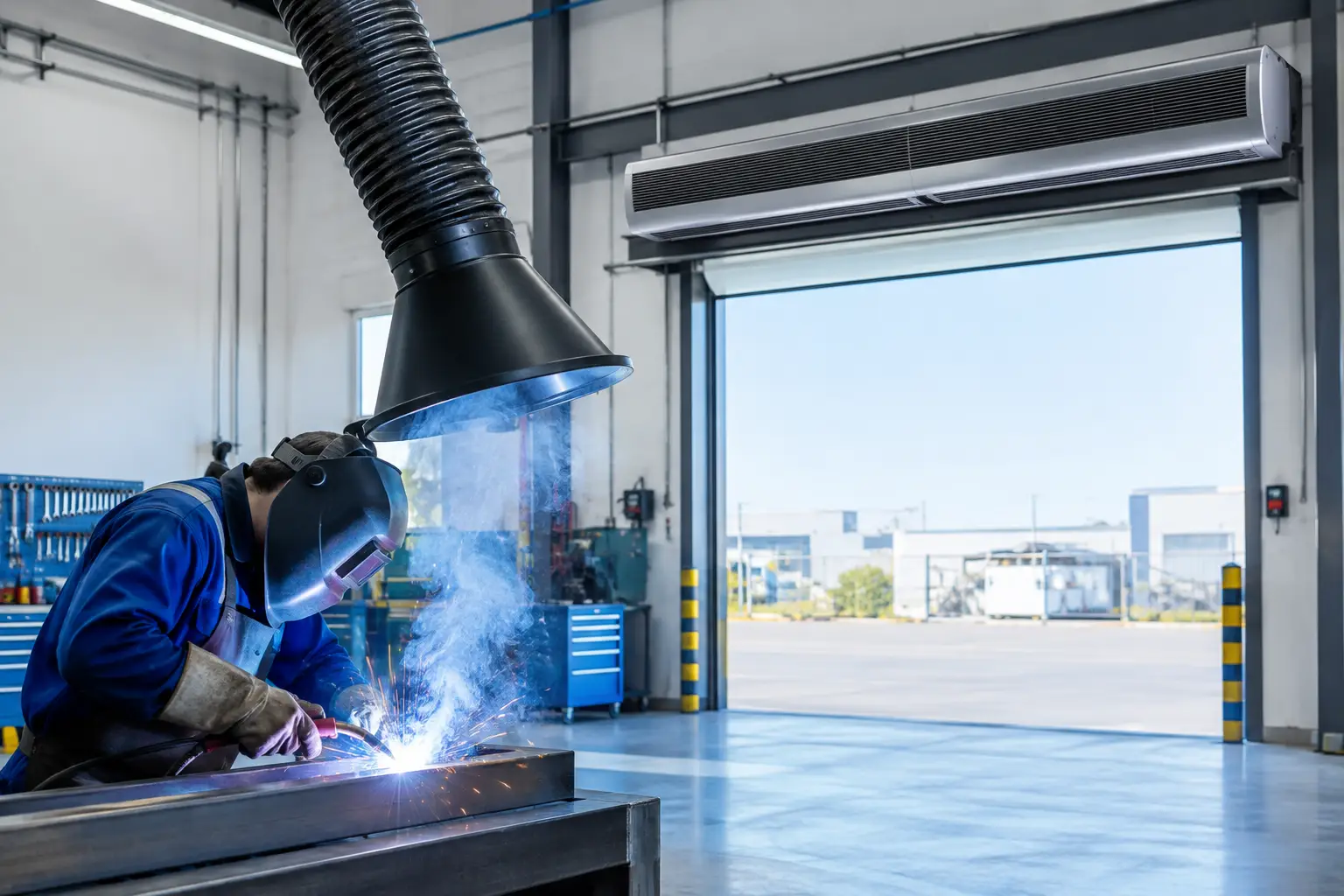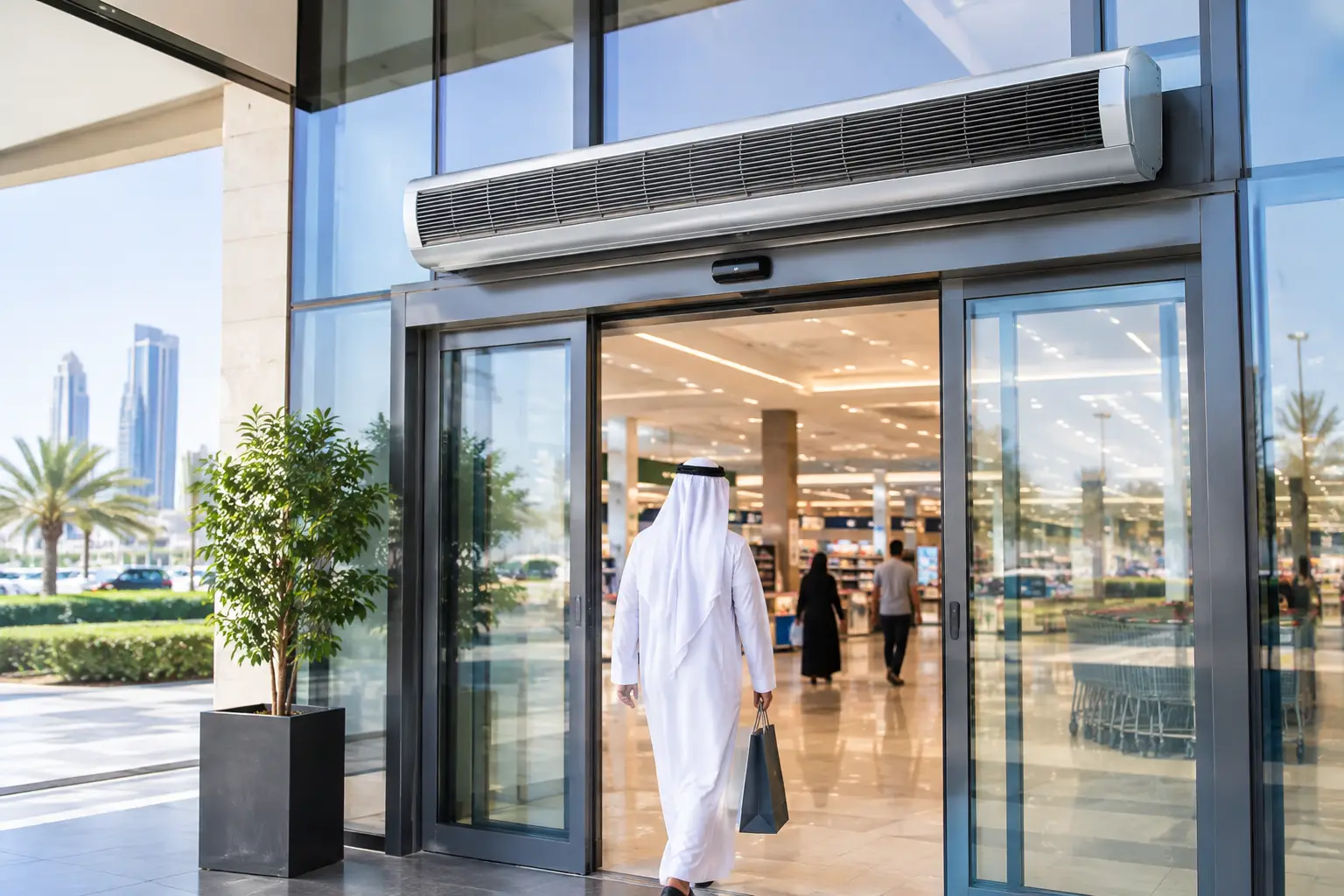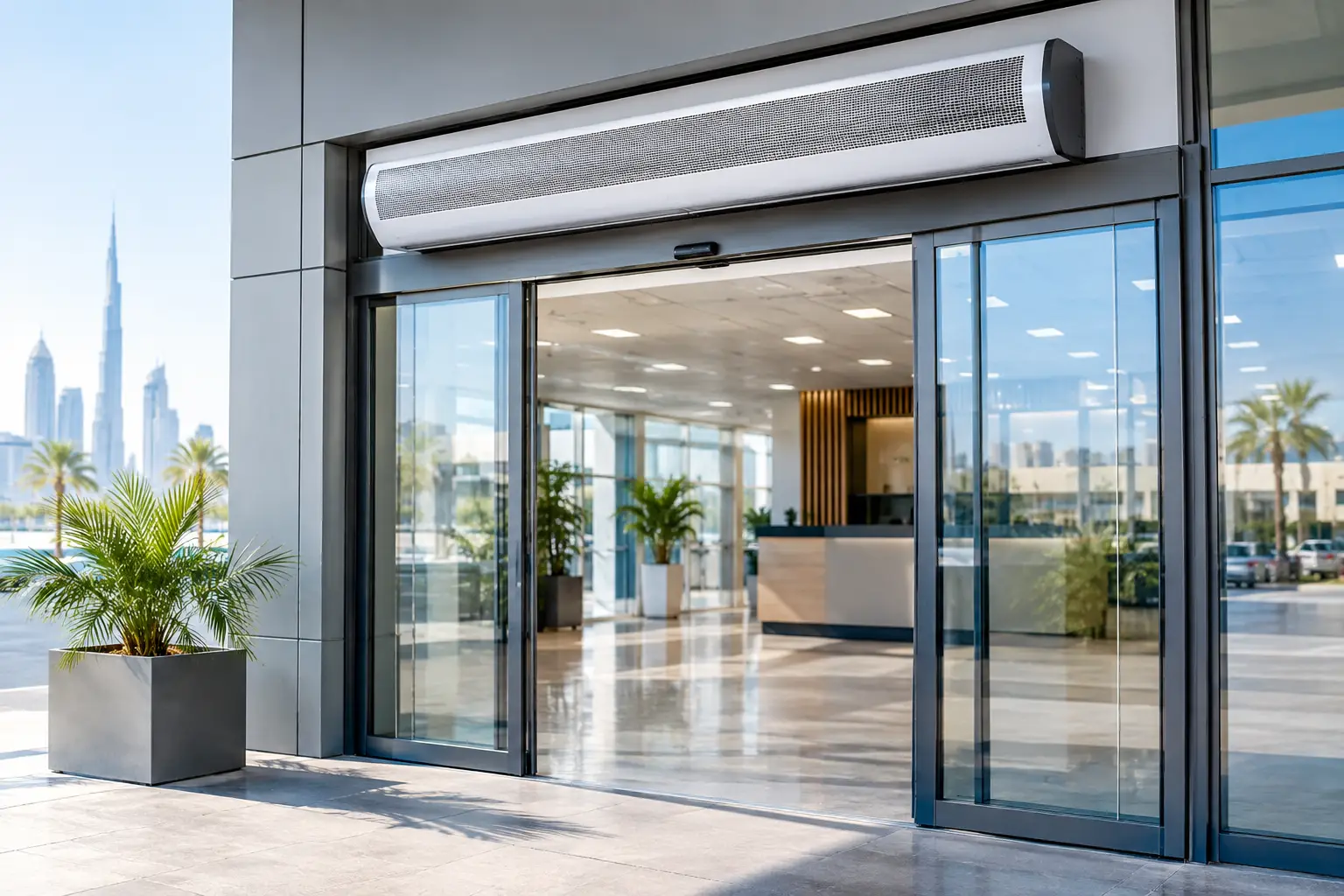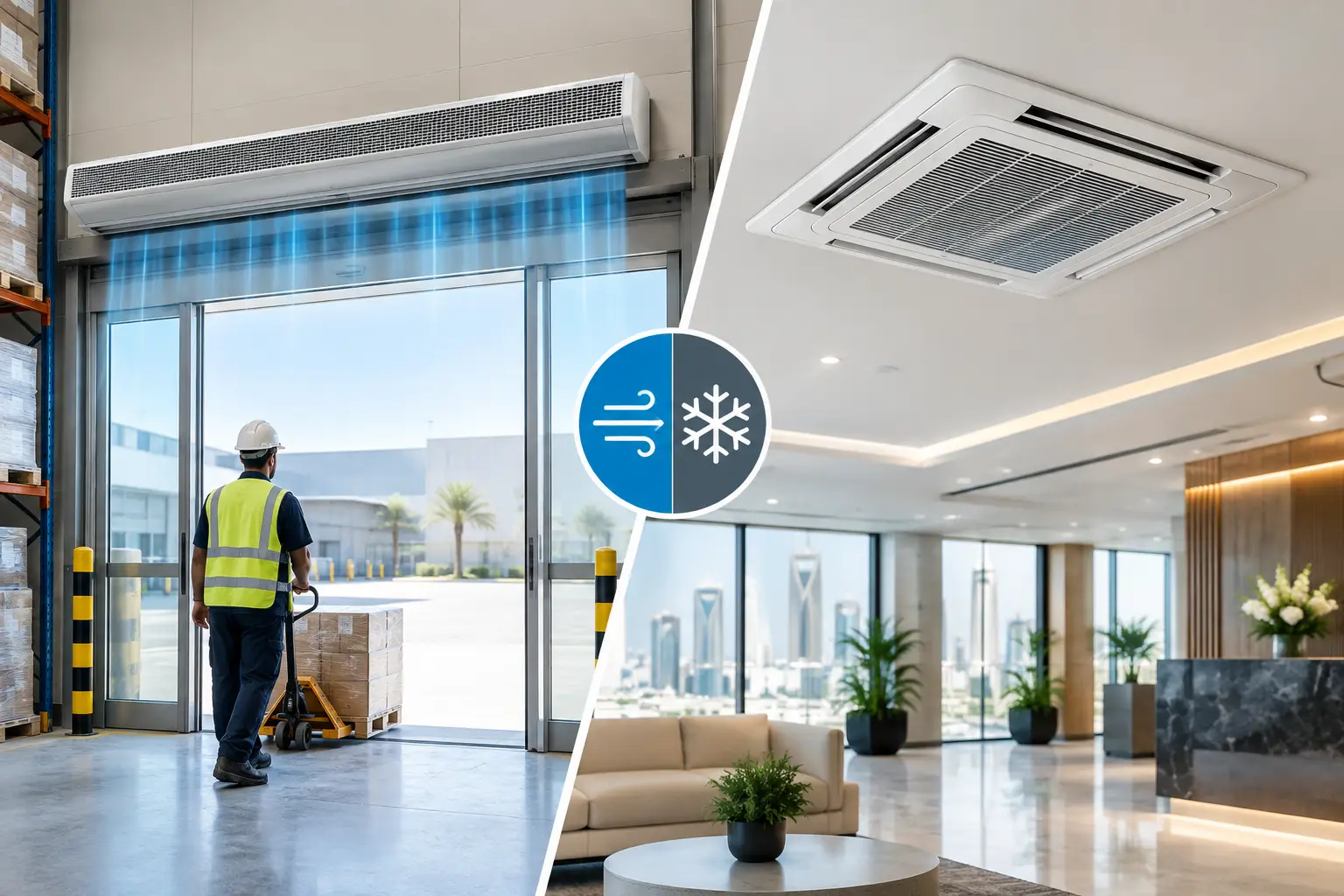
A warehouse loading door can remain open for hours during a busy shift. In Dubai, Riyadh, Doha, or Lagos, that opening is not simply a traffic route – it is a direct path for hot air, dust, humidity, insects, and outdoor contaminants to enter conditioned space. The top warehouse barriers are selected around this operational reality: they must protect the environment without slowing forklifts, pallet movement, or delivery schedules.
For most facilities, there is no single barrier that solves every problem. A physical door offers strong separation when it is closed, while a high-performance air curtain protects the opening while it is in use. The correct specification depends on door dimensions, traffic frequency, indoor temperature requirements, external conditions, and the level of contamination control required.
Top Warehouse Barriers and Where They Fit
Warehouse barriers generally fall into two groups: physical systems that close or divide a space, and active systems that create separation while access remains open. The distinction matters because a barrier that performs well during idle periods may become ineffective at a high-traffic loading bay.
Industrial air curtains
An industrial air curtain projects a controlled, high-velocity stream of air across an opening. Properly selected, it forms an air seal that limits the exchange of outside and inside air without blocking vehicles or personnel. This makes it particularly useful at dispatch doors, receiving bays, production-to-warehouse openings, and entrances where a roller shutter cannot stay closed.
For air-conditioned warehouses in hot, humid, or desert climates, the primary benefit is reduced cooling loss. Less hot air entering the building means the HVAC system has a smaller heat and moisture load to manage. Air curtains also help limit dust, flying insects, smoke, and light airborne debris at the threshold.
Performance depends on more than the unit’s stated airflow. Mounting height, discharge angle, fan pressure, door width, crosswinds, and negative pressure within the warehouse all affect whether the airstream reaches the floor and remains stable. A lightweight commercial model may suit a personnel entrance, but a tall, frequently open loading door often requires an industrial centrifugal unit designed for greater throw and demanding duty cycles.
High-speed and sectional doors
High-speed doors reduce the time an opening is exposed. They are useful where the door can close between movements, such as controlled production areas, cold storage transition points, or lower-frequency forklift routes. Sectional and roller shutter doors provide a more substantial physical seal during non-operating periods and support security requirements.
Their limitation is operational: a door cannot protect the opening while it is raised. At a busy loading dock, repeated opening cycles can still allow large volumes of hot, dusty outdoor air to enter. Pairing a door with an industrial air curtain is often more effective than relying on either measure alone. The door controls exposure when idle; the air curtain protects the active opening.
Strip curtains and flexible PVC barriers
PVC strip curtains are a familiar option for internal warehouse divisions, chilled areas, and lower-speed vehicle passages. They are economical, visible, and capable of reducing direct air movement between zones. In some applications, they are appropriate as a secondary thermal barrier behind a main door.
However, they introduce physical contact. Forklift operators must pass through the strips, which can slow movement, collect dust, reduce sight lines, and wear over time. They may also be unsuitable where hygiene, fast pedestrian movement, or a clear, unobstructed opening is required. At external doors exposed to strong heat, wind, and dust, strip curtains rarely provide the consistent air isolation achieved by a correctly engineered air curtain.
Dock seals and dock shelters
Dock seals and shelters close the gap between a loading dock and a vehicle body. They reduce weather ingress around the perimeter of the truck during loading and can improve comfort near the dock. They are valuable where vehicles have reasonably consistent dimensions and dock positions.
They do not, however, address the open path through the vehicle doorway or protect an internal opening after the vehicle departs. Their role is complementary. Facilities with refrigerated goods, conditioned picking areas, or strict dust-control targets may use dock equipment together with fast doors and air curtains to manage multiple leakage paths.
Choosing a Barrier by Operating Condition
The best decision starts with the opening, not the product category. A small, low-traffic staff door needs a different approach than a 5-meter loading bay with continuous forklift activity. Engineers and facility managers should assess the complete operating condition before specifying equipment.
Door height is especially critical for air curtain selection. As mounting height increases, the airstream needs enough velocity and pressure to reach the threshold without breaking apart. Wide openings may require multiple units arranged as a continuous run. Door geometry also matters: recessed headers, side obstructions, and roller-shutter housings can affect mounting location and discharge performance.
Traffic type changes the trade-off. A cleanroom-adjacent pharmaceutical warehouse may prioritize particulate control and pressure management. A food distribution center may focus on insects, hygiene, and temperature retention. A general logistics warehouse may place the greatest value on keeping dust and extreme outdoor heat out while maintaining uninterrupted forklift access.
External conditions cannot be treated as an afterthought. Facilities in the GCC and across MENA and Africa can face intense solar heat, desert dust, humid coastal air, and wind-driven infiltration. A barrier specified only for nominal door size may underperform when exposed to pressure differences and crosswinds. Industrial-grade centrifugal airflow is often preferable where conditions are severe or doors remain open for long periods.
When an Air Curtain Is the Practical First Barrier
An air curtain is usually the practical first barrier when the warehouse must keep an entrance open to operate efficiently. It is particularly suitable for loading bays with frequent dispatch activity, doors between air-conditioned and non-conditioned zones, and openings where physical curtains would interfere with traffic flow.
It is not a replacement for a closed door in every situation. Where a facility needs security, fire separation, or full isolation during downtime, a physical door remains necessary. Likewise, where a dock door opens directly into an uncontrolled outdoor area with extreme wind, the air curtain must be selected with sufficient throw and installation conditions must be reviewed carefully.
The most effective setup is often layered. A shutter door closes when the bay is inactive; dock equipment controls the vehicle interface; and an air curtain operates during active loading. This approach reduces energy waste without asking operations teams to change the way they move goods.
Specification Details That Affect Real Performance
Air volume alone does not define a warehouse air curtain. The unit must deliver an even, stable discharge across the full opening. Centrifugal blower designs are commonly favored for industrial applications because they can develop the pressure needed for taller mounting positions and more challenging airflow conditions.
Control integration also deserves attention. Door-contact activation can run the air curtain only when the opening is in use, while manual or building-management controls may suit facilities with fixed operating schedules. The objective is to match runtime to traffic, not to operate equipment unnecessarily.
Maintenance access is another specification point. Warehouse air carries dust, fibers, and particulates that can accumulate around intake areas. Units should be positioned for professional inspection and cleaning without disrupting loading operations. Noise expectations should also be discussed, particularly where offices, packing stations, or customer collection counters sit near the entrance.
For a new project or retrofit, provide the opening width and height, mounting position, door type, average open time, traffic pattern, indoor setpoint, and local site conditions. This information allows a supplier to recommend the appropriate airflow class rather than selecting by appearance or nominal width alone.
Build Protection Around the Way the Warehouse Works
A warehouse barrier should support throughput, not become another obstacle for drivers and dock teams. Physical doors, dock seals, and strip systems all have a place, but an industrial air curtain is often the missing layer at openings that must remain available throughout the day.
FreezeeX helps contractors, consultants, and facility teams evaluate entrance dimensions, traffic volume, and climate exposure to specify an air curtain suited to demanding tropical and desert conditions. Request a project consultation and quotation based on the actual door, operating schedule, and environmental control target – because the right barrier is the one that protects conditioned space while keeping the warehouse moving.