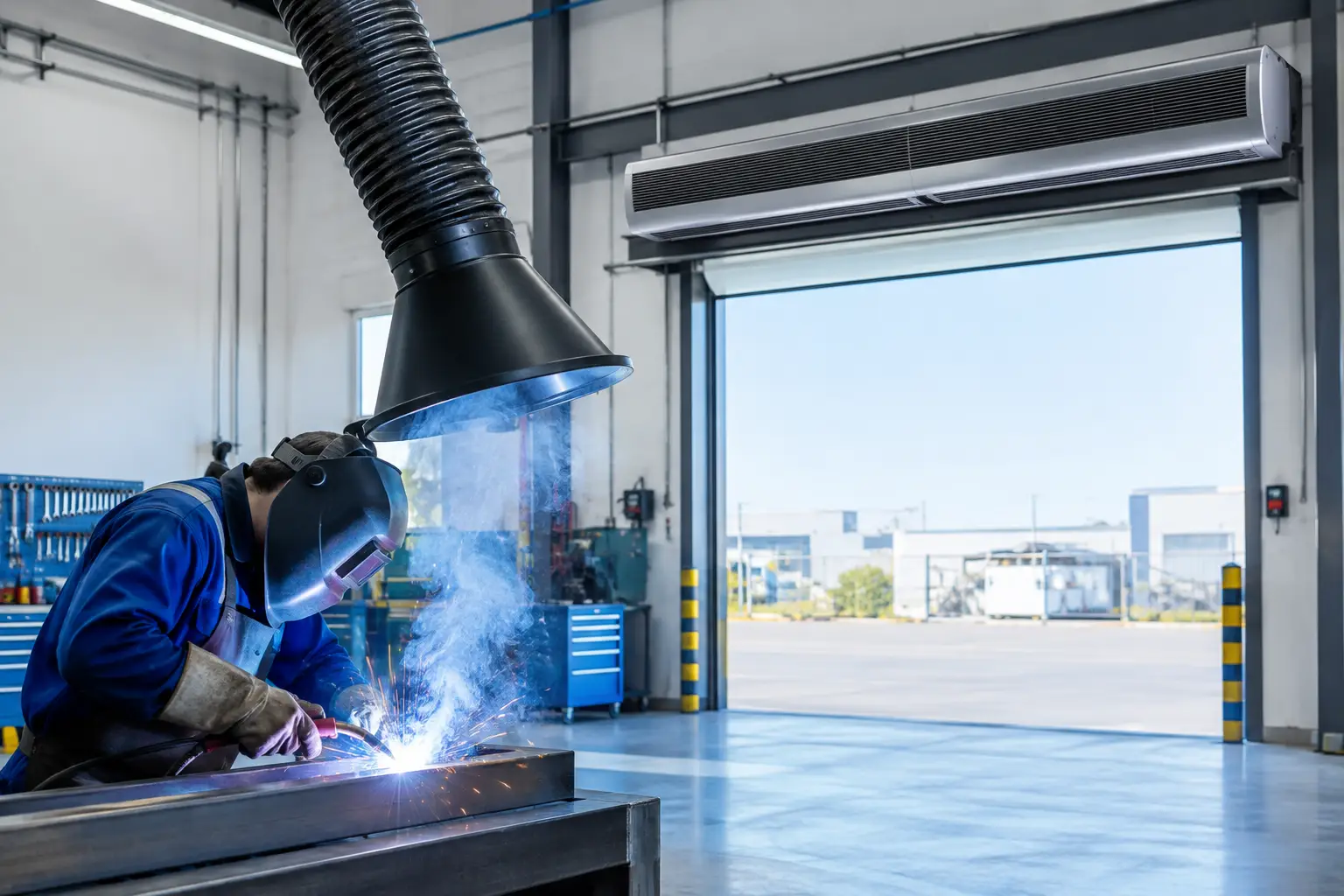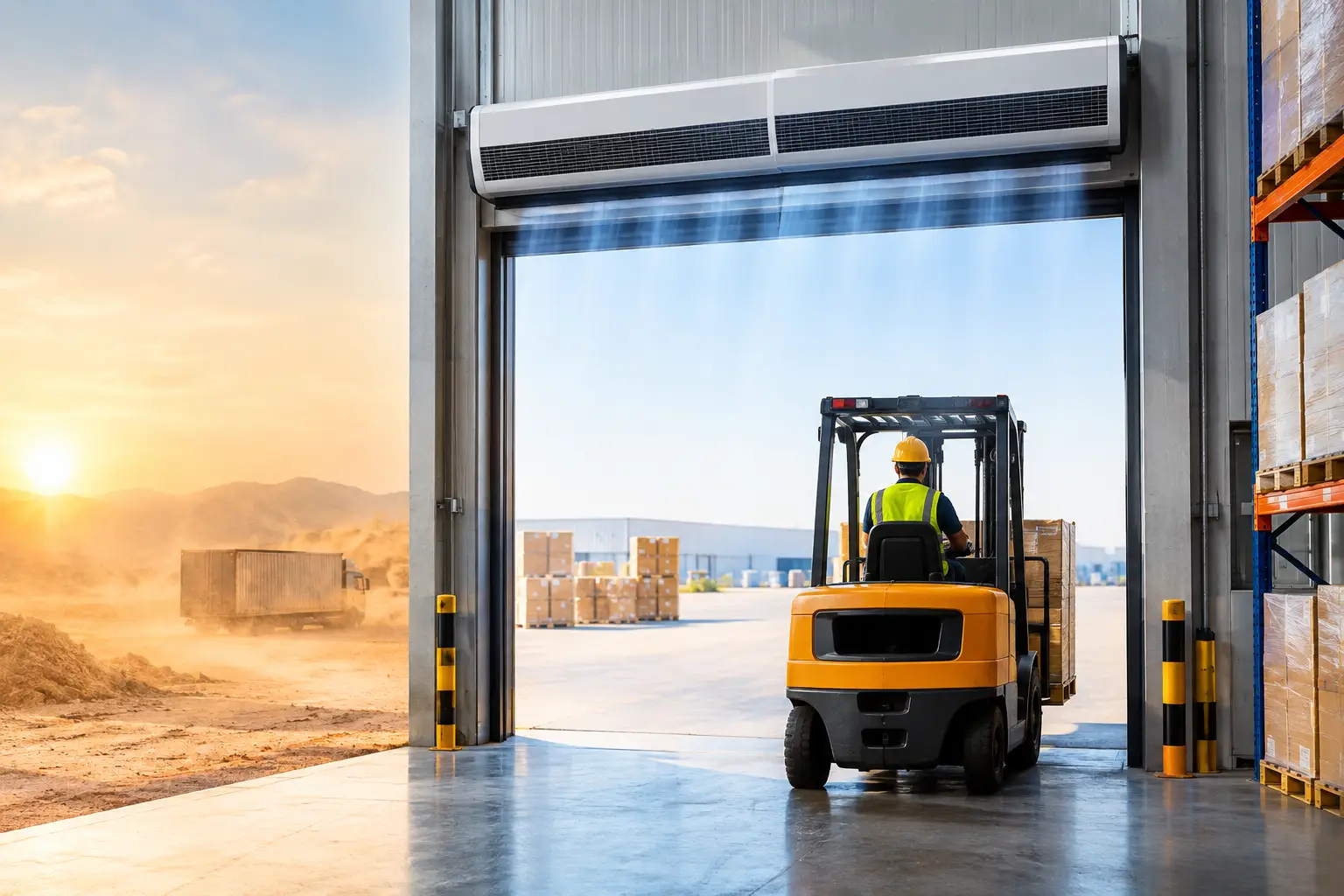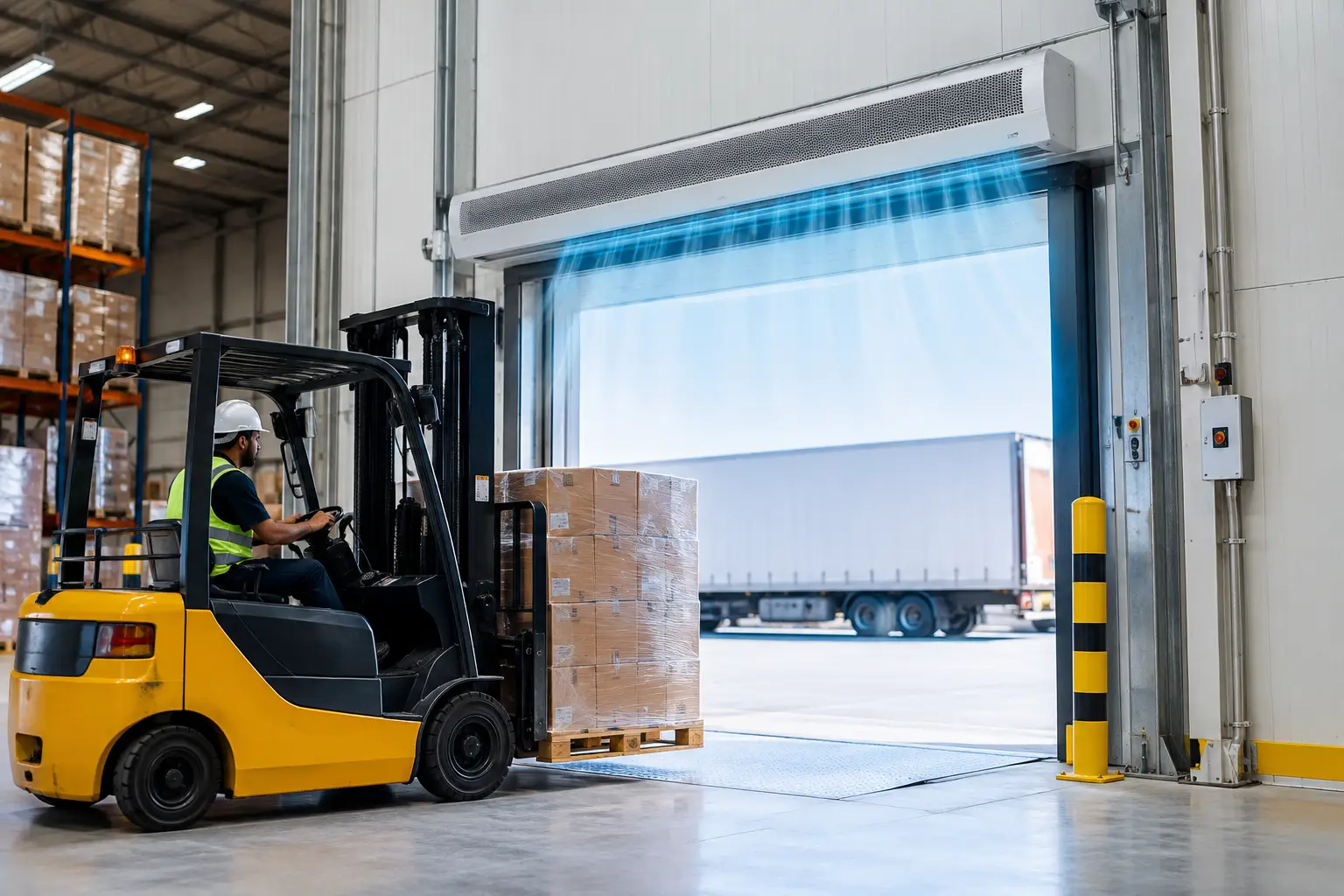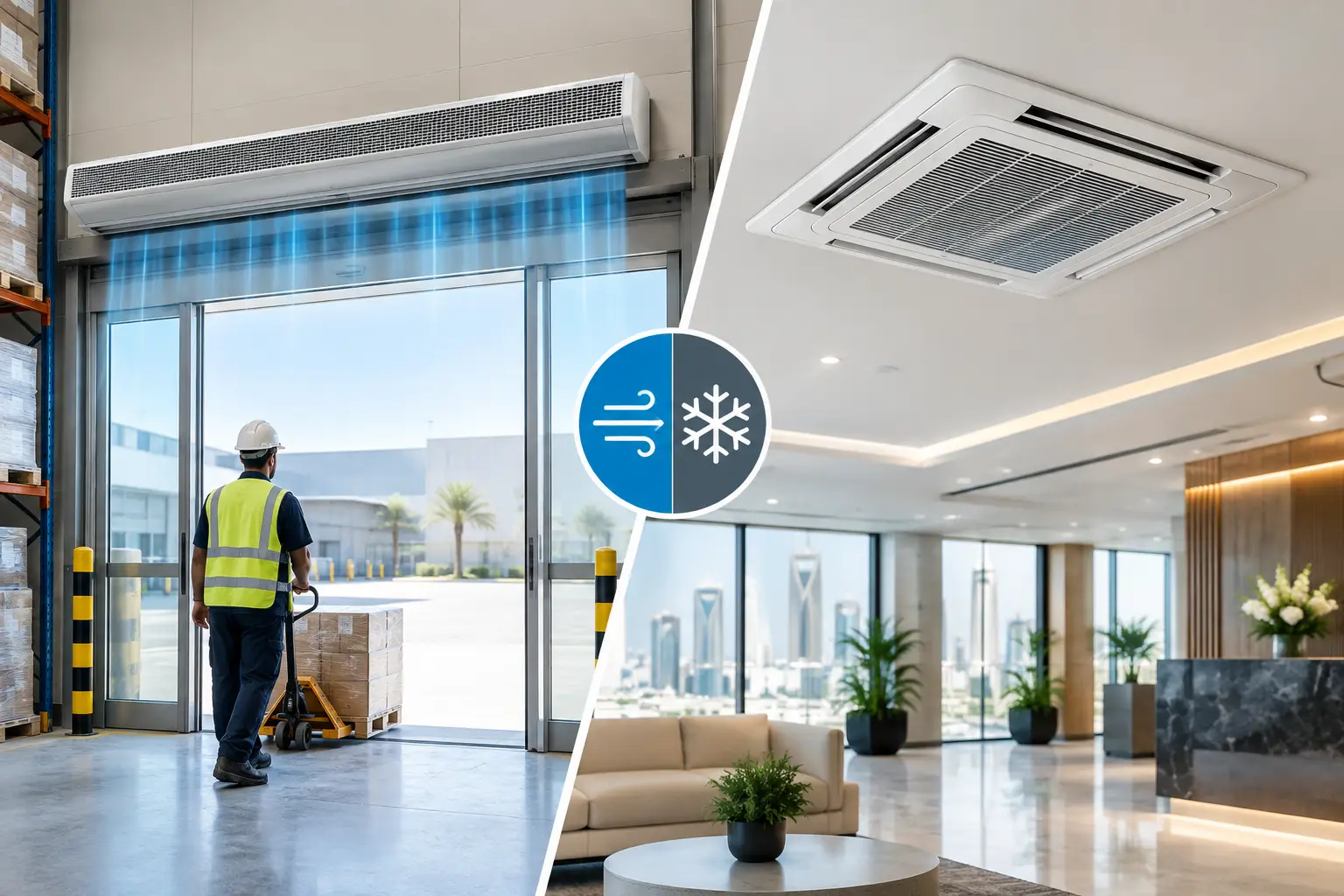
A loading door left open for forklift traffic can become one of the largest uncontrolled heat-gain paths in a conditioned warehouse. This warehouse cooling savings example uses a realistic operating scenario to show how an industrial air curtain can reduce infiltration-related HVAC demand at a busy door in a hot, dusty climate.
The aim is not to promise a fixed percentage for every facility. Actual savings depend on door size, opening hours, indoor temperature setpoint, outdoor conditions, air-conditioning capacity, building pressure, and traffic patterns. However, a transparent calculation gives facility managers, MEP consultants, and warehouse operators a practical basis for evaluating an air curtain specification.
Warehouse cooling savings example: a busy loading door
Consider a distribution warehouse in Dubai with one frequently used loading entrance. The warehouse is air-conditioned to maintain a 75°F indoor environment for staff, stored goods, and scanning operations. Outside summer conditions are assumed at 104°F, with high moisture content and airborne dust.
The loading door is 13 feet wide by 16 feet high, giving an opening area of 208 square feet. It is open for forklift movements for an estimated six hours each working day, five days per week. Even when the door is not fully open, repeated opening cycles create substantial exchange between hot outdoor air and cooled indoor air.
For an illustrative baseline, assume the open doorway creates an average infiltration-related cooling load of 70,000 Btu/h while traffic is active. This figure includes sensible heat from the temperature difference and latent load from humidity. In a desert or tropical market, latent heat and dust ingress can be operational concerns even where humidity levels vary by season and location.
At six open hours per day, the daily infiltration load is:
70,000 Btu/h x 6 hours = 420,000 Btu per day
Over 260 operating days per year, that becomes:
420,000 Btu x 260 days = 109,200,000 Btu per year
That is heat the HVAC system must remove simply because the loading entrance is open.
Applying an industrial air curtain to the calculation
A properly selected industrial air curtain creates a high-velocity air stream across the full opening. The stream acts as an air barrier, limiting the exchange of cooled indoor air and hot outdoor air while preserving access for forklifts and personnel. It does not make the doorway airtight, and it cannot compensate for an incorrectly sized HVAC system. Its value is in reducing infiltration during normal door-open operation.
For this example, assume the air curtain reduces the infiltration-related load by 45%. This is a reasonable planning assumption for a correctly engineered installation, but project results can be higher or lower. Mounting height, discharge velocity, crosswinds, door geometry, and whether the unit reaches the floor all affect performance.
The avoided cooling load is therefore:
109,200,000 Btu per year x 45% = 49,140,000 Btu per year
To convert thermal load into electrical consumption, assume the warehouse cooling system operates at an average seasonal efficiency equivalent to an EER of 10. In simple terms, the system uses approximately one kWh of electricity for every 10,000 Btu of cooling delivered.
49,140,000 Btu / 10,000 = 4,914 kWh saved annually
If the facility pays $0.12 per kWh, the annual electricity saving is:
4,914 kWh x $0.12 = $590 per year
That figure may appear modest, but it represents only one entrance under a conservative operating profile. Warehouses often have multiple loading doors, longer opening periods, higher cooling loads, or electricity tariffs that materially increase the value of reduced infiltration. In Gulf markets, facilities that operate long shifts through peak summer conditions may see a stronger case than this simplified example suggests.
The calculation should also include the power consumed by the air curtain itself. If the selected unit uses 2 kW and operates six hours a day for 260 days, its annual consumption is 3,120 kWh. At $0.12 per kWh, that is about $374 per year. The direct net energy saving in this scenario is therefore approximately $216 annually.
That is why a credible financial assessment should never rely only on gross cooling savings. Air curtain fan energy, duty cycle, and control strategy must be included.
Why direct electricity savings are only part of the return
For a high-traffic warehouse, the business case can extend beyond the utility calculation. A loading door is also a path for dust, humidity, insects, vehicle fumes, and unconditioned air. These conditions can affect worker comfort, product handling, housekeeping requirements, and the ability of HVAC equipment to maintain stable conditions near the entrance.
Reducing the influx of hot air can lessen temperature swings in adjacent staging zones. This matters for facilities handling food, pharmaceuticals, packaging materials, electronics, or products sensitive to moisture and contamination. It can also reduce the tendency for conditioned air to spill out through the doorway, particularly where indoor air is slightly pressurized.
In practice, facility managers may value these operational outcomes as highly as the direct energy figure. A warehouse that is cleaner and more comfortable at the loading zone can support better day-to-day performance, even when energy tariffs alone produce a longer payback period.
Variables that can change a warehouse cooling savings example
The 45% reduction used above is not a universal design value. A 10-foot-high personnel entrance and a 20-foot-high truck door require very different airflow performance. Industrial doors also face conditions that are rarely uniform: side winds from yard traffic, negative building pressure caused by extraction systems, and door opening cycles that range from seconds to hours.
Door height is particularly important. As mounting height increases, the air stream must retain enough velocity and coverage to reach the floor. A unit selected only by door width may look adequate on paper but fail to create effective separation at floor level, where forklift movement and pressure differences are greatest.
Climate also changes the load. In Riyadh, Abu Dhabi, Doha, Muscat, Cairo, Lagos, and Nairobi, the balance between extreme dry heat, humidity, dust, and rainfall differs. The entrance solution should be selected for local ambient conditions rather than based on a generic cooling-load assumption.
Building pressure is another decisive factor. If the warehouse is strongly negative relative to outdoors, hot air will be pulled inward through every opening. An air curtain can still help, but the specification should be coordinated with the HVAC and ventilation design. Addressing the underlying pressure imbalance may improve results more than increasing air curtain velocity alone.
Selecting the right system for an industrial opening
An industrial loading door normally requires a unit designed for high mounting heights, large openings, and sustained operating periods. Centrifugal blower designs are commonly suited to these conditions because they can provide the pressure and throw needed to resist infiltration across a larger doorway. The final selection should be based on the clear opening dimensions, mounting arrangement, traffic frequency, external wind exposure, indoor cooling conditions, and required operating controls.
For example, an air curtain that runs continuously during a full shift may need a different motor, control arrangement, and maintenance plan than a unit interlocked with a high-speed door. Door contacts, occupancy schedules, and building management controls can reduce unnecessary run time while ensuring the air barrier is active when the opening is in use.
Noise also deserves consideration. In a warehouse, acceptable sound levels are usually different from those in a hotel lobby or retail entrance, but units positioned near office areas, packing stations, or quality-control zones should be evaluated for acoustic impact. Equipment selection is always a balance between airflow performance, operating energy, noise, and installation constraints.
Use the calculation as a specification tool
A warehouse cooling savings example is most useful when it becomes part of a site-specific evaluation rather than a generic sales estimate. Start with actual door dimensions and opening hours. Then review local outdoor design conditions, current indoor temperatures, HVAC operating costs, and the operational effects of dust and humidity at the entrance.
For warehouses, logistics centers, and industrial facilities operating in hot desert and tropical climates, an air curtain should be specified as an entrance climate-control component, not as an afterthought. FreezeeX can review the opening, traffic profile, and environmental conditions to recommend an appropriate industrial air curtain and provide a project quotation based on realistic performance assumptions.