When a hypermarket entrance in Dubai stays open all day, or a cold room loading bay in Lagos cycles traffic every few minutes, the wrong air curtain becomes expensive fast. A serious commercial air curtain buying guide starts with one fact: performance at the doorway matters more than the label on the housing. If the unit cannot hold an effective air barrier against heat, dust, humidity, and insects in real operating conditions, it will not protect your cooling investment.
For commercial and industrial buyers, that changes how selection should be handled. Air curtains are not commodity boxes. They are entrance-control equipment, and in tropical and desert climates the operating environment is far less forgiving. High ambient temperatures, wind pressure, frequent door openings, and heavy foot or trolley traffic all raise the performance requirement. That is why specification should be based on application, opening size, and environmental load rather than price alone.
What a commercial air curtain buying guide should actually help you decide
The real buying decision is not simply wall-mounted versus recessed, or standard versus premium. The decision is whether the unit can maintain strong air isolation without creating noise, energy waste, or maintenance headaches.
In retail, hospitality, healthcare-adjacent commercial spaces, workshops, and cold storage facilities, the air curtain has to protect conditioned air while keeping the entrance usable. That means balancing throw, velocity, mounting position, and duty cycle. A unit that looks powerful on paper may still underperform if the door height is too great, side winds are present, or the blower type is not suited to the site.
For facility managers and consultants, the key question is simple: what is the actual entrance problem being solved? Heat gain, dust infiltration, flying insects, humidity migration, or temperature separation between zones can all require different performance priorities.
Start with the opening, not the product range
The first filter is the door itself. Width and height determine far more than many buyers expect. An air curtain that works well on a standard commercial entrance may fail at a taller warehouse opening or a busy service corridor with strong pressure differences.
Door height is especially critical because the airstream has to reach the floor or target zone with enough residual force to create a stable barrier. As mounting height increases, required airflow performance rises. In hot-weather markets such as Riyadh, Cairo, or Nairobi, incoming hot air and dust can quickly overwhelm undersized units.
Door width matters too, but width is usually easier to solve by selecting the correct unit length or combining multiple units across the span. Height is less forgiving. If the opening is tall, buyers should not force-fit a light commercial model into an industrial role.
Ask how the entrance is actually used
A front entrance to a hotel has a different operating profile from a back-of-house loading point. One may prioritize appearance, noise control, and customer comfort. The other may need stronger airflow, longer running hours, and better resistance to dust and harsh site conditions.
Traffic pattern matters as much as dimensions. A doorway that stays open continuously needs a different specification approach than one that opens in short cycles. If forklifts, carts, or pallet movement are involved, the air barrier must stay effective without obstructing operations.
Airflow type is not a minor detail
One of the most common specification mistakes is ignoring blower design. In commercial and industrial air curtain selection, airflow architecture directly affects throw distance, stability, and suitability for the environment.
Centrifugal flow units are often preferred for stronger, more stable air delivery, especially where entrance conditions are demanding. They are well suited to commercial facilities with high usage and to industrial sites where a simple decorative solution will not hold up. For buyers dealing with dust-heavy or heat-loaded entrances, this is usually where technical discussions should begin.
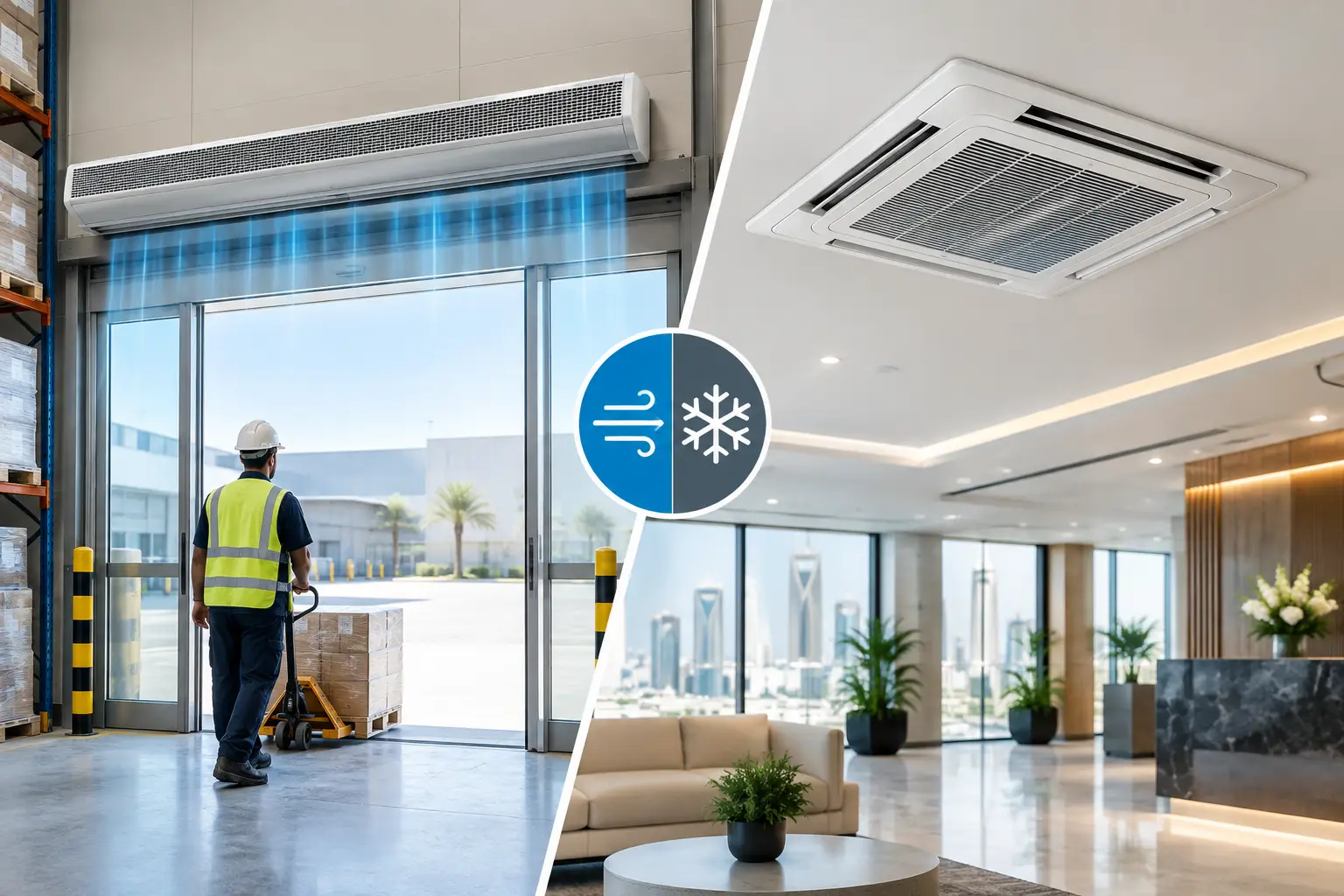
More compact or design-sensitive applications may call for recessed ceiling models, especially in premium retail, hospitality, or office spaces where visual integration matters. That said, concealed installation should never come at the expense of performance. If ceiling recess conditions reduce intake or service access, the clean finish may create future maintenance problems.
Velocity at the outlet is only part of the picture
High outlet velocity sounds impressive, but it is not enough on its own. The useful question is whether the airstream remains consistent from the unit to the floor line. Air distribution, fan quality, motor reliability, and installation height all shape the final barrier.
This is where many quote comparisons become misleading. Two units can show similar headline numbers and still behave very differently on site. Buyers should ask for application-based sizing, not just catalog matching.
Climate conditions should shape the specification
In the GCC, MENA, and many African markets, climate is not background information. It is the main reason air curtains are specified in the first place.
Desert heat increases cooling loss the moment an entrance opens. Coastal humidity adds another layer of load, especially for supermarkets, food service environments, and facilities trying to maintain stable indoor comfort. Dust and insect pressure can also be severe, particularly at high-traffic entrances or industrial sites with frequent external access.
A commercial air curtain buying guide for these regions must account for extreme ambient conditions, not mild-weather assumptions. Materials, motors, control setup, and airflow capacity should be selected for sustained operation in harsh environments. A unit that performs acceptably in a moderate climate may not maintain barrier quality in Doha, Muscat, or Casablanca during peak heat periods.
Match the unit to the application category
Commercial entrances usually fall into a few clear categories, and the right product family depends on which one you are dealing with.
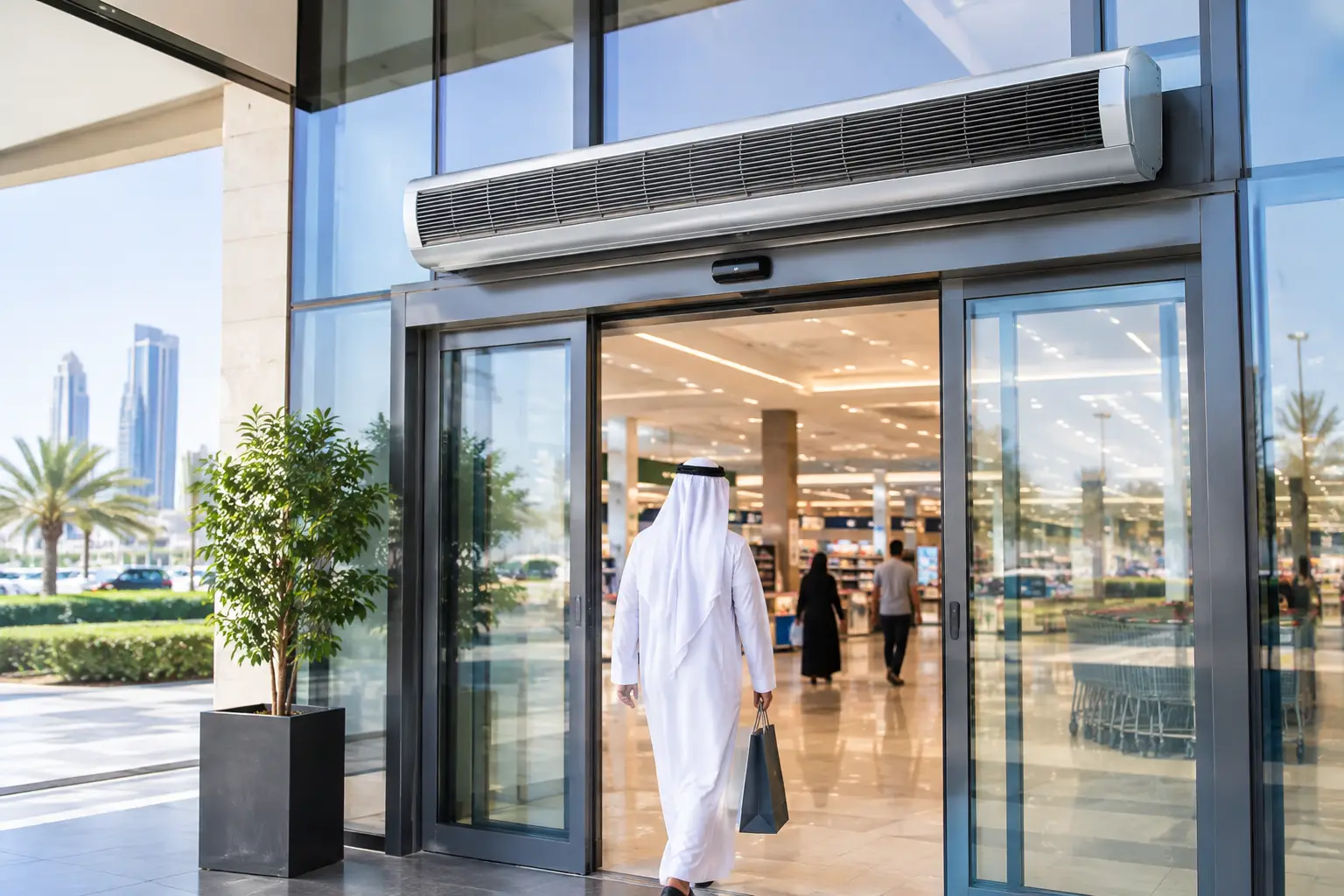
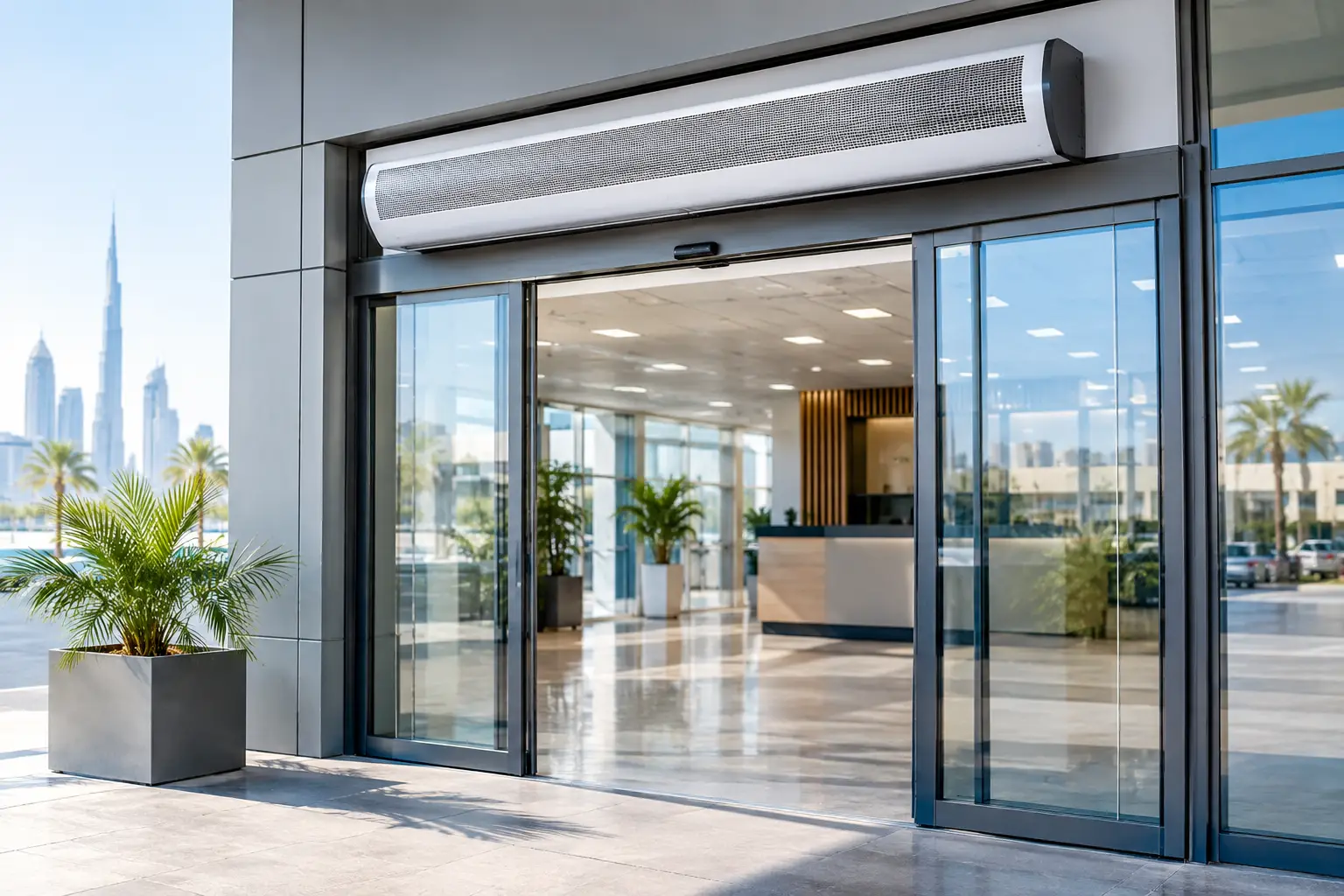
For customer-facing spaces such as retail stores, hotels, showrooms, and commercial offices, appearance, noise, and steady climate separation all matter. These projects often benefit from refined commercial systems or recessed models where architectural integration is important.
For supermarkets, food distribution points, cold rooms, and service entries, the requirement becomes more performance-driven. Stronger centrifugal units are often the better fit because they handle frequent traffic and greater temperature separation more effectively.
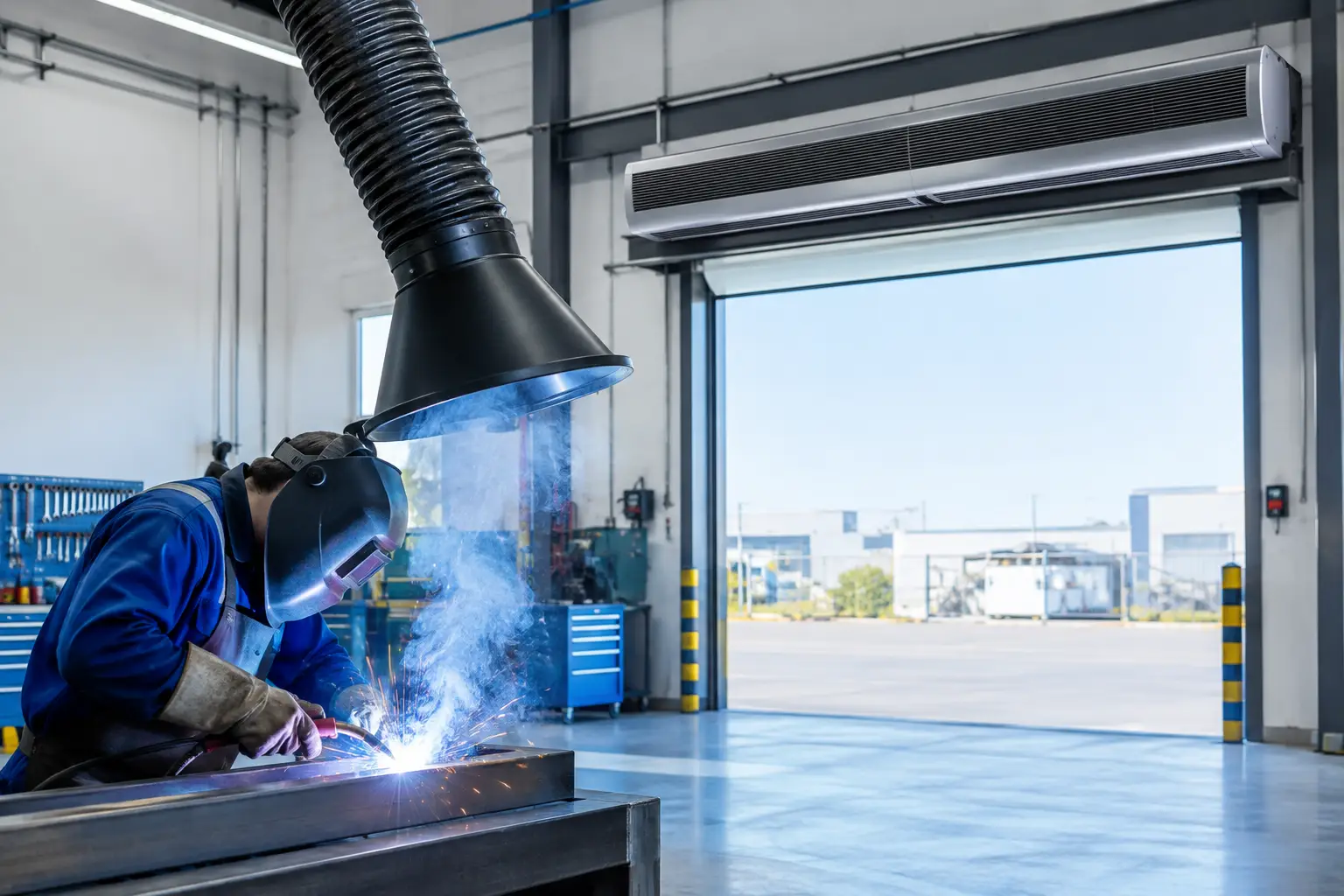
For workshops, plants, logistics facilities, and other heavy-duty openings, industrial-grade equipment is the safer specification. These sites place more strain on motors, housings, and airflow performance. Choosing a lighter commercial model to save on initial cost usually leads to weaker barrier performance and shorter service life.
Noise, controls, and maintenance all affect long-term value
A powerful unit that creates constant complaints at the entrance is not a successful installation. Noise level matters, especially in hospitality, office, retail, and healthcare-adjacent commercial environments. The right answer is not always the quietest model. It is the quietest model that still does the job.
Control strategy also deserves attention. Some facilities need simple on-off operation tied to door activity. Others benefit from speed settings, coordinated controls, or integration with entrance operation. If traffic patterns vary throughout the day, control flexibility can improve energy performance without sacrificing protection.
Maintenance access is another practical factor buyers often address too late. Filter nets, motor access, cleaning requirements, and service clearance should be reviewed before approval. A well-specified unit should support straightforward maintenance, particularly in dusty markets where neglected buildup can reduce effectiveness over time.
Price matters, but operating cost matters more
Procurement teams naturally compare initial equipment pricing, but air curtains should be evaluated as part of building operating performance. If the unit reduces cooling loss, limits dust entry, improves comfort near entrances, and lowers HVAC strain, the value sits in operational savings as much as in equipment cost.
The opposite is also true. An undersized or poorly matched unit can create the appearance of savings while allowing continuous conditioned air loss. In hot-climate facilities, that penalty shows up quickly in energy use and indoor comfort complaints.
This is why consultation-based selection is the smarter route for most B2B projects. Correct sizing, application fit, and environmental assessment usually prevent expensive revisions later.
Questions to ask before requesting a quote
Before moving to specification, buyers should be clear on the opening dimensions, mounting position, traffic type, and whether the main issue is heat, dust, humidity, insects, or zone separation. They should also identify whether the site prioritizes aesthetics, heavy-duty performance, low noise, or all-day operation.
It also helps to define the facility type clearly. A hotel lobby, hypermarket entrance, cold storage access point, and industrial workshop should not be quoted as if they have the same performance demand. The more exact the operating conditions, the better the equipment match.
For projects in high-temperature and high-humidity regions, climate-adapted selection is not optional. It is the basis of whether the installation delivers measurable results.
FreezeeX supports contractors, consultants, procurement teams, and facility operators with specification-ready recommendations built for tropical and desert environments. If you are planning a new project or replacing an underperforming unit, request a consultation or quote based on your actual doorway conditions, traffic load, and climate exposure. The right air curtain should protect the entrance every day, not just look correct on a datasheet.