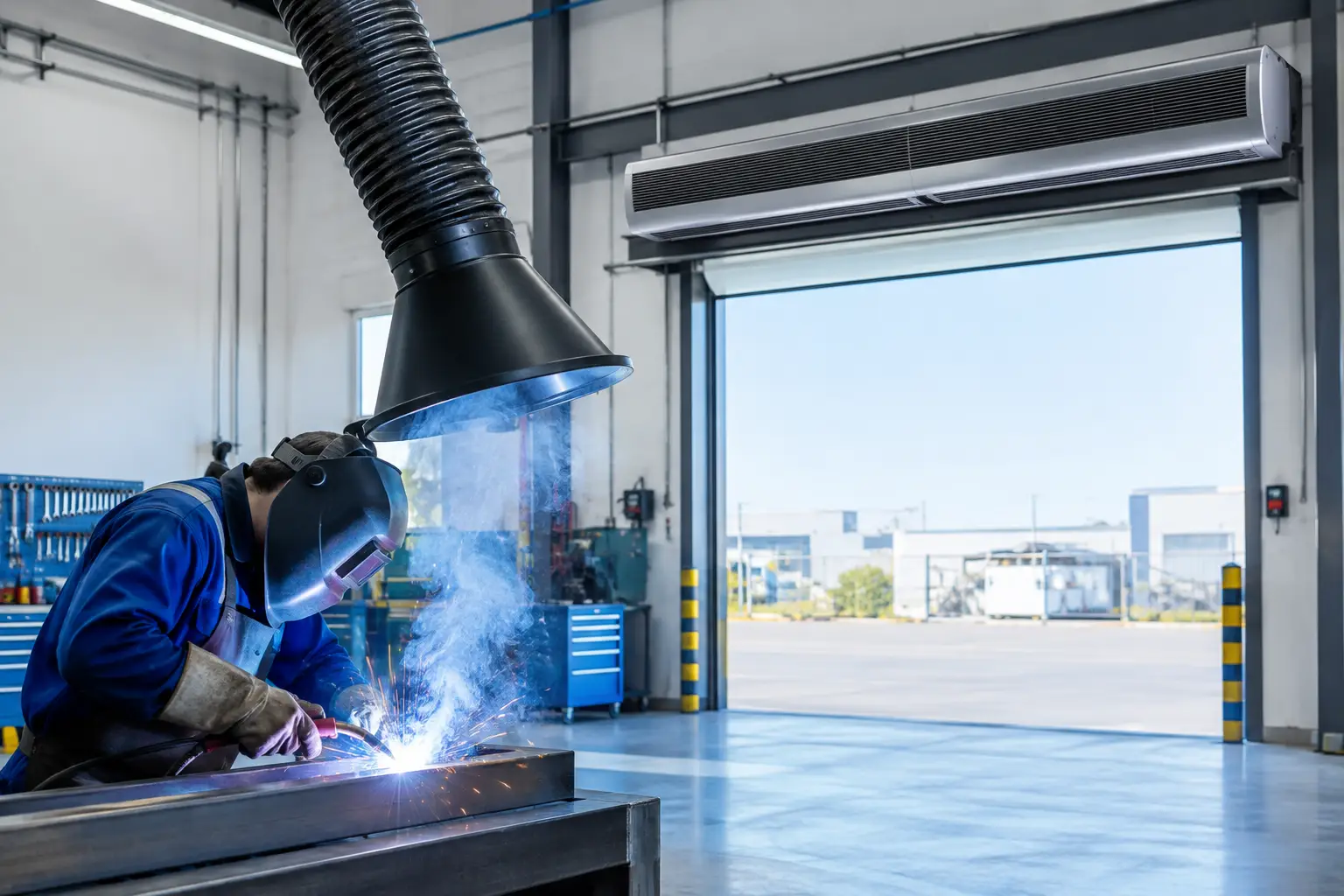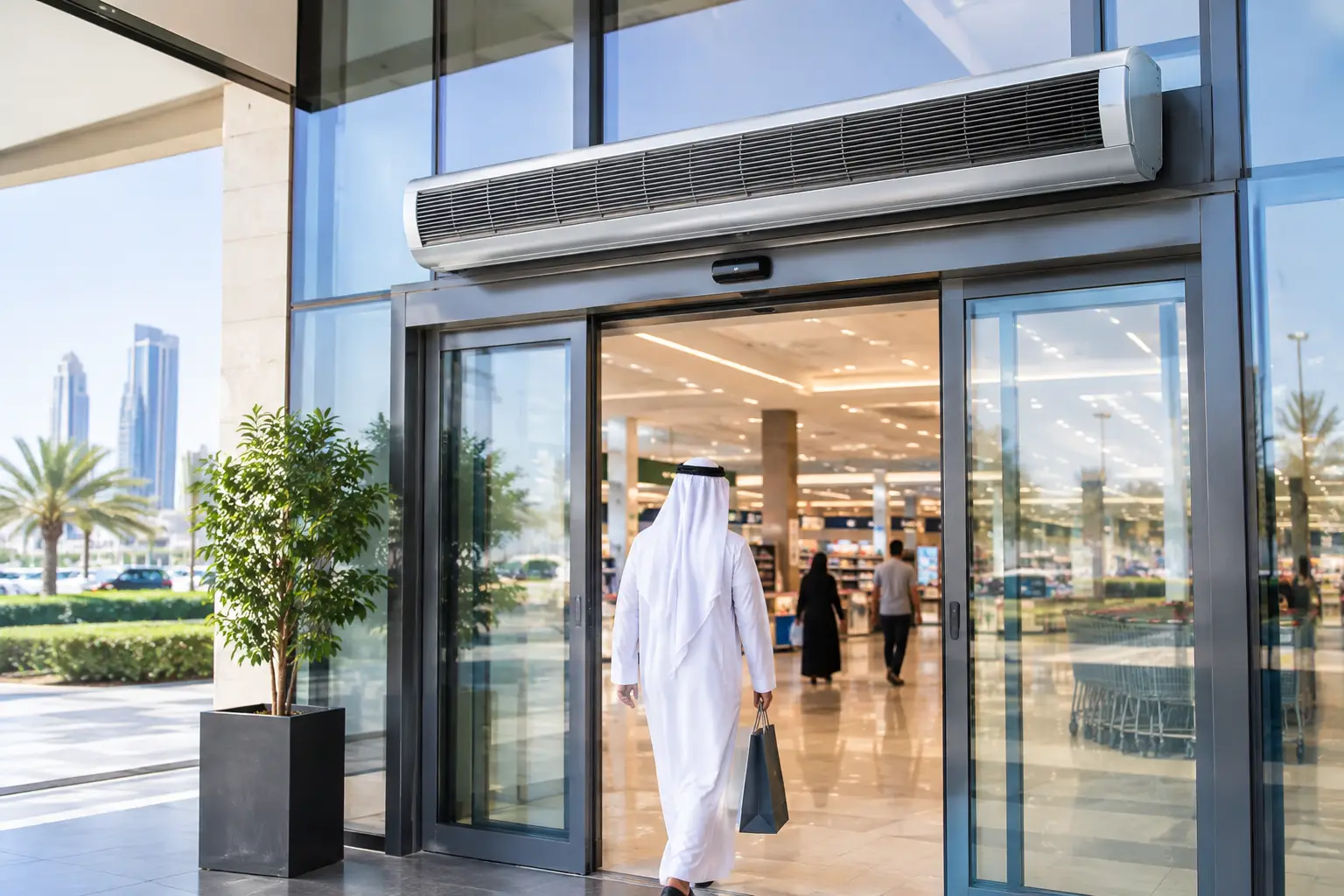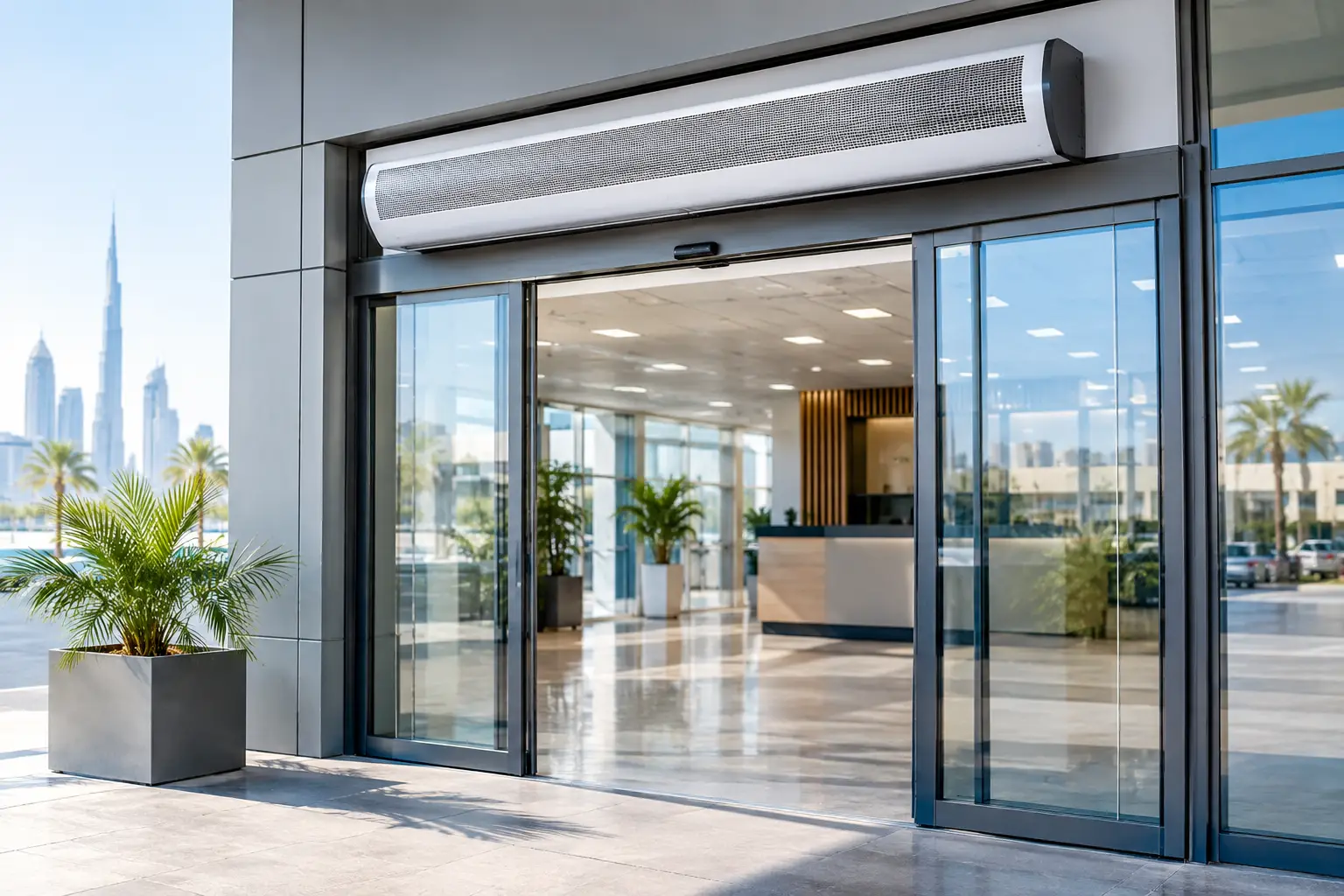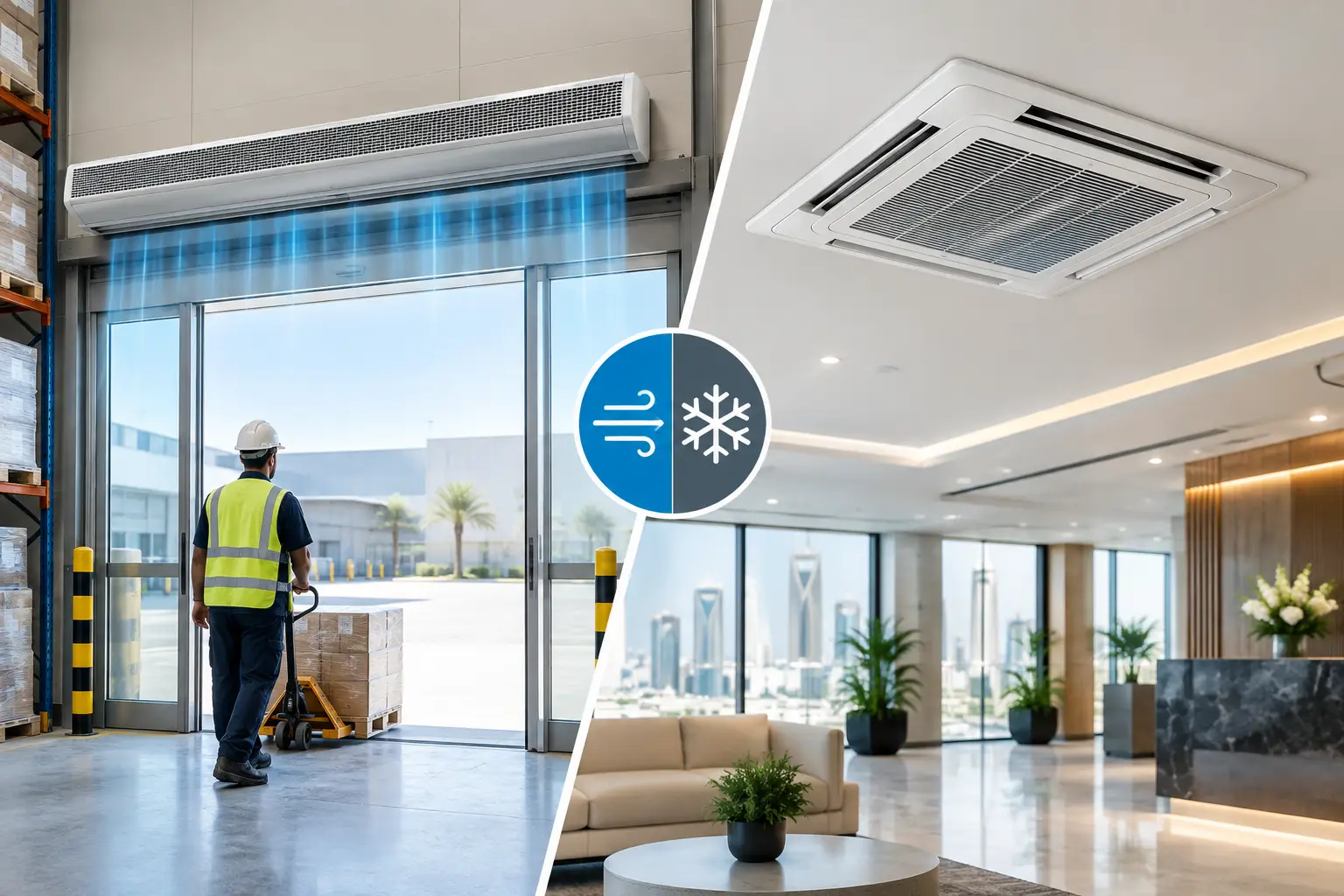
A loading-bay door can turn a well-managed warehouse into a dust pathway in minutes. This warehouse dust control case study examines a common industrial scenario: a temperature-controlled distribution warehouse in a hot, dusty climate where frequent vehicle and pedestrian traffic was bringing airborne dust into the building.
The facility did not have a housekeeping failure. Its problem was at the boundary between outdoors and indoors. Every open door allowed windborne particles, hot air, and humidity to enter the loading area, increasing cleaning demand and placing added load on the cooling system.
The warehouse dust control case study: the operating problem
The warehouse operated with a high-volume dispatch schedule. A large loading entrance was open repeatedly throughout the day for pallet movement, deliveries, and forklift access. Outside conditions included dry airborne dust, vehicle movement near the dock, and high ambient temperatures.
Inside, the consequences were visible. Fine dust settled on racking, product packaging, floor markings, and equipment surfaces near the entrance. The issue became more pronounced during busy periods and when wind direction pushed outdoor air toward the opening. Workers also reported a noticeable temperature change at the dock, even though the main cooling system was operating as intended.
This distinction matters. The HVAC system was designed to condition the enclosed warehouse, not continuously overcome unrestricted infiltration through an open industrial doorway. Increasing cooling capacity alone would not stop dust from entering. The site needed to control the opening itself.
Why the existing controls were not enough
The warehouse already relied on routine sweeping, scheduled cleaning, and closed-door procedures when traffic allowed. Those measures remained necessary, but they addressed dust after it entered rather than limiting the source of infiltration.
The facility team considered physical barriers, but the operation required unobstructed access for frequent goods movement. Any solution that slowed forklift traffic, required staff to manually manage a barrier, or created a collision risk would likely be bypassed during peak activity.
The practical requirement was an air barrier that could operate with the doorway open. A correctly specified industrial air curtain can project a controlled stream of air across the entrance, helping separate the warehouse environment from outdoor dust, heat, humidity, and insects. It does not seal the door in the same way as a closed shutter, but it can materially reduce the exchange of air when open-door access is unavoidable.
Site assessment before selecting an air curtain
The recommendation was not based on doorway width alone. For industrial dust control, airflow must reach the floor with enough velocity and stability to resist crosswinds and pressure differences. An undersized unit may create airflow near the header while leaving the lower part of the opening exposed.
The assessment focused on the clear opening height and width, mounting position, door cycle frequency, forklift paths, and the direction of prevailing winds. The consultant also reviewed whether the loading door was recessed, whether a canopy reduced wind exposure, and whether nearby vehicle routes were stirring dust immediately outside the entrance.
These details shaped the specification. A warehouse in Dubai, Riyadh, Doha, or Muscat may face sustained heat and airborne dust, while facilities in Lagos, Nairobi, or coastal Gulf locations can also contend with high humidity. The air curtain must be selected for the actual climate and entrance behavior, not simply installed as a standard accessory.
For this application, an industrial air curtain system with centrifugal airflow was the appropriate category. Centrifugal fans are typically preferred at large or demanding industrial openings because they can deliver the pressure needed for deeper air projection. Selection still depends on the project: mounting height, door width, and wind exposure determine the required airflow performance.
The air barrier strategy
The proposed system was mounted above the loading entrance and configured to discharge air downward across the full opening. The discharge angle was adjusted toward the outdoor side of the threshold, rather than straight down. This helps counter outward and inward pressure effects and supports a more stable barrier at floor level.
The air curtain was interlocked with the door operation so it could run when the opening was in use. This avoided unnecessary run time while ensuring the barrier was active during the periods when dust infiltration was most likely.
The design objective was not to create uncomfortable turbulence for personnel or interfere with forklift movement. It was to establish powerful air isolation at the building envelope without placing a physical obstacle in the traffic route. Proper mounting and commissioning are essential here. A unit positioned too high, set to the wrong discharge angle, or operated at an unsuitable fan speed can underperform even if its nominal airflow appears sufficient on paper.
Operational results after commissioning
The result was not a dust-free dock. No open loading entrance in a dusty industrial environment can promise that outcome, particularly during severe wind events or intense vehicle activity. The improvement was a reduction in the amount of outdoor dust crossing the threshold during normal operating conditions.
The warehouse team observed less visible dust accumulation in the immediate entrance zone between cleaning cycles. Packaging and racking closest to the door required less frequent wipe-down attention, and staff reported a more stable indoor environment near the dock. The cooling system also faced less direct exposure to hot outdoor air whenever the door was open.
These outcomes are operationally significant because dust control is rarely just a cleaning issue. Fine dust can affect product presentation, storage hygiene, equipment reliability, and employee comfort. In food handling, pharmaceutical logistics, and clean packaging operations, the consequences can be more serious, requiring a broader contamination-control approach.
For the facility manager, the key value was consistency. Instead of depending entirely on staff behavior to close the door immediately after every movement, the warehouse had a control measure that worked while access was still required.
What an air curtain can and cannot solve
An industrial air curtain is an entrance-control solution, not a substitute for every dust-management measure. It is effective against outdoor dust infiltration through active openings, but it will not remove dust generated inside the warehouse from cartons, pallets, manufacturing activity, or poor internal cleaning practices.
A complete dust-control plan may also require better traffic routing, paved and maintained external yards, dock seals where appropriate, cleaning schedules, filtration review, and positive building-pressure strategies. Where crosswinds are particularly severe, a recessed entrance, canopy, or additional doorway design measures may be needed to support air curtain performance.
This is why a generic model selection can be costly. A small commercial unit may suit a staff entrance, but it is not automatically appropriate for a tall warehouse door with regular forklift traffic. Heavy-duty applications should be evaluated against the entrance dimensions, pressure conditions, traffic volume, and environmental exposure.
Specification lessons for warehouse projects
This case points to four decisions that should be resolved before procurement:
- Match the air curtain’s throw and airflow pressure to the actual mounting height, not just the door width.
- Account for prevailing winds, nearby truck routes, and dust-generating activity outside the entrance.
- Connect operation to the door cycle or building controls so protection is available when the doorway is open.
- Treat the air curtain as part of a coordinated dust, HVAC, and operational-control strategy.
For projects with multiple loading doors, it may be more effective to prioritize the entrances with the highest traffic and greatest wind exposure first. This gives the operations team a practical way to validate performance before extending the approach across the facility.
A better starting point for dusty warehouse entrances
The right question is not whether an air curtain can eliminate all warehouse dust. The better question is how much uncontrolled outdoor air is entering through each open doorway, and what that infiltration costs in cleaning effort, cooling demand, product protection, and operating comfort.
For warehouses across the GCC, MENA, and Africa, climate conditions make that question especially urgent. Desert dust, high heat, humidity, and frequent logistics traffic put more pressure on every open loading entrance. An industrial air curtain specified around the real site conditions can help create a more controlled boundary without restricting the movement that keeps the warehouse productive.
For a project-specific recommendation, request a consultation and quotation with the entrance dimensions, mounting height, operating hours, door type, traffic pattern, and local climate exposure. The strongest dust-control result begins with airflow designed for the doorway, not a one-size-fits-all unit.