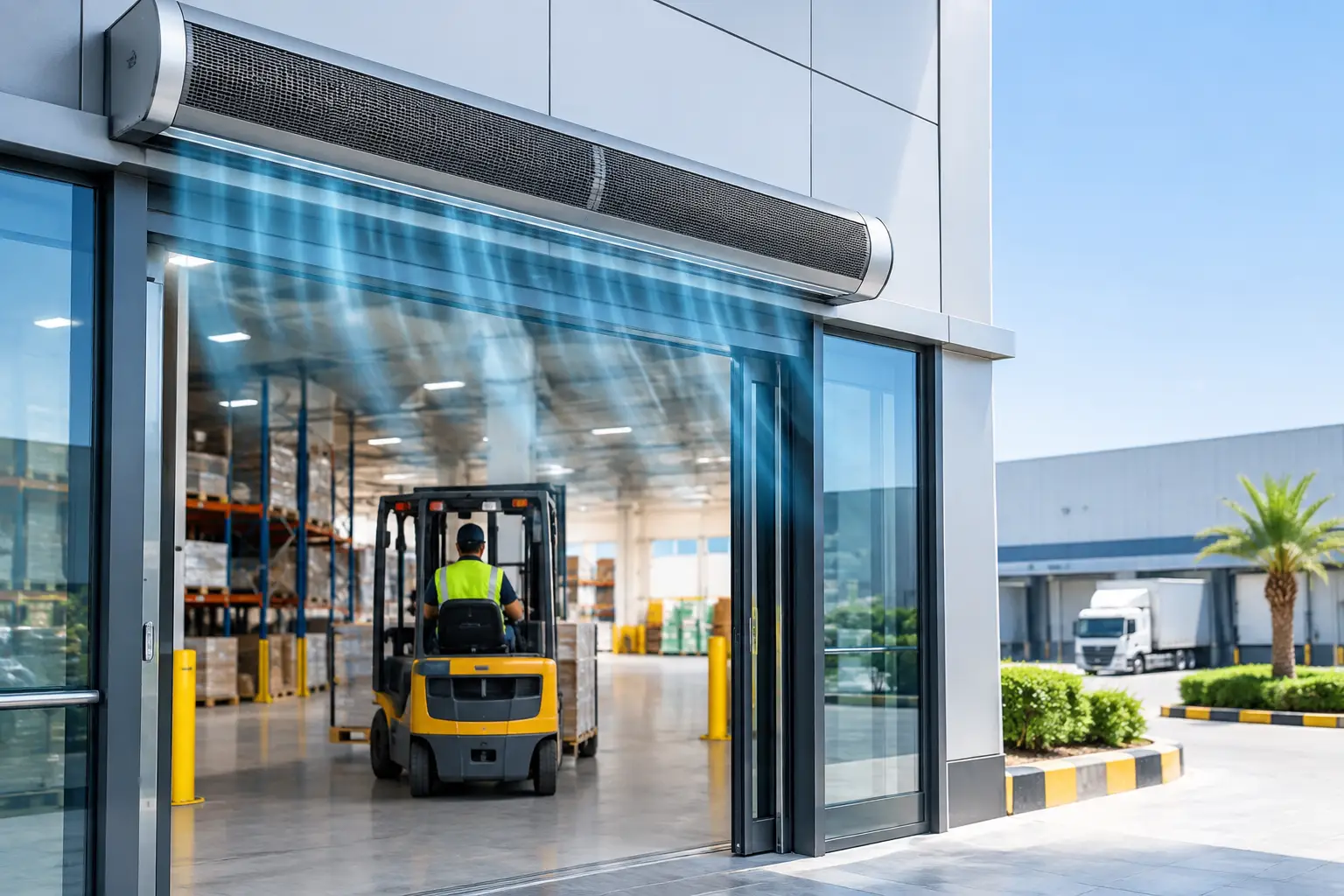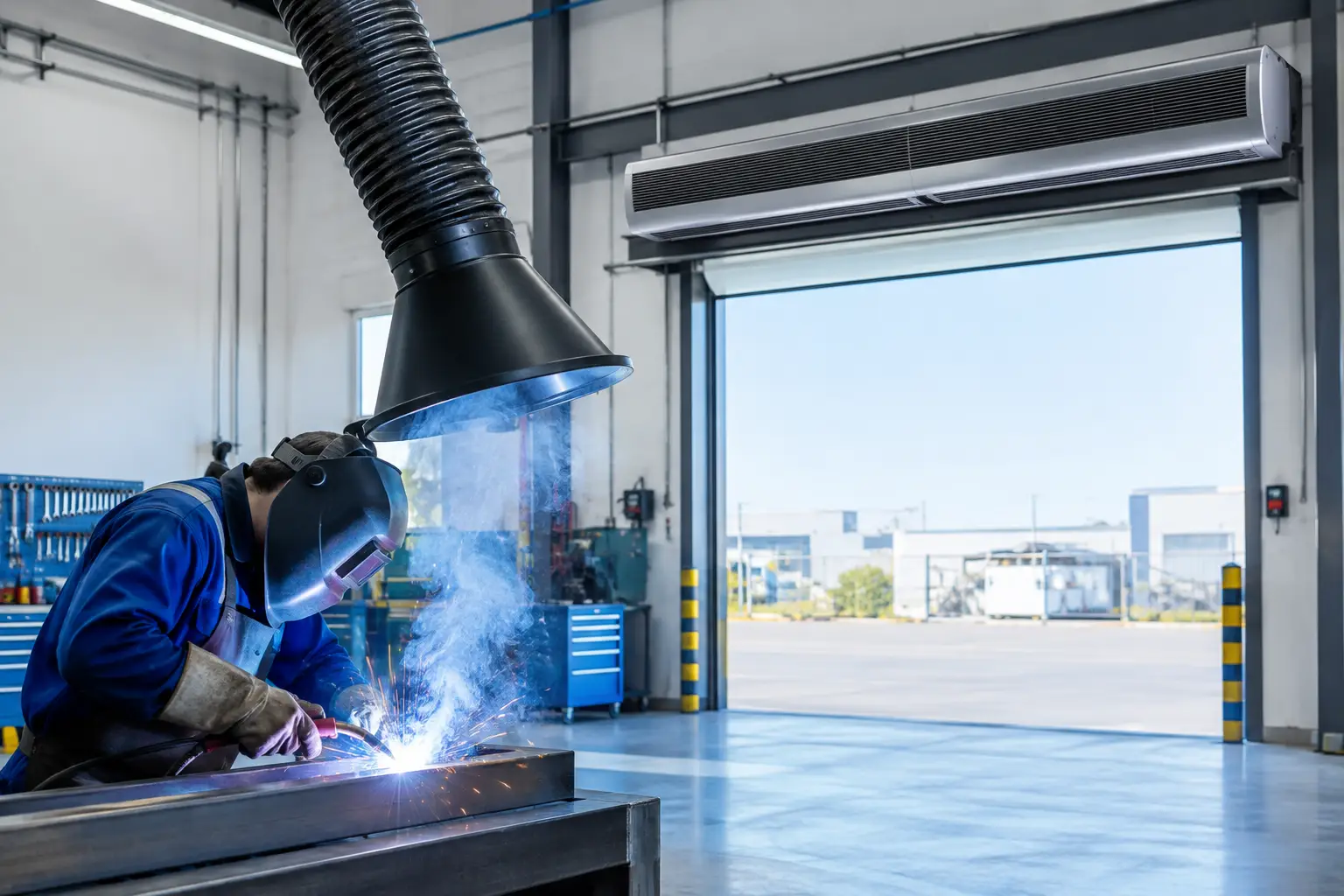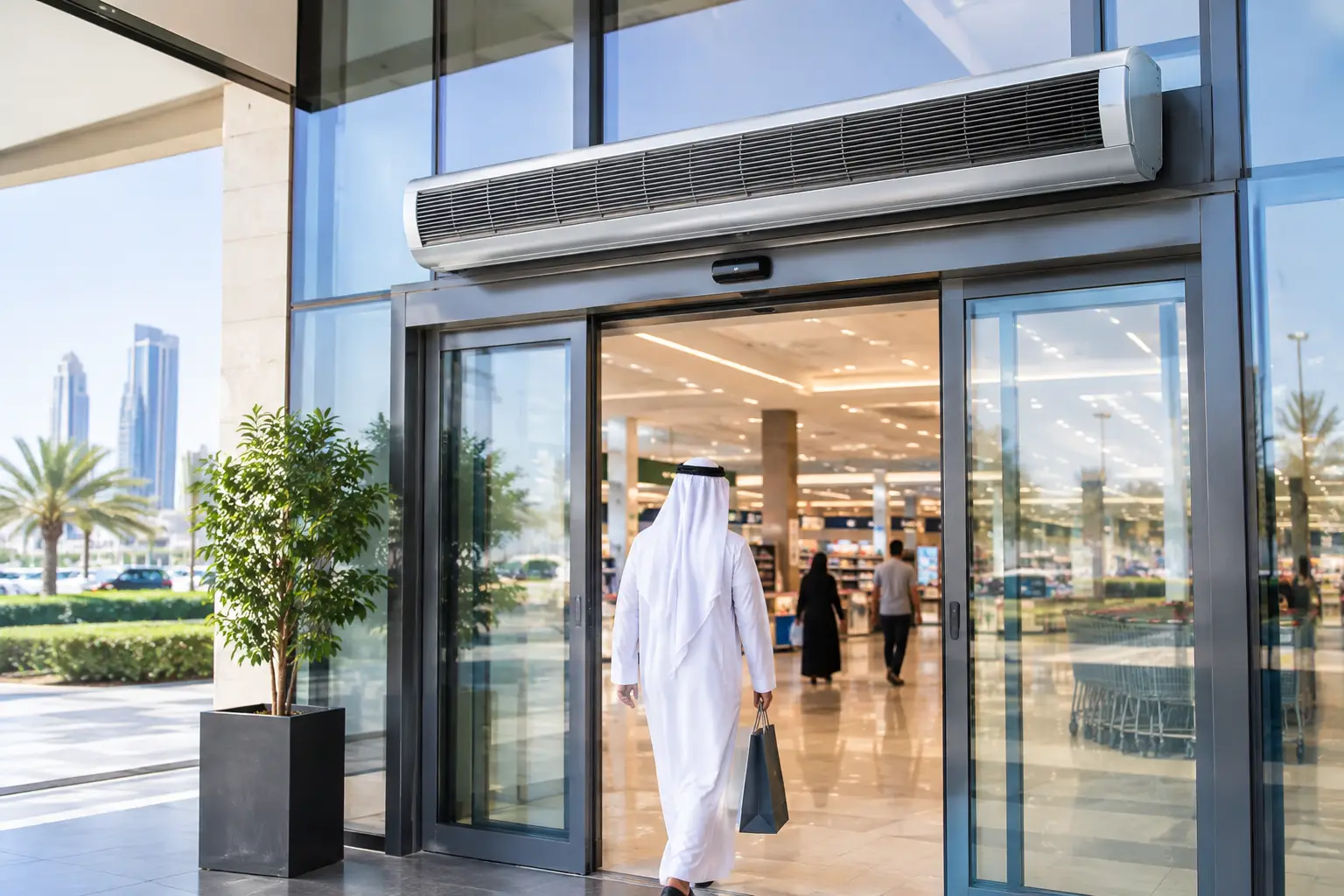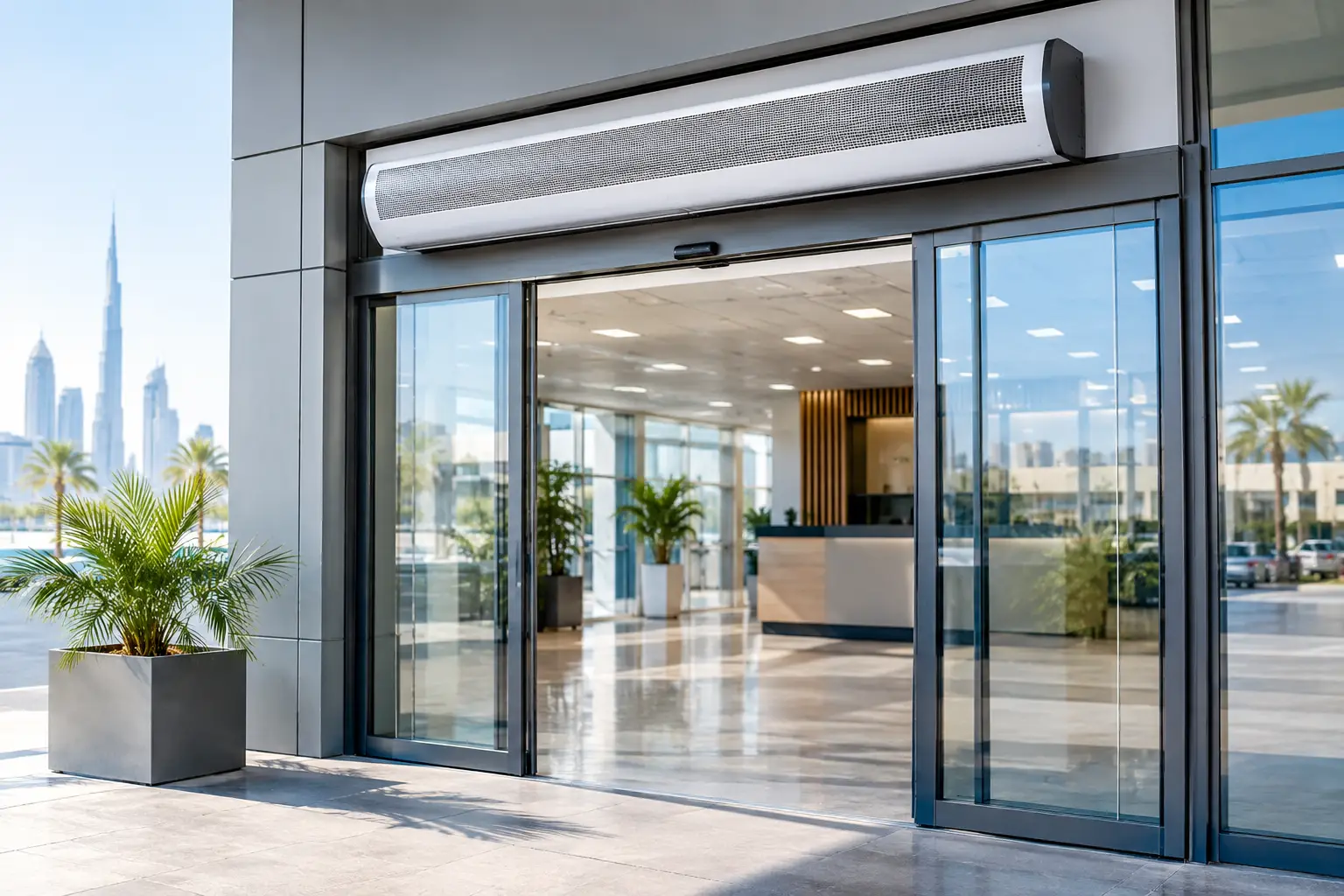
A receiving door left open during a delivery can become a direct path for flies, windblown dust, humid air, and outdoor heat. In a supermarket, food plant, commercial kitchen, or cold-chain warehouse, that exposure affects far more than indoor comfort. Effective food safety barriers help control what crosses the building envelope while people, carts, pallets, and deliveries keep moving.
For facilities operating in Dubai, Riyadh, Doha, Cairo, Lagos, Nairobi, and similar hot, humid, or dusty locations, entrance control is a practical part of food protection. The right approach combines operational discipline, physical separation, cleaning controls, and properly specified air movement at open doorways. An air curtain is not a substitute for sanitation or pest-management programs, but it can be a valuable engineered layer where a conventional door cannot remain closed. For similar clean-entry applications, see our pharmaceutical cleanroom door barrier example.
Why entrances matter to food safety
Food safety plans often focus on production rooms, preparation surfaces, refrigeration, personal hygiene, and storage. These controls are essential, yet the entrance is frequently the point where external conditions challenge all of them. A busy doorway can introduce insects, particulate matter, moisture, odors, fumes, and unconditioned air into a controlled space.
This is particularly relevant when staff prop doors open for goods receiving, waste removal, customer traffic, or material transfer. Traditional strip curtains and self-closing doors can help in certain areas, but they may slow handling, obstruct visibility, or wear quickly under continuous traffic. Their effectiveness also depends heavily on users closing them consistently.
An air curtain creates a high-velocity air stream across an opening. When selected and installed correctly, that stream helps separate interior and exterior air masses, reducing the opportunity for airborne contaminants and flying insects to enter. It also reduces cooling loss, which supports more stable internal conditions near entrances.
The key word is “reduces.” No entrance system creates a sterile boundary, and no air curtain should be represented as a food-safety control on its own. Its value comes from supporting a wider risk-control strategy without interrupting operations.
Food safety barriers work as a system
The most dependable facilities use multiple layers because each barrier addresses a different risk. A food processing facility may need hygienic zoning and controlled staff movement inside, while its loading dock needs protection from dust and heat outside. A restaurant may prioritize insect reduction at a frequently used service entrance, while a cold storage operation must limit warm, humid infiltration that can increase condensation and refrigeration load.
A practical entrance-control strategy usually brings together four elements:
- Physical controls, including suitable doors, dock seals where applicable, screens, and separated receiving areas.
- Operational controls, such as keeping openings closed when idle, scheduling deliveries, and maintaining clean receiving zones.
- Pest and hygiene controls, including inspection routines, waste management, cleaning schedules, and documented corrective action.
- Air separation, using an air curtain where traffic makes a permanently closed door impractical.
The balance depends on the hazard profile. For example, an open retail entrance is designed for continuous customer access, so an air curtain can provide an invisible boundary without disrupting foot traffic. At a raw-material receiving door, the solution may need to work alongside a roller shutter, dock process controls, and stricter inspection procedures.
Where air curtains add practical protection
Air curtains are most useful at openings that must remain accessible but expose food operations to external contaminants. The application determines the required airflow pattern, installation position, motor duty, and housing design.
Supermarkets, hypermarkets, and retail food areas
Customer entrances create a constant exchange between conditioned sales floors and hot outdoor air. In tropical and desert climates, the incoming heat and humidity can affect comfort, HVAC performance, and the stability of conditions around fresh-food departments near the entrance.
An air curtain above the entrance helps contain cooled air while discouraging dust and insects from entering with each opening cycle. For broad, high-traffic entrances, commercial centrifugal units are commonly considered because they can deliver strong, more uniform airflow over wider door widths. The objective is not merely to make the entrance feel cooler. It is to maintain a more controlled internal environment while preserving easy customer access.
Restaurants, hotels, and commercial kitchens
Rear service doors and receiving entrances are often more exposed than front-of-house doors. Deliveries, staff movement, and waste handling can create repeated open-door periods, especially during peak service. A correctly selected air curtain can reduce insect entry and limit the inflow of hot, humid air without creating a physical obstruction for staff carrying supplies.
Placement matters. The unit should protect the actual opening, not simply be installed where ceiling space is available. Door width, opening height, prevailing wind, nearby extraction conditions, and the route used by staff all influence performance. Where appearance and ceiling integration matter at public-facing entrances, recessed ceiling air curtains can provide a less visually prominent installation.
Food processing, packaging, and pharmaceutical-adjacent areas
Facilities with controlled hygiene practices require greater attention to airflow direction and pressure relationships. An air curtain may support separation at selected transfer points, but it must not undermine the facility’s established ventilation, filtration, or pressure-control design.
This is where coordination between the MEP consultant, food-safety team, and air curtain supplier is essential. Excessively high discharge velocity may create turbulence in a sensitive area. Too little velocity, meanwhile, can allow the barrier to break down before it reaches the floor. The selection must suit the opening and the room’s operating conditions rather than follow a generic door-height rule.
Cold storage and temperature-controlled logistics
At cold-room access points and distribution facilities, open doors bring in warm, moisture-laden air. That air raises refrigeration demand and can contribute to condensation around entrances, depending on the operating temperatures and traffic pattern. Air curtains can help reduce infiltration during frequent movements, particularly where pallets and handling equipment make rapid door closure difficult.
However, cold storage applications require careful specification. The door type, temperature differential, humidity level, opening cycle, and equipment clearance all affect whether an air curtain is appropriate and how it should be configured. Industrial centrifugal units are often suited to demanding loading and logistics environments because they are designed for heavier duty and higher mounting conditions.
Selecting an air curtain for food-facing operations
The correct unit is determined by the opening, not by floor area alone. A small staff door and a wide loading-bay opening may both need air separation, but they require very different equipment and performance expectations.
Start with the clear opening width and height. The air stream must cover the full width and retain enough velocity to reach the floor or intended landing point. Mounting height is therefore a core design input, especially at warehouse and factory doors.
Next, assess traffic. Frequent pedestrian movement calls for a stable barrier that does not impede access or produce excessive noise. Forklift routes, pallet movement, and industrial doors require tougher construction, appropriate controls, and airflow that can resist disruption from vehicle movement.
External conditions deserve equal attention. Desert dust, high ambient heat, coastal humidity, and wind exposure can all reduce real-world performance compared with a sheltered internal opening. In locations with strong crosswinds, air curtains may need higher output, side protection, revised mounting, or an additional physical control. This is why a door opening should be assessed in its actual operating environment.
Finally, consider maintenance access and hygiene requirements. Units should be positioned so facility teams can inspect intake areas, clean surfaces, and maintain equipment without disrupting food operations. A neglected air curtain with blocked intake protection or damaged controls will not deliver its intended barrier performance.
Common specification mistakes
The most common error is treating an air curtain as a standard accessory. Selecting solely by door width can result in insufficient throw at a tall opening, while oversizing without considering airflow direction can create uncomfortable drafts or turbulence.
Another mistake is ignoring the door’s use pattern. A door that opens twice per hour has different needs from a retail entrance that remains open all day. Likewise, a receiving door exposed to hot crosswinds needs a different approach than an internal transfer opening between two conditioned areas.
It is also risky to position the equipment without considering other air systems. Supply diffusers, extract hoods, loading-bay pressure, and nearby shutters can influence the air curtain stream. For food facilities, the design should support established hygiene and HVAC objectives rather than operate in isolation.
A performance-focused approach for hot-climate facilities
Food safety barriers at entrances should protect operational flow as well as food integrity. When the barrier slows deliveries, obstructs carts, or requires staff to override it, compliance weakens. Air separation provides a useful option because it works without adding a physical obstacle at an opening.
For FreezeeX projects, selection is based on the entrance size, mounting position, traffic volume, HVAC requirements, and external climate exposure. Commercial applications may suit a centrifugal or HiFi Plus configuration, while demanding warehouses, factories, and logistics entrances may require an industrial centrifugal solution. The right choice depends on the site survey and the performance target, not a one-size-fits-all product category.
A properly specified air curtain can support cleaner, more stable entrances in environments where heat, humidity, dust, and insects are persistent operational risks. For a food facility, supermarket, commercial kitchen, or temperature-controlled warehouse, request a consultation and quotation based on the actual door conditions. A site-specific recommendation is the practical starting point for a barrier that supports both food safety and efficient day-to-day operations.