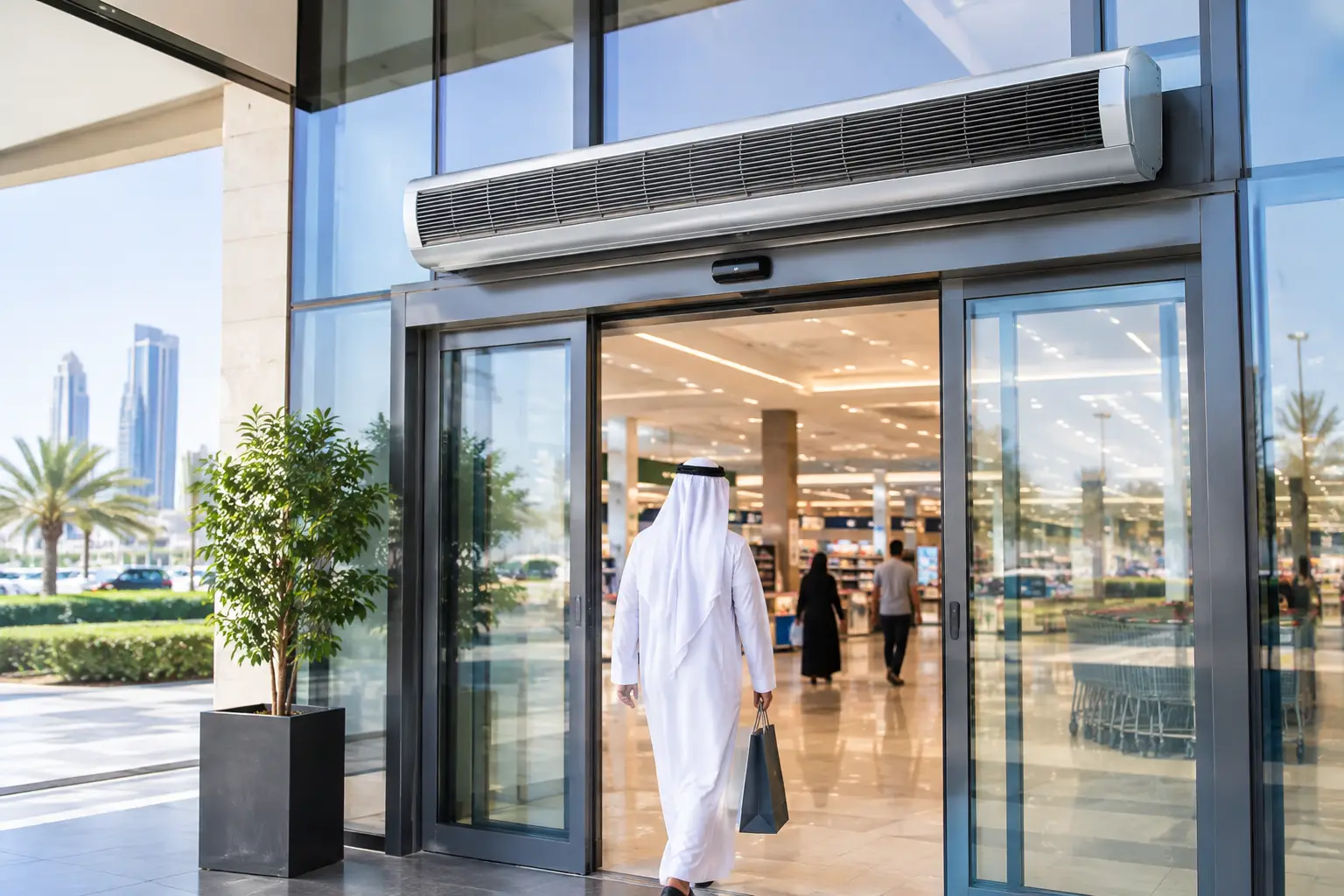
A supermarket entrance in Dubai can admit far more than foot traffic. Every door opening allows hot, moisture-laden outdoor air to move toward a cooler, conditioned sales floor. In a hotel lobby, hospital receiving area, or food facility, that exchange can raise indoor humidity, create slippery floor conditions, increase HVAC demand, and compromise the comfort customers and staff expect. Effective humidity control at entrances starts by treating the doorway as a critical part of the building envelope.
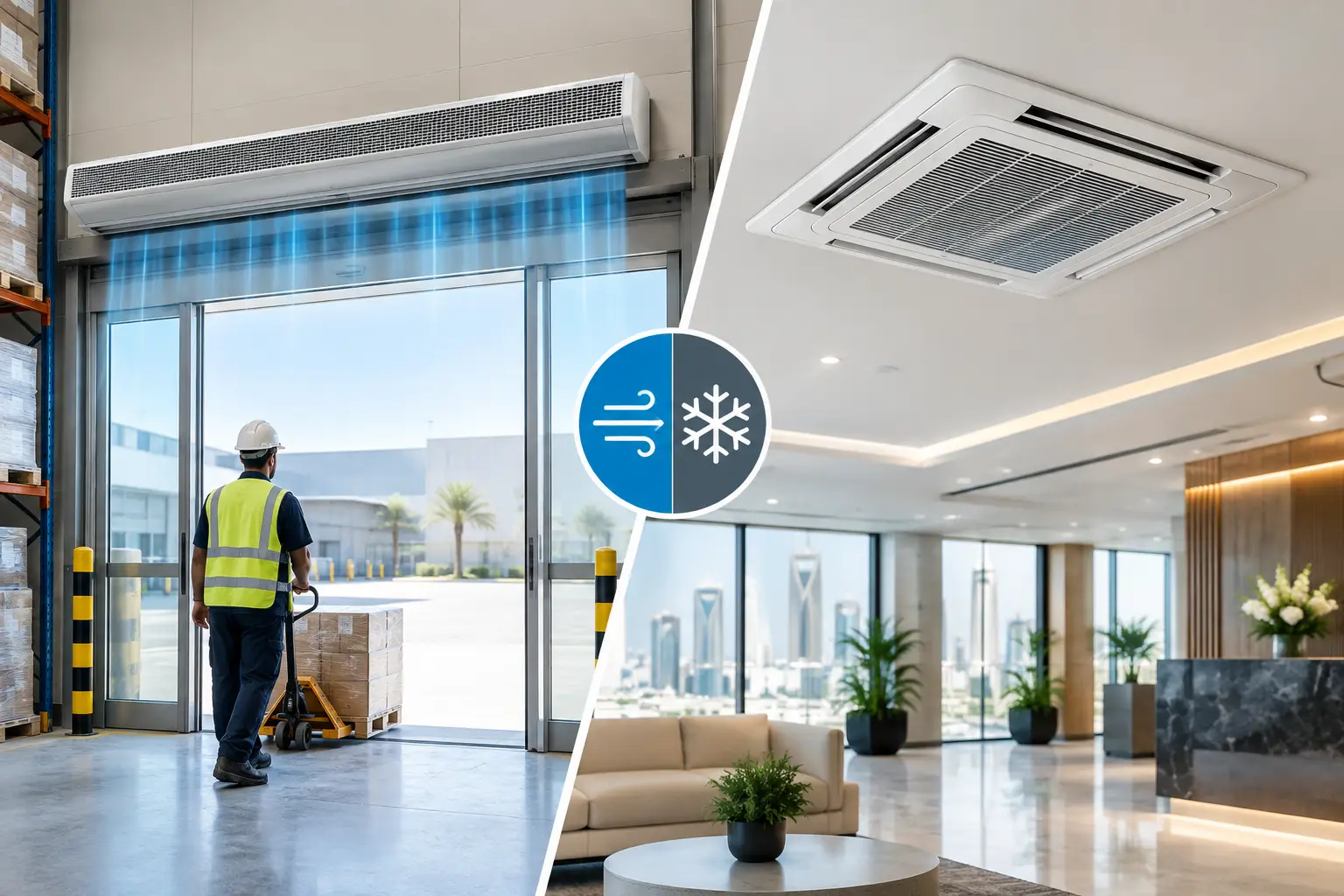
An air curtain cannot dehumidify air in the same way as a dedicated HVAC dehumidification system. What it can do is reduce the volume of humid air entering through an open door. This distinction matters when specifying equipment. The objective is controlled air isolation: maintaining a stable indoor environment while allowing people, carts, and goods to move efficiently.
Why entrance humidity becomes an operating problem
In the GCC, MENA, and many African markets, outdoor conditions create a demanding combination of high ambient temperatures, humidity, dust, and frequent door use. Coastal locations such as Dubai, Abu Dhabi, Doha, Muscat, Jeddah, Lagos, and Mombasa can experience particularly high moisture levels. Desert cities may be drier for much of the year, yet still face periods of humidity and intense sensible heat gain.
When warm, humid air reaches a cooler indoor space, its relative humidity changes as it cools. If surfaces are below the dew point, condensation can form on glazing, door frames, floors, refrigerated display equipment, and nearby ceiling surfaces. The immediate effects may be minor at first – a damp threshold or fogged glass – but repeated moisture entry can increase cleaning requirements, contribute to odor concerns, and place additional latent load on the HVAC system.
For a supermarket or retail store, the result is often felt as inconsistent comfort near the entrance. In cold storage loading areas, humidity infiltration can affect temperature stability and increase frost-related operational pressure. In pharmaceutical, healthcare, and food-processing environments, moisture control can also support hygiene and environmental-control objectives.
How air curtains support humidity control at entrances
A commercial air curtain creates a high-velocity stream of air across an opening. Properly selected and installed, that stream forms an air barrier that resists the natural exchange between outdoor and indoor air when the door is open.
The barrier works against several forces at once: wind pressure outside the building, stack effect within taller buildings, pressure differences caused by HVAC operation, and the movement of people or materials through the doorway. This is why an air curtain should not be treated as a generic accessory. Its effectiveness depends on airflow volume, discharge velocity, throw distance, mounting height, opening width, and the actual conditions at the entrance.
For humidity management, the benefit is straightforward: less outdoor air entering means less moisture the air-conditioning system must remove. That can reduce latent cooling demand and help the HVAC system maintain its intended temperature and humidity setpoints during busy periods.
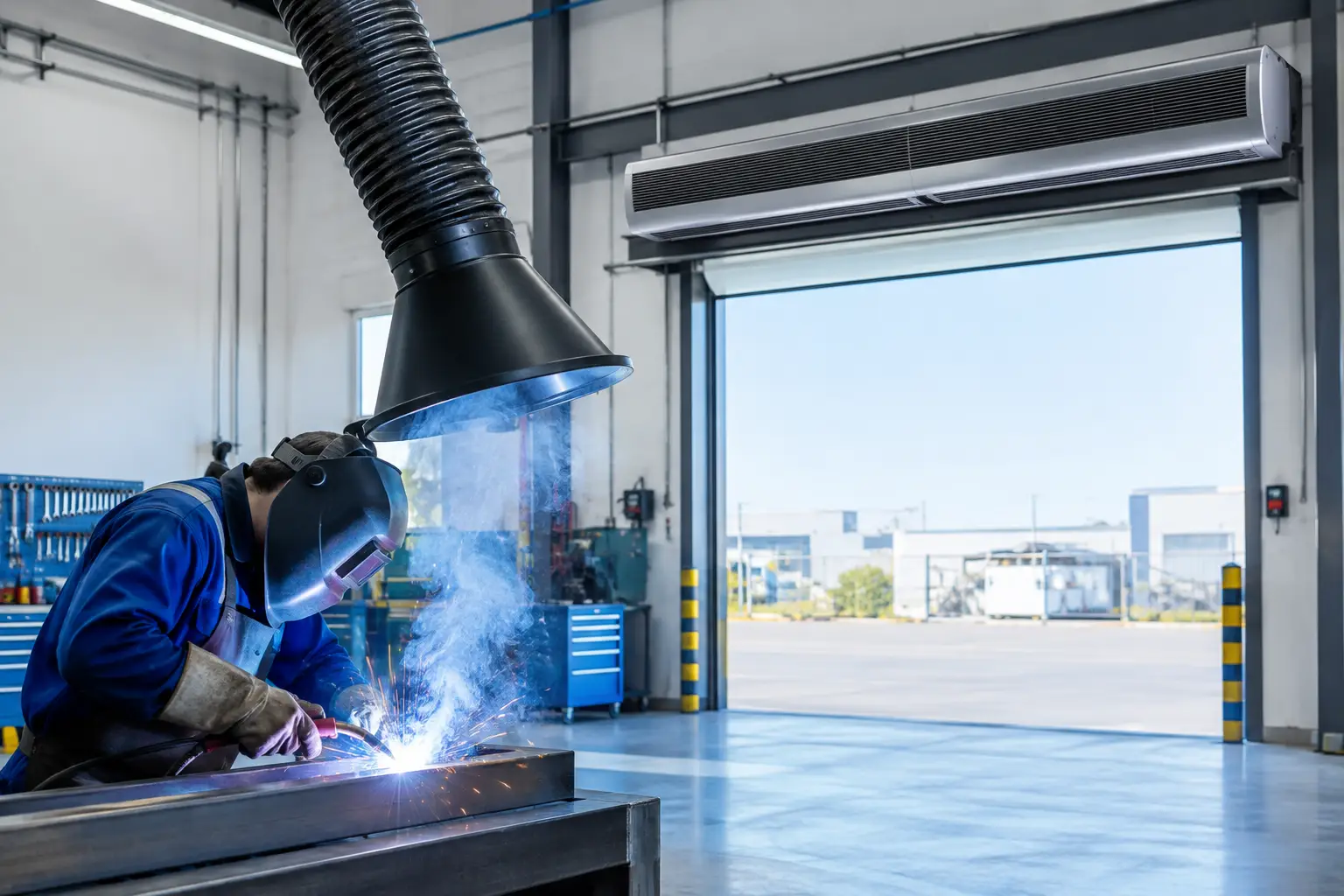
Air curtains also help limit ingress of dust, insects, smoke, fumes, and airborne contaminants. This makes them useful at entrances where climate protection and operational cleanliness are closely connected, including restaurants, malls, logistics facilities, factories, and healthcare buildings.
The door opening is not the whole design question
Selecting an air curtain by doorway width alone is a common specification mistake. Width is essential, but it is only one part of the performance requirement. A 3-meter-wide entrance in a sheltered mall corridor has a very different operating profile from a 3-meter-wide warehouse door exposed to crosswinds and forklift traffic.
Mounting height and effective air throw
The air stream must reach the floor or the opposing side of the opening with enough velocity to resist infiltration. As mounting height increases, the equipment needs greater throw and often a more powerful fan configuration. If the airflow loses momentum before it reaches the lower part of the opening, humid air can pass underneath the barrier.
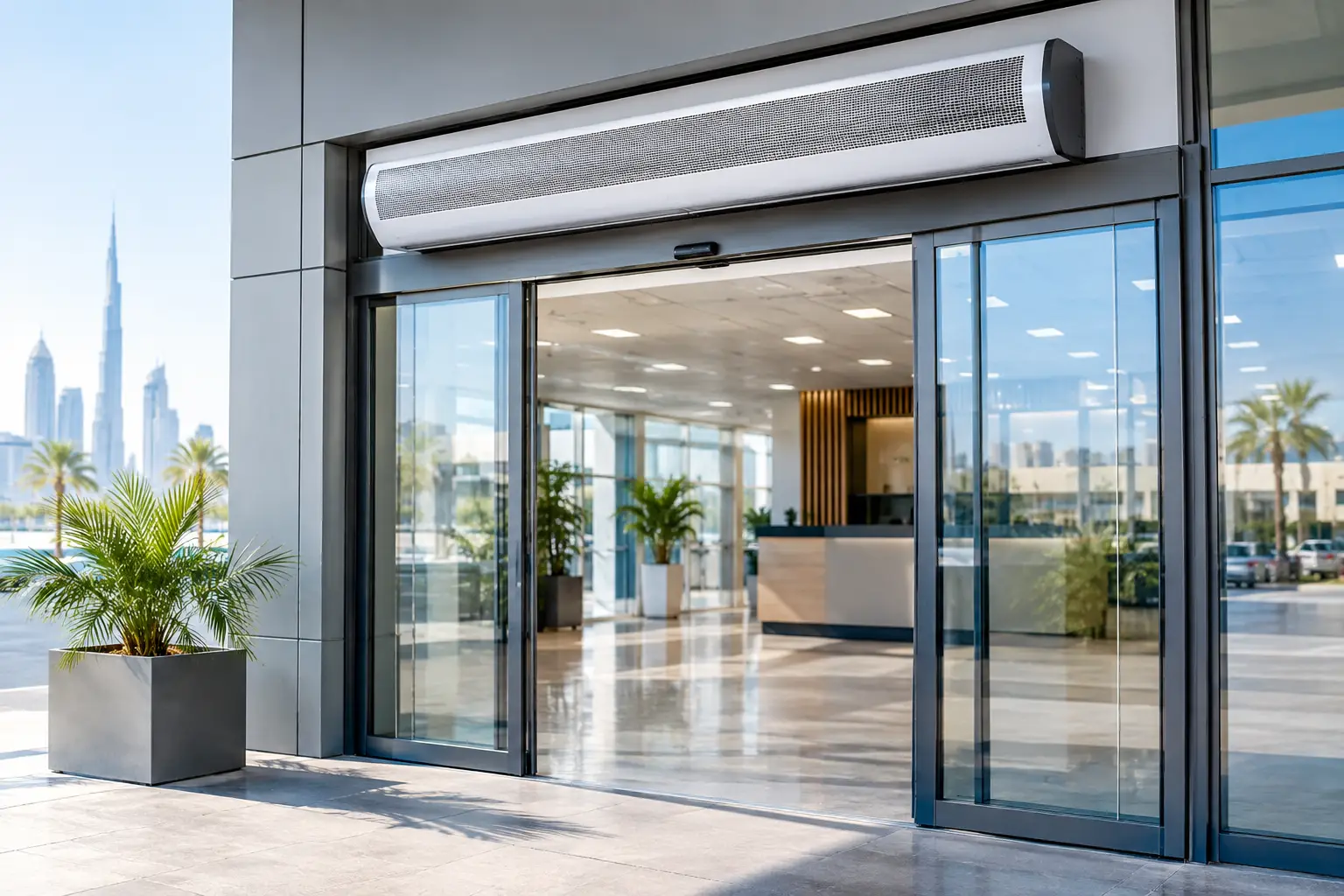
Recessed units can be appropriate for premium retail stores, hotel lobbies, and architectural applications where a clean ceiling line is required. Surface-mounted commercial centrifugal units are often a practical choice for high-traffic retail and restaurant entrances. Industrial centrifugal air curtains are designed for larger openings and more demanding environments such as warehouses, workshops, factories, and logistics centers.
Door traffic and opening duration
A manually operated staff door that opens occasionally does not need the same approach as a supermarket entrance that remains open for extended periods. Frequent pedestrian traffic, shopping carts, baggage trolleys, and pallet movement all disturb the air barrier.
High-traffic entrances need stable, continuous coverage. In industrial applications, the system may need to be coordinated with door controls so it operates whenever the opening is active. The goal is not simply to blow air downward. It is to maintain effective separation during the conditions that occur in real operation.
Pressure balance and crosswinds
Air curtains perform best when building pressure is reasonably balanced. Strong negative pressure inside a building can pull outdoor air inward, while excessive positive pressure can push conditioned air out. Nearby exhaust systems, loading docks, open service doors, and poorly coordinated HVAC controls can all affect the result.
External wind is equally important. A doorway exposed to prevailing winds may require a higher-performance industrial solution, a revised discharge angle, or complementary physical measures such as a vestibule. For critical spaces, an airflow assessment should consider the door orientation and nearby openings before equipment is finalized.
Application-specific priorities
Humidity control at entrances should reflect the facility’s operational risk. The same equipment category is not automatically suitable for every building type.
In retail stores, shopping malls, and hotels, the priority is usually guest comfort, energy retention, and an unobstructed entrance. A well-integrated commercial or recessed air curtain can reduce warm, humid air intrusion without creating a visual barrier or slowing customer flow.
For supermarkets and food-service entrances, the focus extends to floor safety and temperature consistency near chilled merchandise. Air isolation helps limit the humid air that can make entrance zones feel uncomfortable or create moisture on nearby surfaces.
Warehouses and distribution centers require a different approach. Large openings, high mounting heights, forklift movement, and wind exposure demand industrial-duty airflow. The selected unit must match the full door width, not leave unprotected gaps at either side, and provide sufficient velocity at the working level.
Hospitals, pharmaceutical facilities, and food-processing sites may have more stringent environmental objectives. Here, air curtains can support a broader entrance-control strategy, but they should be coordinated with the facility’s pressure regime, filtration requirements, and hygiene protocols. They are an effective perimeter measure, not a substitute for required cleanroom or controlled-environment design.
What air curtains can and cannot solve
An air curtain is highly effective when the problem is infiltration through an open doorway. It reduces the amount of hot, humid air that crosses the threshold, helping HVAC equipment operate under a more manageable load. It is particularly valuable where doors are open frequently and physical doors alone cannot maintain separation.
It will not correct humidity caused by internal processes, undersized air-conditioning capacity, water leaks, unsealed building penetrations, or poor drainage. Nor will it perform as intended when selected too small for the opening, mounted too high for its throw capability, or installed in an entrance with severe pressure imbalance.
That is why the specification process should begin with the operating condition rather than a product model. Engineers and facility teams should define the clear opening dimensions, mounting position, traffic type, hours of use, exposure to wind, indoor temperature target, and any contamination-control requirements. This information makes it possible to match the air curtain’s airflow pattern and capacity to the actual entrance.
Specify for the climate, not the catalog photo
Tropical, coastal, and desert-climate projects require equipment that can sustain performance under long operating hours and demanding ambient conditions. Materials, motor reliability, blower design, service access, noise expectations, and control integration all affect long-term value.
For a front-of-house entrance, low perceived noise and architectural fit may carry significant weight. For a loading bay, air velocity, coverage, and durability are usually more important. Neither priority is wrong; the correct choice depends on how the opening is used and what the facility risks when outdoor air enters.
FreezeeX evaluates entrance size, mounting height, traffic volume, exposure, and HVAC conditions to recommend air curtain systems suited to commercial and industrial operations across hot, humid, and dusty markets. A properly specified solution can help protect indoor comfort while reducing unnecessary cooling loss at one of the building’s most vulnerable points.
For a new project or an underperforming entrance, request a technical consultation and quotation based on the actual doorway and operating environment. The right air barrier is not defined by appearance alone – it is defined by how reliably it controls the conditions outside the door.