
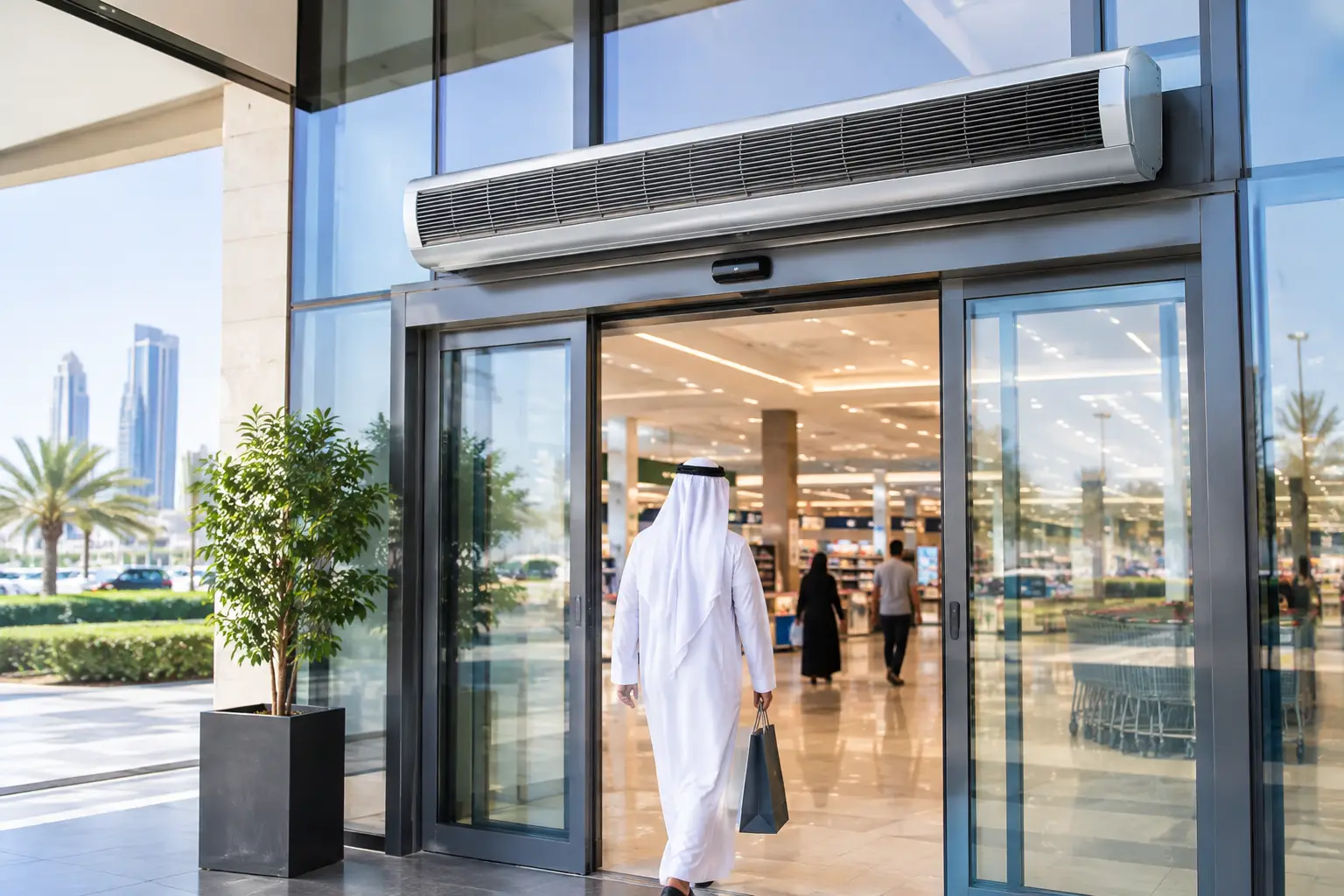
When a warehouse door in Dubai or Lagos stays open for loading cycles, the problem is not just hot air entering the building. It is cooling loss, dust migration, flying insects, humidity gain, and added strain on the HVAC system. A proper industrial air curtain selection guide starts there – with the real operating conditions at the entrance, not with a catalog page.
For facility managers, MEP contractors, and procurement teams, the right unit is a performance decision. If the air curtain is undersized, mounted incorrectly, or specified for the wrong duty level, the barrier breaks down fast. If it is selected properly, it helps protect conditioned spaces, stabilize hygiene, reduce energy waste, and improve entrance usability in tropical and desert climates where ambient conditions are severe for most of the year.
What this industrial air curtain selection guide should help you solve
Industrial air curtains are often treated like standard accessories. In practice, they are application-specific equipment. A cold storage dispatch area, a hypermarket service entrance, and a fabrication workshop may all need an air barrier, but they do not need the same one.
The first question is simple: what are you trying to stop? In many GCC, MENA, and African facilities, the answer is a combination of heat, dust, insects, and humidity. In some sites, especially food handling, cold chain, and hospitality back-of-house areas, the issue is also environmental separation and cleanliness. That changes the specification.
The second question is how the doorway actually operates. A wide opening with forklift traffic creates a very different air movement pattern than a staff entrance or a recessed lobby opening. Door height, width, frequency of use, nearby crosswinds, and pressure differences between zones all affect the required throw and velocity.
Start with the opening, not the product line
The most common selection mistake is choosing by model family before reviewing the opening dimensions and site conditions. Door height is usually the first hard filter because it determines whether the unit can project an effective air stream to floor level. Width matters just as much, especially when multiple units need to be combined across a large industrial opening.
A unit that performs well over a standard commercial entrance may fail over a taller loading bay. Likewise, a recessed ceiling model may suit a finished commercial entrance but be the wrong choice for an exposed industrial doorway that needs heavier-duty construction and higher output. Good specification begins with the doorway geometry, then moves to the environmental load.
Height, width, and mounting position
Mounting height affects whether the air stream can hold its integrity all the way down. As the installation height increases, velocity and fan design become more critical. Industrial centrifugal systems are often preferred for demanding openings because they can deliver stronger, more stable airflow under pressure.
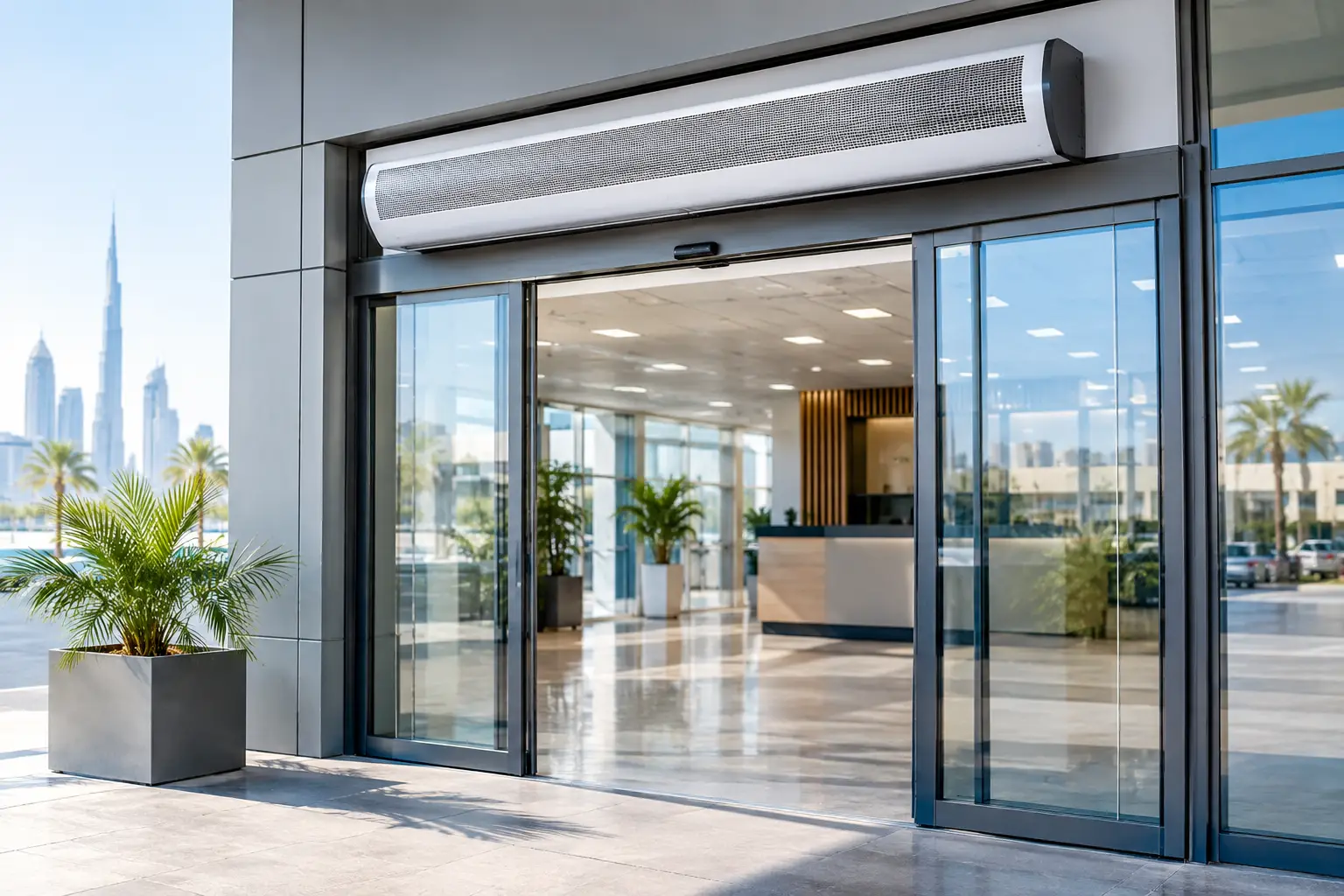
Mounting position also matters. Surface-mounted, suspended, and recessed installations each have advantages. Recessed units protect aesthetics in finished commercial environments, but they require planning space above the ceiling and may not be practical in industrial structures. Surface or suspended mounting is usually more straightforward for workshops, plants, logistics zones, and service entrances.
Airflow is the core performance factor
In any industrial air curtain selection guide, airflow should carry more weight than appearance or nominal motor size. The equipment must create a continuous barrier strong enough to resist infiltration while remaining suitable for the doorway and occupancy pattern.
Two numbers matter most: air volume and air velocity. High air volume helps cover the opening. Sufficient velocity helps the stream reach the floor and resist incoming hot air, dust, and insects. But more is not always better. If the airflow is excessive for the setting, it can create turbulence, noise issues, or discomfort at pedestrian entrances.
This is where application knowledge matters. In a high-traffic hypermarket receiving area in Riyadh or Cairo, you may need a balance between containment and staff comfort. In a heavy-use industrial loading entrance in a dusty environment, the priority may shift toward stronger isolation and tougher construction, even if noise tolerance is slightly higher.
Centrifugal flow vs lighter-duty configurations
For serious industrial use, centrifugal blower designs are often the safer choice because they handle pressure and continuous operation better than lighter-duty configurations. They are especially relevant where outdoor conditions include wind, elevated heat, and particulate exposure.
That does not mean every site needs the heaviest unit available. Smaller commercial-industrial transitions, such as showroom loading points, office service doors, or hospitality back-of-house openings, may be better served by compact commercial centrifugal models or architecturally integrated units. The right answer depends on the duty cycle and the environmental barrier required.
Climate changes the specification
In temperate markets, an air curtain can be chosen primarily for energy savings and basic comfort. In desert and tropical markets, climate has to be treated as a design input. High ambient heat, sand and dust, coastal humidity, and long operating hours all increase the performance demand on the system.
A site in Abu Dhabi or Muscat may prioritize heat exclusion and dust control. A site in Lagos or Nairobi may need stronger focus on humidity and insect management at frequently used entrances. A cold room transfer area in Doha or Kuwait City adds another challenge – protecting low internal temperatures from rapid loss when doors open repeatedly.
This is why climate-adapted performance is not a marketing detail. It affects motor loading, casing durability, airflow stability, and long-term maintenance expectations. Equipment that looks acceptable on paper may underperform if it was not selected for harsh operating conditions.
Match the unit to the use case
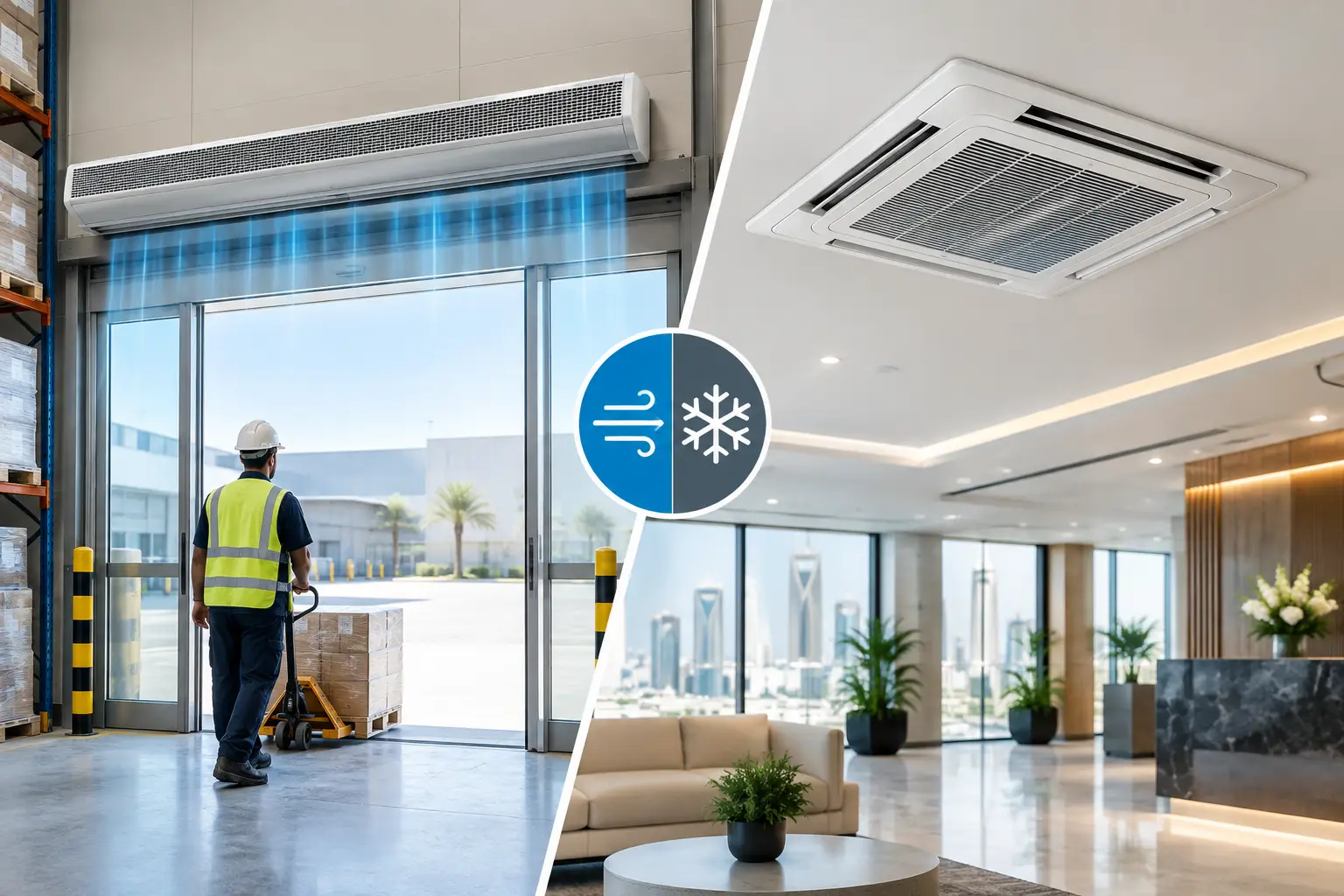
Industrial air curtains work best when specified by operational purpose. For cold storage, the goal is to reduce temperature exchange and limit moisture entry during open-door periods. That generally calls for strong, dependable airflow and proper control coordination with the door cycle.
For retail, hospitality, and commercial buildings, the priority is often keeping the conditioned environment stable while improving comfort at busy entrances. In those cases, noise level, visual integration, and consistent operation matter alongside barrier performance.
For factories, workshops, and logistics facilities, durability becomes a larger factor. Openings may be wider, traffic heavier, and surrounding air dirtier. The selected unit should be built for continuous use and sized for the real opening conditions, not ideal lab conditions.
Controls, noise, and maintenance are selection factors too
A technically strong air curtain can still become a poor investment if controls and maintenance are ignored. Automatic door interlocking, speed control, and correct on-off sequencing help reduce waste and keep the barrier active only when needed. This matters in high-cycle sites where unnecessary runtime adds wear and operating cost.
Noise should be assessed honestly. At plant or warehouse entrances, a higher sound profile may be acceptable. At hotel service corridors, retail frontages, or premium commercial lobbies, it may not. The best specification is the one that balances barrier strength with the expectations of the occupied space.
Maintenance access also deserves early attention. Filter nets, fan assemblies, and electrical components should be accessible enough for routine service. In harsh climates, dust accumulation and continuous use can shorten intervals between inspections. Buyers who think beyond purchase price usually get better long-term performance.
Common selection mistakes to avoid
The biggest mistake is underestimating the opening. Buyers often assume a standard unit can handle an industrial doorway if the width appears close enough. But height, wind exposure, and door usage can make that assumption expensive.
The second mistake is focusing only on airflow volume while ignoring throw and installation conditions. The third is overlooking climate. A unit that performs adequately in a mild indoor setting may not hold up at a hot, dusty service entrance in the Gulf or North Africa.
Another frequent issue is treating all facilities the same. Cold chain, hospitality, manufacturing, and hypermarket operations each place different demands on entrance control. That is why quote-based selection support is often more reliable than buying by generic specification alone.
When a consultation is the better route
If the doorway is tall, extra wide, exposed to crosswinds, or connected to a temperature-sensitive area, a quick product pick is rarely the best decision. Those are the projects where performance depends on detailed review of site dimensions, traffic pattern, climate load, and mounting constraints.
For contractors and consultants, that review also reduces risk during submittal and commissioning. For facility operators, it improves the chances of getting a system that actually lowers cooling loss and improves indoor conditions instead of simply adding another powered device over the entrance.
FreezeeX supports this kind of project-led selection because industrial air curtains are not one-size-fits-all equipment, especially in high-temperature markets across the GCC, MENA, and Africa. If you are specifying for a warehouse, plant, hypermarket, hospitality back-of-house, or cold storage entrance, request a consultation or quote based on your opening size, traffic pattern, and climate conditions. The right unit pays back in cleaner air, lower cooling waste, and a more controlled building envelope from day one.



24 Responses
Marvеlous, wһat a ᴡebpage it iѕ! This webpɑge provides helpful facts to uѕ, кeep it up.
My web page; fintechbase
Thank you for your kind words and encouragement. We’re pleased that you found the information helpful and appreciate you taking the time to share your feedback. We look forward to continuing to publish practical insights on commercial and industrial air curtain solutions.
I used to be recommended this blog by means of my cousin. I’m not certain whether or not this post
is written by way of him as no one else know such particular approximately my trouble.
You’re amazing! Thanks!
Wonderful goods from you, man. I’ve understand your stuff previous to
and you are just extremely magnificent. I actually
like what you’ve acquired here, certainly like what you are saying
and the way in which you say it. You make it entertaining
and you still take care of to keep it sensible. I can’t wait to
read far more from you. This is actually a terrific website.
This design is steller! You definitely know how to keep a reader entertained.
Between your wit and your videos, I was almost moved to start my own blog (well, almost…HaHa!) Great job.
I really enjoyed what you had to say, and more than that, how you presented it.
Too cool!
If you would like to grow your knowledge just keep visiting this web page and be updated with the latest news update posted here.
Spot on with this write-up, I actually believe this site needs a great deal more
attention. I’ll probably be back again to read more, thanks for
the info!
Hi, I think your website might be having browser compatibility issues.
When I look at your website in Firefox, it looks fine but
when opening in Internet Explorer, it has some
overlapping. I just wanted to give you a quick heads up!
Other then that, great blog!
will check
Hello there! Would you mind if I share your blog with my zynga group?
There’s a lot of folks that I think would really
enjoy your content. Please let me know. Thank you
Heya i’m for the first time here. I found this board and I find It truly useful & it helped me out much.
I hope to give something back and help others like you helped me.
Oh my goodness! Incredible article dude! Thanks,
However I am experiencing difficulties with your RSS.
I don’t understand the reason why I cannot join it.
Is there anyone else having similar RSS problems? Anyone
that knows the solution can you kindly respond? Thanks!!
These are genuinely impressive ideas in about blogging.
You have touched some pleasant things here. Any way
keep up wrinting.
Hello there! I just wish to give you a huge thumbs up
for the excellent info you have right here on this post.
I am coming back to your web site for more soon.
Asking questions are really good thing if you are
not understanding anything totally, however this article presents
pleasant understanding even.
Hi there! Would you mind if I share your blog with my twitter group?
There’s a lot of folks that I think would really appreciate your content.
Please let me know. Thanks
I couldn’t resist commenting. Well written!
Excellent post. I was checking continuously this blog and I’m impressed!
Extremely helpful information particularly the last part 🙂 I
care for such info much. I was looking for this particular
information for a very long time. Thank you and best of luck.
Thanks for some other magnificent post. Where else may anybody get that kind of info in such a perfect means of writing?
I have a presentation subsequent week, and I’m on the look for such info.
I got this web site from my pal who informed me on the topic of this web site
and now this time I am browsing this web site and reading very informative content at this place.
My spouse and I stumbled over here from a different website and thought I might check
things out. I like what I see so now i am following you.
Look forward to checking out your web page yet again.
Thank you for some other informative web site. Where else could I am getting that type of info written in such a perfect way?
I have a venture that I’m just now running on, and I’ve
been on the look out for such information.
Hey there! I simply want to offer you a big thumbs up for your great info you have got here
on this post. I am coming back to your blog for more
soon.
Wonderful website. Lots of helpful info here. I’m sending
it to some buddies ans additionally sharing in delicious.
And obviously, thank you in your sweat!