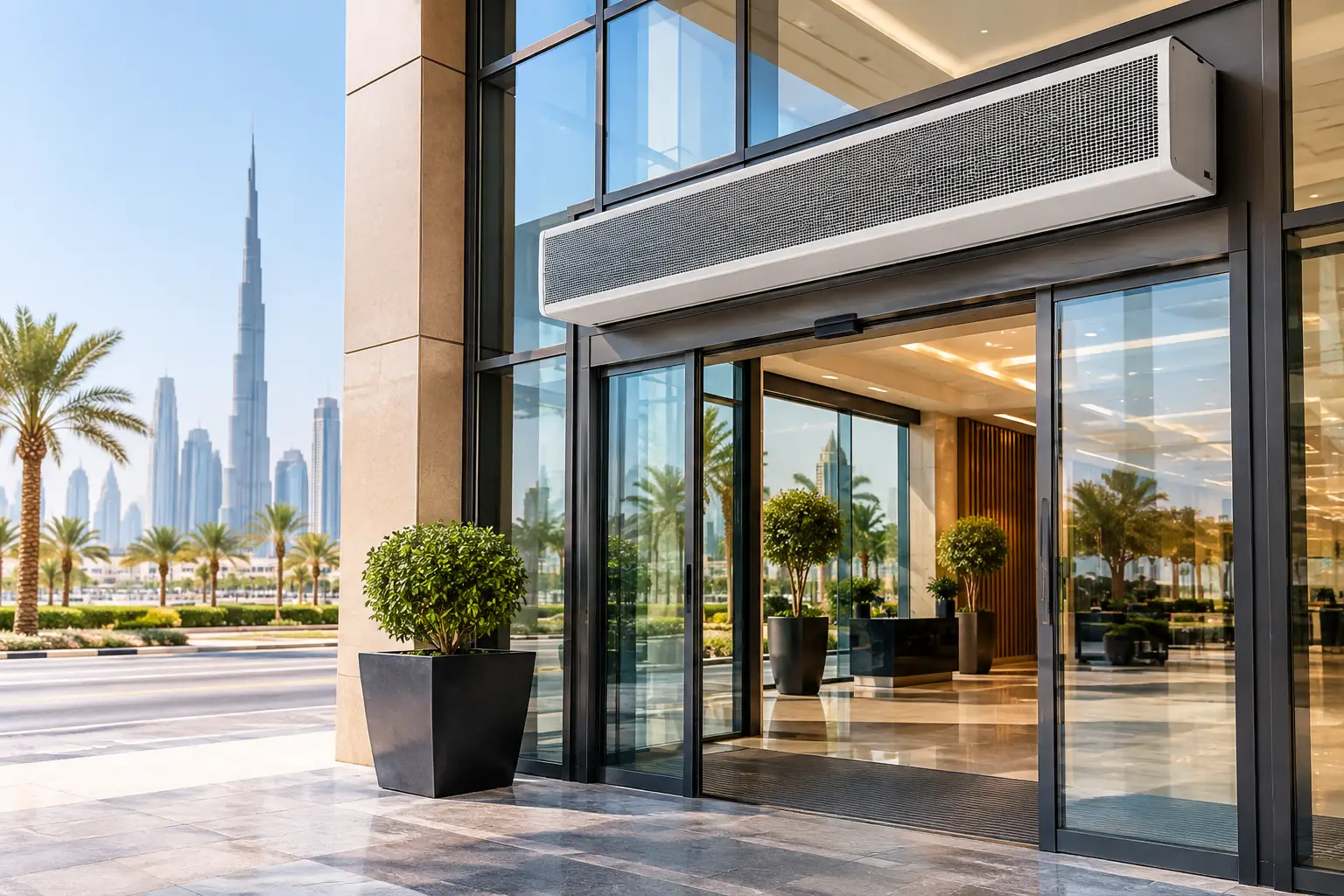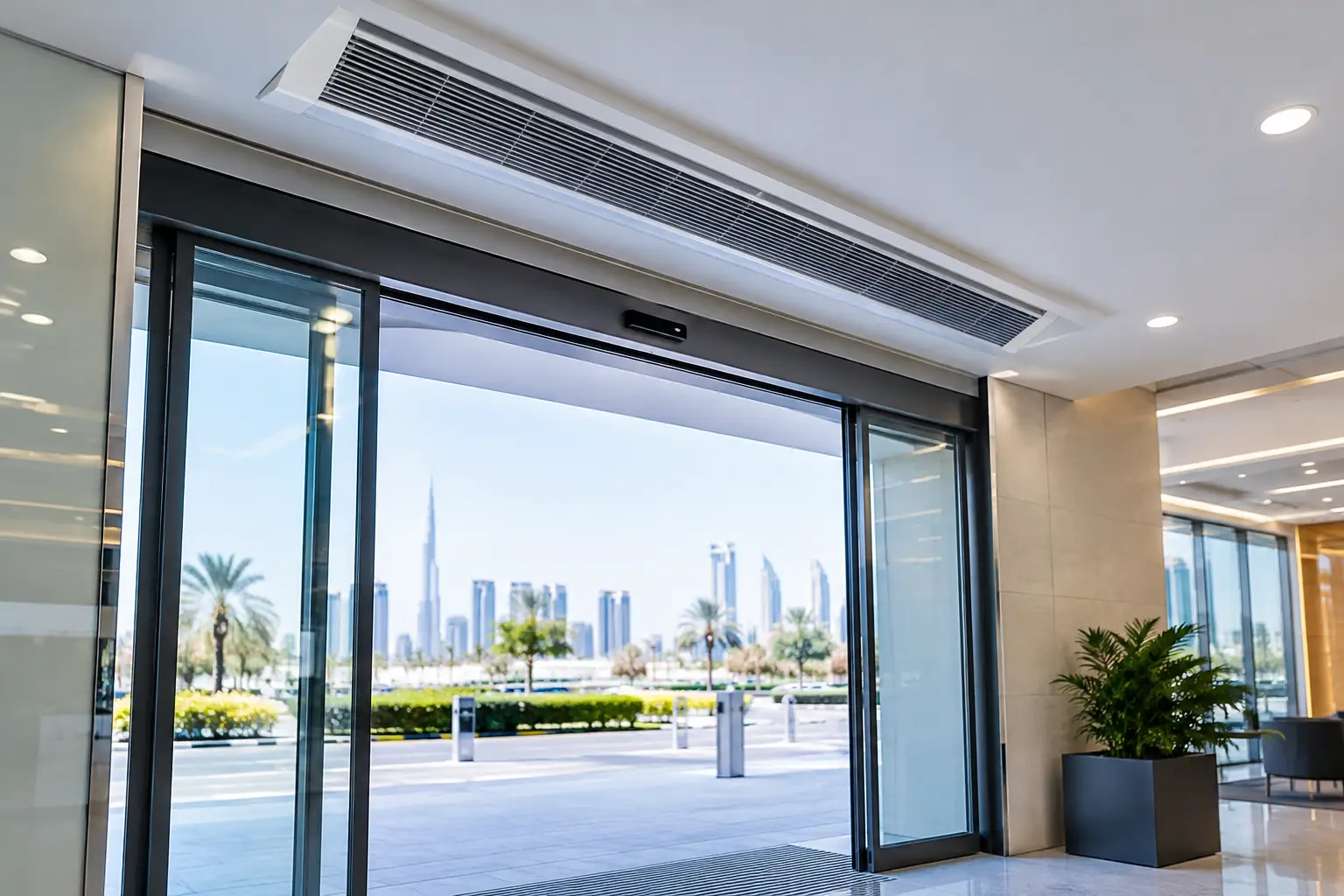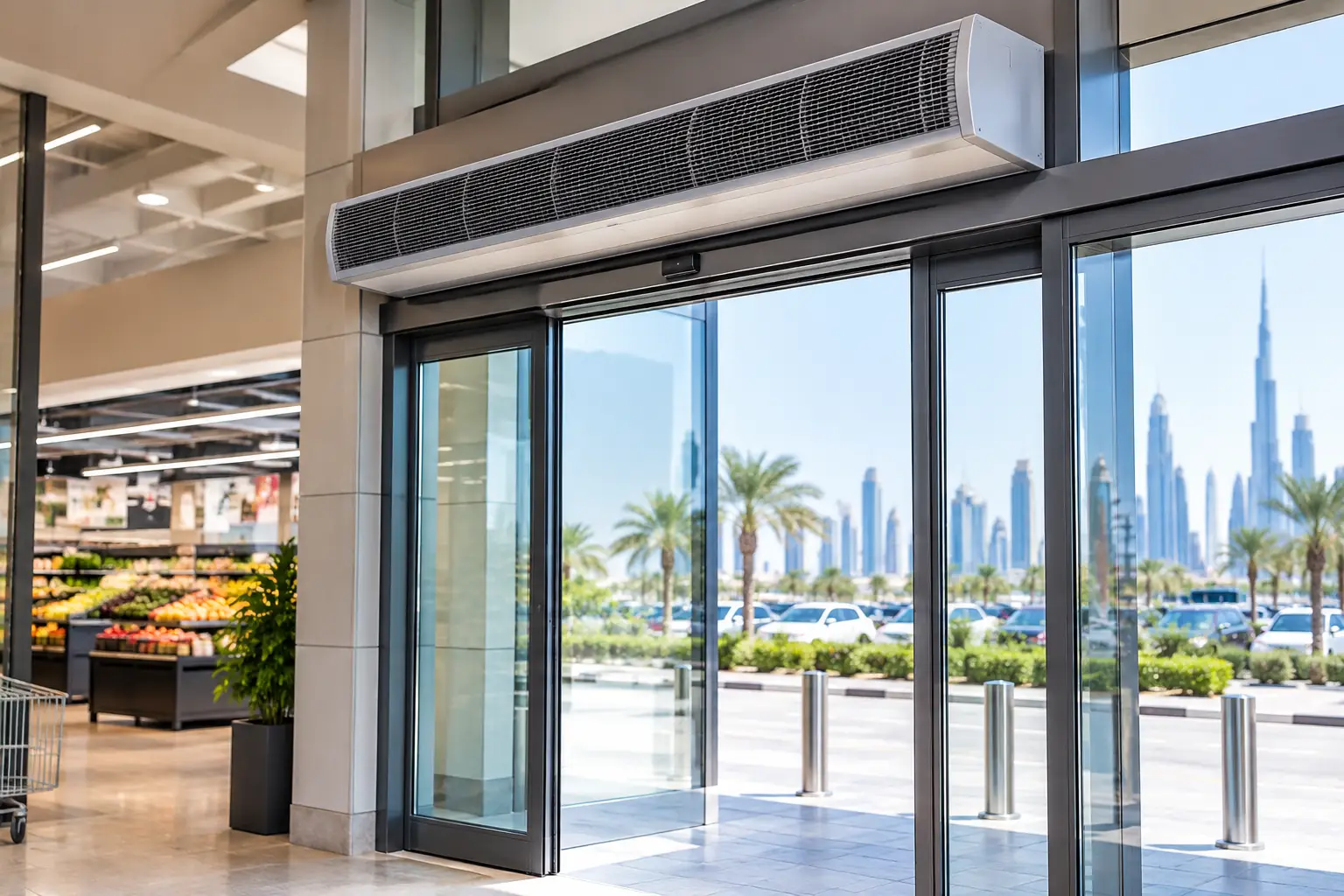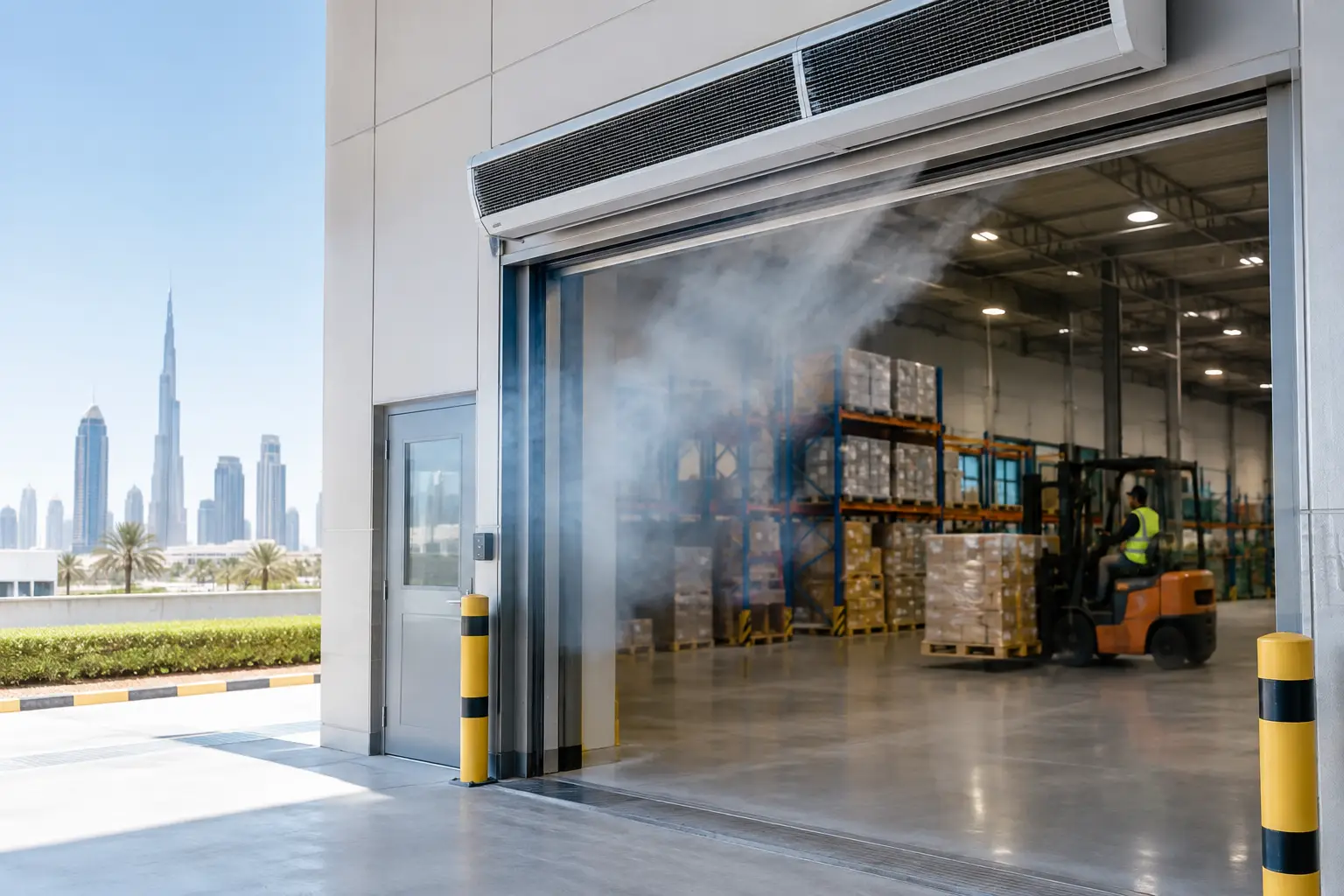
A loading bay in Dubai at 2 p.m. is not a gentle test for any entrance system. Heat pushes in, dust rides the wind, insects follow open access, and conditioned air escapes fast. That is why buyers keep asking the same question: do air curtains work outdoors, or are they only effective at enclosed commercial entrances?
The short answer is yes, they can work outdoors, but only when the application is defined correctly. An outdoor air curtain is not a magic wall. It is an engineered air barrier, and its performance depends on opening size, wind exposure, mounting height, discharge velocity, and the climate conditions around the entrance. In tropical and desert markets, those factors matter even more.
Do air curtains work outdoors in real facilities?
They do, but the better question is what “work” means in your facility. If the goal is to reduce dust ingress at a semi-exposed warehouse opening, limit flying insects at a service entrance, or cut cooling loss at a frequently used commercial doorway, an outdoor-rated air curtain can deliver a measurable result. If the expectation is complete environmental separation at a fully exposed opening facing strong crosswinds, performance becomes far more conditional.
That distinction is where many projects go wrong. Air curtains are often treated as generic accessories. In reality, they are application-driven equipment. A unit that performs well at a recessed lobby entrance will not automatically perform well at an exposed industrial door in Riyadh, Lagos, or Nairobi.
What makes outdoor air curtain performance harder?
Indoor entrances are relatively stable. Outdoor openings are not. The air barrier has to compete with pressure differences, moving vehicles, temperature extremes, humidity, and unpredictable wind.
In hot-weather regions, the challenge is not just outside air entering the building. It is the speed and volume of that infiltration. When a door is open at a retail entrance, cold room threshold, hotel service area, or plant access point, the HVAC system starts losing ground immediately. The hotter and dustier the external environment, the more valuable a well-designed air barrier becomes.
At the same time, this is exactly why poor specification fails. If the unit is undersized, mounted too high, or selected without considering side winds, the air stream can break apart before it reaches the floor. Once that happens, the barrier effect drops sharply.
Where outdoor air curtains perform well
Outdoor air curtains perform best at openings that are exposed but still reasonably controlled. A commercial entrance with an overhang, a logistics opening shielded from direct wind, or a service door with high traffic but limited lateral gusts are all good examples.
In these conditions, the unit can create a stable downward air stream that helps separate indoor and outdoor zones. That separation can reduce heat transfer, airborne dust, insects, and humidity migration. For facilities running air conditioning continuously, that also means less strain on cooling equipment and more stable indoor comfort near the doorway.
This is especially relevant in hypermarkets, hospitality back-of-house zones, food handling spaces, workshops, and industrial support buildings across the GCC, MENA, and Africa. In these markets, entrances are often open longer and exposed to harsher ambient conditions than specifiers in mild climates ever have to consider.
Where they struggle outdoors
An air curtain has limits. At a fully exposed opening with heavy crosswinds or turbulent air movement, performance can become inconsistent. This is common at large industrial doors facing open yards, transport docks with constant vehicle movement, or entrances where wind funnels between structures.
In those cases, the outdoor environment can overpower the air stream. The result is not that the air curtain stops working entirely, but that its effectiveness falls below the operational target. You may still reduce insects or dust to some degree, yet fail to hold the thermal separation needed for real energy savings.
That is why serious projects should not ask whether an air curtain works outdoors in theory. They should ask whether it works at this opening, under this wind load, at this mounting height, with this traffic pattern.
The technical factors that decide the outcome
Air velocity and throw
For an outdoor application, discharge velocity is critical. The air stream must travel from the unit to the floor or opposing side with enough force to stay intact. If velocity is too low, the barrier disperses before it can do the job.
This is one reason industrial and commercial centrifugal designs are often preferred for demanding entrances. They are built to produce the pressure and airflow stability required for larger or more difficult openings.
Mounting height
The taller the opening, the more demanding the application. A unit mounted above a standard pedestrian door has a very different performance profile from one installed over a tall service entrance. Matching the air curtain to the actual installation height is non-negotiable.
Wind exposure
Crosswinds are the biggest outdoor complication. Even a strong unit can be compromised if side gusts disrupt the air stream. In exposed sites, shielding measures, door orientation, or a different equipment layout may be required.
Opening width and traffic frequency
A wide opening with constant traffic creates repeated disturbances in the barrier. Forklifts, carts, and foot traffic all affect stability. The unit must be selected not only for dimensions, but for how the opening is used during peak operation.
Climate severity
In desert and tropical regions, high ambient heat, dust, and humidity make the case for air curtains stronger, but they also raise the specification standard. The equipment has to be built for hard-duty performance, not just occasional use.
Outdoor air curtains and energy savings
This is often the commercial driver behind the decision. If a cooled facility keeps losing conditioned air through a frequently open entrance, energy costs rise and indoor comfort drops. An effective air curtain helps reduce that loss by limiting the exchange between indoor and outdoor air masses.
But this benefit is not automatic. The energy result depends on whether the air barrier is actually maintained under real operating conditions. A correctly selected unit at a hotel entrance in Abu Dhabi or a supermarket in Cairo can support meaningful cooling retention. A weak unit at a fully exposed industrial opening may offer only partial benefit.
For buyers focused on operating cost, the right question is not “Will it save energy?” It is “How much infiltration can it realistically reduce at this entrance?” That is a specification question, not a marketing one.
Dust, insects, and hygiene control outdoors
For many facilities, outdoor performance is less about temperature and more about cleanliness. Air curtains are widely used to reduce airborne dust, flying insects, and unconditioned air entering through high-traffic openings.
This matters in food retail, hospitality receiving areas, light industrial processing, and commercial buildings where entrance hygiene affects operations. In hot and humid markets, insect pressure can be severe. In desert-adjacent sites, fine dust infiltration becomes an ongoing maintenance and air quality issue.
A properly engineered air barrier can help on both fronts. It will not replace physical doors, pest-control protocols, or good building envelope design. But it can significantly improve control at openings that cannot remain closed during normal business activity.
Choosing the right outdoor setup
If the entrance is partially exposed and operationally important, an air curtain may be the right solution. If it is fully open to strong weather, the project may need a more specialized design approach or a combination of measures.
That is why consultation matters. Outdoor applications should be selected around actual site conditions, including wind direction, opening dimensions, traffic volume, and cooling objectives. Product family matters too. Commercial entrances, heavy industrial doors, recessed architectural openings, and high-performance centrifugal applications do not belong in one generic category.
For specifiers and facility teams, the safest approach is to treat outdoor air curtains as engineered climate-control equipment, not off-the-shelf accessories. That is the difference between a unit that looks correct on paper and one that performs in Doha humidity, Muscat heat, or a dusty service entrance in Casablanca.
So, do air curtains work outdoors?
Yes, when the opening is suitable and the unit is specified for the actual environment. No, not every model will succeed at every exposed entrance. Outdoor performance is real, but it is conditional.
That is not a weakness of the technology. It is simply how air movement works. Strong results come from matching air volume, velocity, mounting height, and environmental exposure to the job at hand.
If you are evaluating an outdoor entrance for a commercial or industrial site in a hot, high-traffic market, the best next step is a specification review. FreezeeX supports contractors, consultants, and facility teams with climate-adapted air curtain recommendations built for tropical and desert conditions. Request a consultation or quote based on your entrance dimensions, traffic pattern, and site exposure, and you will get a system recommendation that fits the real operating load – not a generic guess.