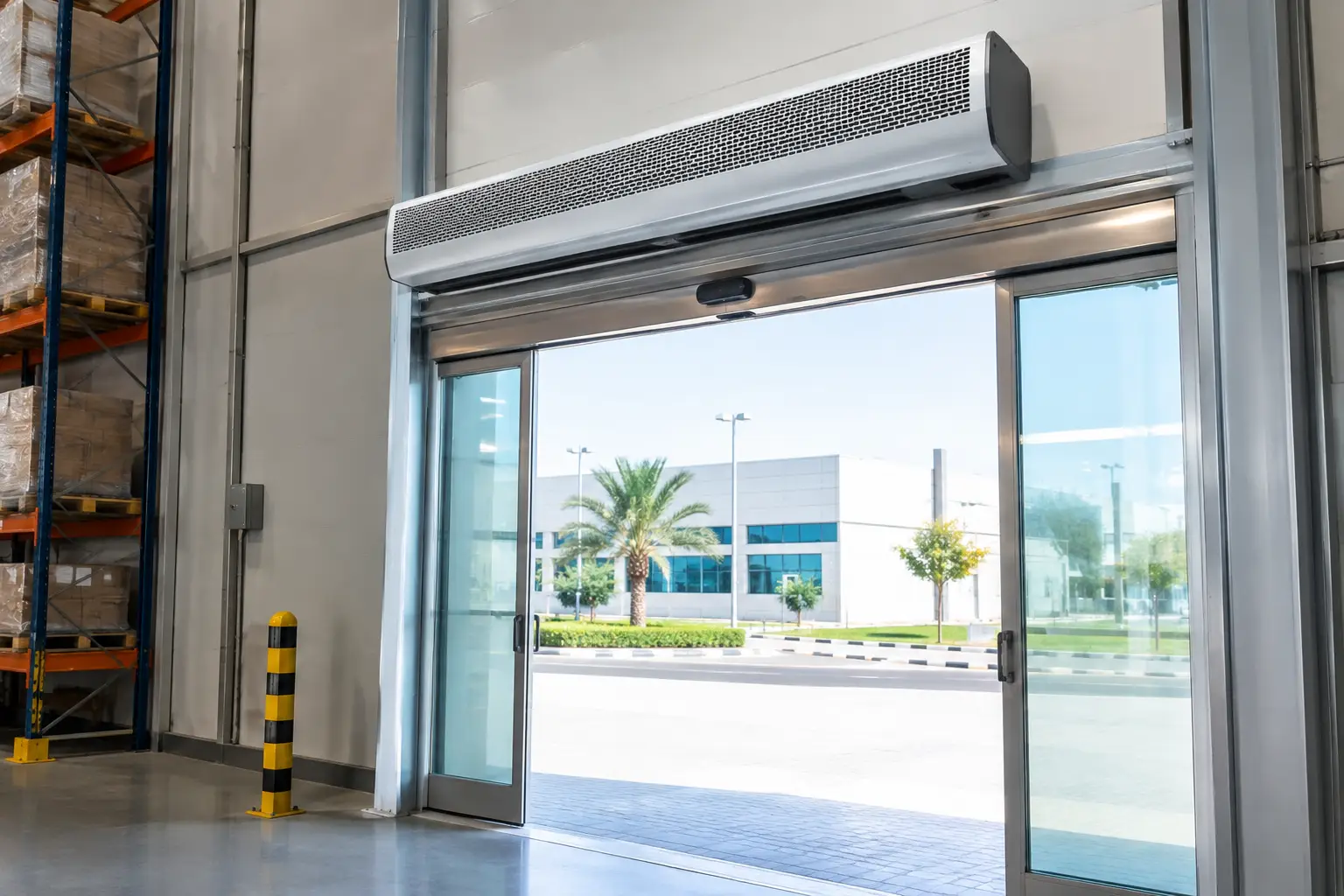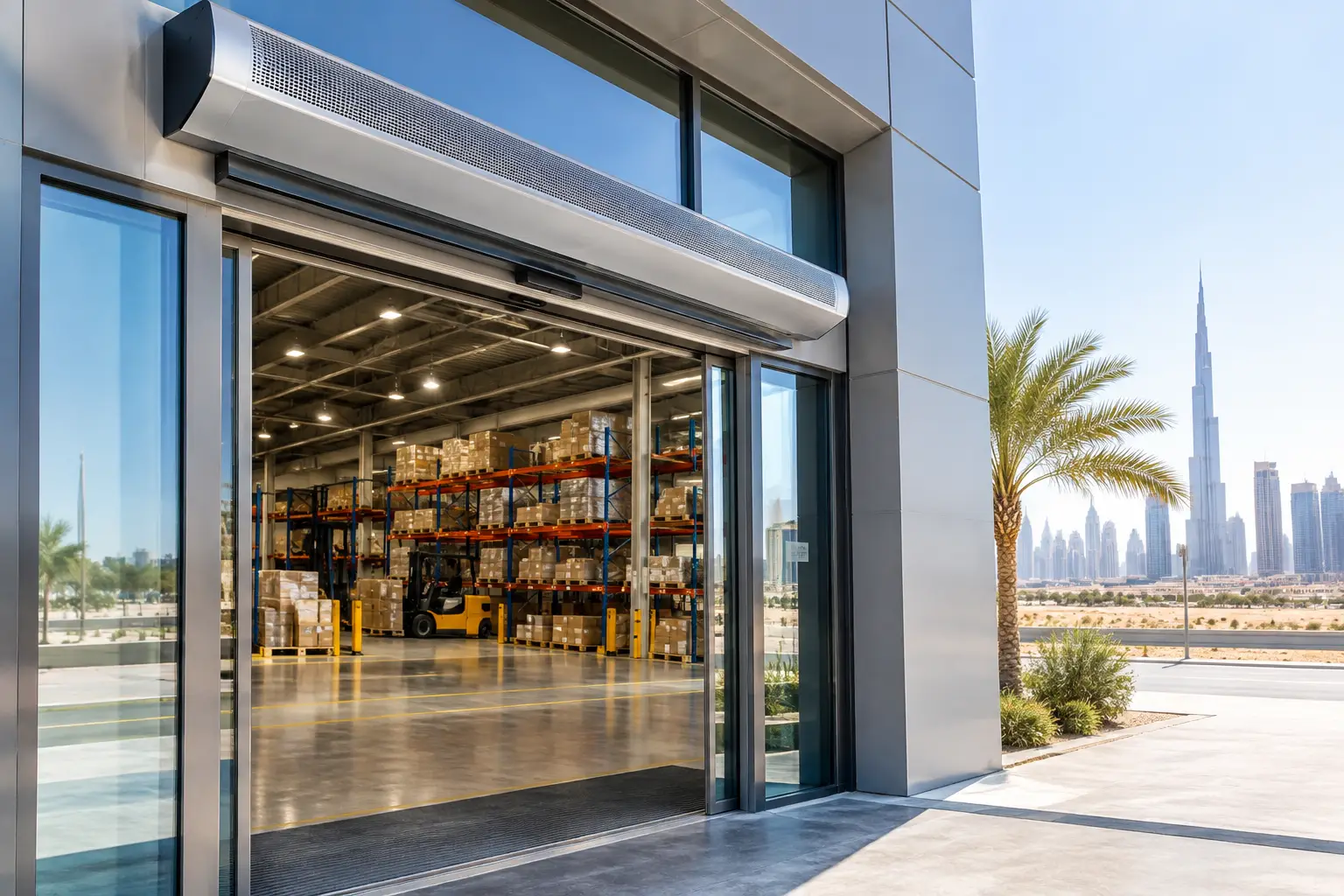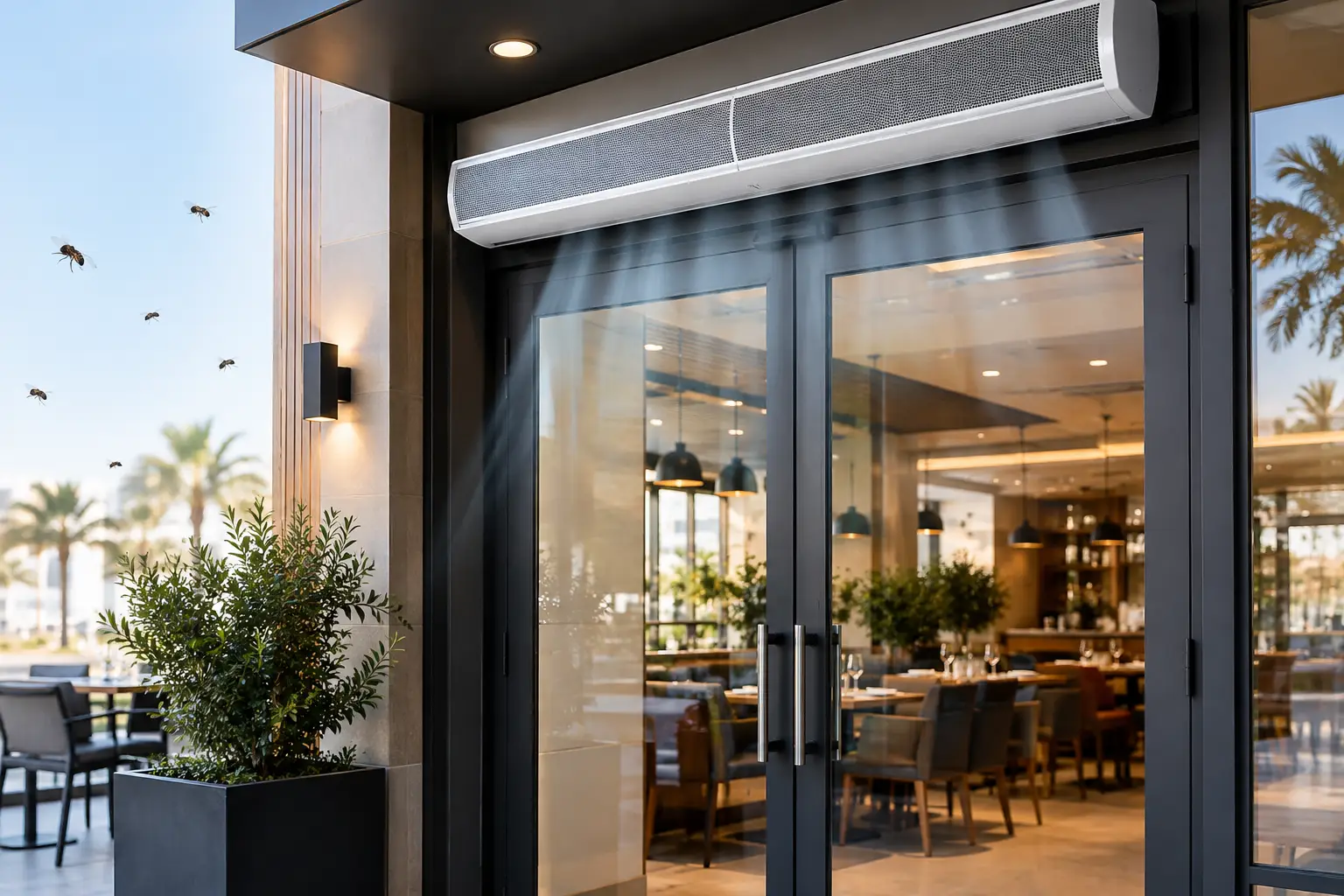
A warehouse roller shutter opens for a delivery, and fine outdoor dust begins moving toward conditioned storage space almost immediately. For facilities in Dubai, Riyadh, Doha, Cairo, Lagos, and other hot or dusty markets, the question is practical: can air curtains block dust without slowing traffic at the entrance?
The answer is yes, to a meaningful extent, when the system is correctly specified and installed. An air curtain creates a high-velocity stream of air across an opening, forming an active barrier between outdoor and indoor conditions. That barrier can reduce the amount of airborne dust drawn through an open doorway. It is not a physical wall or a replacement for filtration and housekeeping, but it is a valuable first line of defense at high-traffic entrances.
How Air Curtains Reduce Dust Entry
Dust enters through open doors because of wind pressure, vehicle movement, foot traffic, and pressure differences between conditioned interiors and hotter outdoor areas. When the entrance is open, cooled indoor air can escape while hot, dusty outdoor air moves inward to replace it.
A properly designed air curtain directs a continuous, controlled airflow from the top or side of the opening. This airflow helps separate the two environments. Rather than allowing outside air to pass freely through the doorway, the air curtain disrupts and deflects much of it before it reaches the interior.
This provides two connected operational benefits: less airborne dust entering the building and less loss of treated indoor air. In desert and tropical climates, those outcomes matter together. Dust increases cleaning demands and can affect product handling, while heat and humidity increase the burden on the building’s HVAC system.
Air curtains do not trap every dust particle
An air curtain should be specified as an air-isolation solution, not as a dust filtration device. Its purpose is to reduce the exchange of air at an open entrance. Very fine particles can still enter, especially when strong winds, long door-open periods, or vehicle movements disturb the airflow.
The most reliable results come from combining the air curtain with sensible entrance design, appropriate indoor filtration, regular cleaning procedures, and doors that are not left open unnecessarily.
What Determines Whether an Air Curtain Will Block Dust Effectively?
The performance of an air curtain depends on the application, not simply on whether a unit is installed above a door. A unit that works well at a retail entrance may not deliver the necessary air separation at a tall warehouse opening or an industrial loading bay.
Key specification factors include:
- Door height and width: The airflow must reach the full opening and maintain enough force near floor level, where dust can be carried inward.
- Mounting position: Over-door, recessed ceiling, and other mounting arrangements affect the direction and stability of the air stream.
- Traffic volume: Frequent pedestrian movement, pallet handling, and forklift traffic create disruption that must be considered during selection.
- Outdoor exposure: Entrances facing prevailing winds, unpaved yards, roads, or loading areas often need more careful airflow planning.
- Indoor pressure and HVAC conditions: The air curtain must work with the building’s cooling and ventilation strategy, not against it.
- Application sensitivity: Food processing, pharmaceutical areas, healthcare facilities, and cold storage entrances may have stricter contamination-control expectations than general retail or warehouse sites.
For this reason, air curtain selection should begin with the opening and operating conditions, not a generic product size. FreezeeX evaluates entrance dimensions, climate exposure, traffic, mounting constraints, and HVAC requirements before recommending a commercial or industrial system.
Can Air Curtains Block Dust in Desert and Humid Conditions?
They can be particularly useful in the GCC, MENA, and African markets where outdoor air may carry dust, sand, heat, humidity, or vehicle-related contaminants. However, the installation must be suited to the actual site conditions.
At a street-facing supermarket in Abu Dhabi, the challenge may be frequent customer traffic and dust from nearby roads. At a logistics facility outside Riyadh, a loading door may be exposed to large volumes of dust during vehicle movements. A hotel entrance in a humid coastal location may need to limit both humid air infiltration and airborne particles.
In each case, the air curtain must establish a stable barrier across the opening. If the discharge air loses momentum before reaching the floor, or if side winds overpower the stream, dust reduction will be limited. This is why industrial entrances generally require a different approach from standard commercial doors.
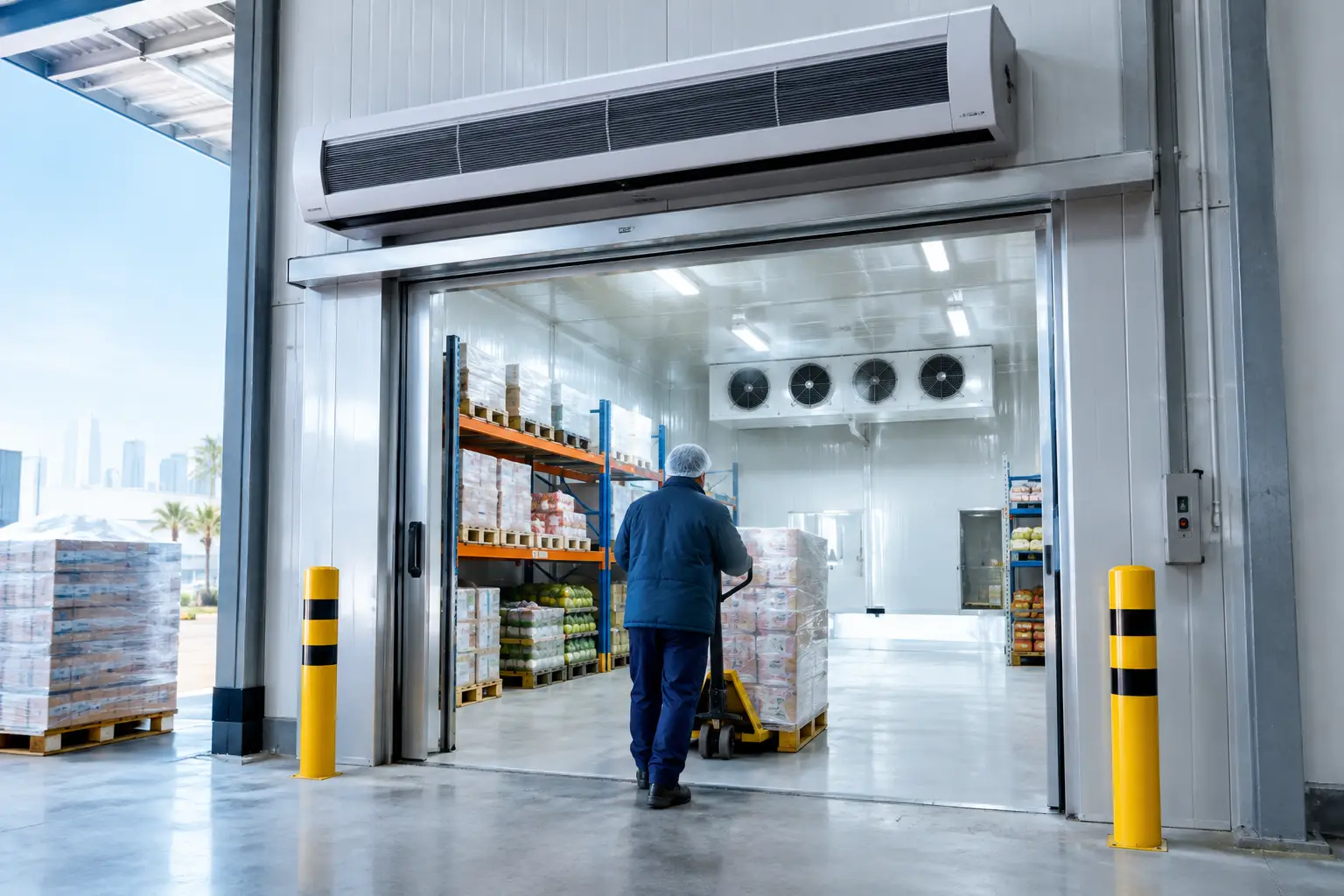
| Entrance condition | Dust-control challenge | Air curtain requirement | |—|—|—| | Retail or supermarket door | Frequent pedestrian traffic and street dust | Consistent coverage with a comfortable, reliable airflow barrier | | Restaurant or hotel entrance | Outdoor dust, humidity, and guest comfort | Controlled air separation matched to the entrance design | | Warehouse loading door | Forklift movement, tall openings, and vehicle dust | Heavy-duty airflow designed for larger, more exposed openings | | Food or pharmaceutical facility | Higher concern over contaminants entering process areas | Application-specific selection coordinated with site hygiene controls | | Cold storage entrance | Temperature loss and airborne contamination | Strong air isolation that supports temperature-control objectives |
Where Air Curtains Deliver the Greatest Dust-Control Value
Air curtains are most valuable where doors must remain open for business operations. A closed door is naturally the strongest barrier, but many commercial and industrial sites cannot keep entrances closed all day.
High-value applications include retail stores, shopping malls, supermarkets, warehouses, distribution centers, factories, airports, hospitals, hotels, restaurants, and food processing facilities. They are also relevant at service counters, receiving bays, staff entrances, and transfer points between differently conditioned spaces.
The operational value is often clearest where dust creates a repeatable cost or risk. For example, a facility may face more frequent cleaning of display areas, contamination concerns around packaged goods, reduced comfort near doors, or added cooling demand caused by warm outdoor air entering the building. An air curtain helps address these issues at their source: the open entrance.
Commercial and industrial systems should not be treated the same
Commercial entrances usually prioritize customer comfort, appearance, and dependable performance during frequent short door openings. Recessed ceiling systems can suit projects where visual integration is important, while commercial centrifugal and HiFi-style ranges can be considered for demanding customer-facing environments.
Industrial sites prioritize coverage, durability, and performance at wider or taller openings. For warehouses, factories, workshops, and logistics centers, industrial centrifugal systems or dynamic air curtain solutions may be more appropriate where exposure and traffic are higher. The correct choice depends on the project conditions rather than the facility label alone.
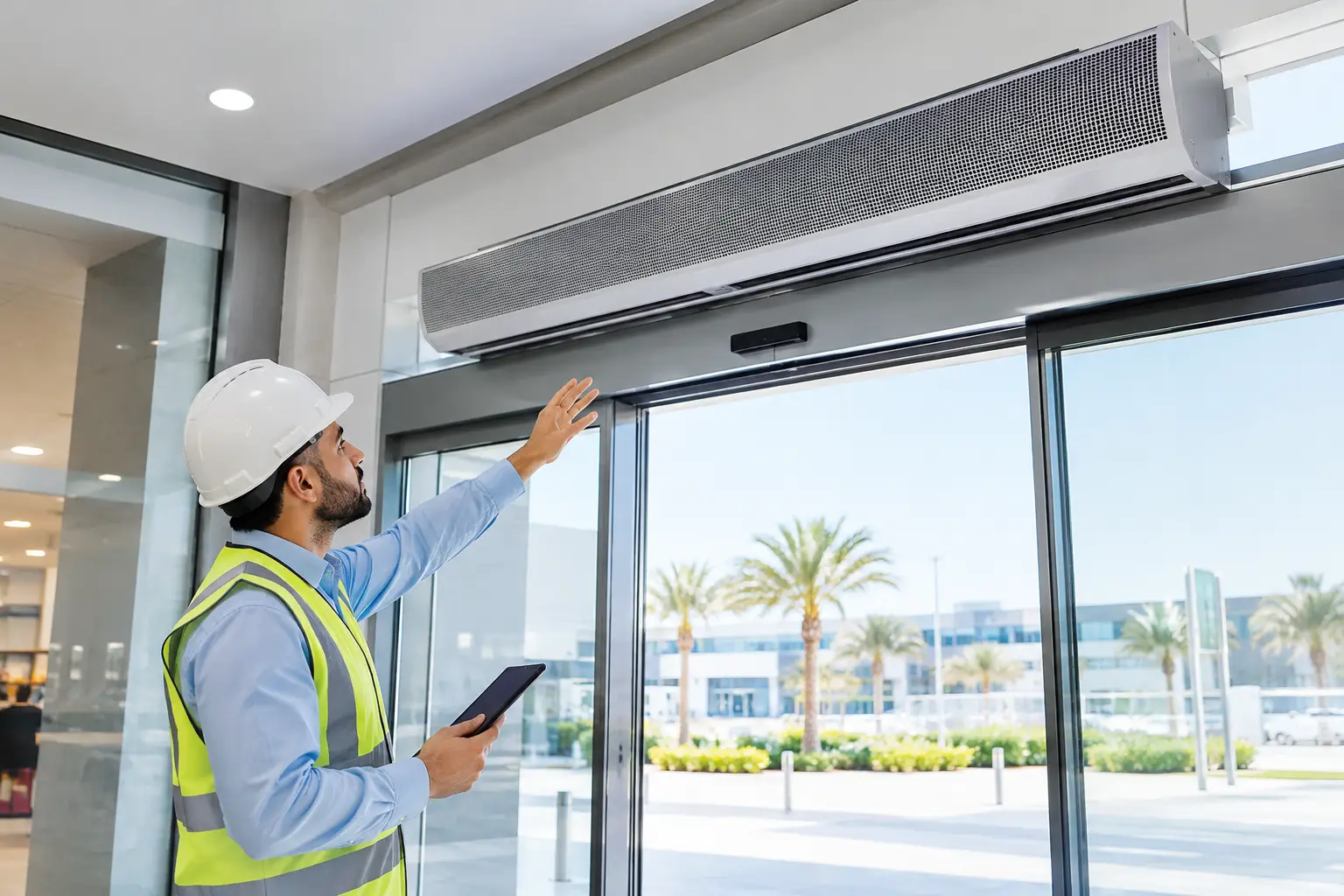
How Should a Project Team Specify an Air Curtain for Dust Control?
A practical evaluation process prevents undersized or poorly positioned equipment from becoming an expensive compromise.
- Assess the opening. Record the clear height, width, door type, mounting space, and whether the doorway is normally open, automatic, or frequently cycled.
- Identify contamination sources. Consider road dust, sand, loading-yard activity, vehicle exhaust, insects, humidity, smoke, or fumes that may affect the entrance.
- Review traffic and exposure. Confirm pedestrian volume, forklift activity, delivery schedules, wind direction, and the degree of outdoor exposure.
- Coordinate with HVAC design. Check how air conditioning, return-air paths, and indoor pressure conditions influence the doorway.
- Select the air curtain category. Match commercial, recessed, or industrial equipment to the opening, appearance requirements, and operating intensity.
- Plan professional installation and commissioning. The discharge angle and final positioning should be set to create effective coverage across the full doorway.
This process is especially relevant for consultants and MEP contractors working on projects where entrance performance affects both indoor comfort and operational cleanliness.
Common Reasons Dust Still Enters Through an Air-Curtained Door
A system may be present but still underperform if it is not matched to the site. The most common causes are an air curtain that is too small for the door height, incomplete coverage across a wide entrance, poor discharge alignment, or installation at an opening with strong crosswinds that were not considered in the design.
Long periods of fully open doors can also change the result. Air curtains reduce air exchange, but they cannot recreate the protection of a closed physical door under every condition. At loading docks, combining an air curtain with operational door discipline and appropriate dock layout can improve results substantially.
Maintenance also matters. Dust accumulation around the equipment or obstruction of the air path can affect airflow quality over time. Facility teams should include air curtain inspection in their planned maintenance program and assess performance after changes to the entrance, traffic pattern, or HVAC operation.
A Better Entrance Strategy for Dust-Prone Facilities
The most effective air curtain is the one designed around the entrance’s real operating conditions. For a high-traffic retail doorway, that may mean discreet commercial air isolation. For a warehouse or factory in a dust-exposed area, it may mean a heavier-duty solution built to maintain separation at a demanding opening.
If your facility operates in extreme heat, humidity, or desert dust conditions, request a project consultation and quotation from FreezeeX. A properly matched commercial or industrial air curtain can help protect indoor comfort, reduce dust infiltration, and support more efficient HVAC operation without interrupting essential traffic flow.