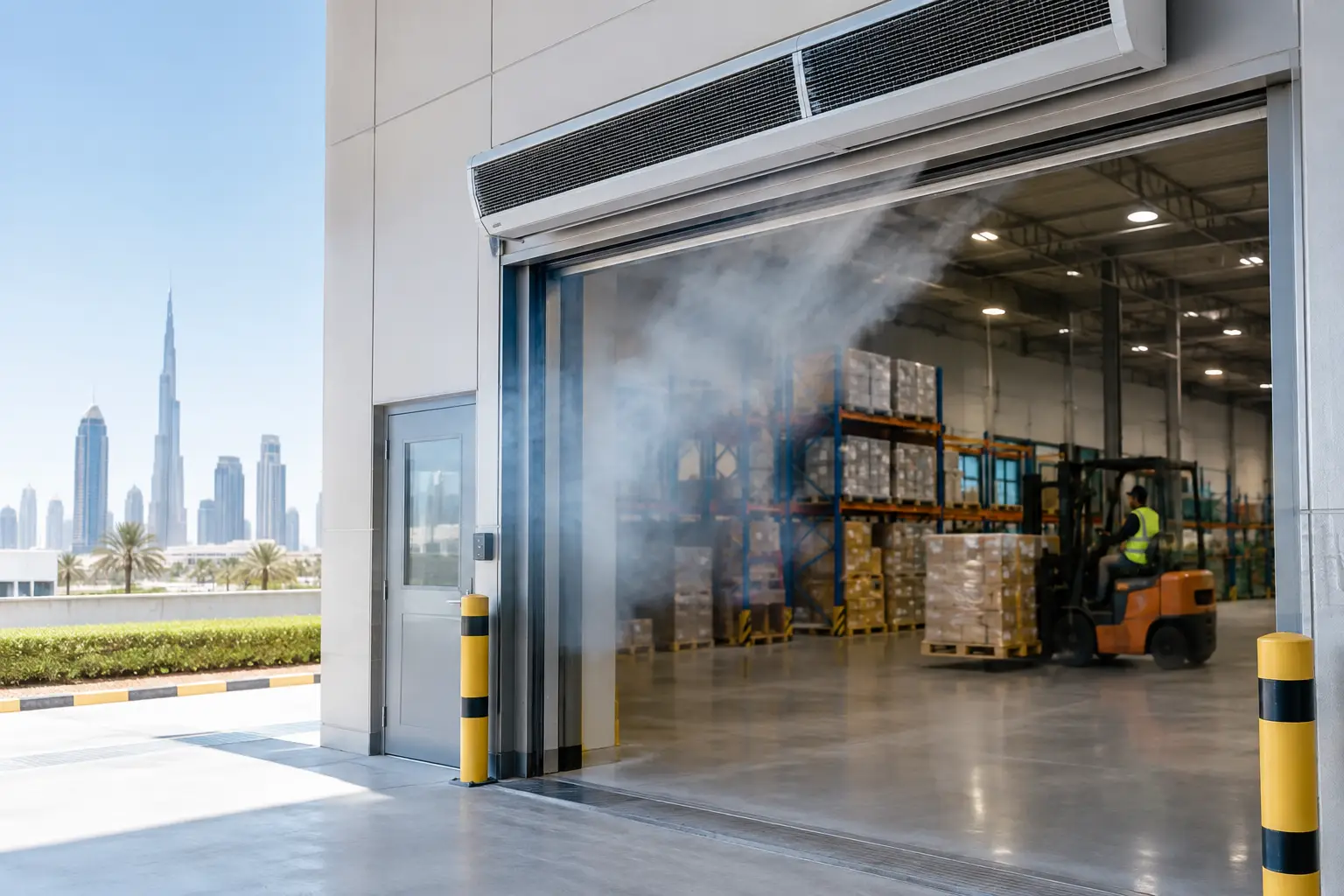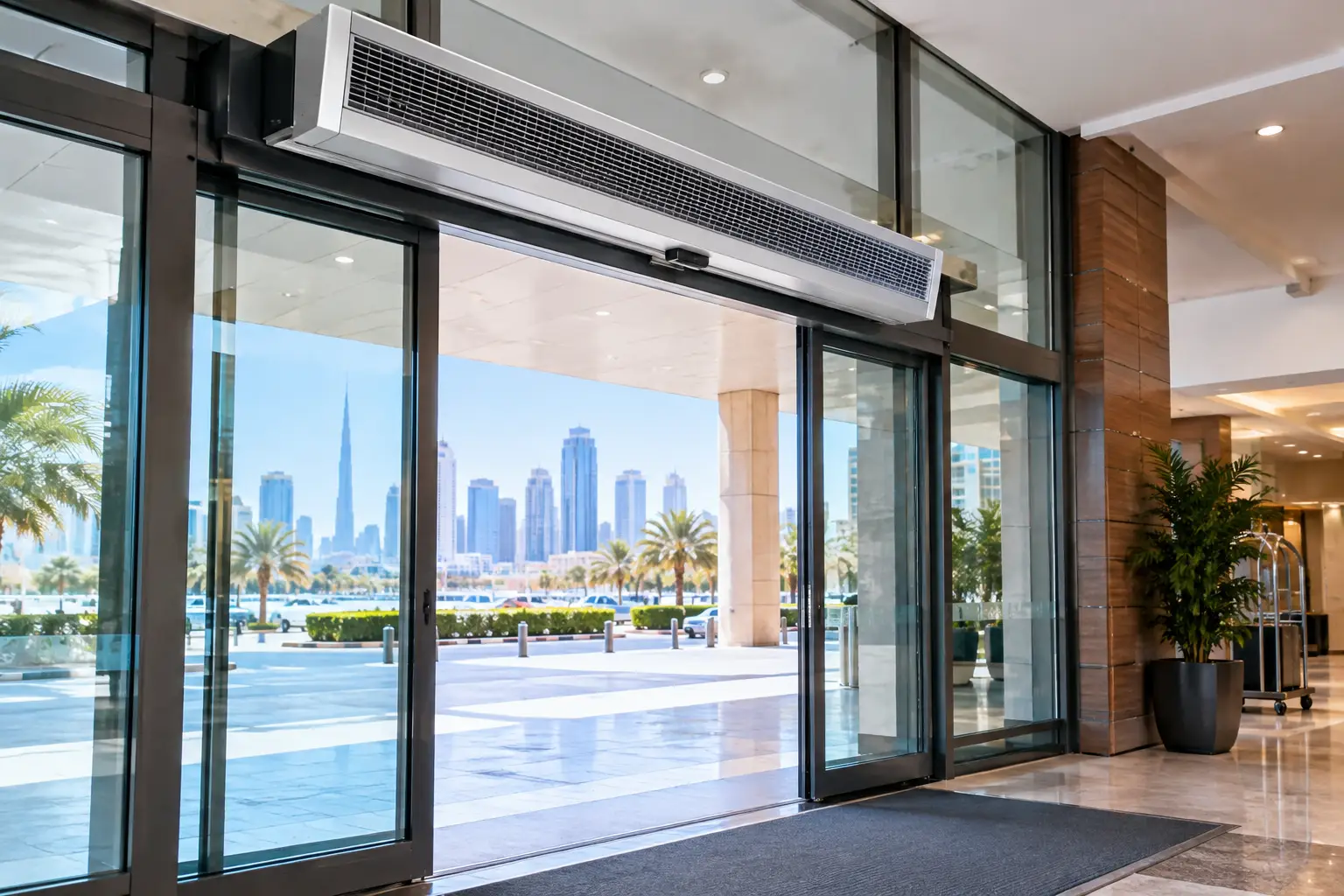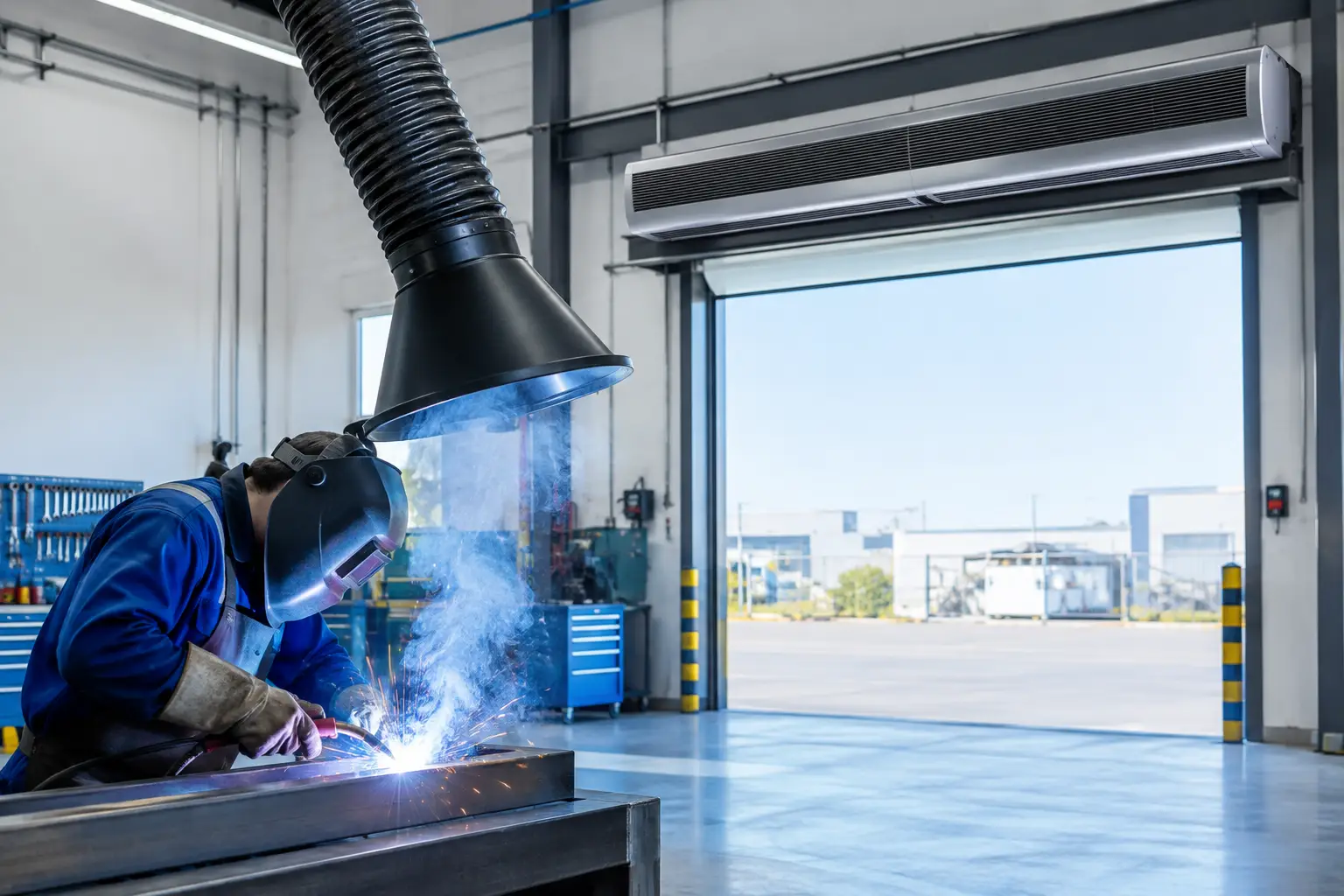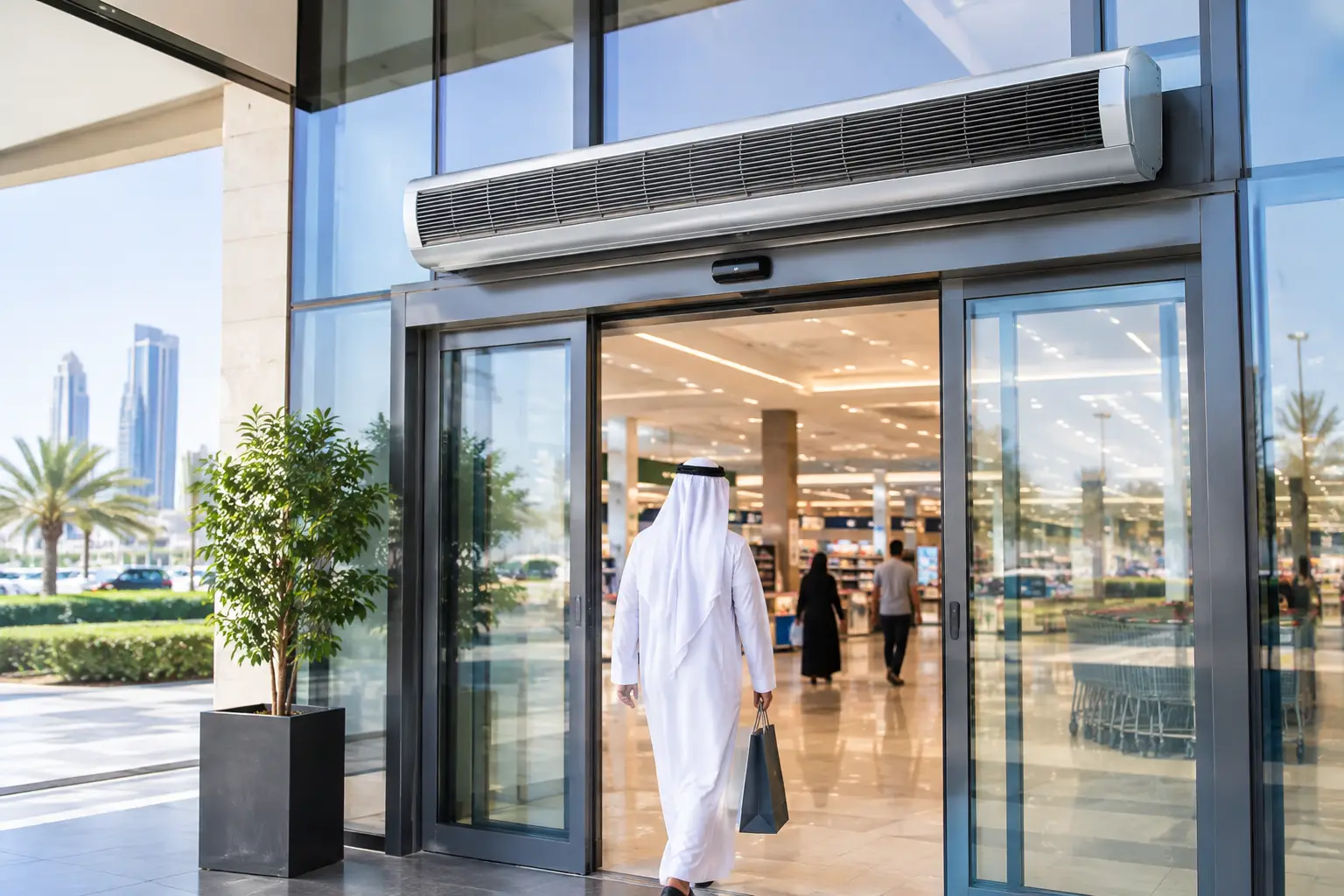
A busy loading bay in Dubai, a supermarket entrance in Riyadh, or a hotel lobby in Doha can lose conditioned air every time its doors open. The best thermal barriers for these environments are not simply the thickest physical partitions. They are systems selected to manage the pressure, airflow, traffic, and climate conditions at an active entrance without interrupting operations.
For commercial and industrial facilities in hot, humid, and dusty regions, an air curtain is often the most practical thermal barrier where doors must remain open or cycle frequently. It creates a controlled, high-velocity air stream across the opening, helping separate indoor conditioned air from outdoor heat, humidity, dust, insects, and airborne contaminants.
What Makes a Thermal Barrier Effective?
A thermal barrier limits the transfer of heat between two spaces. At a fixed wall or insulated door, that job is mainly handled by material resistance. At an operational entrance, the challenge is different: the opening itself becomes a path for hot air infiltration and cooled-air escape.
A correctly specified air curtain addresses that moving boundary. Its airflow must reach the floor or threshold with enough velocity and stability to resist crosswinds, pressure differences, and passing people or vehicles. An undersized unit may look appropriate above the opening but lose effectiveness before the air stream reaches the bottom. An oversized unit can create unnecessary noise, energy use, or discomfort near the doorway.
For this reason, “best” should mean best suited to the entrance condition, not a one-size-fits-all model. Door width, mounting height, indoor temperature setpoint, exterior exposure, building pressure, and door traffic all affect the selection.
Best Thermal Barriers by Entrance Type
Retail, supermarkets, and hotel entrances
Customer-facing entrances need effective air separation without creating an aggressive draft or detracting from the interior design. Commercial air curtains are typically specified above single doors, sliding entrances, and wider retail openings where frequent foot traffic makes physical doors impractical.
For these applications, appearance, noise level, and even airflow distribution matter alongside performance. Recessed ceiling air curtains can provide a more integrated finish in hotel lobbies, premium retail, and malls. Surface-mounted commercial units may be more practical where ceiling access or installation timing is limited.
In high-heat locations such as Abu Dhabi or Kuwait City, the air curtain should be evaluated with the entrance fully exposed to outdoor conditions, not only against the nominal door size. A shaded internal mall doorway and a street-facing glass entrance can require very different airflow capacity.
Warehouses, logistics centers, and factories
Industrial openings require a different approach. Dock doors, dispatch bays, workshops, and manufacturing entrances often have greater mounting heights, wider spans, forklift movement, and stronger pressure fluctuations. Here, the thermal barrier needs reach and durability first, with noise usually a secondary consideration.
Industrial centrifugal air curtains are suited to demanding openings because centrifugal blowers can deliver the pressure needed to project airflow over larger distances. The equipment must also be selected around actual door operation. A 12-foot-high opening that stays open for several minutes during loading creates a different infiltration load than a personnel door that opens for seconds at a time.
Where dust is a persistent issue, such as facilities near construction zones, ports, or desert transport routes, the barrier contributes to cleaner indoor conditions while reducing the cooling load on the facility HVAC system. It should not be treated as a substitute for appropriate filtration or building pressurization, but it can reduce the volume of contaminated outdoor air entering through the opening.
Cold storage and food processing entrances
Cold rooms, refrigerated distribution areas, and food processing sites face a severe temperature differential at the doorway. Warm, moisture-laden air entering the space can raise refrigeration demand and introduce condensation risks. The aim is not merely to keep a room feeling cooler. It is to reduce infiltration that affects operational stability, product handling, and energy consumption.
Air curtains can form part of an entrance-control strategy at these openings, particularly where traffic makes strip curtains or rapid doors alone insufficient. The specification must account for door height, traffic pattern, temperature differential, humidity, and hygiene requirements. Equipment placement and service access also matter in food environments, where cleaning and operational continuity are essential.
Hospitals, pharmaceutical facilities, and controlled spaces
In hospitals and pharmaceutical facilities, thermal separation often overlaps with cleanliness and pressure management. An air curtain can help reduce the entry of dust, insects, and airborne particulates through a high-traffic doorway, but it does not independently create a certified cleanroom or replace a dedicated contamination-control design.
The right solution depends on the room classification and the facility’s pressure regime. Consultants should assess whether airflow direction, door operation, and adjacent spaces support the intended barrier effect. This is particularly relevant at receiving doors, staff entrances, and transitions between conditioned public areas and external access points.
Air Curtain Design Factors That Matter Most
The performance of an air curtain depends on more than its motor rating. Specification teams should examine the full entrance condition before choosing a model.
Mounting height determines whether the air stream can reach the floor with useful residual velocity. Width coverage is equally critical: gaps at either side of the opening become weak points where hot air and dust can enter. For wider doors, multiple units or a purpose-configured arrangement may be necessary.
External wind and building pressure can also disrupt the air stream. A doorway facing prevailing winds, a facility with powerful exhaust systems, or an open loading area may need greater air throw and pressure capability than a protected entrance. In humid coastal markets such as Lagos, Mombasa, or Muscat, moisture infiltration adds another reason to size the barrier carefully.
Control strategy should match usage. Door contacts, building management controls, and staged operation can allow the air curtain to run when the entrance is active rather than continuously at full output. The result is more consistent protection and a better balance between barrier performance and operating cost.
Thermal Barrier Options and Their Trade-Offs
Physical doors, vestibules, strip curtains, rapid doors, and air curtains can all contribute to thermal control. The appropriate choice depends on how the opening is used.
A vestibule can be highly effective at a public entrance, but it requires floor area and may disrupt circulation. Strip curtains are useful in some industrial and cold-storage applications, yet they can obstruct forklift or pedestrian flow and may be unsuitable for customer-facing areas. Rapid doors can reduce open-door duration, but loading activity and repeated traffic may still create infiltration whenever the door is open.
Air curtains are especially valuable when the opening must remain accessible and unobstructed. They work best as part of a coordinated entrance strategy, not as a generic add-on. For example, a logistics facility may combine an industrial air curtain with disciplined dock-door controls, while a supermarket may use a commercial unit at its primary entrance to preserve customer comfort and reduce cooling loss.
Selecting a System for Desert and Tropical Climates
Extreme outdoor conditions raise the cost of poor entrance control. In desert climates, the concern is intense sensible heat and dust. In tropical climates, high humidity can add latent cooling load and condensation concerns. Across many GCC, MENA, and African markets, facilities encounter both high temperatures and heavy daily traffic.
This is why product selection should be based on measured site conditions rather than catalog dimensions alone. Specify the clear opening width and height, mounting location, exposure to wind, door type, expected traffic, indoor and outdoor temperatures, and the HVAC objective. For a warehouse, the objective may be reducing dust and cooling loss at a dispatch bay. For a restaurant or supermarket, it may also include insect control and guest comfort.
Commercial centrifugal, HiFi, recessed, dynamic, and industrial series units each suit different combinations of aesthetics, airflow requirement, and mounting condition. The decision should follow the application, not the other way around.
A Better Basis for Specification
The best thermal barrier is the one that protects the opening under real operating conditions while supporting the facility’s HVAC and workflow requirements. It should provide continuous width coverage, sufficient air throw, controllable operation, and a practical maintenance arrangement. It should also be selected for the climate it will face, particularly where extreme heat, humidity, and dust are routine.
Before finalizing an air curtain schedule, provide the entrance dimensions, mounting height, photographs or drawings, traffic type, and exposure conditions for a project consultation and quotation. A site-specific recommendation helps ensure the selected system performs at the door, where cooling loss and infiltration actually occur.