A terminal entrance can open hundreds or thousands of times each day. Every opening gives hot, humid, dusty outdoor air a direct path into a conditioned public space, placing immediate demand on the building HVAC system. The best air curtains for airports are therefore not defined by a single model or a simple airflow rating. They are specified around each entrance’s height, width, exposure, passenger traffic, pressure conditions, and acoustic requirements.
For airport operators, MEP consultants, and contractors, the goal is clear: preserve indoor comfort at busy doorways without creating a physical obstacle for passengers, baggage carts, accessibility equipment, or emergency movement. A properly selected air curtain creates a controlled air barrier across the opening, helping reduce the infiltration of heat, humidity, dust, insects, and airborne contaminants.
Why Airport Entrances Need a Different Specification
Airport doors are not typical commercial entrances. A retail storefront may have intermittent traffic and a relatively protected facade. An airport terminal must manage continuous passenger movement, automatic sliding doors, frequent luggage cart activity, curbside vehicle pollution, and, in many regional locations, extreme outdoor conditions.
In Dubai, Abu Dhabi, Riyadh, Doha, Muscat, Cairo, Lagos, and Nairobi, outdoor heat and humidity can place substantial strain on terminal cooling. Desert environments add windblown dust and fine particulates. Coastal terminals may face persistent humidity. In either case, conditioned air escapes whenever doors open, while untreated outside air enters at floor level and through the full door height.
An air curtain cannot replace correctly designed HVAC capacity or entrance vestibules where those are required. It can, however, reduce the load imposed by open doors and improve the effectiveness of the existing cooling strategy. This makes air curtains a practical part of entrance climate control, particularly where a physical second-door arrangement would slow passenger flow.
What Makes the Best Air Curtains for Airports
The right airport air curtain must deliver enough air velocity to reach the floor or threshold while remaining stable in the face of crosswinds and pressure differences. A unit that looks adequate on paper but loses its air stream before it reaches the floor will not provide meaningful separation between the terminal and the exterior.
Door Height and Air Throw Matter More Than Nominal Power
The first design question is the clear opening height. Standard terminal doors may be within the range of commercial centrifugal air curtains, while taller glazed entrances, baggage connections, service docks, or oversized access points may require industrial centrifugal systems or multiple units arranged in a coordinated line.
Air throw should be assessed at the actual installation height, not only at the product’s maximum stated mounting height. A terminal door with a seven-foot opening behaves differently from a tall landside entrance exposed to wind and frequent automatic door cycles. The selected system needs sufficient discharge velocity and a consistent air pattern at the floor level.
For long openings, coverage is equally important. Gaps between units allow outdoor air to bypass the barrier. Air curtain lengths should be coordinated closely with the width of the entrance, with mounting layout reviewed alongside door tracks, signage, security equipment, sprinkler clearances, and ceiling details.
Centrifugal Blowers Are Often Better for Demanding Openings
Airport entrances commonly benefit from centrifugal-flow air curtains because they are suited to higher static pressure and demanding operating conditions. Their discharge pattern can provide the controlled, concentrated airflow needed at wide or exposed openings.
Commercial centrifugal units are generally appropriate for public terminal doors of moderate height, particularly where appearance, sound levels, and reliable daily operation are all priorities. Industrial centrifugal systems are better suited to tall doors, service corridors, baggage areas, logistics access points, and other entrances where heavy-duty airflow performance takes precedence over architectural concealment.
The choice depends on the entrance, not the building label. A passenger terminal may require a discreet recessed solution at a premium check-in hall and a heavy industrial-style unit at a landside loading or maintenance access door.
Noise Must Be Considered in Public Zones
Airports are already acoustically complex environments. Public-address systems, security announcements, rolling baggage, and passenger conversation make sound control a real specification issue. An air curtain should not add unnecessary noise at boarding areas, terminal entrances, premium lounges, or customer-service zones.
Noise level must be reviewed in relation to the mounting height, fan speed, operating mode, and the surrounding ceiling design. Higher airflow is not automatically better if it creates an uncomfortable sound profile or disrupts communication near the entrance. Variable-speed control can be particularly valuable, allowing the unit to operate at an appropriate level during normal periods and increase output when doors are exposed to stronger outdoor conditions.
Select the Air Curtain by Airport Zone
Airports contain several distinct entrance environments. Treating all of them as identical is a common specification mistake.
Passenger Terminal Entrances
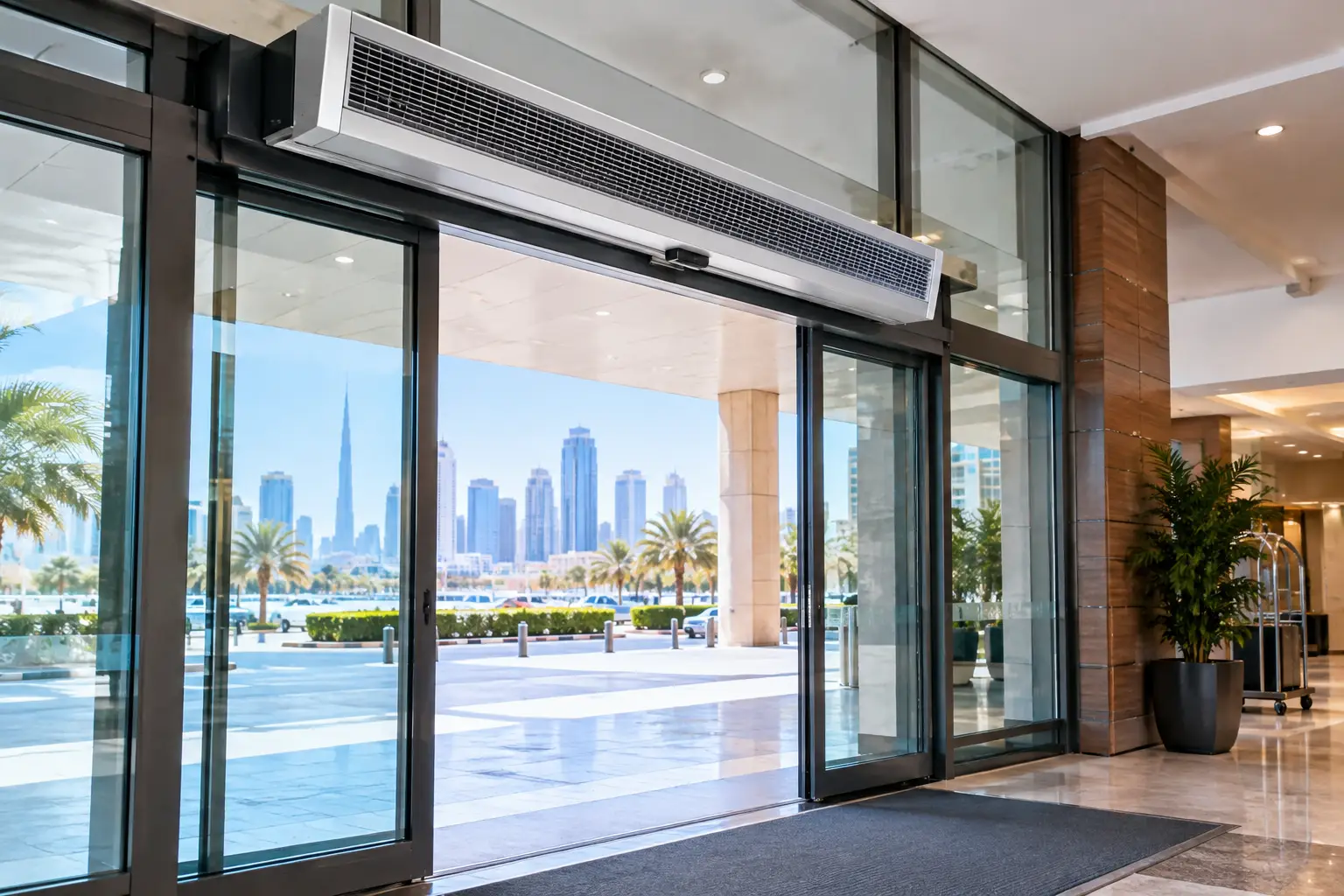
Main terminal doors typically combine high traffic with a need for a clean, professional appearance. Recessed ceiling air curtains are often considered where the ceiling design allows concealed installation and the entrance height is within the unit’s effective range. They preserve visual continuity while supporting air separation at automatic sliding doors.
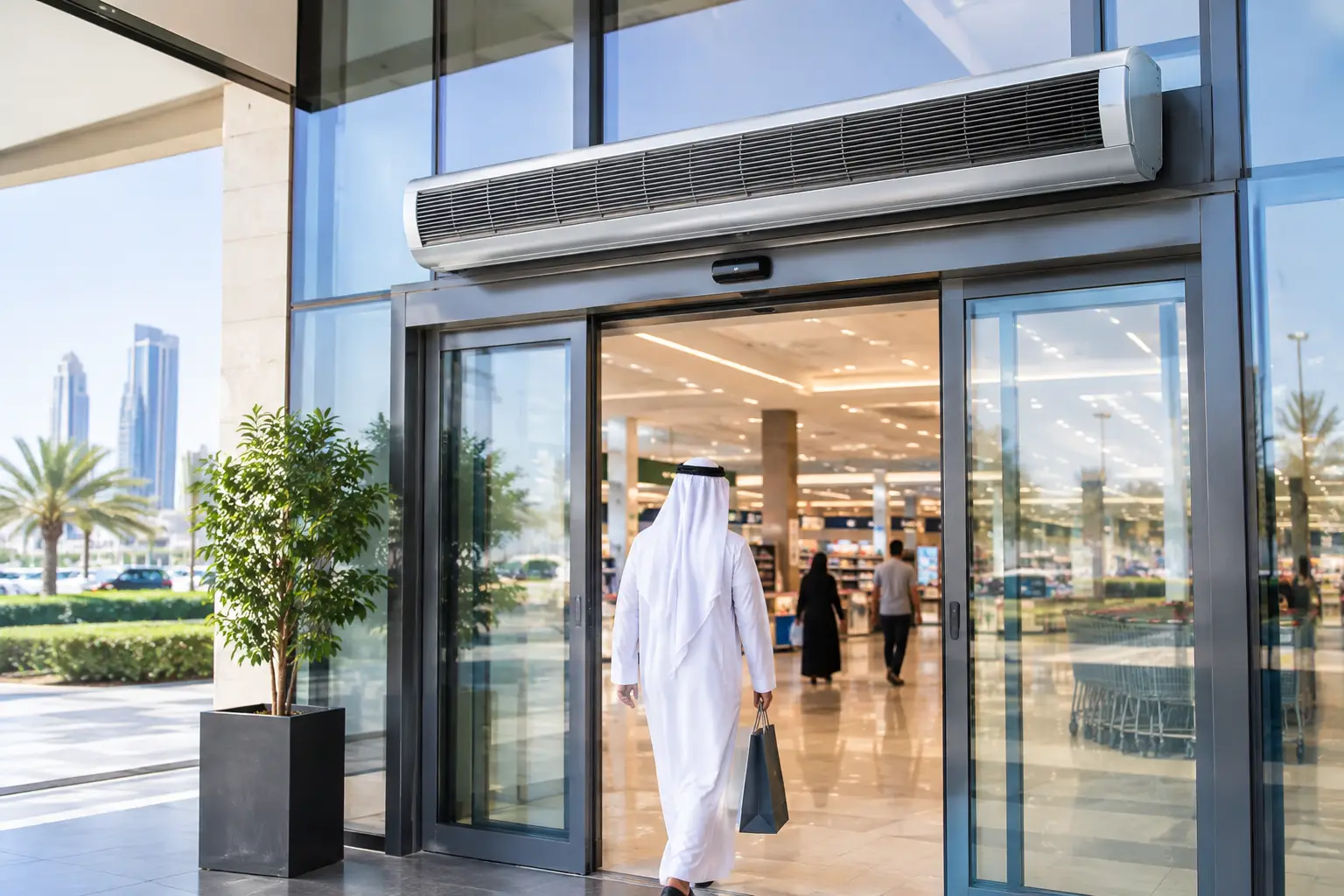
Where recessing is not practical, a commercial HiFi-style air curtain can provide a more refined visible installation for public-facing spaces. The final selection should account for façade exposure, door width, ceiling height, and peak passenger periods rather than average daily traffic alone.
Arrivals, Departures, and Curbside Doors
Curbside doors experience some of the hardest conditions in an airport. Repeated opening cycles, vehicle-generated dust and fumes, hot pavement temperatures, wind effects, and large groups moving through the entrance can all destabilize the air barrier.
These doors often need higher-performance commercial centrifugal systems, potentially with grouped units across wide door banks. Controls should be coordinated with door contacts or the building management system so the air curtain responds to door activity rather than operating at maximum output unnecessarily throughout the day.
Baggage, Cargo, and Service Access
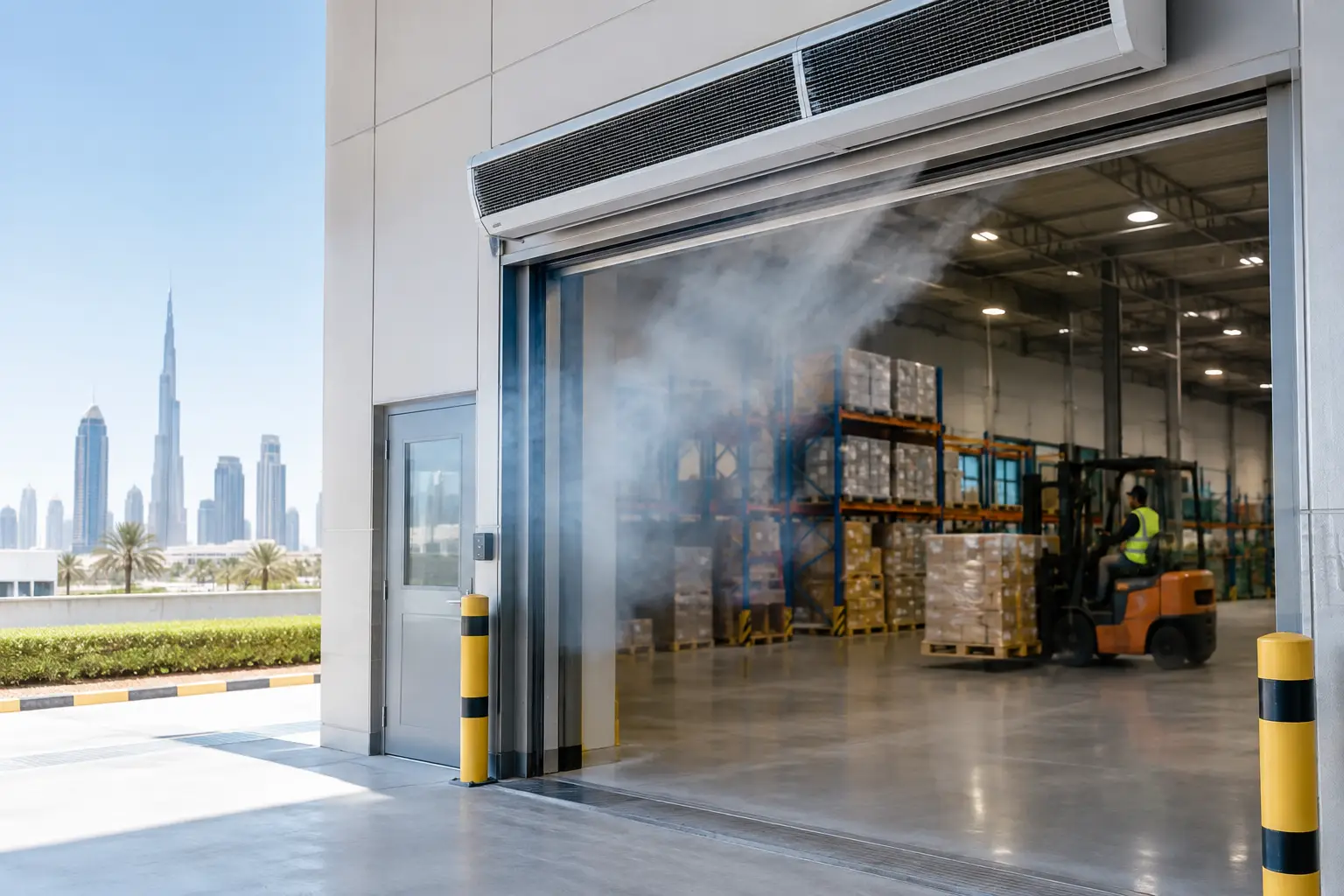
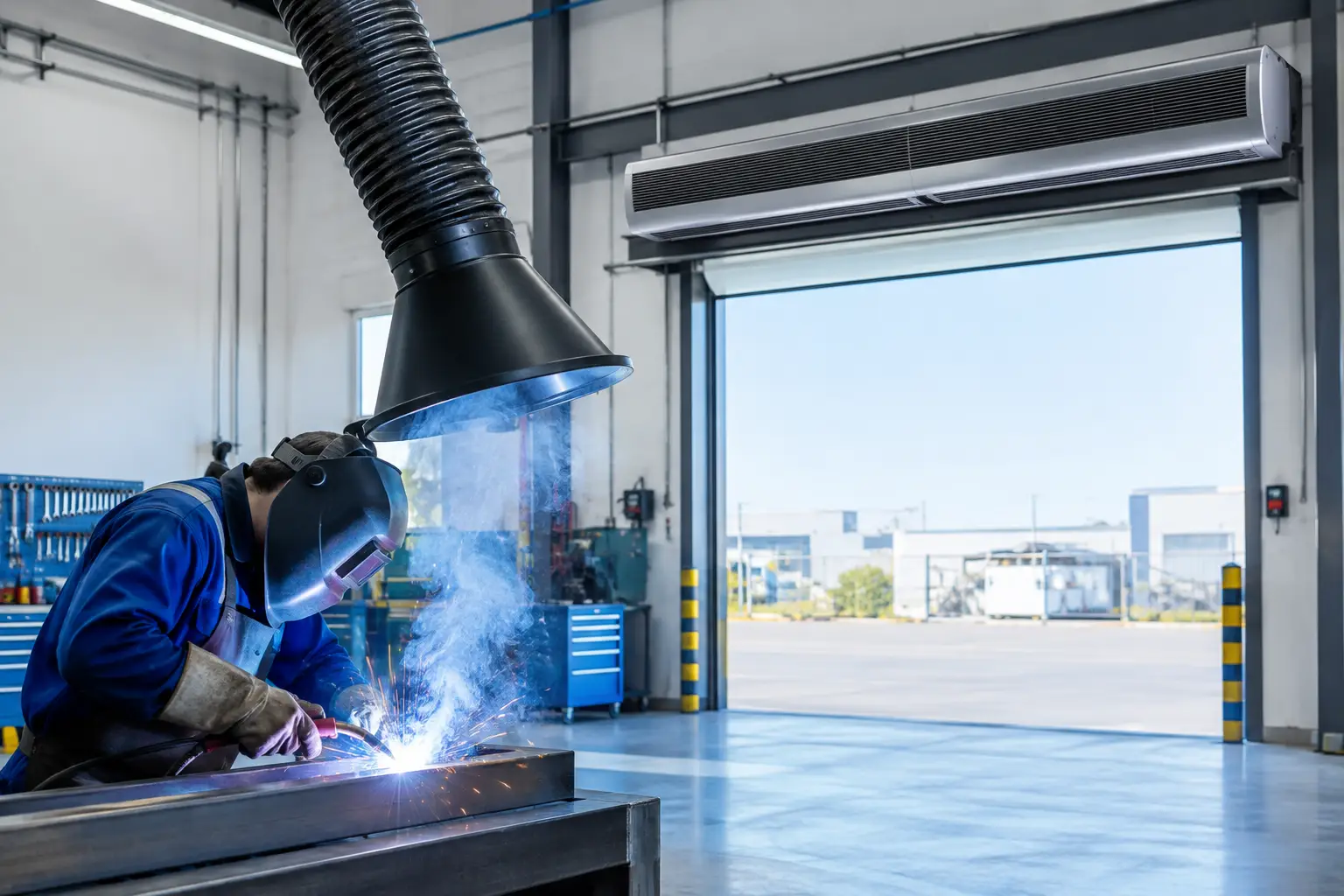
Back-of-house airport openings need a different balance of priorities. Baggage handling areas, cargo terminals, kitchens, loading zones, and maintenance access points may have taller doors, forklifts or carts, and higher dust exposure. Industrial centrifugal air curtains are generally the appropriate starting point because they are built for heavy-duty airflow applications.
At these openings, the specification should consider equipment clearance, operational hours, particulate exposure, and maintenance access. A filter net or suitable protective arrangement may help in dusty environments, but it also needs to be accessible for planned inspection and cleaning. An air curtain that cannot be practically maintained will lose performance over time.
Controls and Integration Affect Operating Cost
The energy value of an airport air curtain depends on how it is operated. Running a unit at a fixed high speed day and night may provide airflow, but it does not necessarily provide the most efficient result.
For high-traffic terminals, consider door-interlocked operation, variable-speed settings, timed schedules, and building management system coordination. These controls allow the air curtain to match real conditions. During peak flights or when doors remain open for extended periods, higher airflow may be justified. During quieter periods, reduced output can maintain reasonable protection while lowering fan energy and sound levels.
Installation coordination also matters. The discharge should be directed correctly across the opening, and the unit should not be blocked by bulkheads, signs, decorative elements, or door hardware. Commissioning should include observation of the air stream under normal door operation, not just a basic power-on check.
A Practical Airport Air Curtain Selection Process
A reliable specification starts with a site-specific review. Contractors and consultants should document the opening dimensions, mounting height, door type, traffic profile, outside exposure, indoor setpoint, HVAC supply and return locations, and any constraints created by the ceiling or façade.
It is also useful to identify the primary infiltration risk. At a desert airport, dust and extreme sensible heat may dominate. At a humid coastal airport, moisture infiltration and latent cooling load may be more significant. Curbside doors may need stronger resistance to wind and vehicle-related contaminants, while airside service doors may require rugged construction and straightforward maintenance access.
FreezeeX can assess these factors and recommend a commercial, recessed, or industrial air curtain configuration based on the actual opening and operating environment. This consultative approach is more reliable than selecting equipment solely by door width or visual preference.
For airport projects across the GCC, MENA, and Africa, request a technical consultation and quotation with your door schedule, mounting details, and operating conditions. The right air curtain should protect the terminal’s cooling investment while supporting fast, comfortable passenger movement in heat, humidity, and dusty desert conditions.