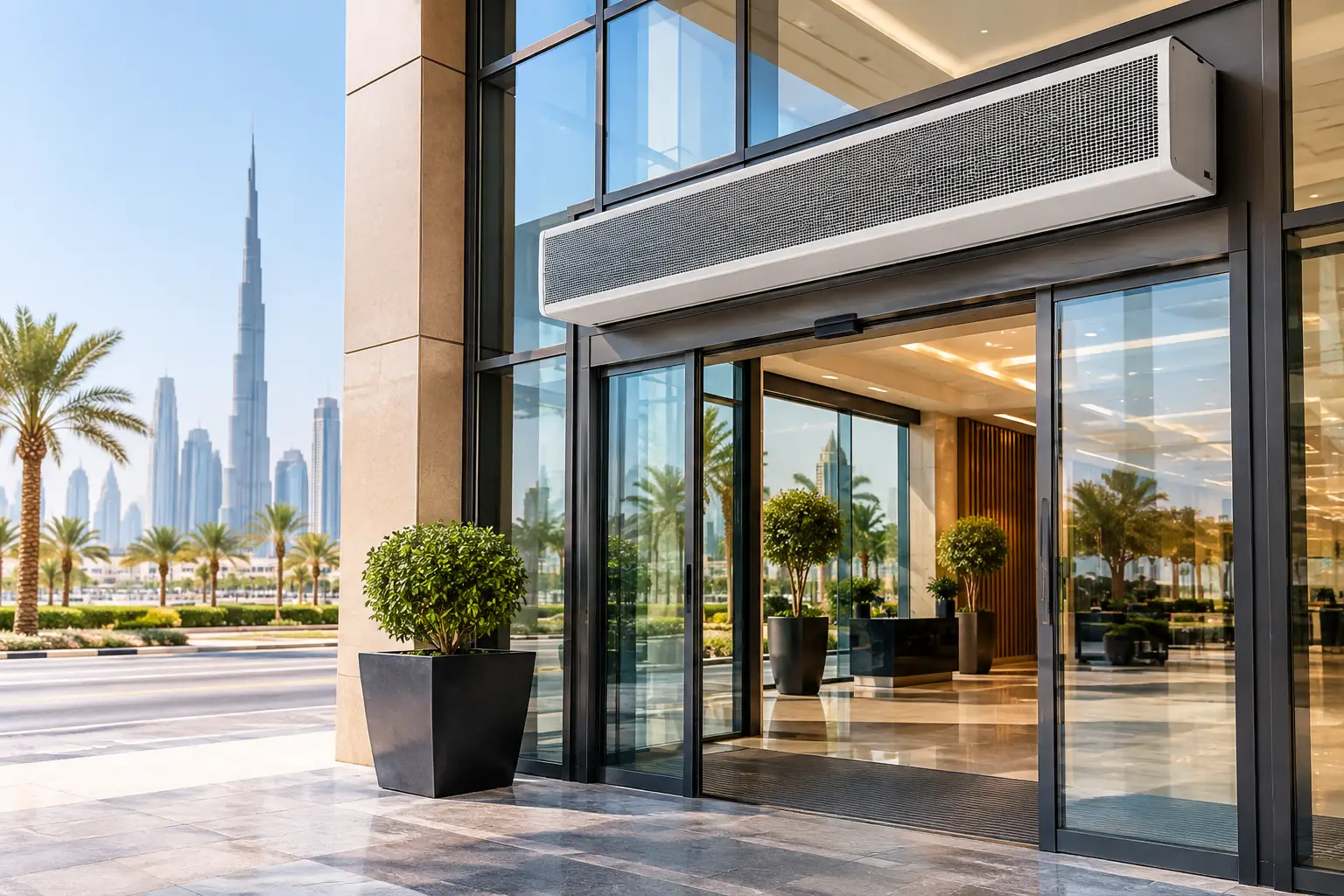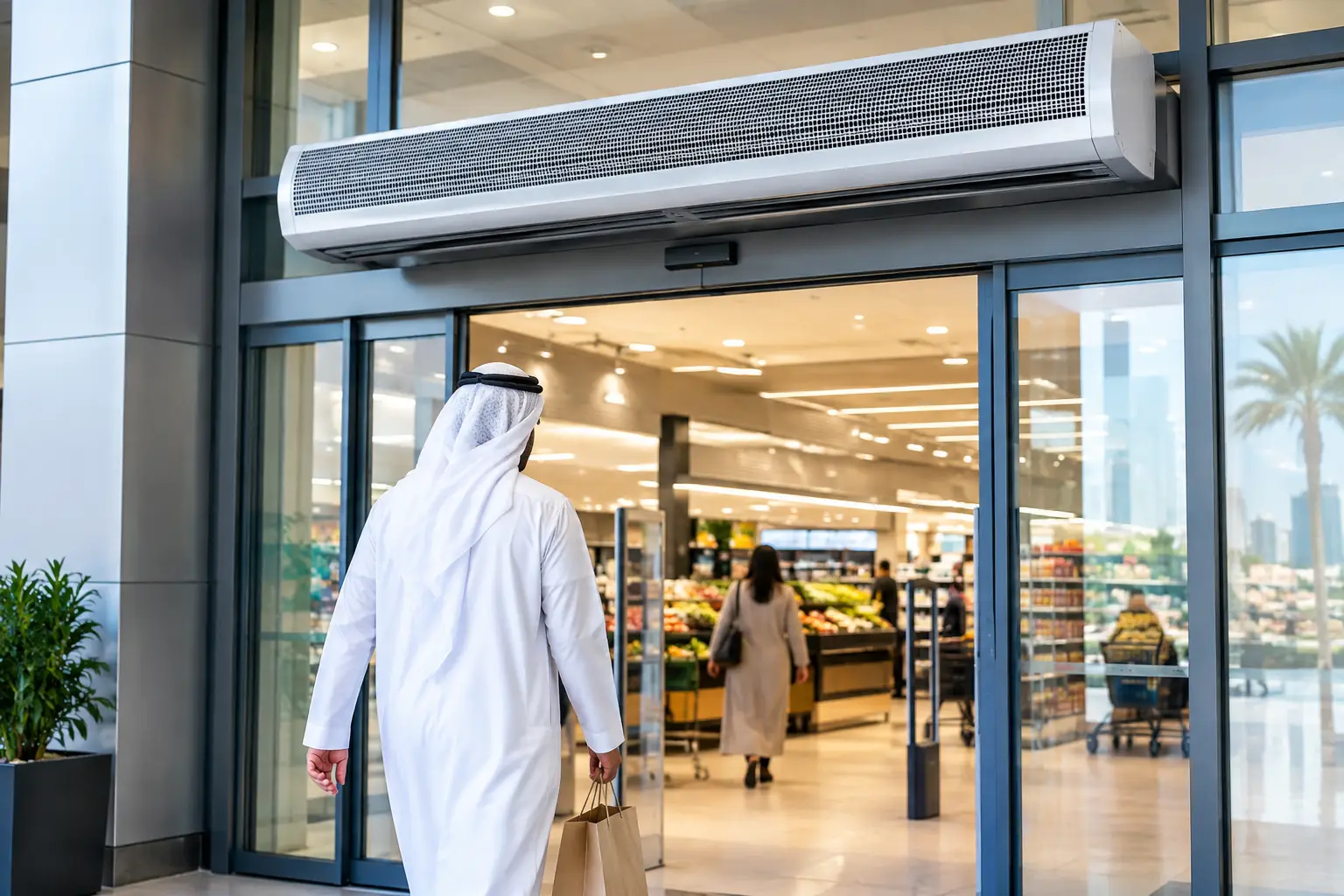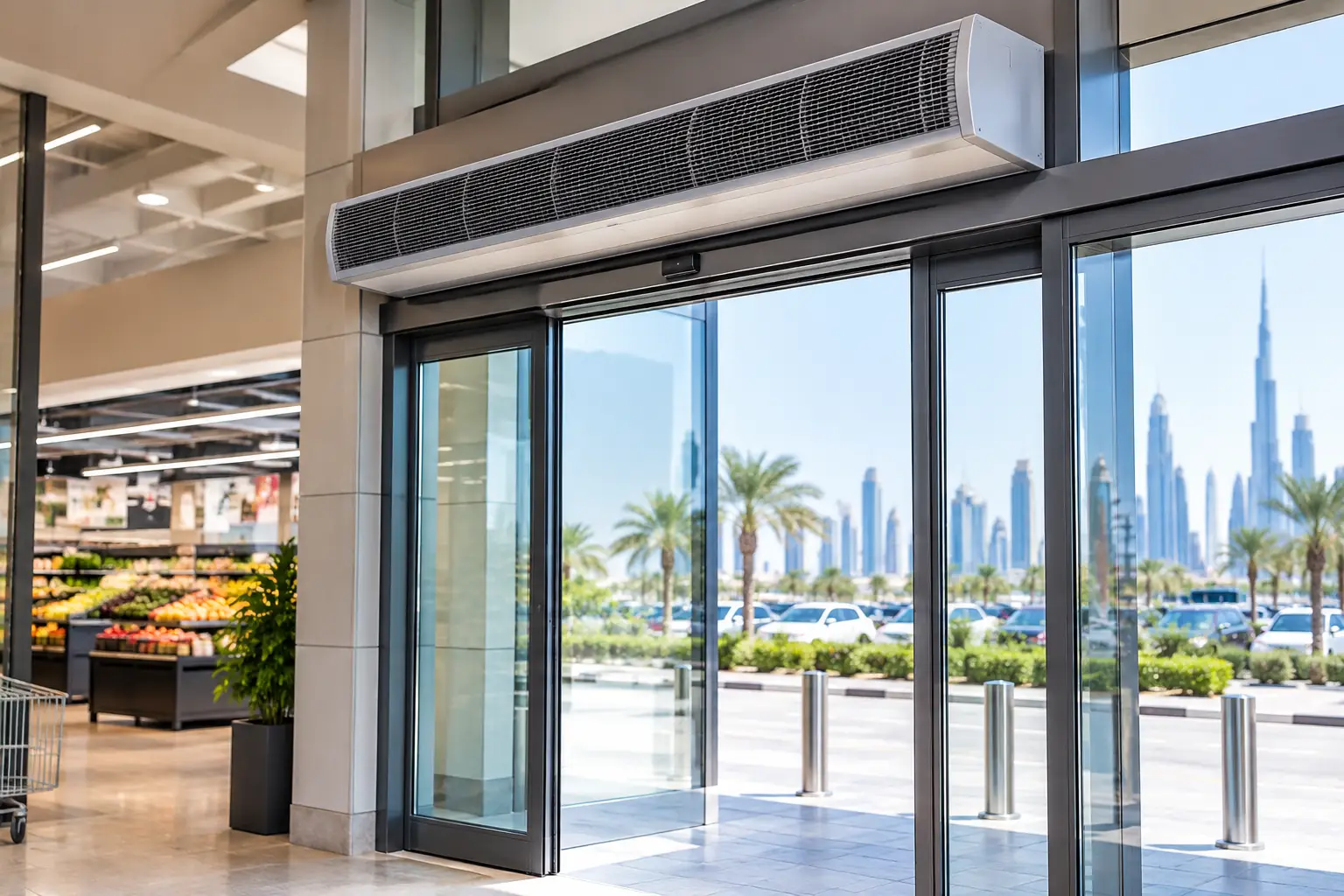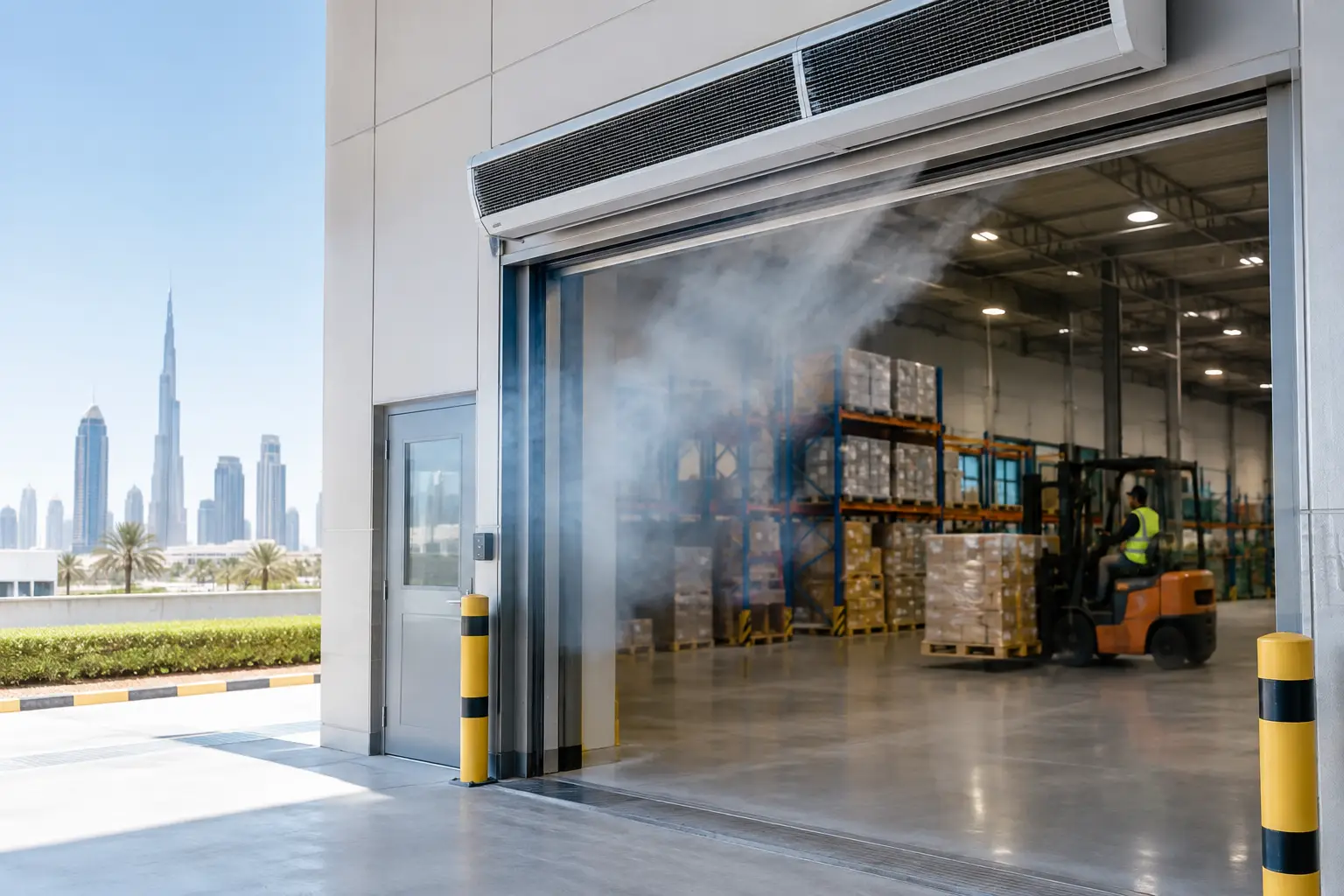
A supermarket entrance in Dubai can admit a significant volume of hot, humid outdoor air every time its doors open. A logistics warehouse in Riyadh faces a different but equally costly issue: hot, dust-laden air entering through loading bays during active dispatch periods. In both cases, HVAC load reduction is not only a matter of selecting larger cooling equipment. It starts by reducing the heat, moisture, and contaminants that cross the building envelope at its most vulnerable point: the open doorway.
For commercial and industrial facilities across the GCC, MENA, and Africa, entrance conditions can determine whether conditioned spaces remain stable during peak traffic. Air curtains provide a practical form of air isolation that helps HVAC systems maintain indoor conditions without physically slowing customers, staff, trolleys, or material handling operations.
What HVAC Load Reduction Means at an Open Door
HVAC load is the amount of cooling capacity required to maintain a target indoor temperature and humidity level. At an exterior doorway, that load rises when outdoor air infiltrates the conditioned space. The incoming air carries sensible heat, which raises the indoor temperature, and latent heat, which is associated with moisture. In humid coastal environments such as Dubai, Abu Dhabi, Doha, Lagos, and Mombasa, latent load can be especially significant.
An open entrance also introduces dust, insects, smoke, fumes, and airborne particles. These are not always reflected in cooling-load calculations, but they affect indoor air quality, cleaning requirements, product protection, and occupant comfort. In food facilities, healthcare environments, retail stores, and pharmaceutical operations, the operational impact can be as important as the energy impact.
Doorway infiltration is variable. It depends on opening width and height, indoor-outdoor temperature difference, wind exposure, pressure conditions, traffic frequency, and whether a facility has multiple entrances operating at the same time. This is why simply lowering the thermostat or increasing fan-coil output rarely addresses the root cause. The conditioned air is still being displaced at the entrance.
Why Entrance Air Isolation Reduces HVAC Demand
A correctly specified commercial air curtain creates a directed, high-velocity air stream across the opening. This stream acts as an active barrier, limiting the exchange between outdoor and indoor air while allowing the doorway to remain operationally open.
The objective is not to create a perfectly sealed doorway. That is not realistic in high-traffic commercial settings. The goal is to reduce the rate of air exchange enough that the HVAC system does not need to repeatedly recover from every door cycle. For a retail store, that can mean more stable temperatures near the entrance. For a warehouse, it can mean less hot air and dust migration into dispatch areas. For cold storage, it supports better temperature retention while protecting workflow.
The resulting benefits can include lower cooling demand, improved temperature consistency, reduced humidity ingress, and fewer contaminants entering the building. These outcomes are particularly relevant in desert and tropical climates, where outdoor air conditions place continuous pressure on commercial cooling systems.
Sensible and latent load both matter
In hot, dry environments, the immediate concern is often sensible heat. Every volume of outdoor air entering a cooled space increases the temperature load the HVAC system must remove. In high-humidity regions, moisture adds another layer of demand because the system must dehumidify as well as cool.
This distinction affects specification. A facility in Muscat or Doha may need an air curtain selected with particular attention to humidity control at the entrance, while an industrial site in Riyadh may prioritize strong protection against heat, dust, and wind-driven infiltration. The air barrier must be matched to local climate and the specific opening, not chosen on door width alone.
Preventing cooled-air loss is often more efficient than adding capacity
When occupants complain about warm zones near an entrance, the initial response is sometimes to increase cooling capacity. That may help temporarily, but it can also increase operating cost without correcting the cause of the discomfort. If infiltration is the source, reducing infiltration is usually the more efficient first measure.
This is especially true where doors remain open for long periods. Reception entrances, supermarket doors, mall access points, restaurant service doors, loading bays, and factory passages can all create a recurring thermal penalty. Air curtains help contain conditioned air where it delivers value: inside the building.
Selecting an Air Curtain for HVAC Load Reduction
Air curtain performance depends on the strength and stability of the air stream at floor level. A unit that looks adequate on paper may underperform if the mounting height is excessive, crosswinds are ignored, or the discharge velocity is not sufficient for the opening.
The key project variables include entrance dimensions, mounting arrangement, door operating pattern, internal setpoint, outdoor conditions, and nearby pressure influences. A recessed entrance at a hotel has different requirements from a warehouse roller-shutter opening exposed to wind and vehicle movement.
For specification discussions, assess these factors together:
- Mounting height and opening width: The air stream must travel the full height of the opening and provide consistent coverage across its width.
- Traffic and door cycle frequency: Entrances with constant pedestrian traffic need reliable continuous protection, while loading areas may need a more industrial-duty approach.
- Outdoor climate and wind exposure: Desert dust, high ambient heat, and coastal humidity all influence the required air velocity and installation approach.
- Application sensitivity: Hospitals, food processing areas, cold storage facilities, and pharmaceutical operations may require stronger control of airborne contaminants in addition to thermal separation.
- Noise and architectural requirements: Customer-facing entrances may prioritize low-noise operation and concealed installation, while industrial applications prioritize airflow performance and durability.
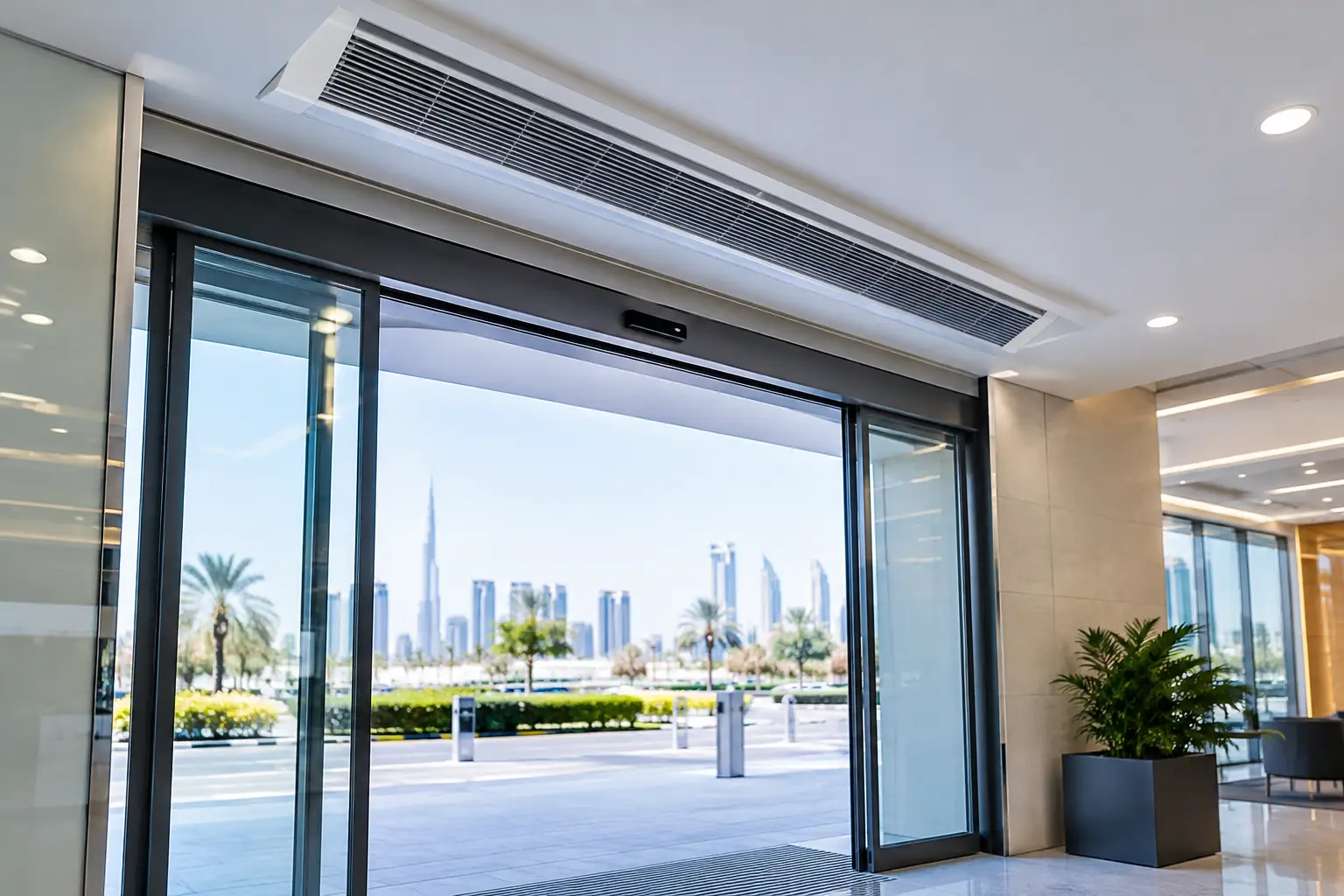
Commercial centrifugal air curtains are often suitable for demanding retail, supermarket, hotel, and public-building entrances where consistent airflow is needed. Recessed ceiling units can support cleaner architectural integration in premium lobbies and malls. For loading bays, warehouses, factories, and high doors, industrial centrifugal models are generally more appropriate because the air barrier must handle larger openings and tougher operating conditions.
FreezeeX evaluates these details as part of a consultation-based recommendation, rather than treating every doorway as a standard-size application.
Where HVAC Load Reduction Delivers the Most Value
The financial case is strongest where doors are large, frequently open, or exposed to severe outdoor conditions. It also strengthens when the indoor environment has a narrow acceptable temperature or cleanliness range.
Retail, supermarkets, and shopping centers
Customer entrances create constant infiltration during busy periods. Without air isolation, shoppers near the doorway may experience heat and humidity, while refrigerated display areas close to the entrance work harder to maintain stable conditions. An air curtain can support comfort at the threshold without creating a physical obstruction to foot traffic.
Warehouses and logistics facilities
Loading bays can be a major source of heat gain and dust ingress. The appropriate solution depends on bay height, door type, vehicle movement, and the duration of open-door operations. A high-performance industrial air curtain is not a substitute for good dock management, but it can significantly reduce the HVAC penalty during active loading and dispatch.
Cold storage and food processing
At cold-room access points, uncontrolled air exchange can create temperature instability, condensation, and higher refrigeration demand. Air curtains should be selected carefully for the temperature differential, opening size, and hygiene requirements. The aim is to preserve the controlled environment while maintaining efficient movement of staff and goods.
Hospitals, hotels, and public buildings
These facilities need comfort, clean entrances, and a professional arrival experience. Recessed or low-noise commercial units can reduce outdoor heat, dust, and insect entry without compromising the visual design of a lobby or public corridor.
Common Mistakes That Limit Results
The most common mistake is selecting a unit based only on the nominal door width. Width matters, but it does not confirm whether the air stream can reach the floor with sufficient velocity. Mounting height, side winds, and stack effect within the building can all disrupt the barrier.
Another mistake is treating an air curtain as a standalone answer to all cooling problems. It works best alongside properly maintained doors, reasonable indoor pressure control, and HVAC equipment that is sized for the actual operating profile. If a facility has unusually high negative pressure, for example, outside air may still be pulled inward aggressively. The broader air-balance issue should be evaluated.
Finally, avoid specifying domestic-grade equipment for commercial openings. High-duty applications require equipment designed for continuous operation, appropriate blower performance, and the environmental conditions of the site. This is particularly relevant in hot, humid, and dusty markets where components are exposed to demanding conditions over long operating hours.
Measure the Right Performance Indicators
Energy savings are valuable, but they should not be the only measure of success. Facility teams should also look for more stable entrance temperatures, reduced humidity sensation, lower dust accumulation near access points, fewer insect incursions, and less frequent HVAC recovery after busy traffic periods.
For larger projects, MEP consultants can compare operating conditions before and after installation using trend data from the building management system. Useful indicators include cooling run time, zone temperature fluctuations, humidity levels, and complaints from occupants or operators near the entrance. Results will vary by site, but measuring actual conditions helps validate the specification and identify whether pressure or door-operation changes are also needed.
A commercial entrance should not become a permanent source of cooling loss. For projects in Dubai, Riyadh, Doha, Cairo, Lagos, Nairobi, and other hot or humid markets, request a technical consultation and quotation based on your opening dimensions, traffic profile, mounting conditions, and HVAC objectives. The right air curtain specification can turn an exposed doorway into a controlled part of the building-performance strategy.