A busy entrance can quietly become the most expensive opening in a commercial building. Every time doors open, cooled indoor air escapes while hot, humid, dusty outdoor air moves in. For facility managers in Dubai, Riyadh, Doha, Lagos, or Nairobi, learning how to reduce cooling loss at entrance points is not a minor efficiency exercise. It directly affects HVAC runtime, guest comfort, product protection, hygiene, and operating cost.
The answer is not simply to keep doors closed. High-traffic facilities need access, deliveries, and customer flow. The practical objective is to control air exchange without disrupting operations.
Why entrance cooling loss rises so quickly
Cooling loss is driven by the pressure and temperature difference between indoors and outdoors, the size of the opening, and how often that opening is used. In desert and tropical climates, that difference is severe. A retail door opening onto a 110°F exterior, or a loading bay exposed to humid coastal air, allows a large heat gain in seconds.
The problem is more than warm air. Moisture increases the latent cooling load. Dust can enter sales areas, food-service zones, warehouses, and production spaces. Insects follow the same path. The building’s air-conditioning system then has to remove heat and humidity it was never meant to handle continuously at the entrance.
This is why facilities may see a comfortable temperature deeper inside the building while the front zone remains warm, sticky, and difficult to manage. Lowering the thermostat rarely fixes this condition. It often increases energy use across the entire facility while the uncontrolled entrance continues admitting outside air.
How to reduce cooling loss at entrance points
The most effective approach combines a properly engineered air barrier with disciplined entrance design and operating controls. Each measure addresses a different part of the problem.
Install an air curtain matched to the opening
An air curtain creates a high-velocity stream across the doorway. When correctly selected and installed, this stream separates conditioned indoor air from the external environment while allowing people, carts, and goods to pass through. It is particularly valuable where physical doors must remain open for long periods or cycle frequently.
The word “correctly” matters. An undersized unit may look active but fail to maintain an air seal at floor level, where outdoor air can enter most aggressively. An oversized or poorly aimed unit can create unnecessary noise, drafts, or wasted electrical consumption. Airflow volume, discharge velocity, mounting height, door width, and exterior exposure all need to be assessed together.
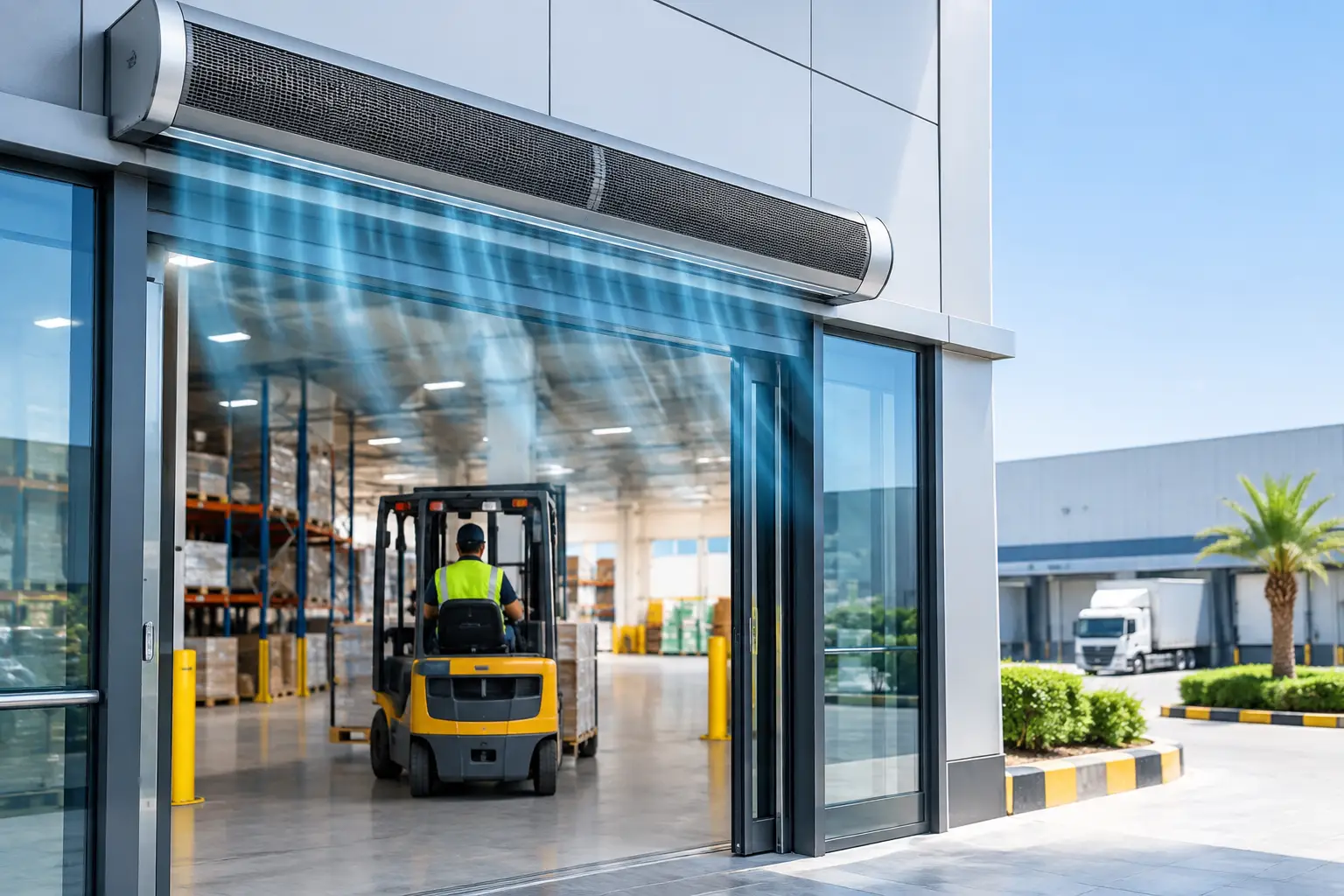
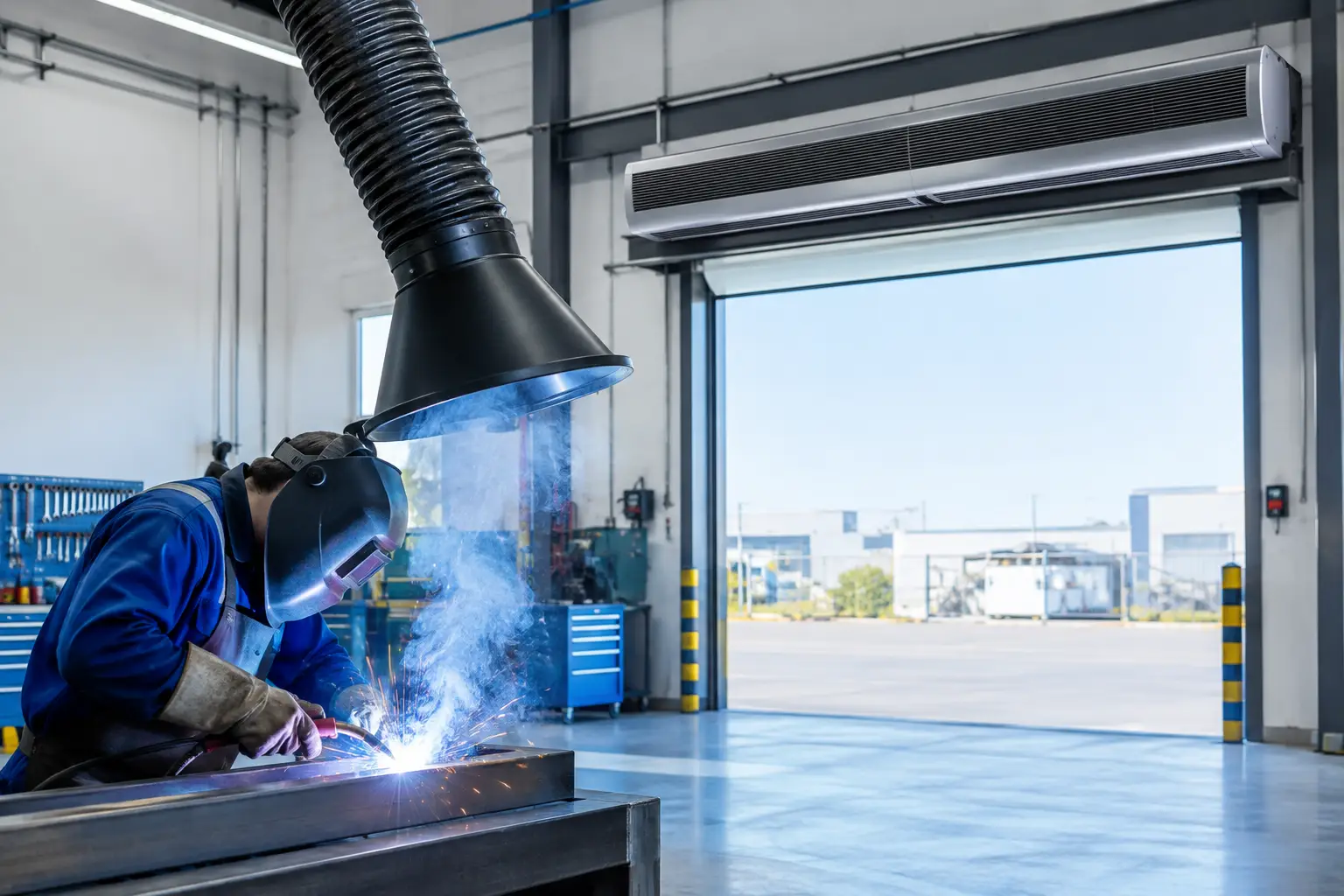
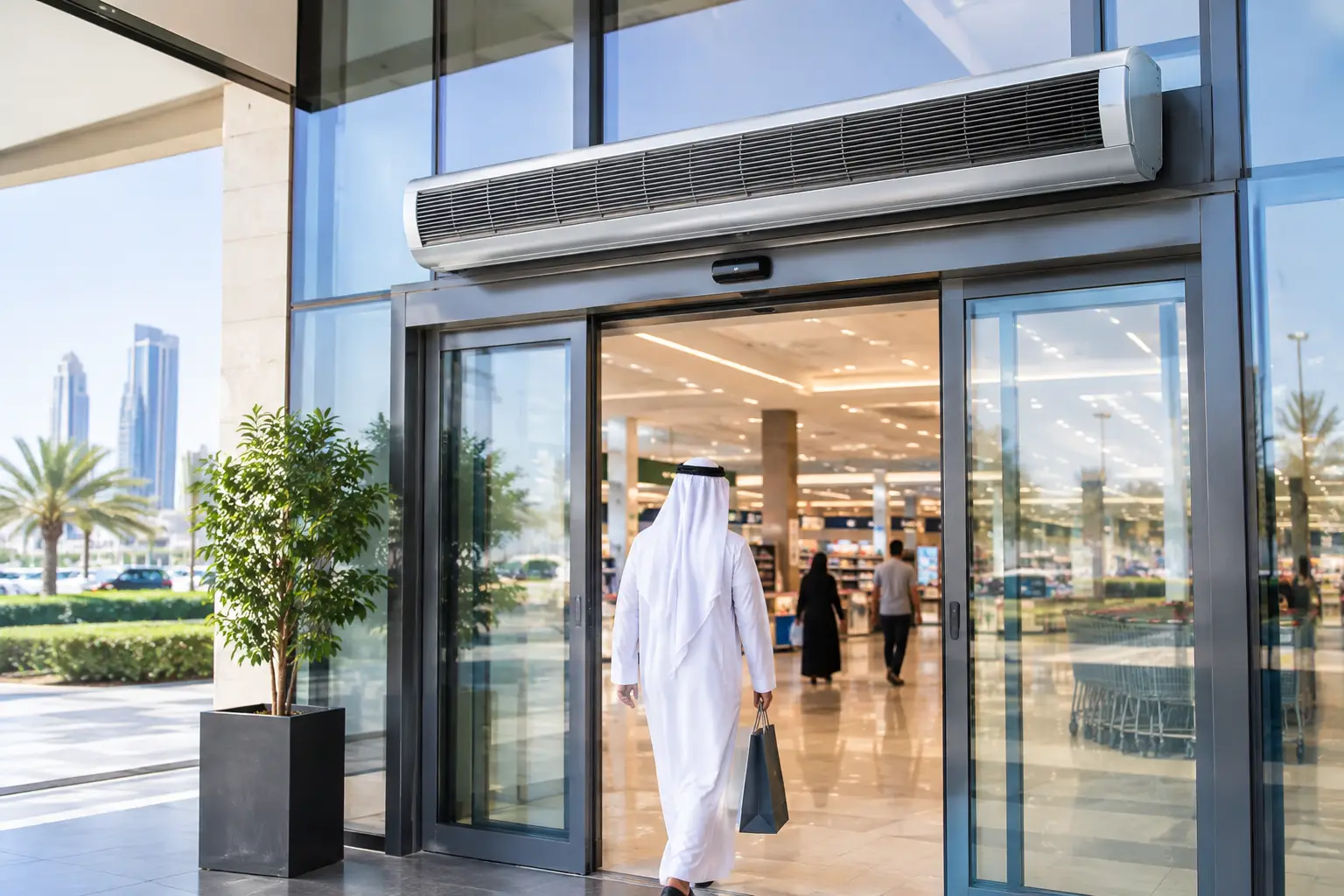
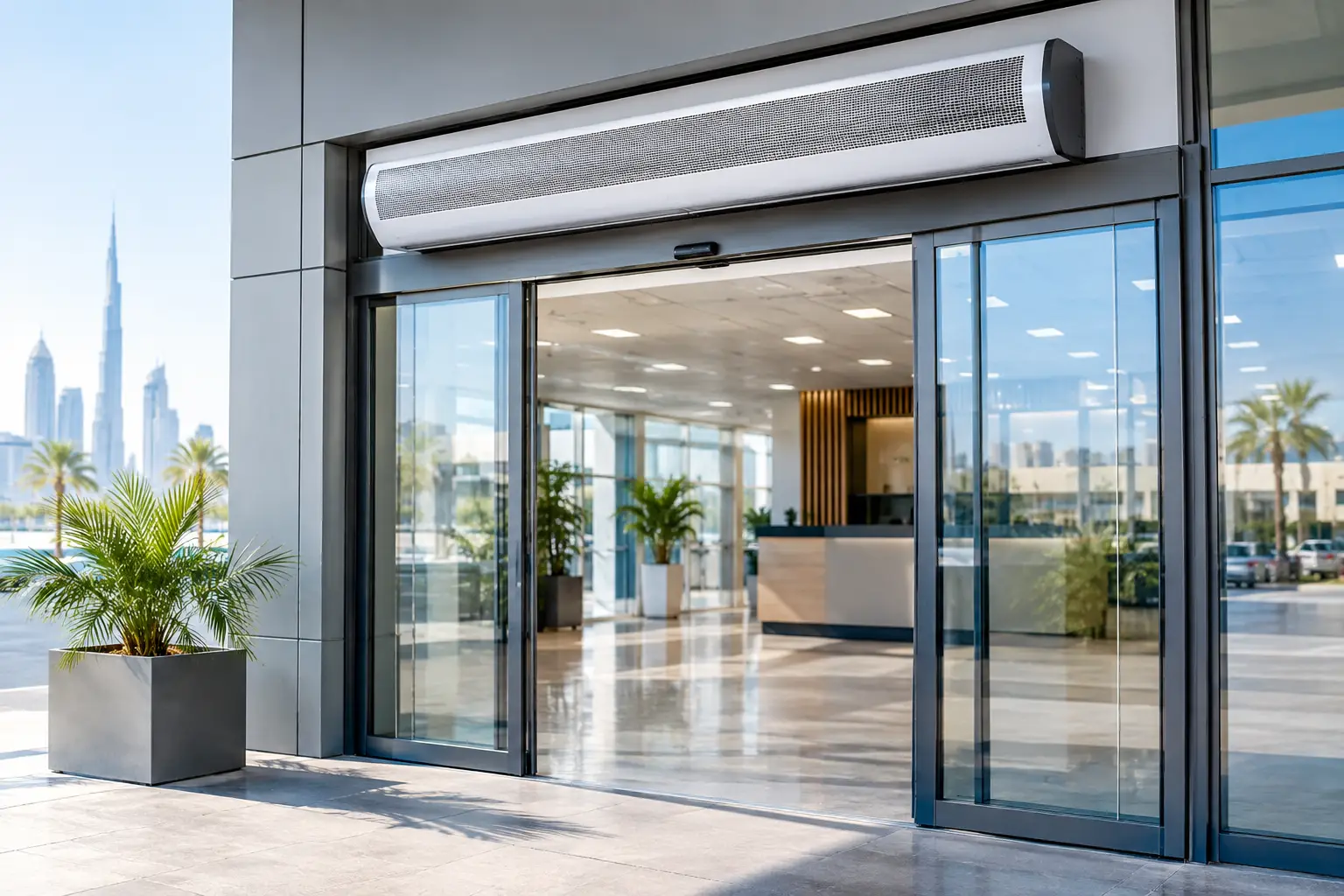
For standard commercial entrances, a recessed ceiling model or commercial centrifugal air curtain can preserve a clean architectural finish while protecting the conditioned space. Hypermarkets, workshops, logistics areas, plants, and large loading entrances generally require industrial centrifugal equipment with the throw and pressure needed to reach the full opening height.
Size for real operating conditions, not the doorway drawing
A specification based only on nominal door dimensions can fall short in harsh conditions. The actual selection should account for door height and width, whether the opening faces prevailing wind, traffic volume, nearby exhaust or supply air movement, and the indoor temperature target.
For example, a sheltered office lobby and a supermarket entrance with automatic sliding doors may have similar dimensions but need different air-curtain performance. The supermarket will typically experience far more opening cycles and greater pressure disturbance from customer traffic. A warehouse shutter exposed to wind and forklift movement requires a different level of air isolation again.
In hot, dusty GCC and African operating environments, ask for performance data that reflects the installation height and application. The goal is a stable, continuous air stream that reaches the threshold rather than a strong discharge that disperses halfway down the opening.
Improve the physical entrance, not just the equipment
Air curtains perform best when the entrance itself is controlled. Automatic doors should close promptly after each person or trolley passes, without causing congestion. Door sensors need sensible timing. If the hold-open delay is too long, conditioned air is exposed unnecessarily. If it is too short, users may force the doors open or interrupt traffic flow.
Where traffic patterns allow, a vestibule or double-door arrangement reduces direct exposure to outdoor conditions. One set of doors closes before the next opens, limiting the volume of air exchanged. This is often a strong solution for hospitality, healthcare-adjacent commercial environments, premium retail, and office towers where entrance appearance and comfort both matter.
For industrial sites, operational controls can be equally valuable. Keep shutter doors closed outside active loading windows. Assign designated access points rather than leaving multiple bays open. Use high-speed doors where material flow justifies the investment. These changes do not replace an industrial air curtain, but they reduce the burden placed on it.
Manage pressure, humidity, and airflow conflicts
An air curtain cannot compensate for major building-pressure problems. If the facility is strongly negatively pressurized, it will actively pull hot outdoor air through every opening. This can happen when large extract systems operate without adequate make-up air or when adjacent zones are not balanced.
Facility teams should investigate recurring signs such as doors that are difficult to open, a noticeable inward rush of air, odors moving in from outdoors, or dust collecting near entrances. These indicate that the issue may extend beyond the doorway itself.
Humidity deserves the same attention in coastal and tropical markets. In places such as Dubai, Doha, Lagos, and Mombasa, moisture infiltration can make a space feel uncomfortable even when the air temperature appears acceptable. It also raises the load on cooling equipment and can contribute to condensation near cold display areas or storage zones. A high-performance air barrier helps limit this infiltration, but indoor humidity control and air balance must support the strategy.
Avoid placing supply diffusers or high-volume return grilles where they disrupt the air curtain’s discharge pattern. The air stream should travel cleanly from the unit to the floor. During commissioning, observe the entrance under normal foot traffic and delivery conditions, not only when the doors are closed and the site is empty.
Choose controls that follow the traffic pattern
Running an air curtain continuously can be appropriate for some exposed entrances, especially in extreme heat or areas with persistent dust and insects. But many facilities benefit from controls that operate the equipment when doors open, then maintain a short run-on period after closure.
The right control strategy depends on the application. A hotel entrance may prioritize quiet, consistent operation and guest comfort. A hypermarket may require reliable synchronization with automatic doors during extended trading hours. A cold storage entrance may need a more aggressive barrier to protect temperature-sensitive operations and reduce moisture migration.
Variable-speed capability can also be useful where traffic and weather conditions change through the day. Lower airflow may suit quieter periods, while higher performance can be needed during peak customer flow, delivery windows, or periods of high exterior wind. The trade-off is that advanced controls require proper commissioning and clear responsibility for settings. A sophisticated system left in the wrong mode will not deliver its potential savings.
Measure performance after installation
Entrance protection should be treated as an operational system, not a one-time equipment purchase. After installation, compare conditions at the entrance before and after operation. Monitor indoor temperature recovery after peak traffic, humidity trends where relevant, dust ingress, complaints from occupants, and cooling-system runtime.
A visible smoke test can help technicians assess whether the air stream is reaching the floor and resisting crosswinds, though it should be performed safely and in accordance with site policies. More importantly, observe the opening during real use. Forklifts, shopping carts, stacked deliveries, and propped doors can all change the result.
Routine maintenance is straightforward but essential. Intake filters and filter nets must remain clean, blower assemblies should be inspected, and controls should be checked for reliable door activation. In dusty industrial and desert locations, neglecting these basics reduces airflow and weakens the air barrier when it is needed most.
Specify entrance protection for the climate you operate in
Reducing cooling loss is about protecting the capacity you already pay for. A properly selected air curtain helps keep conditioned air inside, limits heat, humidity, dust, and insect infiltration, and creates a more stable entrance environment without slowing the operation down.
For high-traffic commercial, industrial, hospitality, retail, or cold storage facilities, FreezeeX can assess the opening dimensions, traffic pattern, exposure, and climate demands to recommend a specification-ready air curtain solution. Request a consultation or project quote built for tropical and desert-climate performance.