
When a loading bay in Lagos, a hotel entrance in Dubai, or a hypermarket doorway in Riyadh stays open all day, conditioned air does not stand a chance without a proper barrier…
The result is higher cooling demand, uncomfortable entrances, and an HVAC system working harder than it should.
FreezeeX Air Curtains provides commercial and industrial air curtain solutions designed for demanding hot-climate environments across the UAE, GCC and Africa. Properly specified air curtains help reduce heat infiltration, improve indoor comfort and support HVAC efficiency in high-traffic entrances.
Why an air curtain for hot climate sites is different
A standard entrance is one thing. A hot-climate entrance is another. In the GCC, MENA, and many African markets, external air is not just warm. It can be extremely hot, dust-laden, humid, and fast-moving around open doors. That changes the performance requirement.
An air curtain in these conditions needs enough discharge velocity and the right airflow pattern to reach the floor and maintain a stable barrier. If air speed collapses halfway down the opening, outside air enters at occupant level and floor level, exactly where comfort and contamination issues become visible first.
Humidity matters too. In tropical environments, the challenge is not only sensible heat but moisture infiltration. When humid air enters a cooled building, it increases latent load, affects comfort, and can create condensation risks near cold rooms, glazed entrances, and temperature-sensitive spaces.
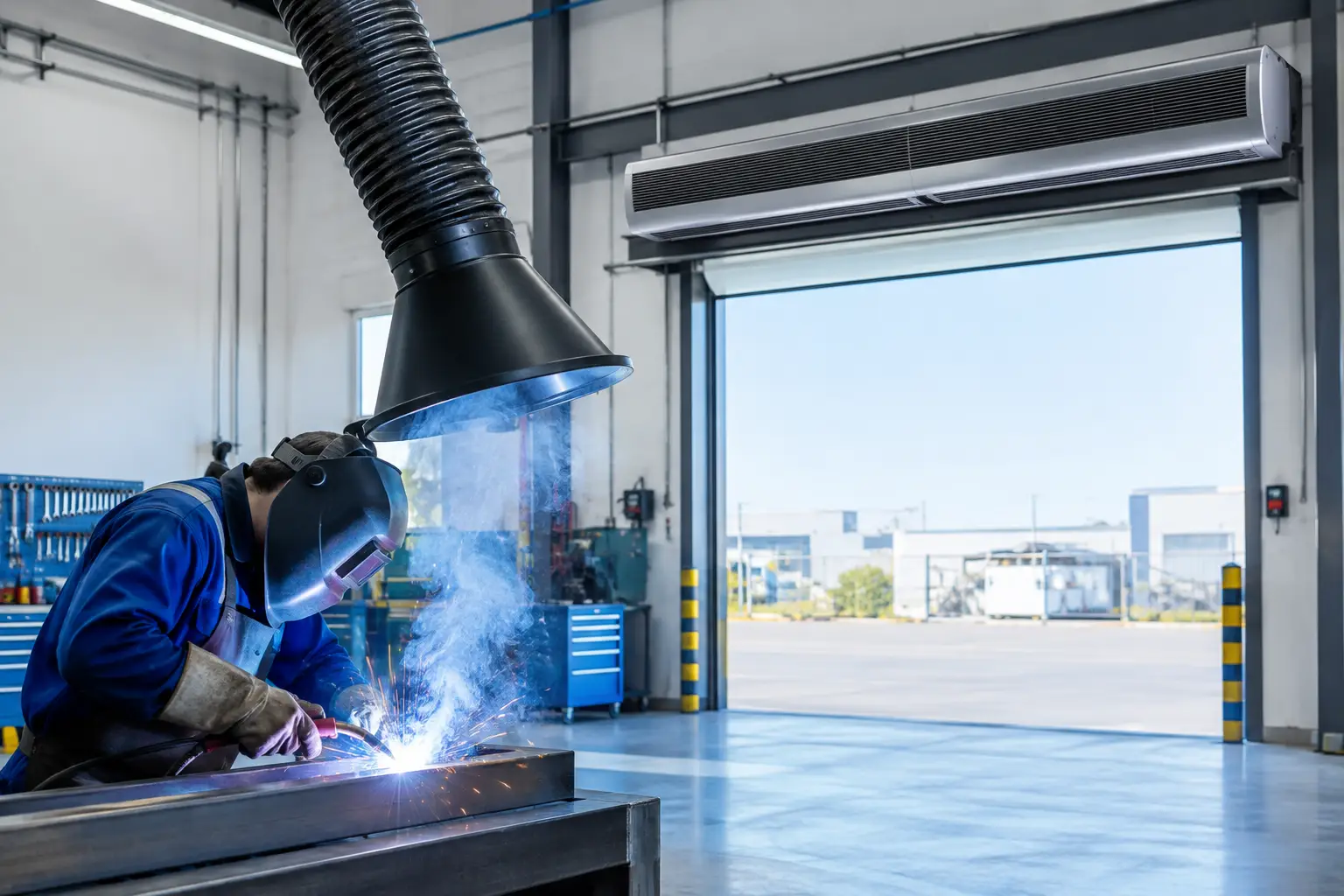
Dust and flying insects add another layer. Industrial sites, workshops, food-related operations, and roadside retail entrances often need the air curtain to support hygiene and housekeeping as much as energy control. In those cases, the right unit is part of operational protection, not just an accessory above the door.
What actually determines performance
The first factor is installation height. An air curtain that performs well over a standard commercial doorway may not be suitable for a taller lobby opening, warehouse entrance, or industrial access point. The higher the mounting position, the more critical fan strength, blower design, and outlet geometry become.
The second factor is the pressure difference across the entrance. A building with strong exhaust, negative pressure, or nearby wind exposure demands more from the unit. This is common in commercial kitchens, large retail footprints, and industrial facilities with extraction systems. Even a well-built air curtain will struggle if the air balance of the building is ignored.
The third factor is traffic pattern. A calm office entrance is one use case. A supermarket receiving door, cold storage access point, or hotel entrance with continuous pedestrian flow is another. High-traffic sites need reliable air separation under repeated disturbance, not just acceptable performance on paper.
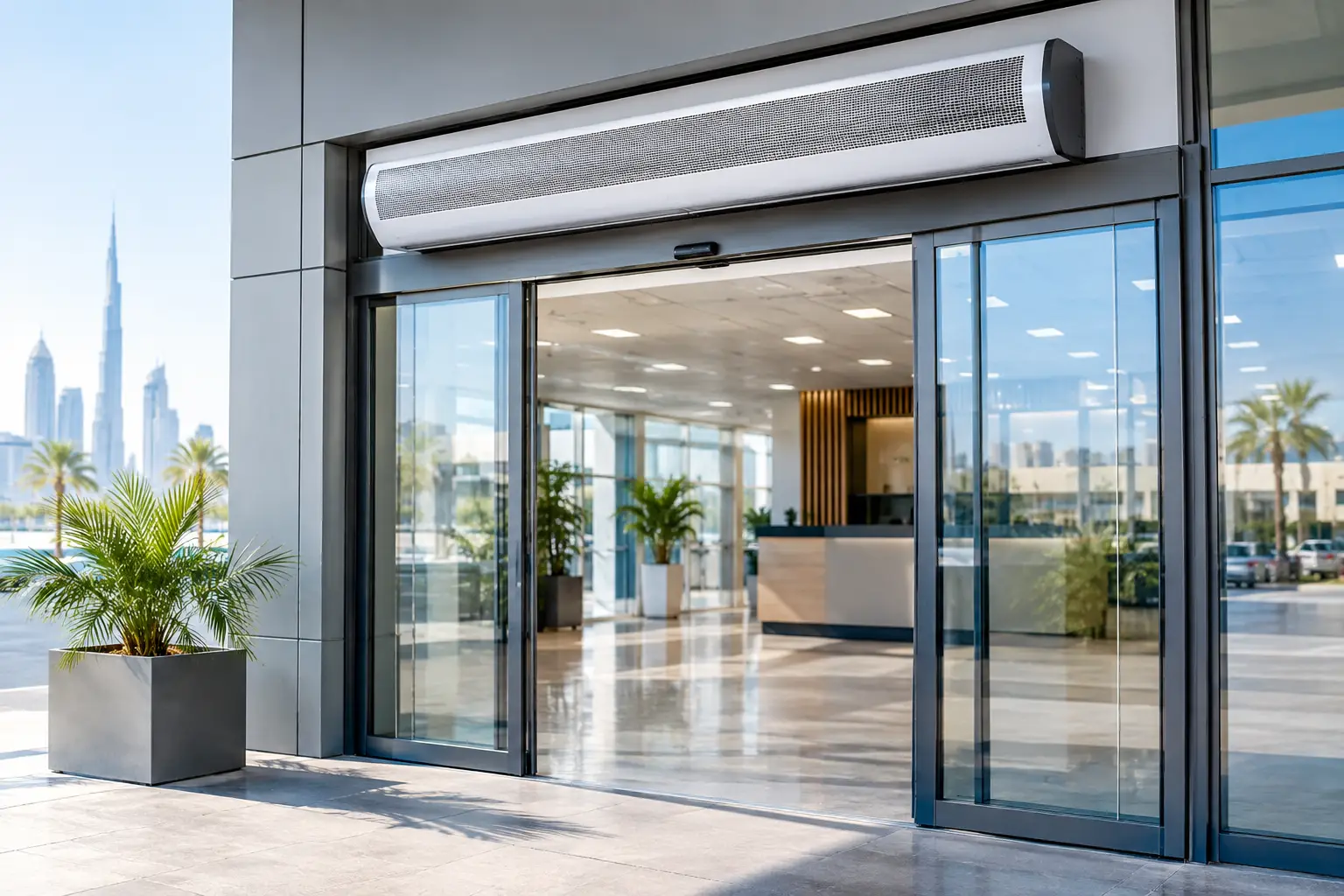
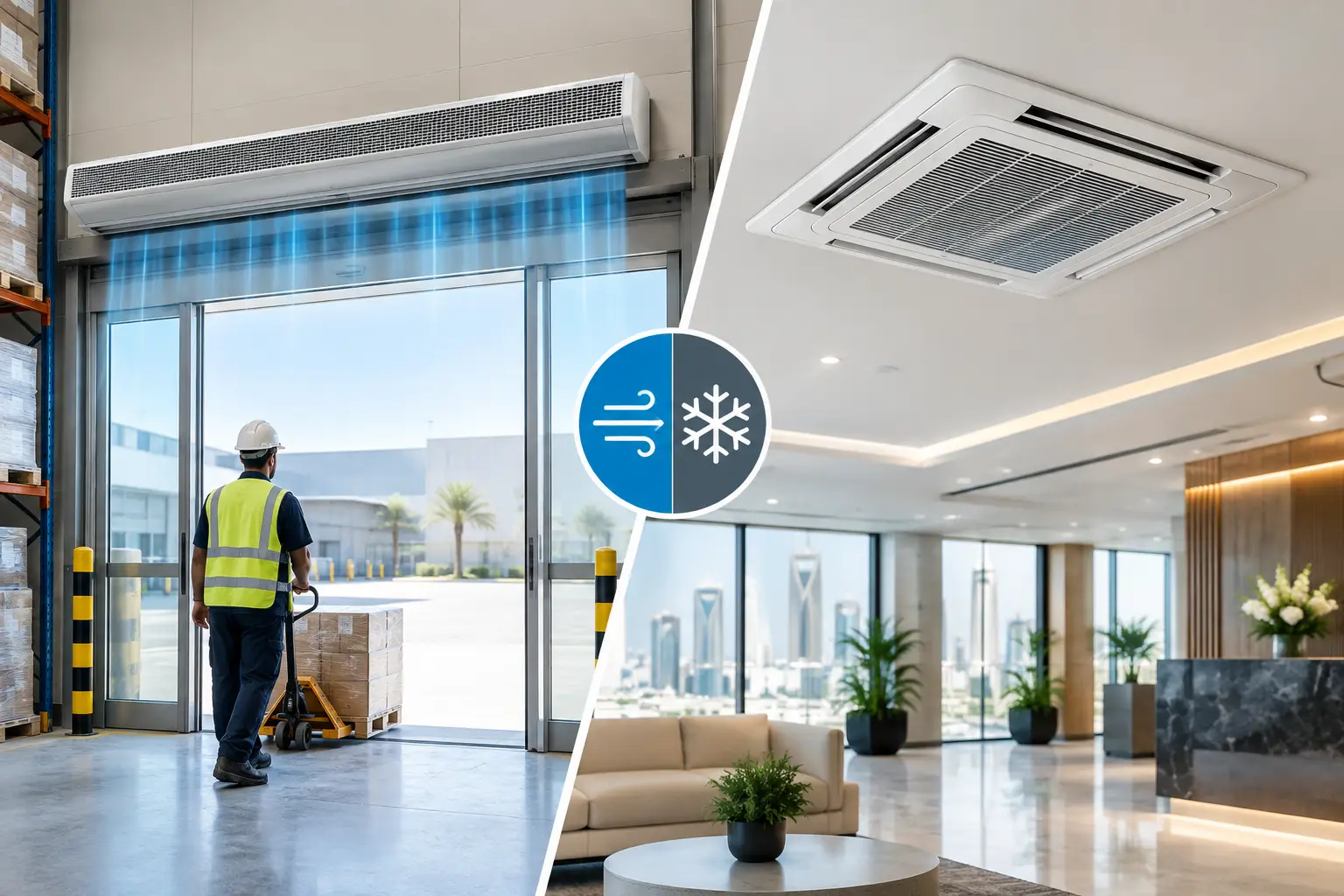
This is why product category matters. Recessed ceiling models may suit premium entrances where aesthetics matter, while commercial centrifugal units often provide stronger throw and better control for demanding retail and hospitality openings. Industrial centrifugal series are better aligned with taller doors, harsher environments, and heavier-duty use. The correct answer depends on the opening, the airflow requirement, and the operating conditions.
The biggest mistakes buyers make
The most common mistake is buying by door width alone. Width is only part of the specification. Height, crosswinds, indoor pressure conditions, and target outcome all matter. If the goal is to reduce cooling loss in a desert-facing entrance, the selected unit needs enough power and correct placement to create real air isolation.
Another mistake is treating all blower types as equal. They are not. In commercial and industrial settings, centrifugal designs are often preferred for stronger, more consistent air delivery, especially where entrances are exposed to severe outdoor conditions. A weaker unit may look acceptable during commissioning and still fail under peak summer load.
Noise is another trade-off that needs honest discussion. A more powerful air curtain usually delivers better separation, but acoustic expectations differ between a luxury hotel, a retail store, and a workshop. That does not mean compromising performance. It means selecting the right model range for the space.
One more mistake is ignoring service environment. High dust conditions, long operating hours, and coastal humidity affect maintenance planning and equipment life. Filter arrangement, motor quality, casing finish, and access for servicing should all be considered early, especially in regions where the unit will operate hard for most of the year.
Matching the unit to the application
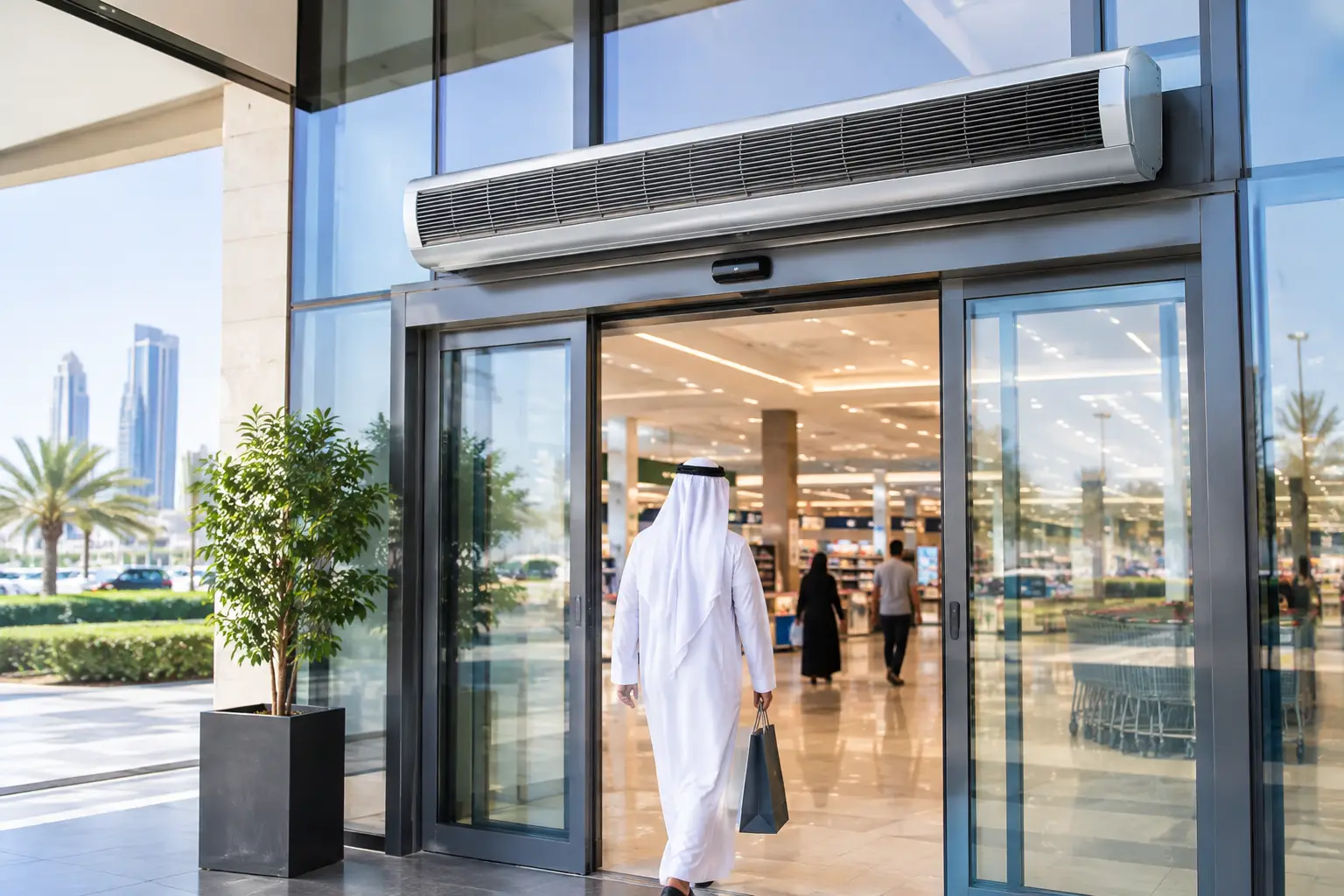
In hospitality, the challenge is usually comfort plus presentation. Guests should not feel a blast of outdoor heat as doors open, and the entrance should remain visually clean and quiet. Recessed or architecturally integrated commercial systems can work well here, but only if they still deliver enough throw for the opening height and traffic level.
In hypermarkets and large retail, the priority shifts toward continuous performance. Doors cycle constantly, cooling losses add up quickly, and entrance comfort affects customer experience. A commercial centrifugal or high-performance entrance unit is often the better fit because it can maintain a stronger barrier over longer hours.
For cold storage and temperature-controlled transitions, the stakes are higher. Warm outside air entering a chilled area increases energy consumption and can contribute to moisture issues, fogging, and ice formation depending on the environment. Here, air curtain selection should be tied closely to temperature differential, door cycle frequency, and hygiene requirements.
In industrial plants, workshops, and logistics sites, durability becomes central. Equipment may face dust, forklifts, long door openings, and large apertures. Industrial-grade air curtains with stronger construction and higher-output airflow are usually the correct path, especially in desert or mixed hot-dust environments.
Sizing for tropical and desert performance
There is no universal shortcut, but there is a practical way to think about specification. Start with the opening dimensions, then assess exposure. Is the door recessed or fully exposed? Is there crosswind? Does the building run negative pressure? Is the climate primarily dry-hot, humid-hot, or both across the year?
Next, define the operational goal. Some sites mainly want to reduce cooling loss. Others need a stronger barrier against insects and dust. Others are protecting a conditioned retail floor, food area, or cold room threshold. The clearer the target, the easier it is to recommend the right velocity profile and product class.
Then look at operating hours and maintenance reality. A showroom entrance running ten hours a day is not the same as an industrial access point running almost continuously. Buyers who plan for real operating conditions usually get better long-term value than those who optimize only for upfront cost.
This is where consultation-based selection makes sense. A climate-adapted recommendation should account for local temperature extremes, humidity swings, opening type, and use profile. That is especially important in markets across the Middle East and Africa, where the same building category can face very different environmental loads depending on city, season, and frontage exposure.
What good results look like
A well-selected air curtain should reduce the immediate rush of hot air through the doorway, stabilize indoor comfort near the entrance, and ease the burden on cooling equipment. Staff notice fewer hot spots. Customers feel a more controlled environment. Dust and insects become easier to manage. The HVAC plant stops fighting a constant avoidable loss.
The financial side is just as relevant. In high-traffic facilities, even modest improvements in entrance control can support lower cooling demand over long operating hours. That does not mean every installation delivers the same payback. It depends on climate severity, door behavior, thermostat setpoints, and the condition of the rest of the HVAC system. But in hot-weather sites with frequent door opening, the operational case is usually strong.
For B2B buyers, that is the real decision point. A proper air curtain is not a decorative add-on. It is an engineered entrance-control measure that protects conditioned space, supports hygiene, and helps facilities run more efficiently in environments that are hard on both buildings and equipment.
FreezeeX supports project teams, contractors and facility operators with specification-ready air curtain solutions built for tropical and desert climates.
Whether you need an air curtain for a retail entrance, warehouse, hotel, supermarket or industrial facility, selecting the right model is critical for long-term performance.
Contact FreezeeX today for expert guidance based on opening size, installation height, traffic level and environmental conditions.
Request a consultation or quotation through our Contact Us page. https://freezee.us/contact-us/


2 Responses
Thank you for your comment. In hot, humid, and high-traffic environments, entrance control plays a significant role in maintaining indoor comfort and energy efficiency. Uncontrolled air exchange can increase HVAC demand, introduce moisture, and affect overall facility performance. Selecting the appropriate air curtain solution for the application helps support better climate separation and more stable operating conditions.